Evidence-Based Caries Management for All Ages-Practical Guidelines” (Featherstone et al., 2021, p. 1) (pdf)
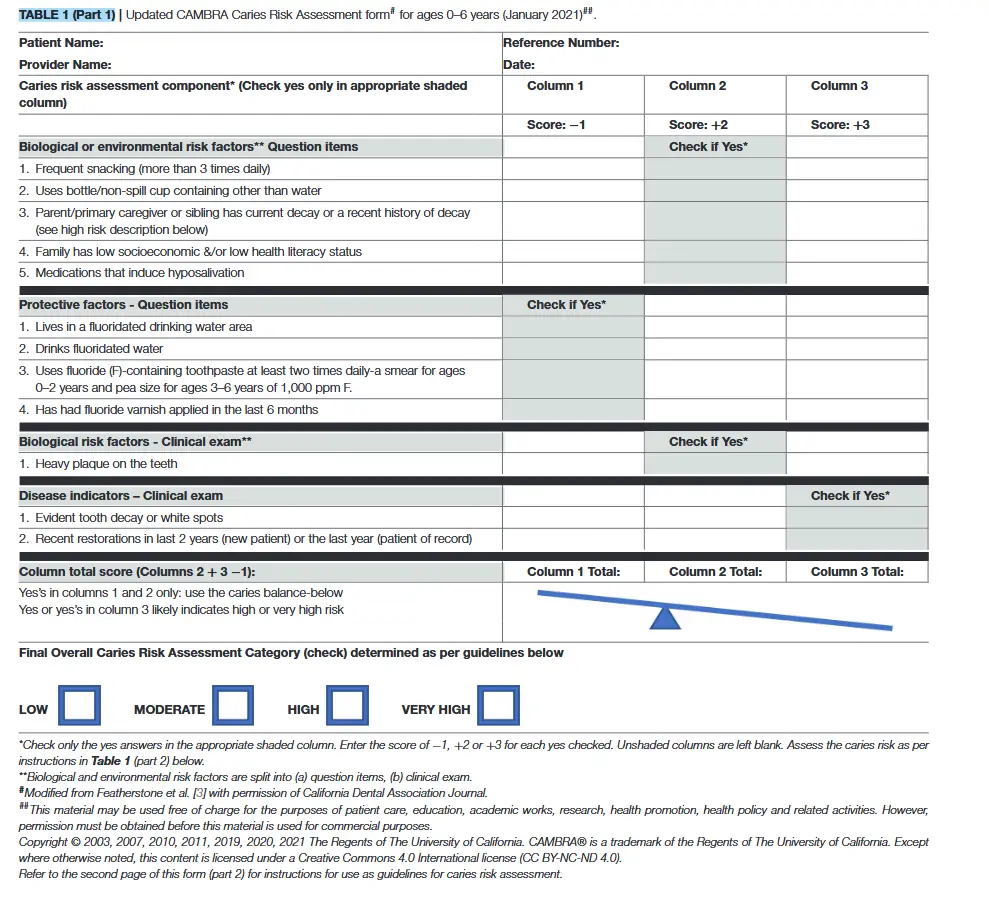
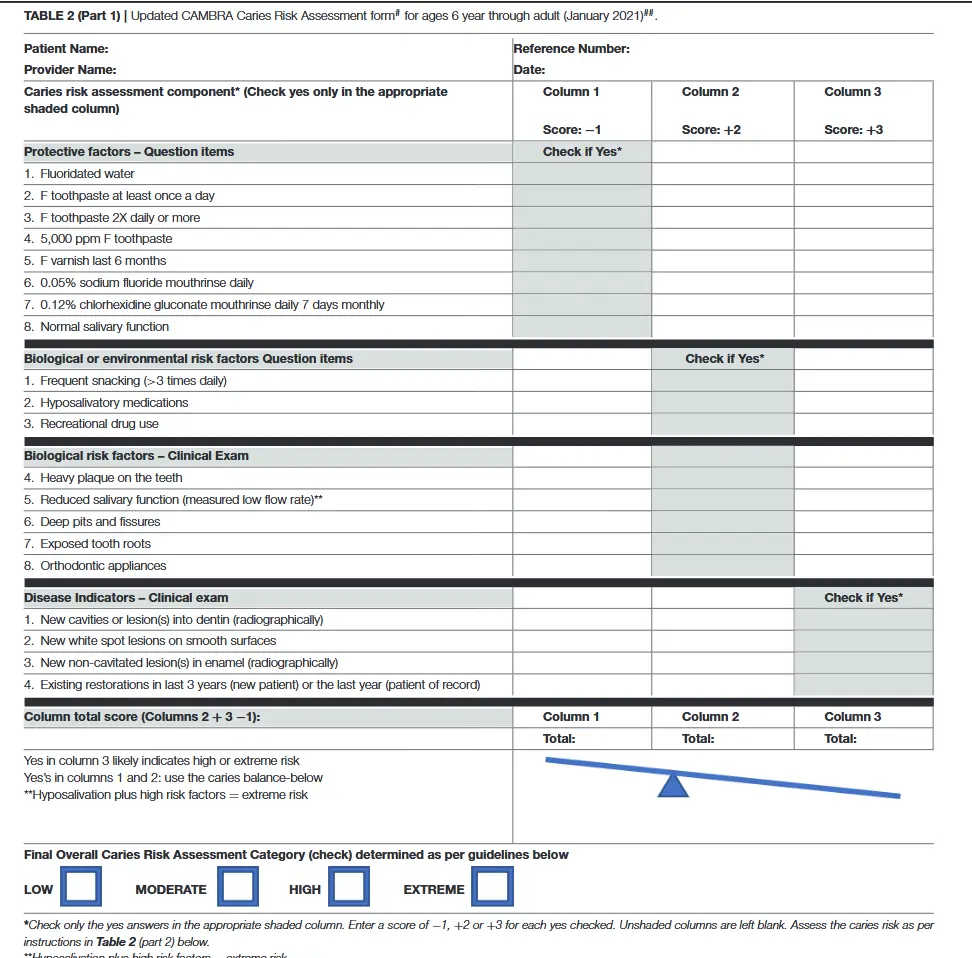
Comprehensive CAMBRA Guidelines Overview
I. Factors Contributing to Caries Risk
The CAMBRA system assesses risk by weighing Biological/Environmental Risk Factors against Protective Factors and Disease Indicators.
A. Ages 0–6 Years
Biological & Environmental Risk Factors
- Diet: Frequent snacking (>3 times daily) on fermentable carbohydrates; use of a bottle or non-spill cup containing liquids other than water.
- Maternal Transmission: Mother, primary caregiver, or sibling has current decay or a recent history of decay.
- Socioeconomic Status: Family has low socioeconomic status and/or low health literacy.
- Medical History: Use of medications that induce hyposalivation.
- Clinical Exam: Presence of heavy plaque on the teeth.
Disease Indicators (Clinical Signs of Disease)
- Decay: Evident tooth decay (cavitated or radiographic) or white spot lesions.
- Restorations: Recent restorations (last 2 years for a new patient; last 1 year for a patient of record).
B. Ages 6 Years through Adult
Biological & Environmental Risk Factors
- Diet: Frequent snacking (>3 times daily) on fermentable carbohydrates.
- Saliva/Medical:
- Use of hyposalivatory medications.
- Recreational drug use.
- Reduced salivary function (observed or measured flow rate <0.5 ml/min).
- Anatomy & Appliances:
- Deep pits and fissures.
- Exposed tooth roots.
- Orthodontic appliances.
- Clinical Exam: Heavy plaque on the teeth.
Disease Indicators (Clinical Signs of Disease)
- New cavities or lesions into dentin (radiographically).
- New white spot lesions on smooth surfaces.
- New non-cavitated lesions in enamel (radiographically).
- Existing restorations placed due to caries in the last 3 years (new patient) or last 1 year (patient of record).
II. Cutoff Scores for Risk Assessment (CAMBRA 123)
The quantitative “CAMBRA 123” method assigns points to visualize the caries balance:
- Protective Factors (Yes): -1 point.
- Risk Factors (Yes): +2 points.
- Disease Indicators (Yes): +3 points.
A. Ages 0–6 Years
| Risk Level | Score Range | Additional Criteria |
|---|---|---|
| Low | -4 to -1 | Protective factors prevail; no disease indicators. |
| Moderate | 0 to +3 | Risk and protective factors balanced; no disease indicators. |
| High | +4 to +13 | A “Yes” in Disease Indicators (Column 3) likely signals high risk. Parent/caregiver decay also indicates high risk. |
| Very High | +14 to +18 | High risk score plus extensive or severe existing/recent decay. |
B. Ages 6 Years through Adult
| Risk Level | Score Range | Additional Criteria |
|---|---|---|
| Low | ≤ -2 | Protective factors prevail; no disease indicators. |
| Moderate | -1 to +2 | Patient is not obviously low or high risk (e.g., exposed roots but no active decay). |
| High | +3 to +17 | One or more disease indicators usually signals high risk. |
| Extreme | +18 to +30 | High risk criteria plus measured or observed hyposalivation. |
III. Caries Management Protocols
A. Ages 0–6 Years (Care Pathways)
1. Low Risk
- Behaviors: Brush twice daily with fluoride (F) toothpaste.
- Chemical Therapy: None required beyond standard toothpaste.
- Restorative: No sealants or restorations typically needed.
- Recall: 6–12 months; Radiographs every 12–24 months.
2. Moderate Risk
- Behaviors: Brush twice daily with F toothpaste; dietary counseling goals set.
- Chemical Therapy:
- In-office Fluoride Varnish (FV) every 6 months.
- Optimize systemic fluoride intake.
- Restorative: Sealants on enamel defects and at-risk pits/fissures; active surveillance of developing lesions.
- Recall: 6 months; Radiographs every 6–12 months.
3. High Risk
- Behaviors: Brush twice daily with F toothpaste; strict dietary counseling.
- Chemical Therapy:
- In-office Fluoride Varnish (FV) every 3 months.
- Restorative:
- Sealants on at-risk surfaces.
- Remineralize enamel-only lesions with FV.
- Restore cavitated lesions.
- Non-surgical management with Silver Diamine Fluoride (SDF) or Interim Therapeutic Restorations (ITR) as appropriate.
- Recall: 3 months; Radiographs every 6 months.
4. Very High Risk (Extensive Disease)
- Behaviors: Brush three times daily with F toothpaste.
- Chemical Therapy:
- In-office Fluoride Varnish (FV) every 1–3 months.
- Consider additional therapies (e.g., baking soda/xylitol wipes, calcium phosphate paste).
- Restorative: Consider caries control (SDF/ITR) prior to definitive surgical treatment (especially to avoid/delay general anesthesia).
- Recall: Monthly to 3 months; Radiographs every 6 months.
B. Ages 6 Years through Adult (Chemical Therapy & Management)
1. Low Risk
- Behaviors: “Keep doing what you are doing.”
- Chemical Therapy: OTC fluoride toothpaste (1,000–1,450 ppm) at least twice daily.
- Restorative: Minimally invasive as needed.
- Recall: 12 months.
2. Moderate Risk
- Behaviors: Counseling to reduce snacking frequency.
- Chemical Therapy (Two Alternatives):
- Option 1: OTC fluoride toothpaste (2x daily) PLUS 0.05% Sodium Fluoride (NaF) mouth rinse daily at night.
- Option 2: Prescription 5,000 ppm F toothpaste at least twice daily.
- Restorative: Sealants on at-risk pits/fissures.
- Recall: 6 months.
3. High Risk
- Behaviors: Strict counseling on reducing fermentable carbohydrate snacking.
- Chemical Therapy (Antibacterial + Fluoride):
- Toothpaste: Prescription 5,000 ppm F toothpaste at least twice daily.
- Antibacterial Rinse: 0.12% Chlorhexidine gluconate (10ml for 1 min) daily for 1 week each month (use 1 hour apart from brushing).
- Varnish: In-office FV application every 4–6 months.
- Restorative: Minimally invasive; glass ionomer or SDF for caries control if needed.
- Recall: 4–6 months.
4. Extreme Risk (High Risk + Hyposalivation)
- Behaviors: Strict diet counseling; hydration.
- Chemical Therapy (Antibacterial + Fluoride + Buffering):
- Toothpaste: Prescription 5,000 ppm F toothpaste (2x daily).
- Antibacterial Rinse: 0.12% Chlorhexidine gluconate (1 week/month).
- Varnish: In-office FV application every 4–6 months.
- Buffering (New Addition): Rinse ad libitum with baking soda solution (2 tsp in 8oz water) throughout the day to neutralize acid.
- Optional: 5,000 ppm F gel in trays or calcium/phosphate pastes if lesions progress.
- Restorative: Aggressive prevention; SDF/Glass Ionomer to stabilize lesions.
- Recall: 3–4 months.
Note on Radiographic intervals for recall
- There is no clear consensus but for children AND adults it would be
- Low risk: 24-36 months
- Moderate risk: 18-24 months
- High risk: 6-18 months
- Extreme risk: 6-12 months
- [
Six years of fluoridation on the goldfields of Western Australia

National Institutes of Health (NIH) | (.gov)
https://pubmed.ncbi.nlm.nih.gov › …
](https://pubmed.ncbi.nlm.nih.gov/1057904/)
by GW Medcalf · 1975 · Cited by 7 — This water was fluoridated at the source in 1968. Comparison of dental data obtained by examination of goldfields schoolchildren before and after 6 years of …Read more
[
Six years of fluoridation on the goldfields of Western Australia

Wiley Online Library
https://onlinelibrary.wiley.com › doi › j.1834-7819.197…
](https://onlinelibrary.wiley.com/doi/10.1111/j.1834-7819.1975.tb04363.x)
by GW Medcalf · 1975 · Cited by 7 — This water was fluoridated at the source in 1968. Comparison of dental data obtained by examination of goldfields schoolchildren before and after 6 years of …Read more
[
Water fluoridation in Australia: A systematic review

ScienceDirect.com
https://www.sciencedirect.com › science › article › pii
](https://www.sciencedirect.com/science/article/pii/S001393512301719X)
by L Senevirathna · 2023 · Cited by 33 — Water fluoridation in Western Australia was first introduced in 1968 … Six years of fluoridation on the goldfields of Western Australia.Read more
[
Water Fluoridation Survey Bunbury Area

Government of Western Australia Department of Health
https://www.health.wa.gov.au › Drinking-water
The aim of the survey was to assess community attitudes and knowledge around the fluoridation of the public drinking water supply in Bunbury and its surrounding.Read more
[
Drinking Water Quality Perth & WA

Water Corporation
https://www.watercorporation.com.au › our-performance
](https://www.watercorporation.com.au/about-us/our-performance/drinking-water-quality)
Fluoride is added to some water supply schemes to improve dental health, as directed by the Department of Health (DoH). The use of fluoride is regulated by the …Read more
[
Fluoride facts for Western Australia

HealthyWA
https://healthywa.wa.gov.au › Articles › Fluoride-facts-f…
](https://healthywa.wa.gov.au/Articles/F_I/Fluoride-facts-for-Western-Australia)
Yes. Drinking water supplies in Western Australia are monitored on a continuous to weekly basis to ensure that fluoride levels do not exceed the legal limit.Read more
Missing: goldfields | Show results with: goldfields