Essentials of Rotary NiTi File Design1
The University of Western Australia, School of Dentistry
DMD 3
File components and features2
Info
Modern rotary files have numerous design features and characteristics that contribute to their overall performance. Understanding these components is crucial for selecting the right instrument and anticipating its behavior.
A typical rotary file consists of:
- ==Shank: The part inserted into the latch-type handpiece.==
- ==Shaft: The main body of the file, which often includes white demarcation lines that indicate working length. These marks are particularly useful under magnification, as they allow for length checks without removing the file or constantly adjusting the rubber stopper.==
- ==Cutting Edge: The working part of the file, featuring flutes.==
The flute34
Info
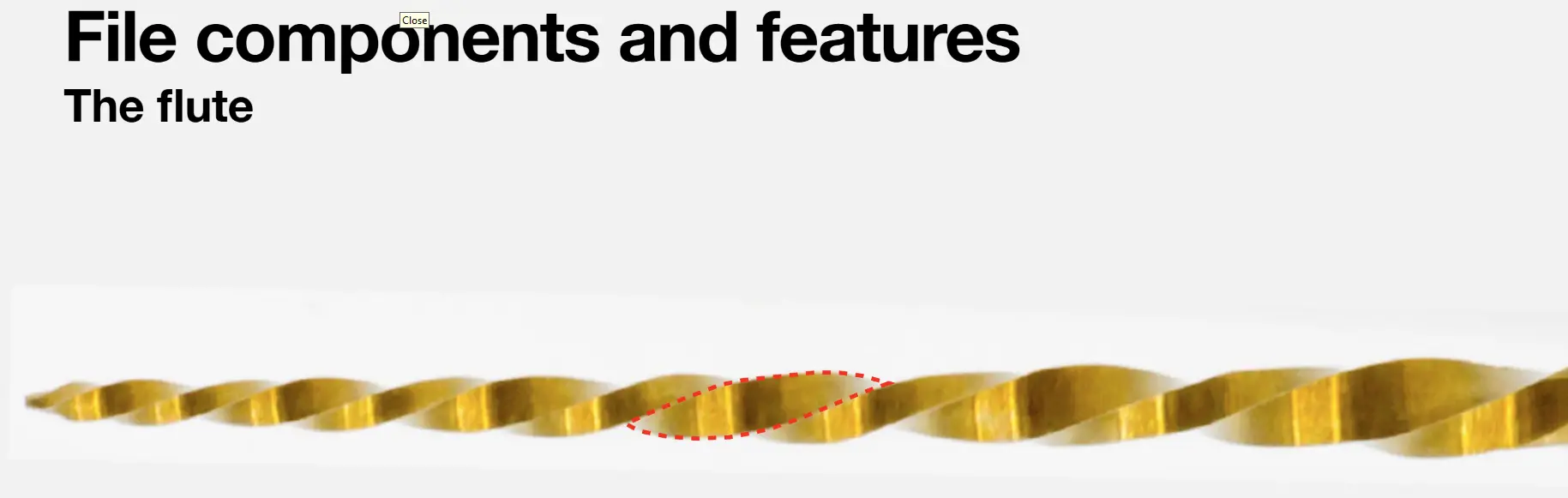
The flute is the groove on the working part of the file designed to collect and remove soft tissue and dentin chips from the root canal walls.
- ==Function: As the file’s cutting edges scrape the canal walls, the generated debris is collected within these grooves for removal. This highlights the importance of cleaning the file before re-inserting it into the canal.==
- ==Effectiveness: The efficiency of a flute depends on its depth, width, configuration, and surface finish.==
The pitch56

Info
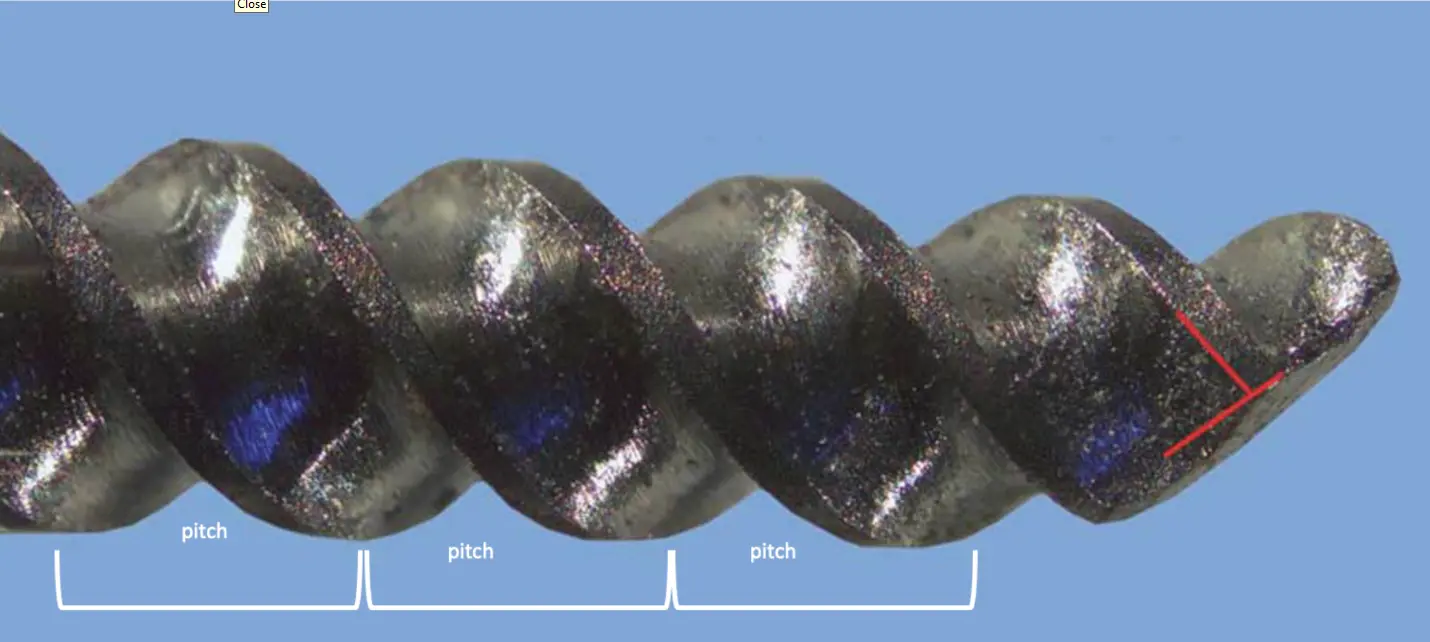
The pitch is the distance between a point on one leading edge and the corresponding point on the adjacent leading edge.
- ==Constant vs. Variable Pitch: Older files often had a constant pitch, which made them behave like a screw, leading to an undesirable “Screw in Effect” and risk of binding
Helical Angle78910
Info
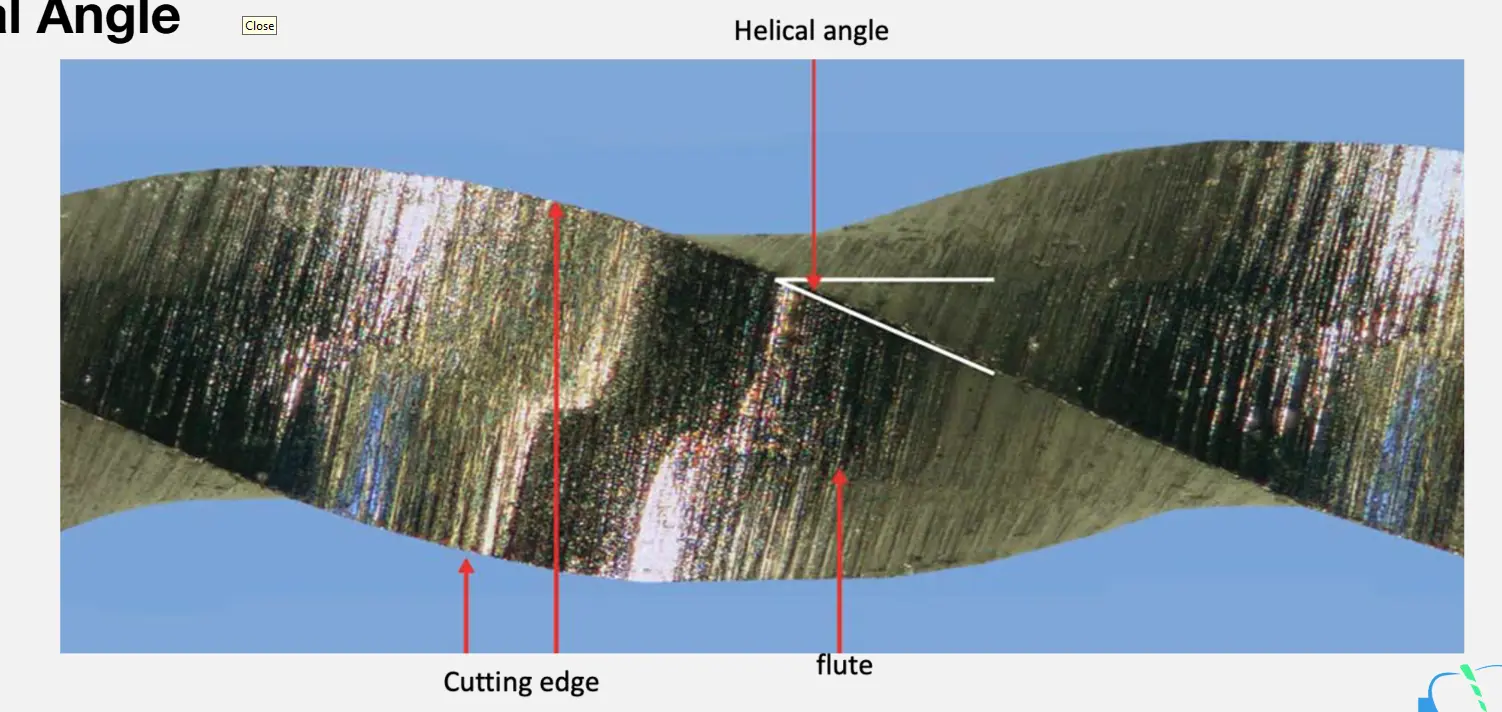
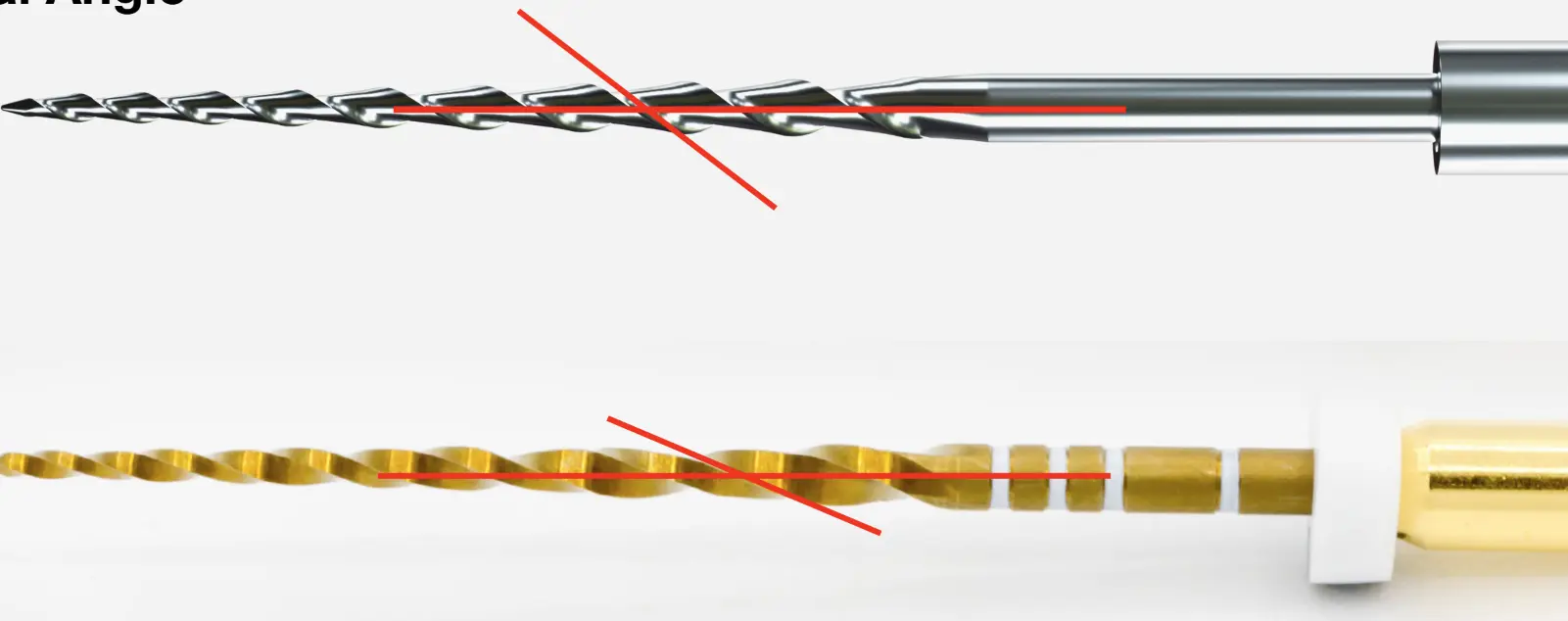
The helical angle is the angle formed between the cutting edge and a line parallel to the long axis of the file.
- ==Impact on Performance: This angle influences the file’s cutting efficiency and its tendency to screw into the canal.==
- ==Screwing Action: A larger (more open) helical angle increases the probability of the file having a screwing action within the root canal. A smaller (more acute) helical angle reduces this effect.==

Core and MFD111213
Info
The cross-sectional design of a file is defined by its core and Maximum Flute Diameter (MFD).
- ==Core: The central cylindrical part of the file, bordered by the depth of the flutes.==
- ==Flexibility: The flexibility of a file is inversely proportional to its core diameter. A larger core means more material, making the file less flexible.==
- ==Torsional Resistance: Torsional resistance is directly proportional to the core diameter. A larger core can withstand more torsional stress before fracturing.==
- ==Maximum Flute Diameter (MFD): The overall diameter of the file, including the extension of the cutting edges. This determines the actual diameter of the preparation being cut in the root canal.==

Relationship between Core Diameter, Torsional Resistance, and Cyclic Fatigue:
- ==Increasing the core diameter: * Increases torsional resistance. * Decreases flexibility. * Decreases cyclic fatigue resistance (the file is more prone to breaking from repeated bending and unbending in a curved canal).==
Rake Angle141516
Info
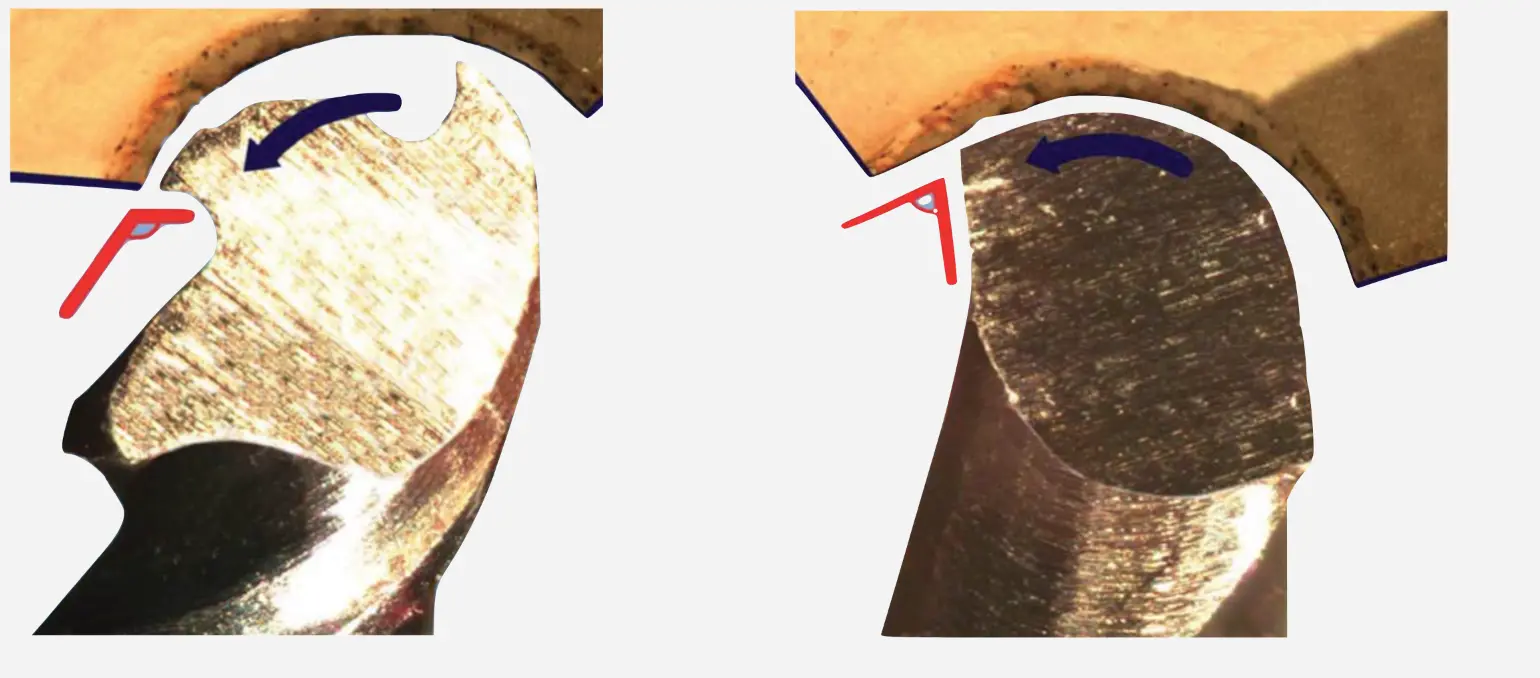
The rake angle is a critical feature seen in a cross-section of the file, perpendicular to its long axis. It is the angle formed by the leading (cutting) edge and the radius of the file.
- ==Negative Rake Angle (Scraping):==
- ==The angle formed by the leading edge and the surface to be cut is obtuse.==
- ==This design, found in older generation files, cuts by scraping the canal wall.==
- It is less efficient and generates more stress on both the file and the root canal.
- ==Positive Rake Angle (Cutting):==
- ==The angle formed by the leading edge and the diameter is acute.==
- ==This design, found in more recent files, is a true cutting edge.==
- It is more efficient, requires less time, and is considered more accurate.
Cutting Angle17181920
Info
The cutting angle, also known as the effective rake angle, provides a more accurate measurement of the cutting edge’s geometry. It is determined by sectioning the file perpendicular to the cutting edge itself, rather than the long axis of the file.
Interplay of Design Features and File Performance
Info
The individual design features of a file do not work in isolation; their interplay determines the file’s clinical behavior.
Impact of Flute Density
Note
If you compare two files of the same unit length, their performance will differ based on the number of flutes.
- ==More Flutes Per Unit Length:==
- ==Cutting Efficiency: Lower, because the smaller flute volume provides less space to collect debris.==
- ==Torsional Resistance: Lower, because more grooves are cut into the file’s core, reducing its bulk material.==
- ==Flexibility: Higher, because the file has a thinner core.==
- ==Less Flutes Per Unit Length:==
- ==Cutting Efficiency: Higher, due to larger flutes that can accommodate more debris.==
- ==Torsional Resistance: Higher, as the file is bulkier with fewer grooves.==
- ==Flexibility: Lower, due to the increased material in the file’s core.==
Shaping Parameters and Techniques
Info
Effective root canal shaping depends on understanding several key parameters beyond just file design.
- ==Cross-Section and Angles: As discussed, the rake and helical angles are fundamental to cutting efficiency and file behavior.==
- ==Kinematics: How the file moves. This can be continuous rotation, reciprocal motion, or an up-and-down motion.==
- ==Rotation Mass: Files can be designed to be centered or off-centered as they rotate, which affects how they contact the canal walls.==
- ==Number of Instruments: Systems can be multi-file or single-file (often reciprocating).==
- ==File Tapers:==
- ==Constant Taper: The diameter increases by a fixed percentage for every millimeter of length. This creates a uniform, conical shape.==
- ==Variable Taper: The taper changes along the length of the file (e.g., ProTaper files). This creates a less traditional but often more effective shape by selectively removing dentin.==
- ==Alloy: Modern files utilize advanced alloys to enhance performance.==
- ==Martensitic Alloys: These are preferred for their flexibility and memory. An example is the Colton Controlled Memory (CM) file, which is highly flexible and can be bent. It regains its original shape after sterilization or by pouring hot water over it.==
Clinical Guidelines for Rotary NiTi Instrumentation
Info
To avoid file failure (fracture from torsional stress or cyclic fatigue) and achieve predictable results, a set of rules and a systematic approach must be followed.
Fundamental Rules for Safe Operation
NOTE
- Reduce Torsional Stresses (Avoid Taper Lock): * ==Torsional stress occurs when the file binds along its full length in the canal (a phenomenon called taper lock), while the handpiece continues to rotate. * Technique: Advance the file in no more than 1mm increments with a gentle insert-and-withdraw motion. Avoid the urge to push the file to the full working length in one continuous motion. This trains muscle memory and provides tactile feedback.==
NOTE
- Apply Appropriate Pressure: * ==The pressure applied should be similar to that used when writing with a pencil. Enough pressure is needed to cut, but too much will break the instrument. * Never force a rotary file. If you need more pressure to advance, stop, remove the file, irrigate, and recapitulate with a manual file or change the file taper.==
NOTE
- Maintain Control: * ==Your supporting finger should be placed on a tooth as close as possible to the tooth being treated. This provides maximum control over the 1mm up-and-down motion and allows for a rapid reaction if the file exhibits a
First Generation21
- Radial Land
- Passive Cutting Edge
atures
Cutting Angle17181920
First Generation
- Radial Land
- Passive Cutting Edge
Footnotes
-
Original PDF page 1: R2Essentials of Rotary NiTi File Design, p.1 ↩
-
Original PDF page 3: R2Essentials of Rotary NiTi File Design, p.3 ↩
-
Original PDF page 4: R2Essentials of Rotary NiTi File Design, p.4 ↩
-
Original PDF page 5: R2Essentials of Rotary NiTi File Design, p.5 ↩
-
Original PDF page 6: R2Essentials of Rotary NiTi File Design, p.6 ↩
-
Original PDF page 7: R2Essentials of Rotary NiTi File Design, p.7 ↩
-
Original PDF page 8: R2Essentials of Rotary NiTi File Design, p.8 ↩
-
Original PDF page 9: R2Essentials of Rotary NiTi File Design, p.9 ↩
-
Original PDF page 10: R2Essentials of Rotary NiTi File Design, p.10 ↩
-
Original PDF page 11: R2Essentials of Rotary NiTi File Design, p.11 ↩
-
Original PDF page 12: R2Essentials of Rotary NiTi File Design, p.12 ↩
-
Original PDF page 13: R2Essentials of Rotary NiTi File Design, p.13 ↩
-
Original PDF page 14: R2Essentials of Rotary NiTi File Design, p.14 ↩
-
Original PDF page 15: R2Essentials of Rotary NiTi File Design, p.15 ↩
-
Original PDF page 16: R2Essentials of Rotary NiTi File Design, p.16 ↩
-
Original PDF page 17: R2Essentials of Rotary NiTi File Design, p.17 ↩
-
Original PDF page 18: R2Essentials of Rotary NiTi File Design, p.18 ↩ ↩2
-
Original PDF page 19: R2Essentials of Rotary NiTi File Design, p.19 ↩ ↩2
-
Original PDF page 20: R2Essentials of Rotary NiTi File Design, p.20 ↩ ↩2
-
Original PDF page 21: R2Essentials of Rotary NiTi File Design, p.21 ↩ ↩2
-
Original PDF page 22: R2Essentials of Rotary NiTi File Design, p.22 ↩