CASE 2(1).pdf
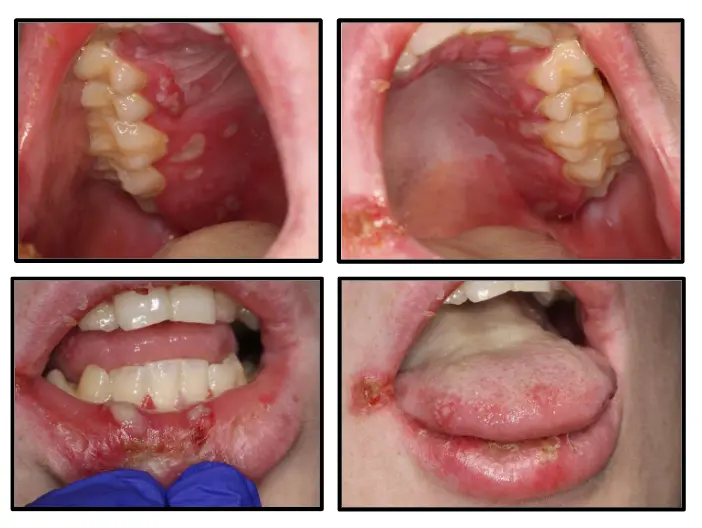
 DISCUSSION CASE
Case description: 21-year-old Female developed mouth ulcers five days ago. She was feeling unwell at that time. The ulcers are painful and she is finding it difficult to eat and brush teeth. Her medical history is non-contributory. She is a non-smoker and consumes minimal alcohol.
Activity:
- Identify the pathosis and describe the clinical features
- What is the differential diagnosis?
- What are the relevant clinical investigations?
Clinical Presentation
The clinical presentation is characterized by widespread involvement of the oral mucosa and surrounding tissues.
- What is the diagnosis?
- How would you manage this patient?
1. Identify the pathosis and describe clinical features
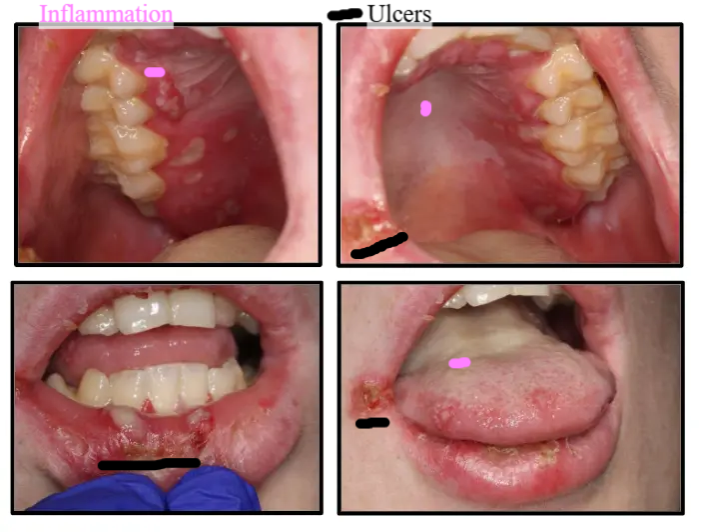
Inflammation
- Palatal Mucosa: The hard palate exhibits significant redness and inflammation.
- Gingiva: There is noticeable inflammation of the gingival tissues.
- Extra-oral: Inflammation extends to the lips and the corners of the mouth.
Ulceration
- Distribution: Multiple ulcers are present throughout the oral cavity.
- Specific Sites: Ulceration is observed on the lips, tongue, corners of the mouth (commissures), palatal mucosa, and gingiva.
- Patient Experience: The patient reports being in a lot of pain, having difficulty eating, and being unable to sleep due to the severity of the ulceration.
2. What is the differential diagnosis?
Looks like a viral infections:
- HIV
- HERPES
- VARICELLA ZOSTER
- Hand, Foot, and Mouth Disease: Mentioned as a possibility due to the presence of mouth ulcers.
Questions you can ask the patient
- Have you had anything before?
- “no never”
- Do you feel unwell
- example: I feel very weak, sore and can’t sleep
- Cervical lymphadenopathy: Patient reported sore glands in the neck.
- Does anyone around you have herpes
- example : “My boyfriend had a cold sore 2 weeks ago”
Case Study: Patient Presentation
- History: Boyfriend had a cold sore two weeks prior.
- Symptoms: Acute pain, inability to eat/sleep, and cervical lymphadenopathy.
- Clinical Findings: Widespread ulcers everywhere including the tongue, palate, and gingiva.
3. What are the relevant clinical investigations?
If herpes infection
- Swab can be used to confirm diagnosis
- PCR (Polymerase Chain Reaction): Testing used on the swab to confirm the virus.
- Hematinics: General investigation for ulcers, though less relevant for acute viral cases.
Blood test:
“There is one blood test you should do ”
- ==Full Blood count
- want to make sure the patient isn’t immunocompromised
4. what is the diagnosis?
The diagnosis is Herpes Infection (Primary Herpetic Gingivostomatitis) based on widespread ulceration and systemic malaise.
5. How would you manage this patient?
-
Acyclovir: Most effective if started early in the course of infection.
-
Systemic analgesics: Such as Ibuprofen or Paracetamol for pain management.
-
Infection Control: Avoid touching lesions (prevent autoinoculation) and avoid kissing/close contact until resolved.
-
Difflam mouthwash
- 2 different preparations
- Pink one : doesn’t have chlorhexidine
- Green: has chlorexidine
- We want to give the chlorhexidine because we want to avoid secondary bacterial infection
- Staining: Warn patients about potential temporary staining from Chlorhexidine.
- For 2 weeks while the patient recovers
- 2 different preparations