Case Discussion Of Oral Lesion
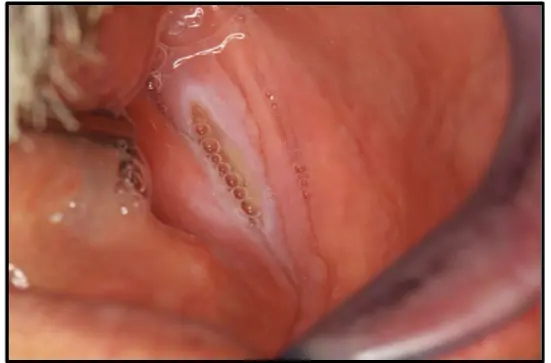
Patient Presentation and History[^1]
A 52-year-old male presented with a 6-week history of a painful oral lesion. The patient has been self-treating the area with Kenalog, which has yielded no clinical response.
Contraindication: Kenalog
The lecturer strongly advised against using Kenalog (Triamcinolone) for such ulcers. As a glucocorticoid, it interferes with healing and increases the risk of secondary infections like Candida.
Medical and Social History
- Medical Conditions: Diabetes, hypertension, and hypercholesterolemia.
- Social History:
- Long-term smoker (30 years), currently smoking 15 cigarettes per day.
- Alcohol consumption averages two drinks per day.
- Dental Status: The patient is edentulous; his current dentures are 5 years old.
- The patient was wearing their dentures constantly, never taking them out, which contributed to the lack of healing.
- Systemic factors like the patient's diabetes must be considered as they can delay wound healing, even if seemingly well-controlled.
Identify the pathosis and describe the clinical features.
Chronic ulcer features vs Acute ulcer
Chronic has scaring:
- Definition of an Ulcer: A breach in the continuity of the epithelium.
- Margins: Often raised, thickened, or indurated (hardened).
- Color: Presence of white margins (hyperkeratosis) rather than the redness (erythema) typically seen in acute inflammation.
- Induration: Refers to the thickness or firmness felt underneath the tissue upon palpation, often caused by scarring or hyperkeratosis.
- Acute ulcers typically present with a "halo" of redness and inflammation, whereas chronic ulcers lack this intense redness.
What is the differential diagnosis?
- traumatic ulceration
- Oral Squamous cell carcinoma
- Leukoplakia
- could be an ulcerated leukoplakia but its a bit of a stretch
- Tuberculosis
- Fungal infection
- Chemical injury
- Syphilis (though lower on the list of probability)
Since OSCC is a differential
- then the differentials for OSCC are fair game too!
- ex. TB, fungal infect
What are the relevant clinical investigations?
Investigations & approach (persistent lesions)
- Biopsy: The definitive investigation for persistent lesions; however, if trauma is suspected, a 10–14 day observation period is standard.
- Blood Tests: Hematinics (B12, folate, iron) to rule out nutritional deficiencies, FBC for systemic issues, and HbA1c for diabetic control.
Blood tests
Full blood count
Hematinic
Ulcerated Lesions
ALWAYS DO HEMATINICS FOR ULCERS
- B12, FOLATE , IRON BY DEFAULT FOR ULCERS
HbA1c
- Diabetic so they may have an ulcer so they’re not
Biopsy
- Should be done after other less invasive tests
Misc
- since he wears a denture ask him if he wears it at night
- this was actually the case with this patient and he wears it at night
What is the diagnosis?
- the diagnosis is a chronic traumatic ulcer
Case summary (diagnosis)
- Presentation: Poorly defined, non-healing ulcer in the mandibular lingual sulcus for six weeks.
- Outcome: Because the ulcer showed signs of shrinking (epithelialization) and pain reduction, a biopsy was deferred. The lesion took two full months to resolve completely. Final diagnosis: Chronic Traumatic Ulcer.
How would you manage this patient?
Management (key steps)
- Management: Denture adjustment and specific instructions to leave the denture out except for eating.
- Pharmacological Intervention: Chlorhexidine mouthwash (antibacterial) and Benzydamine/Difflam (analgesic/anti-inflammatory).
Meds and rinses
- Chlorhexidine (highest concentration)
- antibacterial
- 2x a day everyday until next appointment
- Difflam
- usage: PRN for pain control
Chlorhexidine gel vs mouthrinse
- The patient will end up poking their wound with their finger, could be dirty and will irritate the wound
On the continuation of kenalog
- it will interfere with healing
- thus it must be stopped
Cause of continuation of ulcer
Part of the reason the ulcer is lasting so long is because he keeps hitting it with kenalog
Dentures
- Instruct the patient to only wear the denture if they have to
- this is because they have a wound that is trying to heal!
Recall interval
- 2 weeks is the recommended recall
theoretical
- the patient comes back after 2 weeks and the ulcer is slowly getting better but not healed
- A BIOPSY IS NOT NEEDED
- a chronic ulcer won’t be healed in two weeks, as long as the ulcer is getting better tell the patient to carry on with the same protocol:
- chlorhexidine twice a day, difflam etc
- bring him back in a 2-3 week interval
- a chronic ulcer won’t be healed in two weeks, as long as the ulcer is getting better tell the patient to carry on with the same protocol:
- Took two months for lesion to result