Clinical Case Studies
Patient Presentation[^8]
- Pain upon biting (usually indicates a periodontal issue, specifically an apical periodontal issue).
- Sensitive to cold (usually indicates pulp sensitivity).
Case 1: Pain and Sensitivity Analysis
Radiographic Assessment
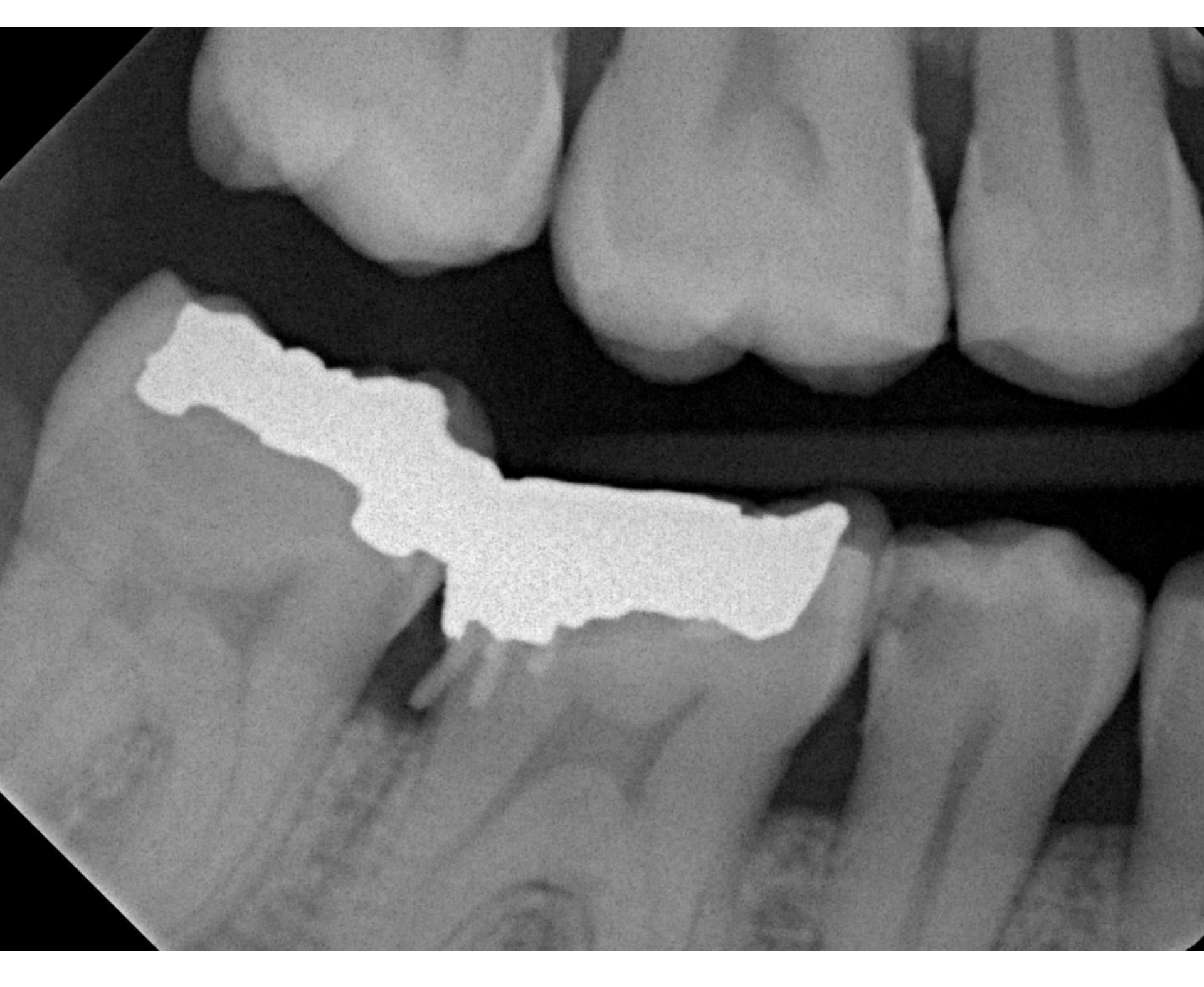
Describe this radiograph by addressing the following:
- What type of radiograph is this? Bite-wing.
- Which side of the mouth is shown?
- Which teeth are imaged?
- Describe the appearance of the 45 and provide a diagnosis.
- Distal lucency in the class proximal lesion pattern. Observation shows a lucency on the distal enamel surface, extending past the dentino-enamel junction (DEJ) into the coronal dentine.
- Diagnosis: ==45 distal caries. Caries start in the dense enamel and spread rapidly (“go ballistic”) once they reach the softer dentine. This specific pattern of spread is clearly visible on bite-wings but is typically not seen on OPGs.==
- Describe the condition or changes occurring to the 46.
- Perforation of retention pins that are sitting distal to the tooth (ectopic). ==The 46 is a heavily restored tooth. Two “stick-like” structures are visible at the base of the distal restoration; these are retention pins (historically used for amalgam restorations).==
- ==Complication: The distal pin is placed ectopically, sitting distal to the tooth structure. This results in a perforation at the distal surface of the 46 near the CEJ. While not a “disease,” it is a structural defect that requires treatment.==
- Is any further imaging required? Provide a rationale for your answer.
- PA of 45/46 due to pain, we must know if there is cracks or pulpal involvement. A Periapical (PA) radiograph of quadrant 4 is recommended to evaluate the periapical region and root structure to investigate the cause of biting pain (apical periodontal assessment).