Mechanical Supragingival Biofilm Control1
Dr Emma Perry | BDSc, AssocDeg DH, GradCert HPEd
Content courtesy of Dr Anna Hughes | BDS, MSC, FDS RCPS, MRACDS (Perio)
Mechanical Supragingival Biofilm Control
THE UNIVERSITY OF WESTERN AUSTRALIA

Introduction and Learning Outcomes234
Textbook
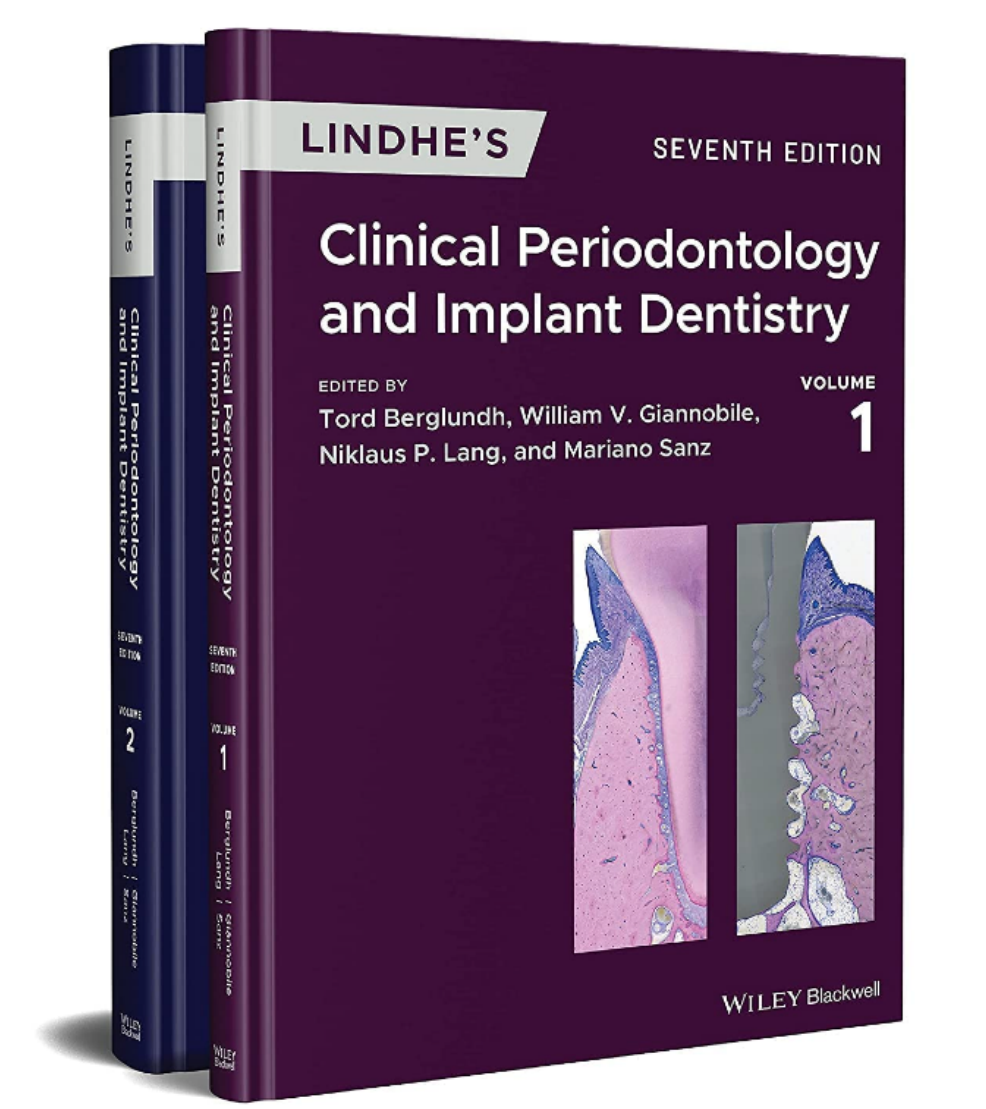
LINDHE’S Clinical Periodontology and Implant Dentistry SEVENTH EDITION VOLUME 1 EDITED BY Tord Berglundh, William V. Giannobile, Niklaus P. Lang, and Mariano Sanz WILEY Blackwell
Chapter 28 Mechanical Supragingival Plaque Control
Fridus van der Weijden and Dagmar Else Slot Department of Periodontology, Academic Centre for Dentistry Amsterdam (ACTA), University of Amsterdam and Vrije Universiteit Amsterdam, Amsterdam, The Netherlands
Learning Outcomes
- Define Mechanical Supragingival Biofilm Control (MSBC).
- Explain the rationale for MSBC.
- Describe the role of MSBC in periodontal treatment.
- Develop an evidence-based, individualised MSBC regime for a patient.
- Instruct a patient in MSBC.
Lecture outline
Define Mechanical Supragingival Biofilm Control (MSBC).
Explain the rationale for MSBC.
- Patient
- Dentist
- Gum disease
- Caries
Describe the role of MSBC in periodontal treatment.
- Professional
- Patient-performed
Develop an evidence-based, individualised MSBC regime for a patient.
- Brush
- Technique
- Interdental
- Other devices
- Dentifrices
Instruct a patient in MSBC.
 |  |
Rationale for Biofilm Control5
Definition
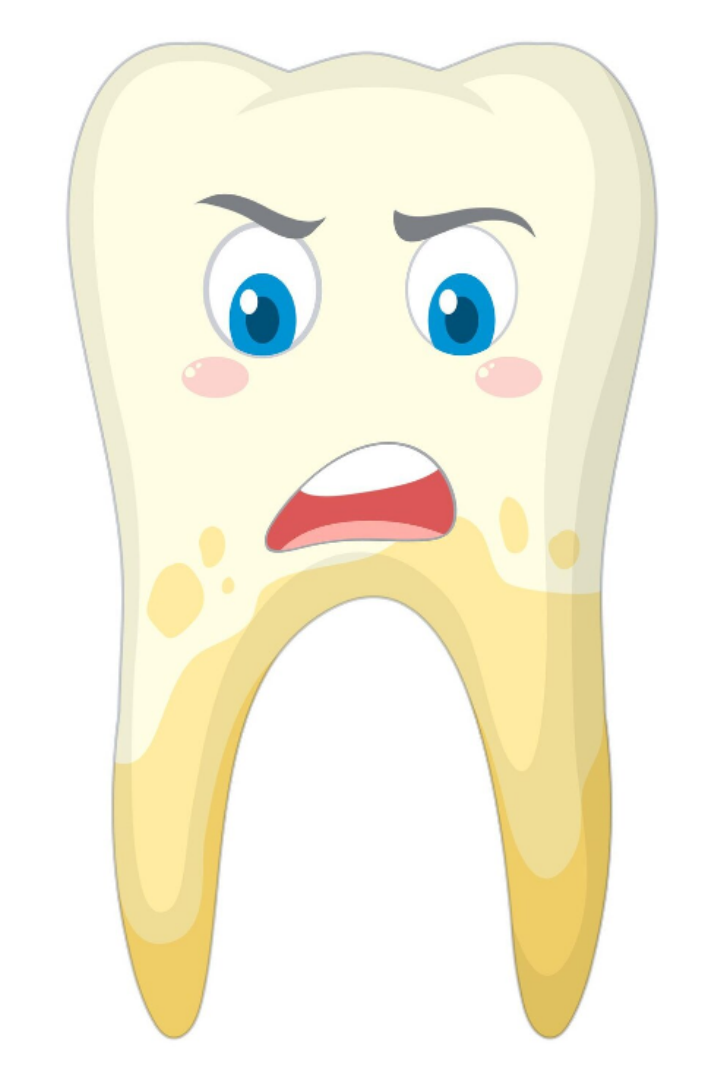
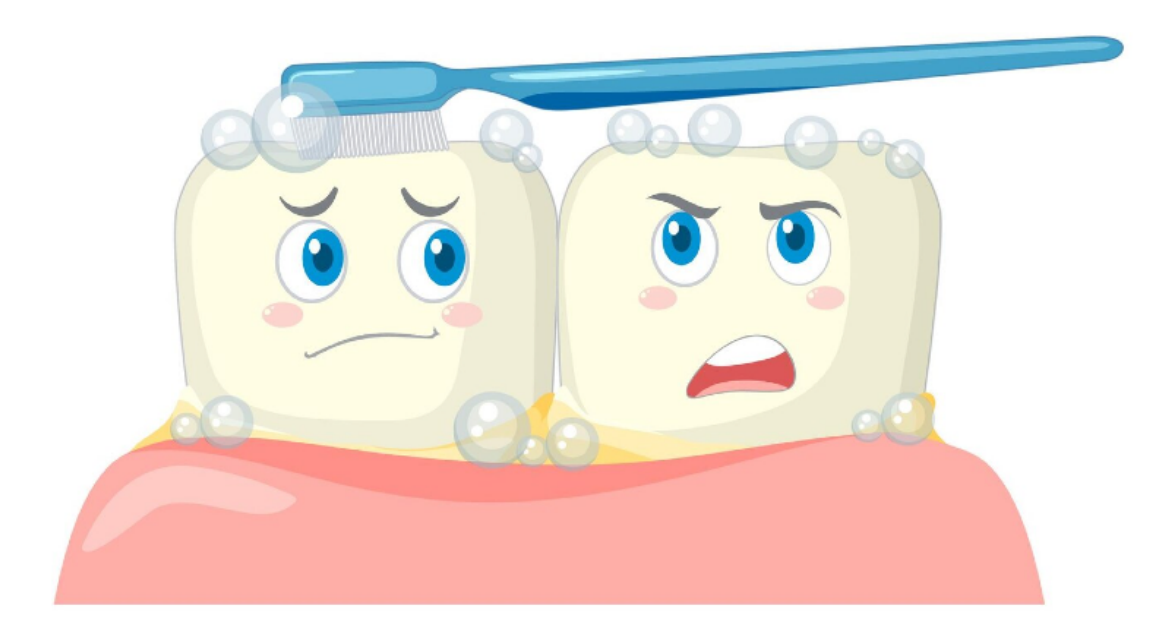
The removal of microbial plaque and food debris from dental hard surfaces through abrasion using physical means such as brushes, floss and other devices.
 |  |
Patient Perspective on Oral Wellbeing6
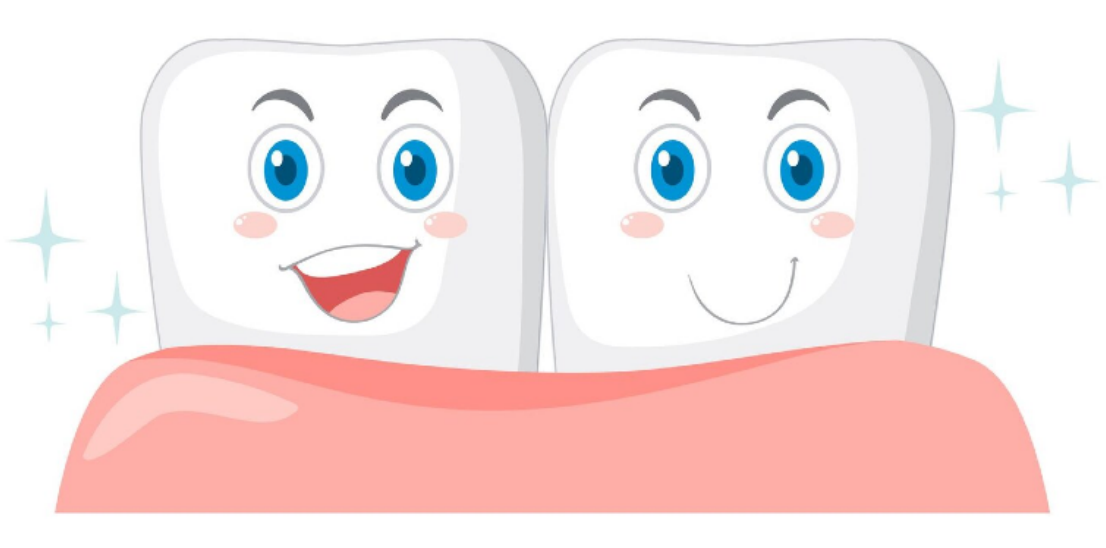
Rationale: A patient’s perspective
- To achieve oral wellbeing
- To feel clean and fresh
- To have a nice smile
- To reduce bad breath

Clinical Perspective on Disease Prevention7
Rationale: A dentist’s perspective
- Gum disease (gingivitis and periodontitis)
- Caries
- Systemic effects
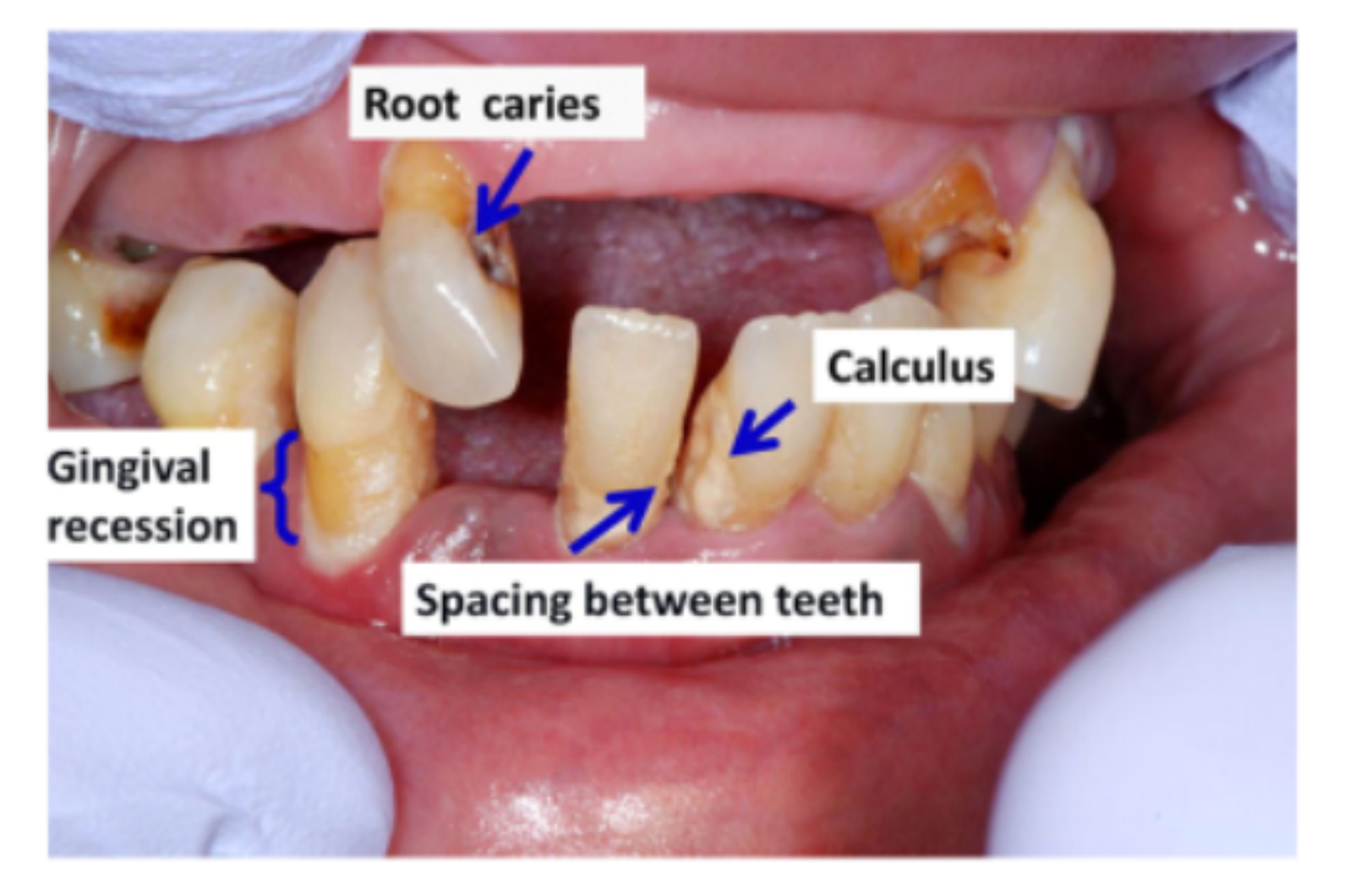
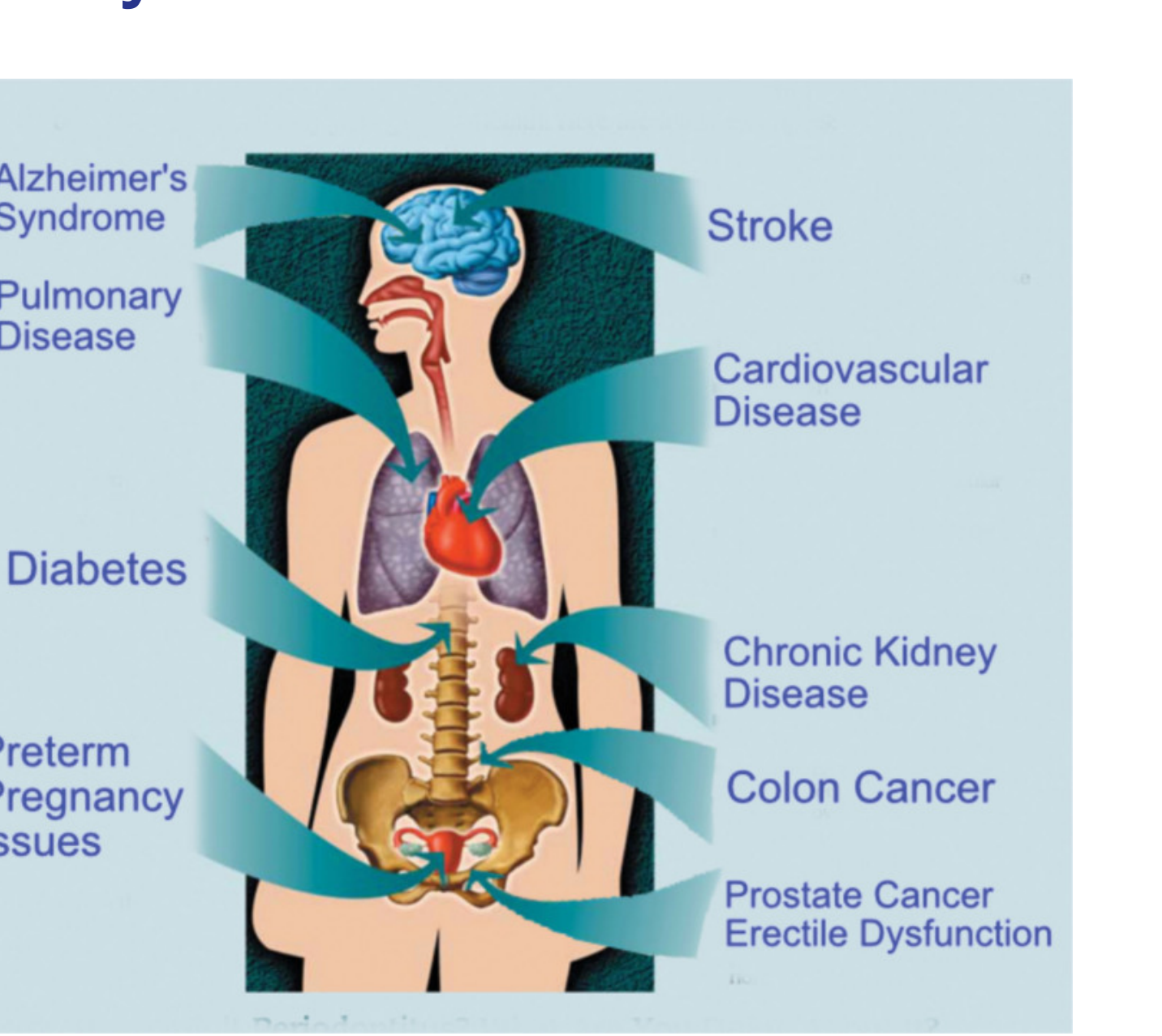
Systemic Effects and Self-Cleansing Limitations89
Rationale: Systemic effects
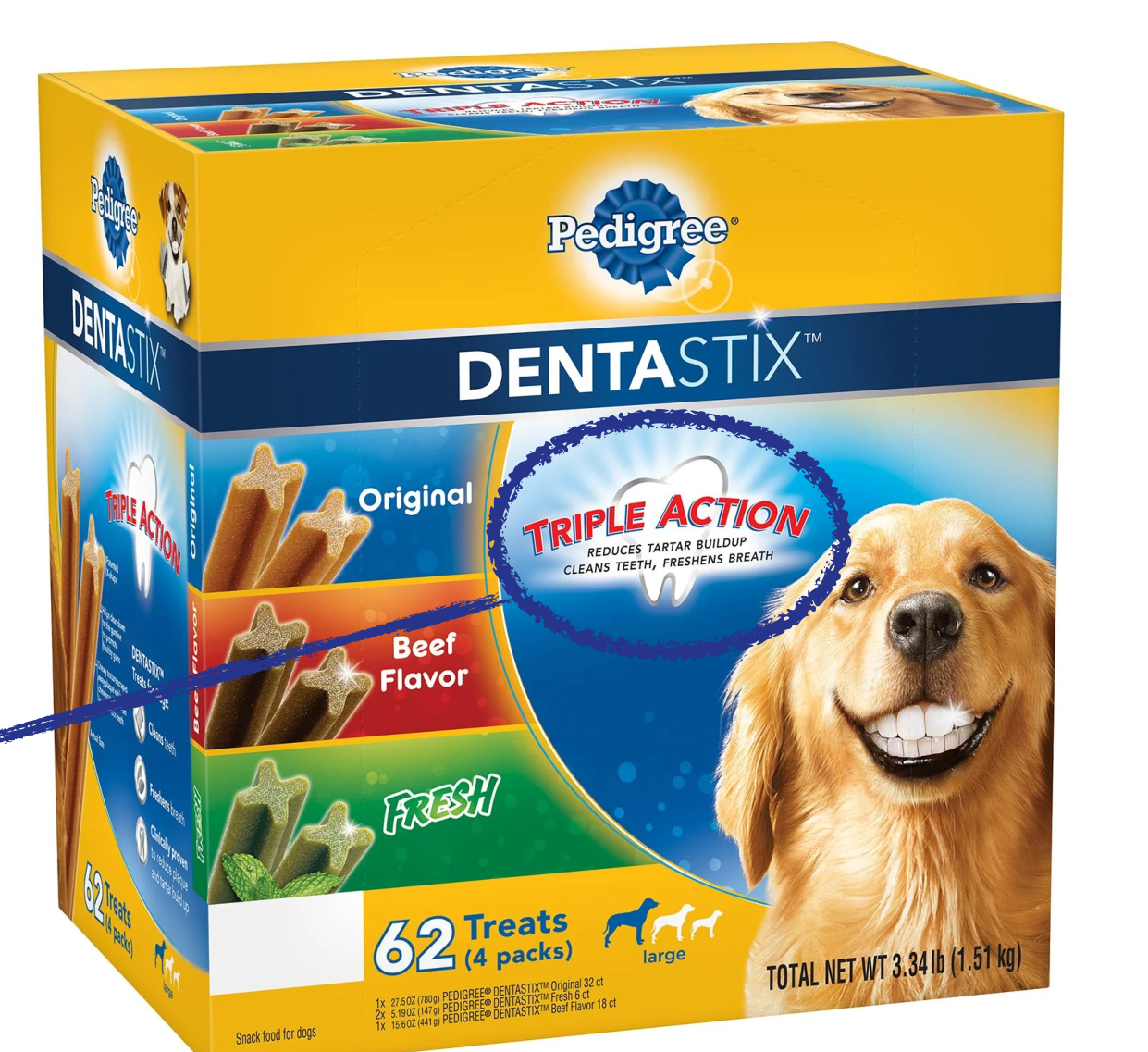
- Natural self-cleansing mechanisms have limited effect on plaque build-up.
- Biofilm adherence to teeth is tenacious and cannot be removed by rinsing alone or chemical dissolution.
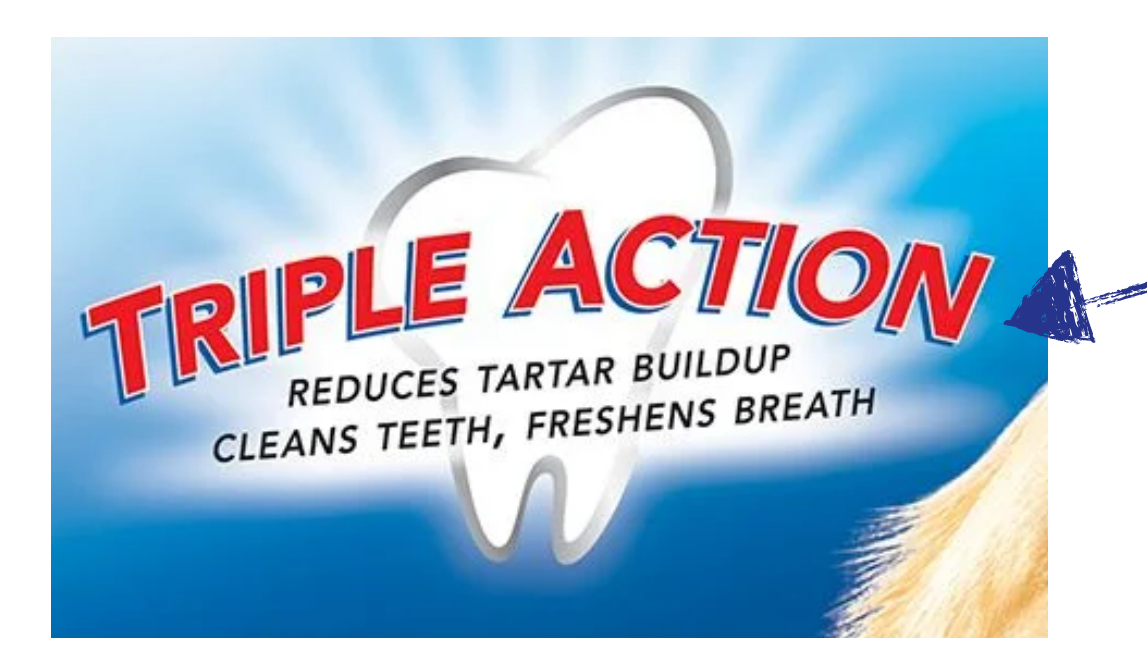
- Triple Action reduces tartar buildup, cleans teeth, freshens breath.
 |  |
 |
Impact on Gum Disease and Caries1011
Rationale: Gum disease
- Regular personal plaque removal measures must be undertaken to achieve and maintain periodontal health.
- Biofilm removal and control is fundamental to prevention and control of periodontal diseases Chapple et al 2015
- Supragingival plaque control can modify the quantity and composition of sub gingival plaque, but by itself cannot treat moderate and severe periodontitis Lindhe et al 1989
Rationale: Caries
- The evidence for toothbrushing itself to reduce caries is weak and inconsistent Addy 1986
More important than brushing (when considering caries), the toothbrush is an effective vehicle for fluoride toothpaste.
- National surveys in Finland Mattila et al 2010 and Germany Jordan et al 2014 have found a strong associated between caries and attachment loss in adults, but no attempts were made to expose to what extent this associated was explained by common risk factors Jepsen et al 2017. Therefore we cannot conclude poor plaque control caused their carious lesions.
Mechanical Supragingival Biofilm Control in Periodontal Treatment1213
- Professional
- Part of preventive or active treatment
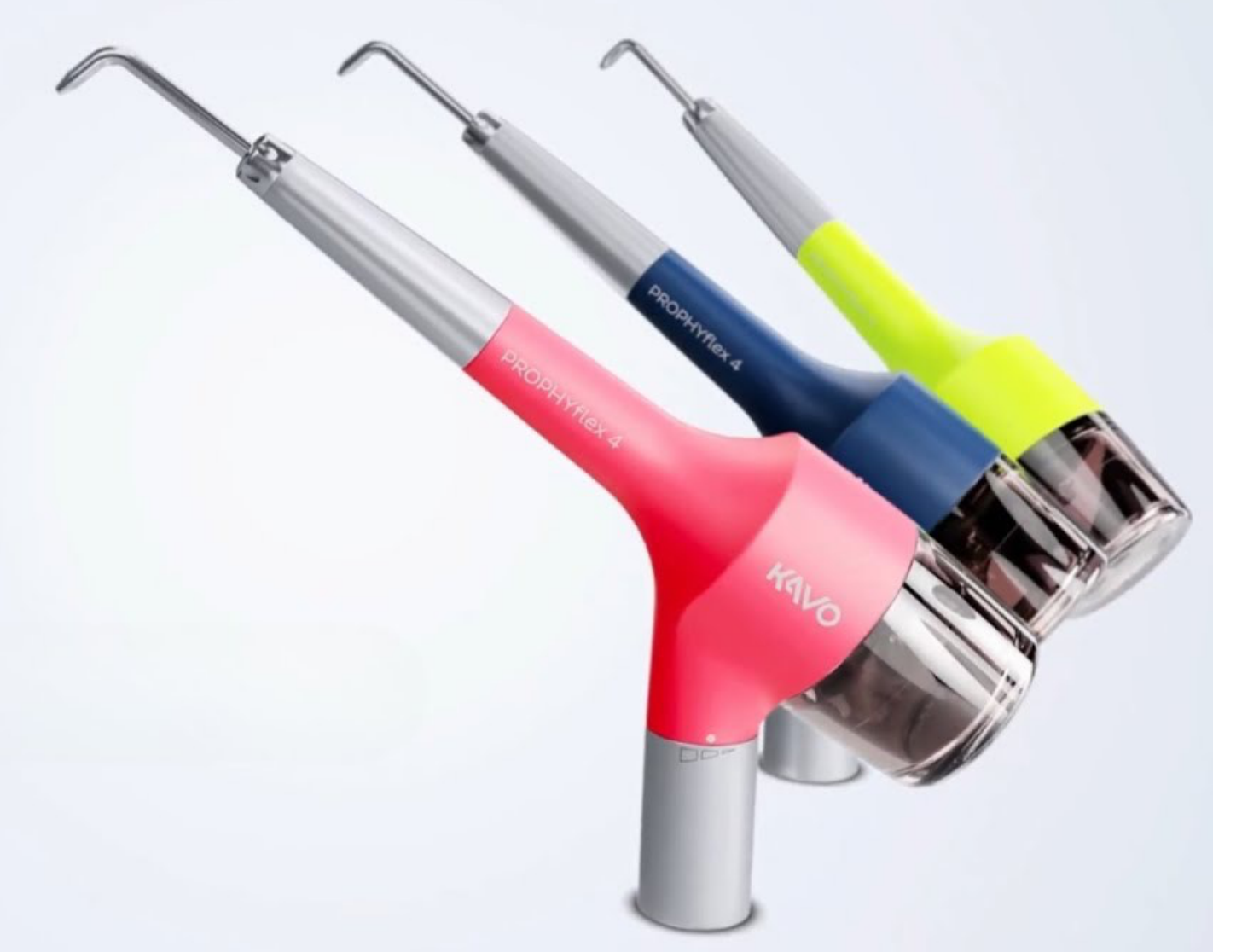
- Prophy
- Traditional cup/brush and paste
- Air/powder/water jets
- Patient-performed
- OHI
Phases and Steps of Periodontal Therapy1415
Phases of Periodontal Treatment
Corbet & Smales 2012
“…sustainable improvements in plaque control form the cornerstone of all phases of periodontal therapy…”
- Emergency care
- Risk management
- Fundamental
- Corrective
- Supportive
Steps of Periodontal Treatment
BSP
Clinical Practice Guidelines and Risk Assessment16171819
The University of Western Australia
Supported by gsk
BSP UK CLINICAL PRACTICE GUIDELINES FOR THE TREATMENT OF PERIODONTAL DISEASES
| ORAL HEALTH AND RISK ASSESSMENT, DIAGNOSIS & CARE PLAN |
|---|
| Diagnosis |
STEP 1 Building foundations for optimal treatment outcomes
I: Explain disease, risk factors & treatment alternatives, risks & benefits including no treatment
II: Explain importance of Oral Hygiene (OH), encourage and support behaviour change for OH improvement
III: Reduce risk factors including removal of plaque retentive features, smoking cessation and diabetes control interventions
IV: Provide individually tailored OH advice including interdental cleaning, + / - adjunctive efficacious toothpaste & mouthwash, + /- Professional Mechanical Plaque Removal (PMPR) including supra and subgingival scaling of the clinical crown
V: Select recall period following published guidance and considering risk factors such as smoking and diabetes
VI: Oral Health Educator (I, II), Hygienist, Therapist (I – IV), Dentist, Practitioner accredited for Level 2 and 3 care (I – V)
16
Steps of Periodontal Treatment
Periodontitis (continued)
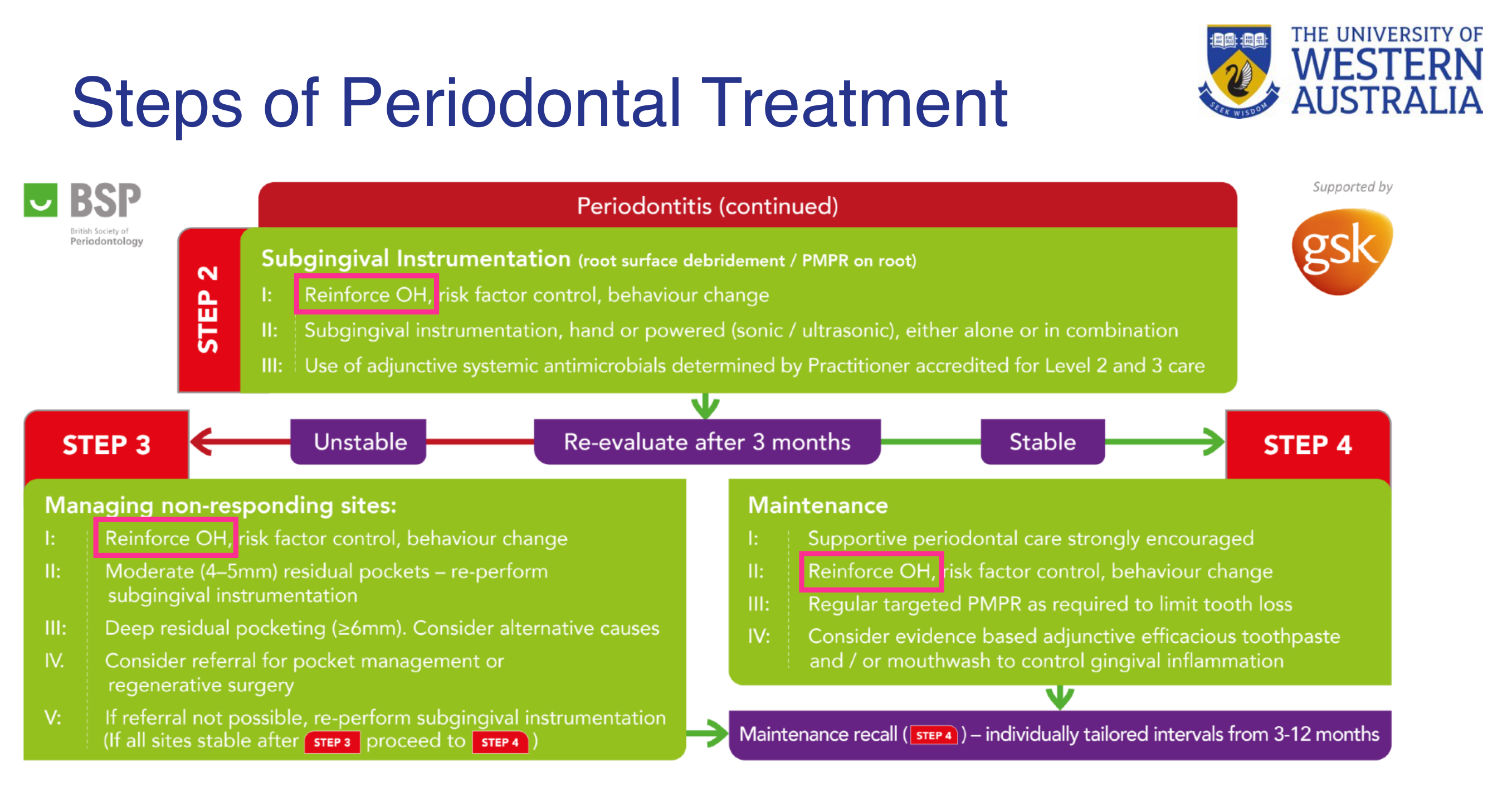
Pre-Dental Hygiene Education STEP 2 Subgingival Instrumentation (root surface debridement / PMPR on root) Reinforce OH, risk factor control, behaviour change Subgingival instrumentation, hand or powered (sonic / ultrasonic), either alone or in combination Use of adjunctive systemic antimicrobials determined by Practitioner accredited for Level 2 and 3 care
Re-e-evaluate afger 3 monthis Unstable Step 3 Managing non-responding sites: Reinforce OH, risk factor control, behaviour change Moderate (4–5mm) residual pockets – re-perform subgingival instrumentation Deep residual pocketing (≥6mm). Consider alternative causes Consider referral for pocket management or regenerative surgery If referral not possible, re-perform subgingival instrumentation (If all sites stable after step 3, proceed to step 4) Step 4 Maintenance Supportive periodontal care strongly encouraged Reinforce OH, risk factor control, behaviour change Regular targeted PMPR as required to limit tooth loss Consider evidence based adjunctive efficacious toothpaste and / or mouthwash to control gingival inflammation
Maintenance recall (step 4) – individuals tailored intervals from 3-12 months
Steps of Periodontal Treatment
I: Patients should be made aware that regular effective self-performed plaque removal offers the largest treatment benefit – engage the patient in a verbal contract to perform daily plaque control
II: Toothbrushing should be supplemented by the use of interdental brushes (where anatomically possible)
III: Individual patient’s abilities, needs, preferences and manual dexterity should be considered when selecting toothbrush & interdental brush
IV: Refer to BSP website for further clarification and glossary of terms
Defining engaging & non-engaging patients (this is a guide)
| Engaging Patients | Non-engaging Patients |
|---|---|
| I. Favourable improvement in OH – indicated by ≥50% improvement in plaque and marginal bleeding scores OR | I. Insufficient improvement in OH – indicated by <50% improvement in plaque and marginal bleeding scores OR |
| II. Plaque levels ≤20% & bleeding levels ≤30% OR | II. Plaque levels >20% & bleeding levels >30% OR |
| III. Patient has met targets outlined in their personal self-care plan as determined by their healthcare practitioner | III. Patient states preference to a palliative approach to periodontal care |
Efficient Periodontal Treatment
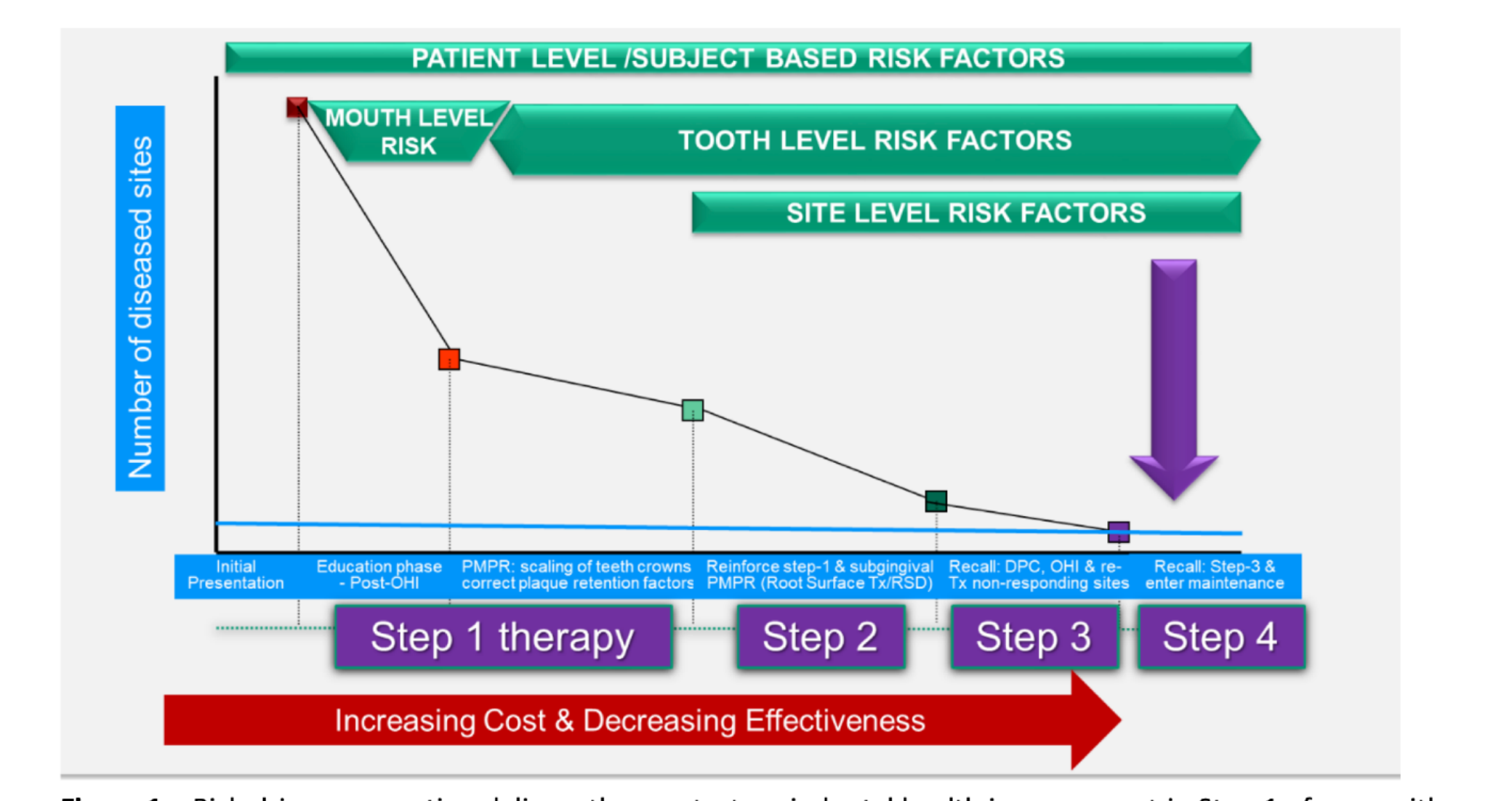
PATIENT LEVEL/SUBJECT BASED RISK FACTORS MOUTH LEVEL RISK TOOTH LEVEL RISK FACTORS SITE LEVEL RISK FACTORS
Number of diseased sites
Initial Presentation — Education phase - Post-OHI — PMPR: scaling of teeth crowns, correct plaque retention factors — Reinforce step-1 & subgingival PMPR (Root Surface Tx/RSD) — Recall: DPC, OHI & re-Tx non-responding sites — Recall: Step-3 & enter maintenance
Step 1 therapy Step 2 Step 3 Step 4
Increasing Cost & Decreasing Effectiveness
Figure 1 – Risk-driven prevention delivers the greatest periodontal health improvement in Step-1 of care, with deceasing return on investment (time & money) towards Step-2 and 3.
 |  |
 |  |
Toothbrushes and Manual Cleaning20
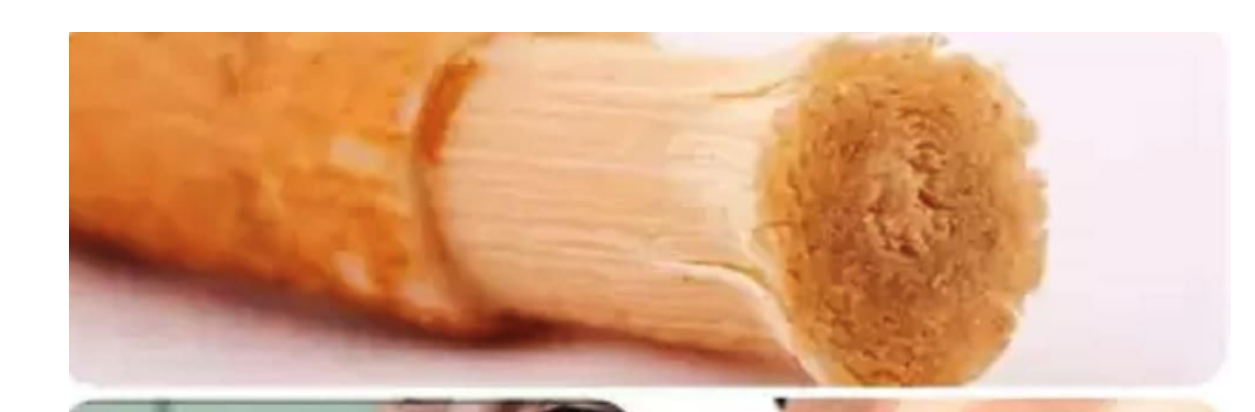
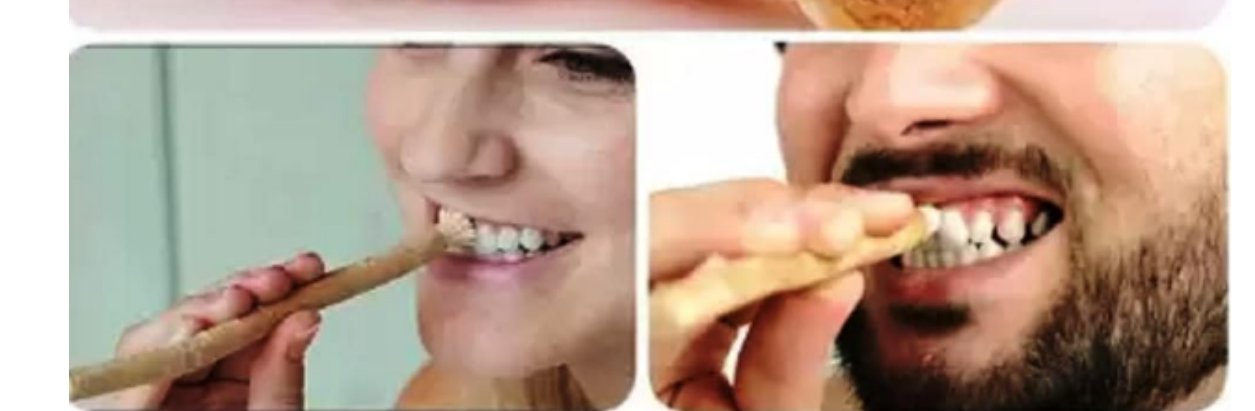
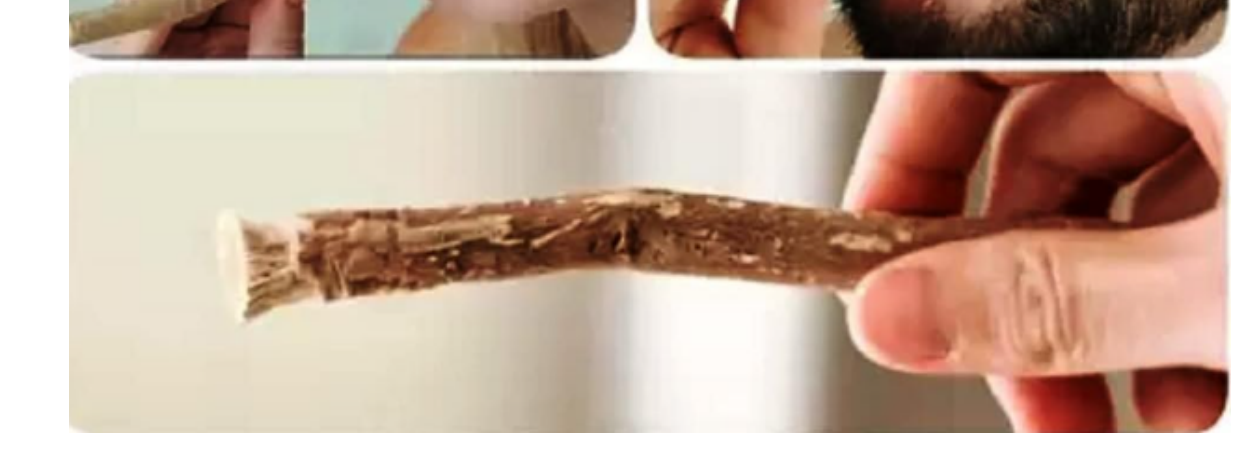
- Miswak
- Arak-salvadora persica tree
- Widely used in Asia, Middle East, Africa.
- Can be as effective as a manual toothbrush if used 3-5 x daily. Adam et al 2021
 |  |
 |
Design and Components212223
- Most common method of mechanical plaque control.
- Handles usually made of plastic +/- rubber.
- Bristles usually made of nylon or polyester +/- rubber.
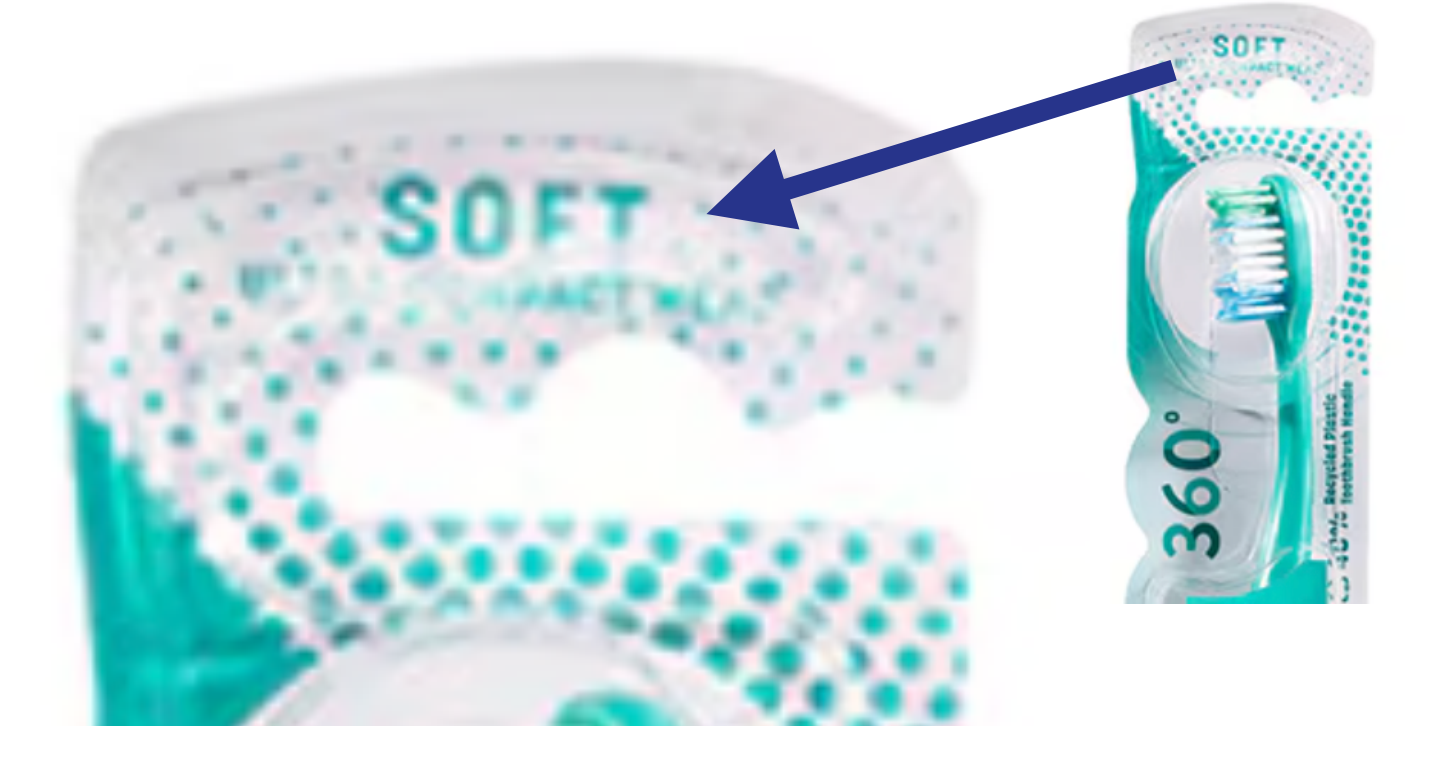
- Head design
- Bristles
- Handle design
- Electric or manual
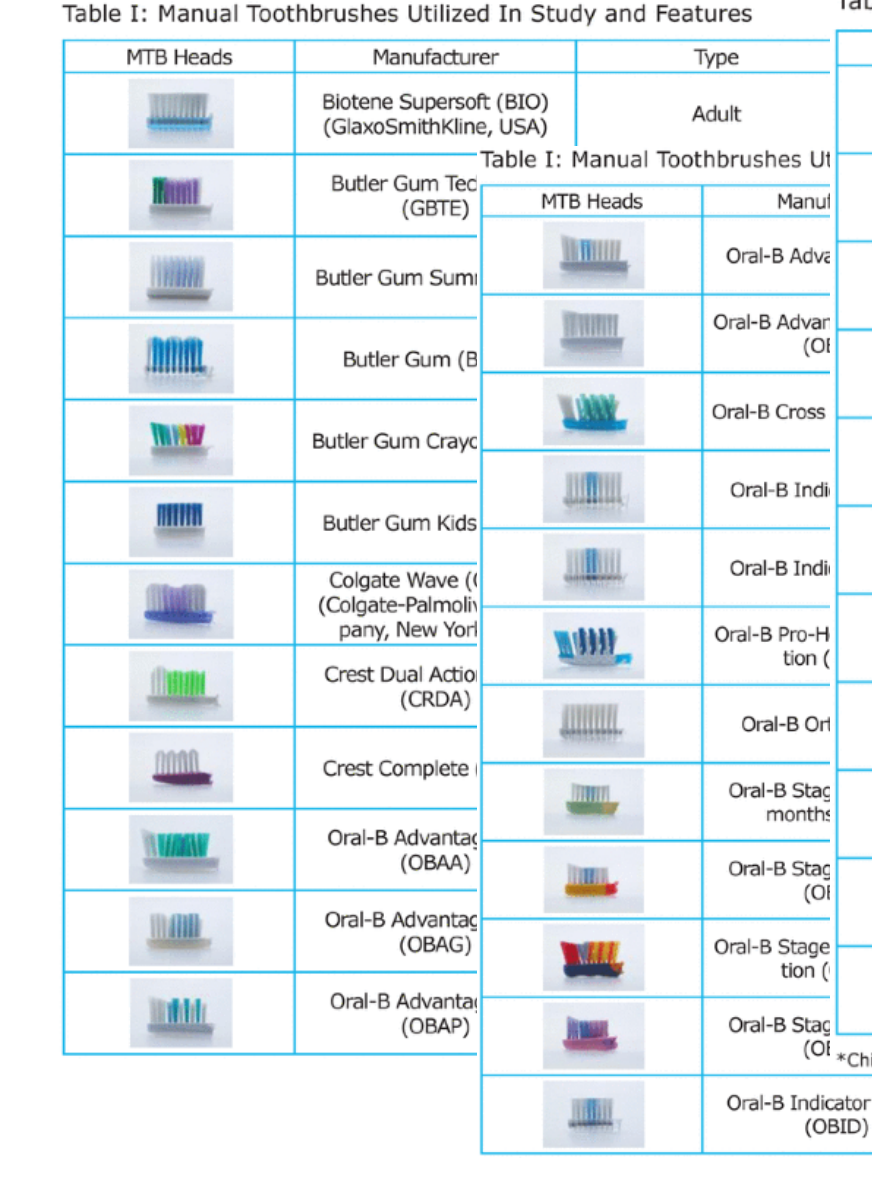
Table I: Manual Toothbrushes Utilized In Study and Features
| MTB Heads | Manufacturer | Type | Features |
|---|---|---|---|
| Biotene Supersoft (BIO) (GlaxoSmithKline, USA) | Adult | ||
| Butler Gum Tec (GBTE) | Manual | ||
| Butler Gum Summit | Oral-B Advantage | ||
| Butler Gum (B) | Oral-B Advantage (OBA) | ||
| Butler Gum Crayon | Oral-B CrossAction | ||
| Butler Gum Kids | Oral-B Indicator | ||
| Colgate Wave (Colgate-Palmolive Company, New York) | Oral-B Indicator | ||
| Crest Dual Action (CRDA) | Oral-B Pro-Health Action (OBPH) | ||
| Crest Complete | Oral-B Ortho | ||
| Oral-B Advantage (OBAA) | Oral-B Stages 4-24 months (OBS1) | ||
| Oral-B Advantage (OBAG) | Oral-B Stages 2-4 (OBS2) | ||
| Oral-B Advantage (OBAP) | Oral-B Stages 5-7 (OBS3) | ||
| Oral-B Indicator Designs (OBID) | Oral-B Stages 8+ (OBS4) | Child |
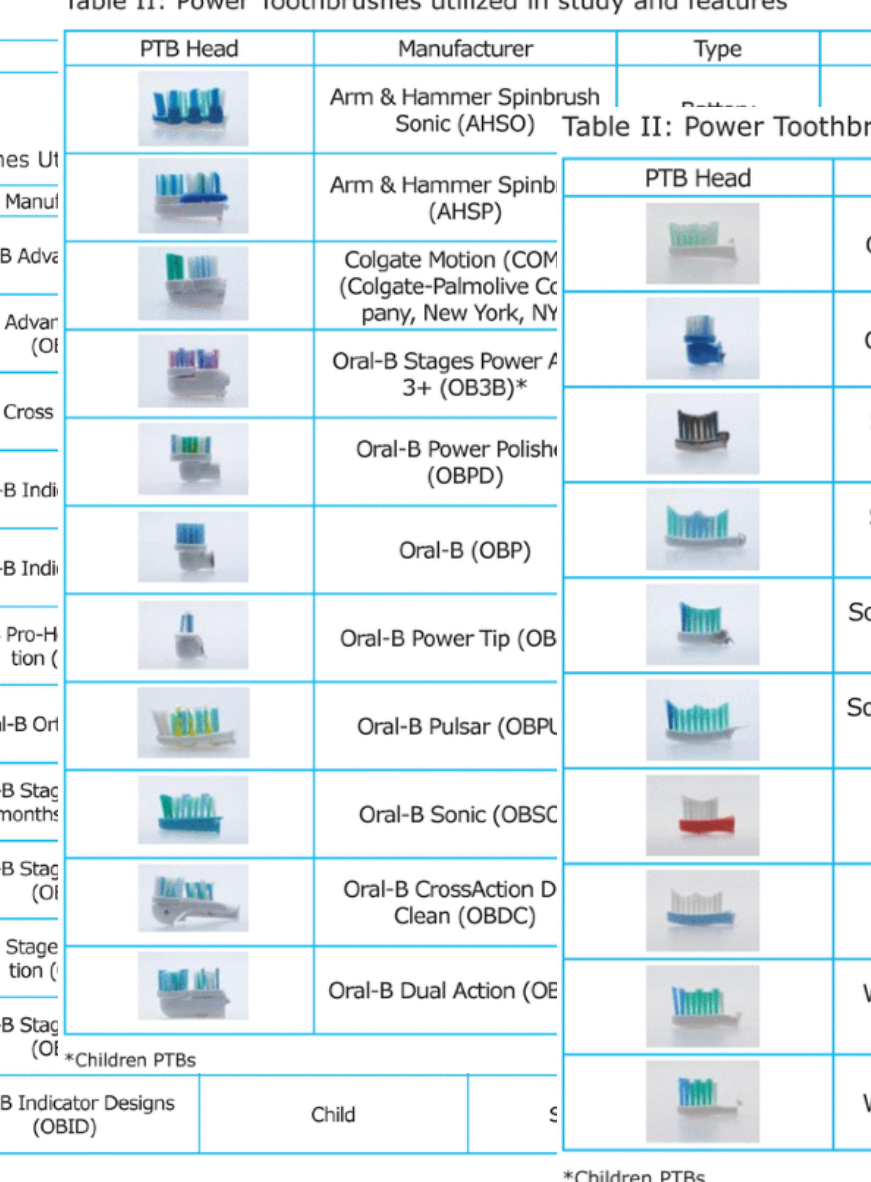
Table II: Power Toothbrushes utilized in study and features (continued)
| PTB Head | Manufacturer | Type | Features |
|---|---|---|---|
| Oral-B Pulsonic (PULSE) | Rechargeable | Prosoft bristles; pivots and pulses | |
| Oral-B Kids 3+ (OBKP)* | Battery | Extras Soft bristles; raised row of bristles, blue indicator bristles, round head; oscillating rotation motion | |
| Sonicare Elite Compact (SECP) | Rechargeable | Soft Bristles; Slim, angled neck and contour-fit bristles; rippled bristles; compact head | |
| Sonicare Elite Standard (SESP) | Rechargeable | Soft Bristles; Slim, angled neck and contour-fit bristles; rippled bristles | |
| Sonicare Flexcare Compact (SFCP) | Rechargeable | Soft rippled bristles; indicator bristles; compact head | |
| Sonicare Flexcare Standard (SSFB) | Rechargeable | Soft rippled bristles; indicator bristles | |
| Sonicare Kid Age 4+ (SKID1)* | Rechargeable | Extrasoft bristles; compact head; rippled | |
| Sonicare Kid Age 7+ (SKID2)* | Rechargeable | Extrasoft bristles; rippled | |
| Waterpik Large (WATP1) (Fort Collins, CO) | Rechargeable | Extrasoft bristles; standard head | |
| Waterpik Small (WATP2) | Rechargeable | Extrasoft bristles; compact head |
*Children PTBs
https://www.colgateprofessional.com.au/products/toothbrush
 |  |  |
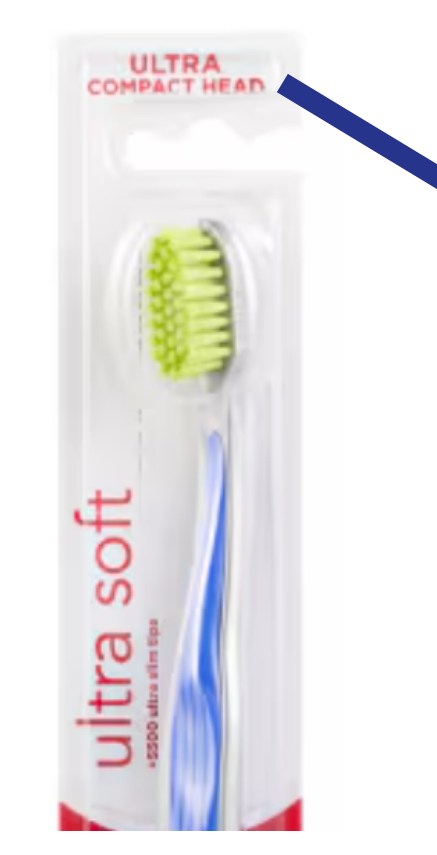 |  |
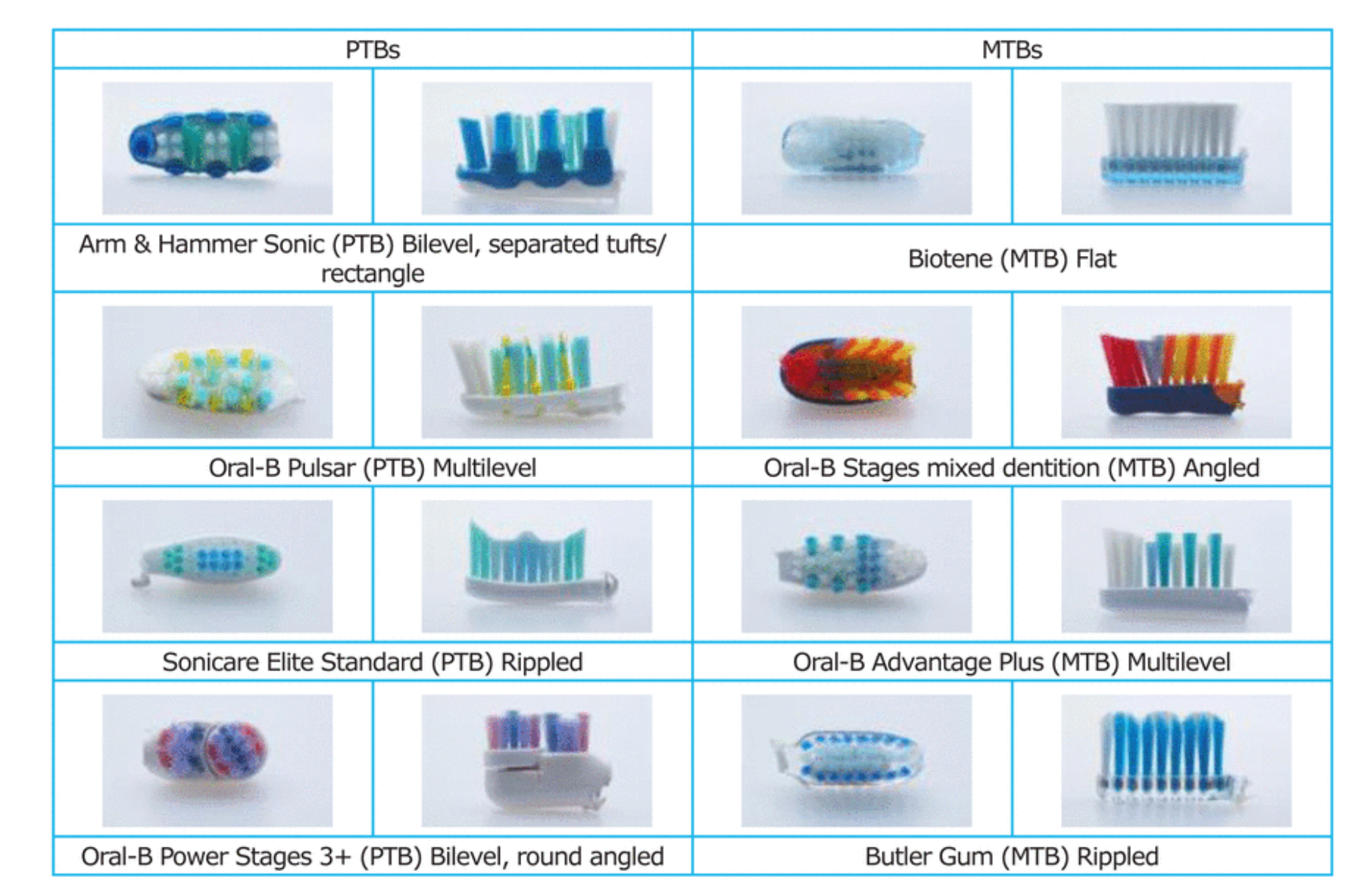
Bristle Characteristics and Ergonomics24252627
- Soft - 0.2mm diameter – less traumatic
- Medium - 0.3mm diameter – better cleaning
- Hard - 0.4mm diameter - more damaging
- Filament ends important - cut vs end-rounded vs tapered
- Number of filaments per tuft
- Length and shape of filaments
| PTBs | MTBs | ||
|---|---|---|---|
| Arm & Hammer Sonic (PTB) Bilevel, separated tufts/rectangle | Biotene (MTB) Flat | ||
| Oral-B Pulsar (PTB) Multilevel | Oral-B Stages mixed dentition (MTB) Angled | ||
| Sonicare Elite Standard (PTB) Rippled | Oral-B Advantage Plus (MTB) Multilevel | ||
| Oral-B Power Stages 3+ (PTB) Bilevel, round angled | Butler Gum (MTB) Rippled |
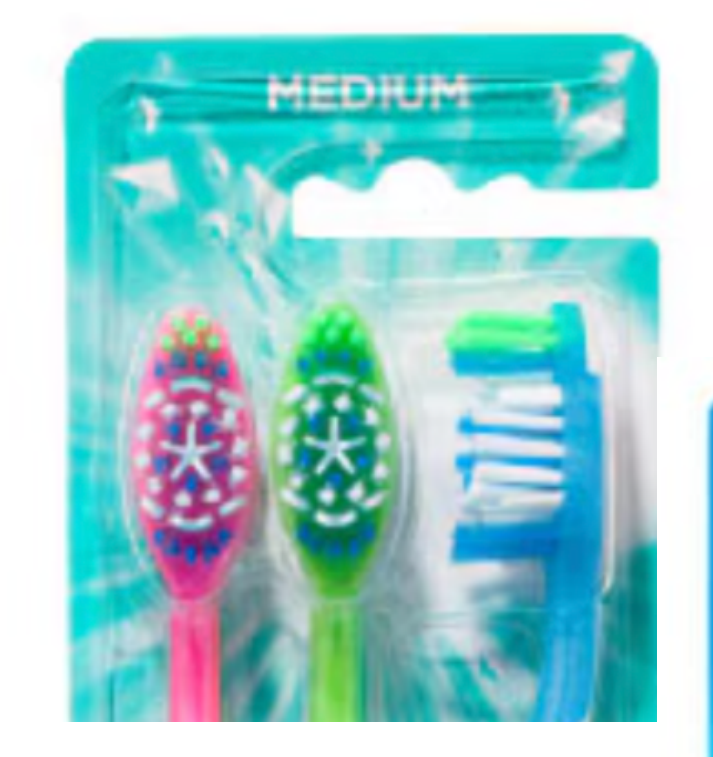
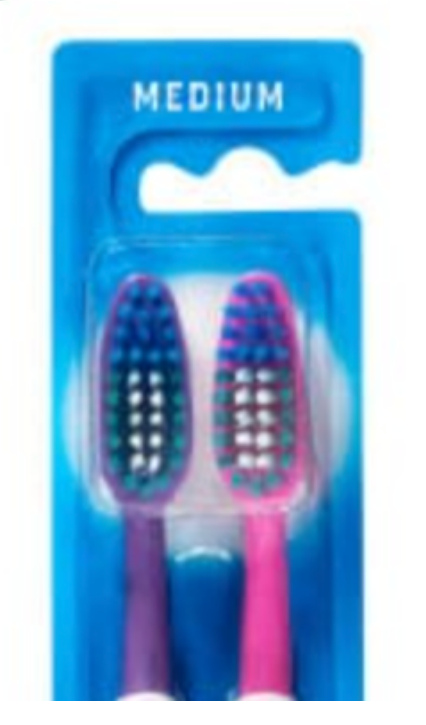
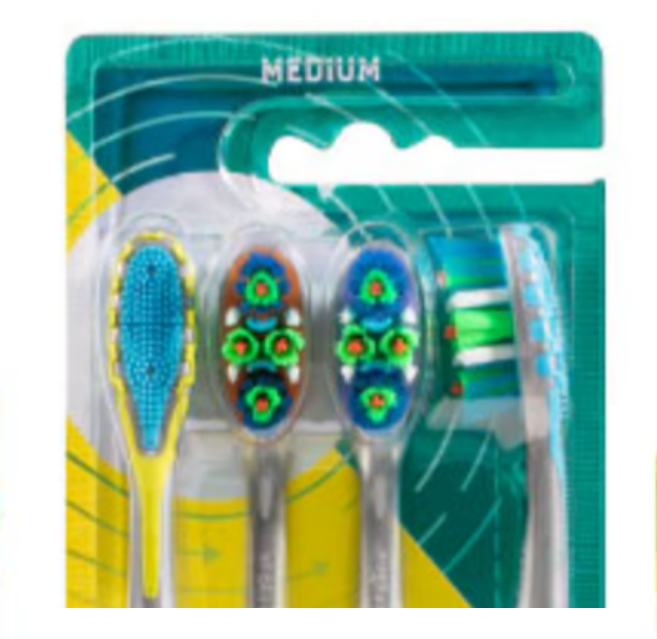
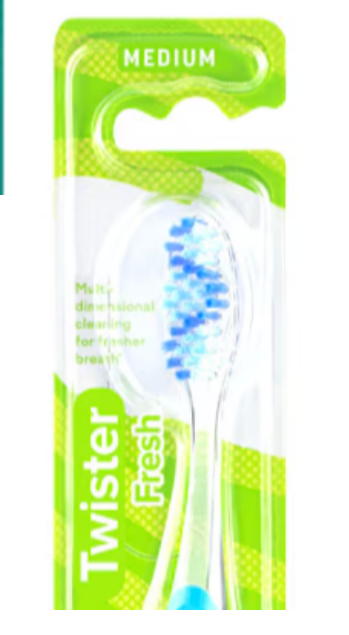
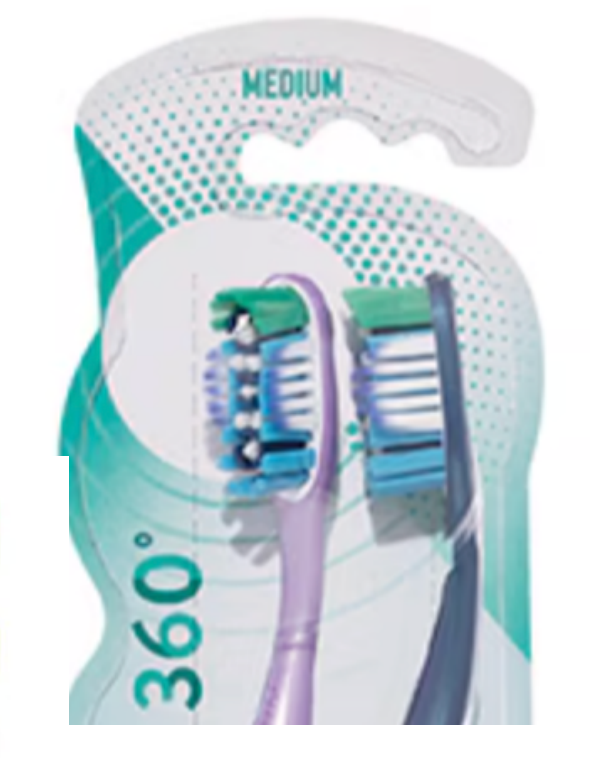
%SOFT 360°
%SOFT CT LA
https://www.colgateprofessional.com.au/products/toothbrush
“360°”
“Twister Fresh”
“Medium”
 |  |  |
 |  |  |
 |
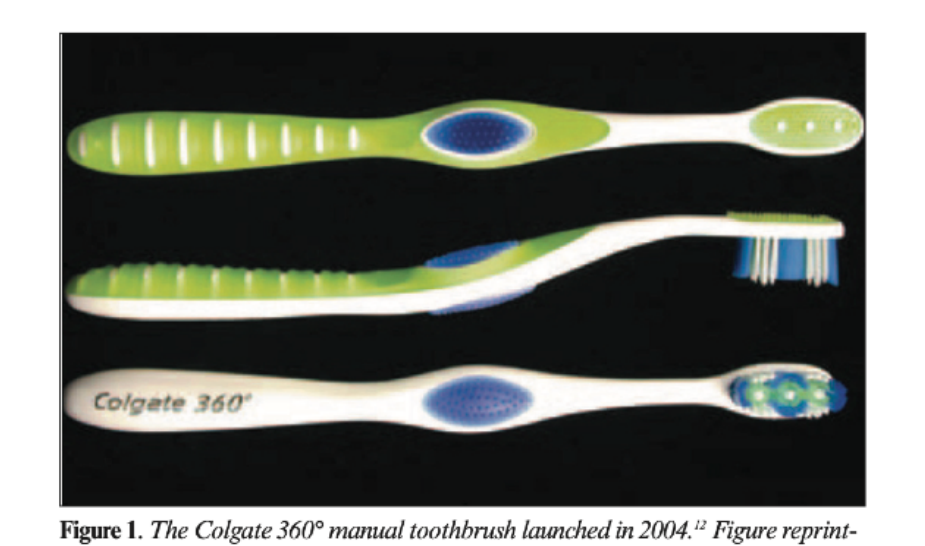
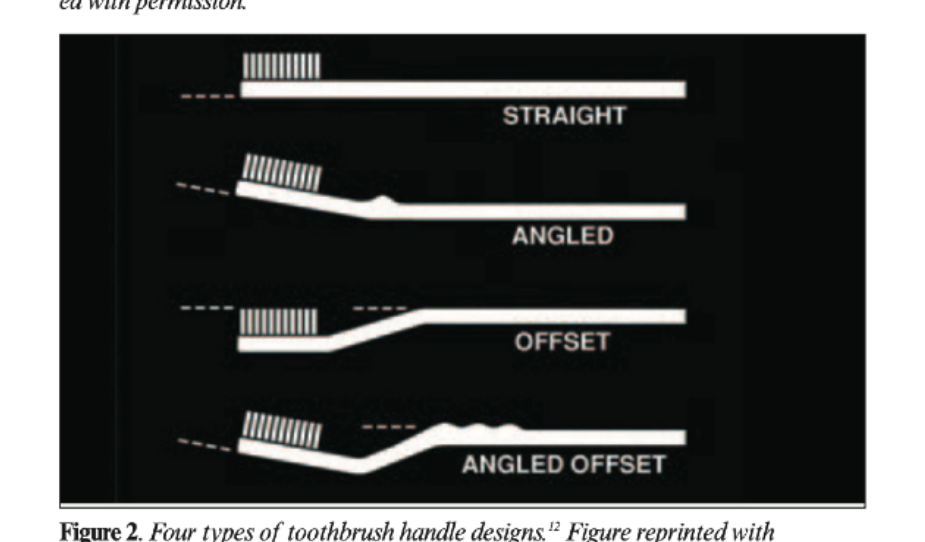
Ergonomics28
“designed to fit their lifestyle through comfort of use”
- Handle design
- Grip design
- Angulation of head
- Design of head
- Size
- Shape
- Tuft length and angle
 |  |
Clinical Evidence and Efficacy29
- Manual toothbrushing reduced plaque levels by 42%, while powered toothbrushing reduced plaque levels by around 46% Van der Weijden & Slot 2015 More than 50% of plaque left
- Angled bristle tuft design scored higher in manual brushes Slot et al 2012
- Oscillating-rotating brushes appear to reduce plaque and gingivitis more than side to side electric brushes in the short term and also to be safer to the hard and soft tissues compared to manual brushes Van der Weijden & Slot 2015
- Dexterity, brushing time and technique, type of brush used, frequency important.
- Crowding/spacing/gingival phenotype and the gingival changes after periodontal treatment influence choice of aids
Brushing Techniques3031
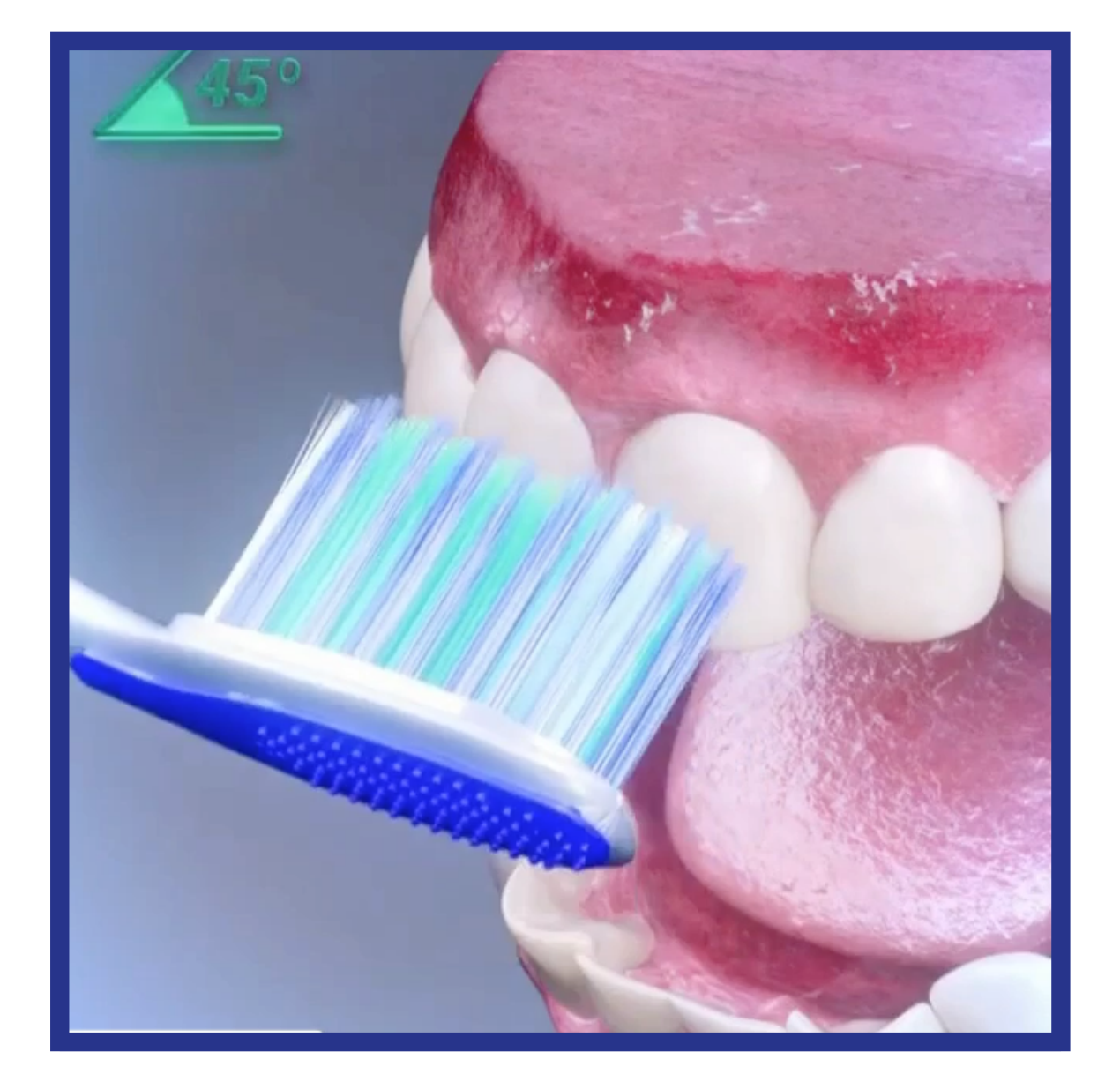
- Sulcular
- Bass/Modified Bass
- Can reach up to 1mm subgingival Waerhaug 1981
- Most recommended
| Vibratory |
|---|
| Stillman |
| Charters |
| Circular |
| Fones |
| Vertical |
| Leonard |
| Horizontal |
Chapter 28 Pages 665-673
LINDHE’S Clinical Periodontology and Implant Dentistry Edited by Tord Berglundh, William V. Giannobile, Niklaus P. Lang, and Mariano Sanz SEVENTH EDITION VOLUME 1 WILEY Blackwell
 |  |
Tissue Damage and Abrasion
Too Much?32
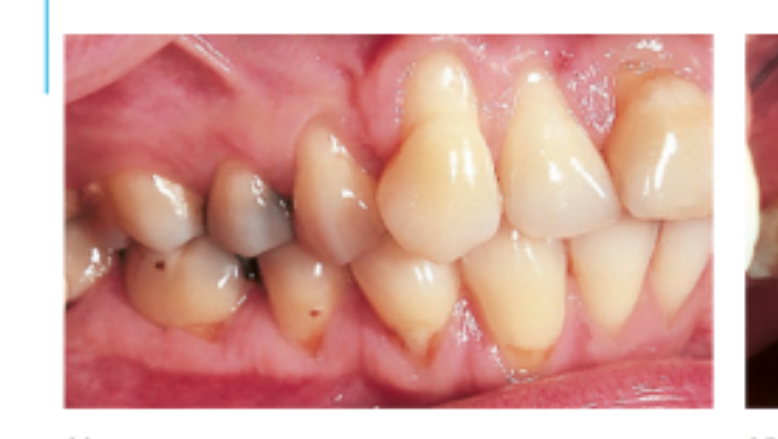
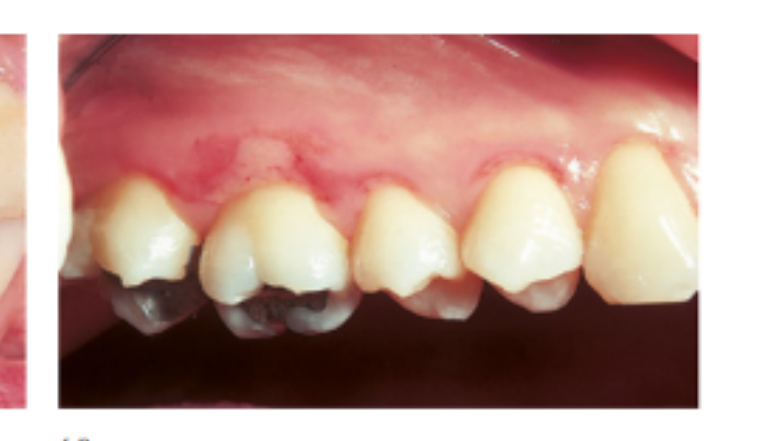
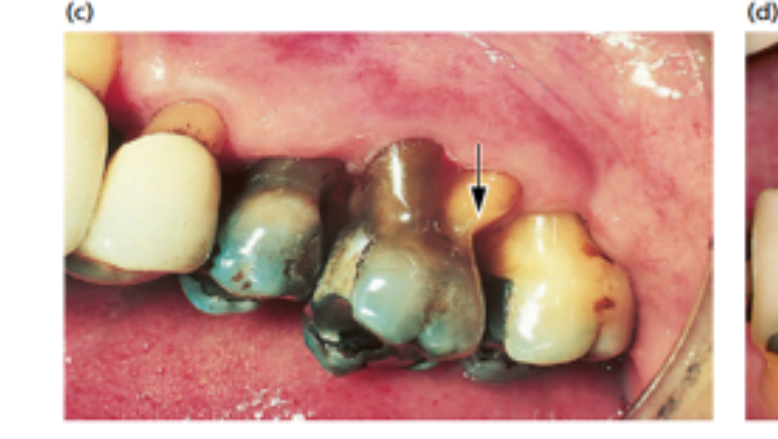
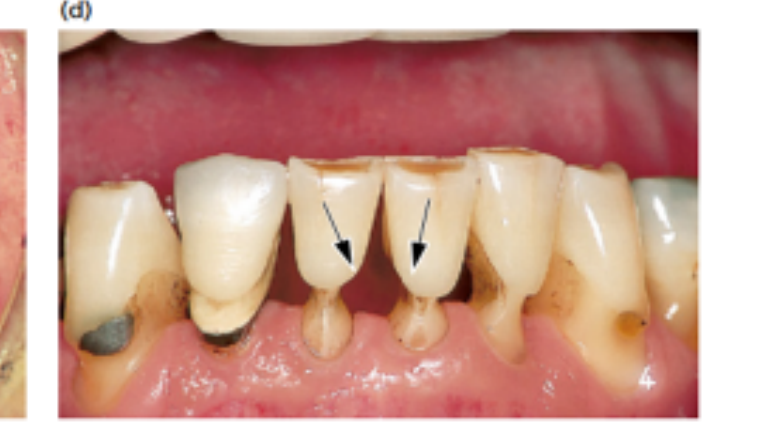
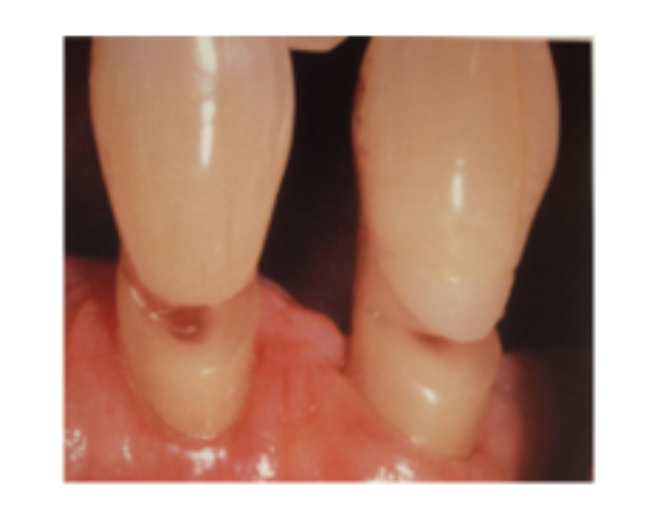
Fig. 28-9 (a) Soft tissue damage as a result of extensive toothbrushing. Note the gingival recession on the buccal gingival surface of tooth 13. (b) Note the multiple ulcerations of the buccal gingival margin in the right maxilla. (c, d) Hard tissue damage (arrows) has resulted after extensive use of interdental brushes.
 |  |  |
 |  |
Electric Toothbrushes33
 |  |
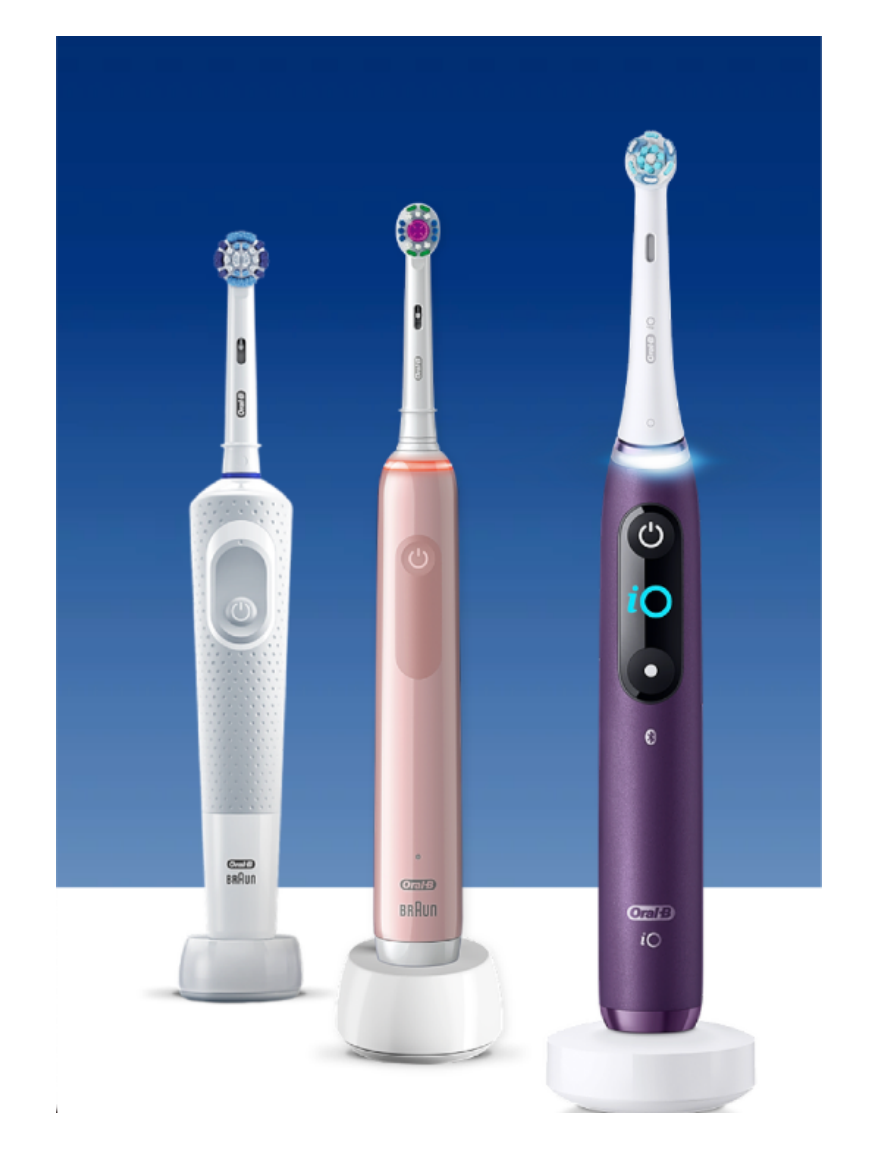
Features of Oscillating-rotating brushes34
- Braun Oral B
- 3D movements
- High frequency vibrations
- Pressure monitoring
It appears that oscillating-rotating brushes reduce plaque and gingivitis more than side to side electric brushes in the short term and are also safer to the hard and soft tissues compared to manual brushes.
Source: Van der Weijden & Slot 2015
- Sonic
- High frequency filament movement creating a turbulent flow
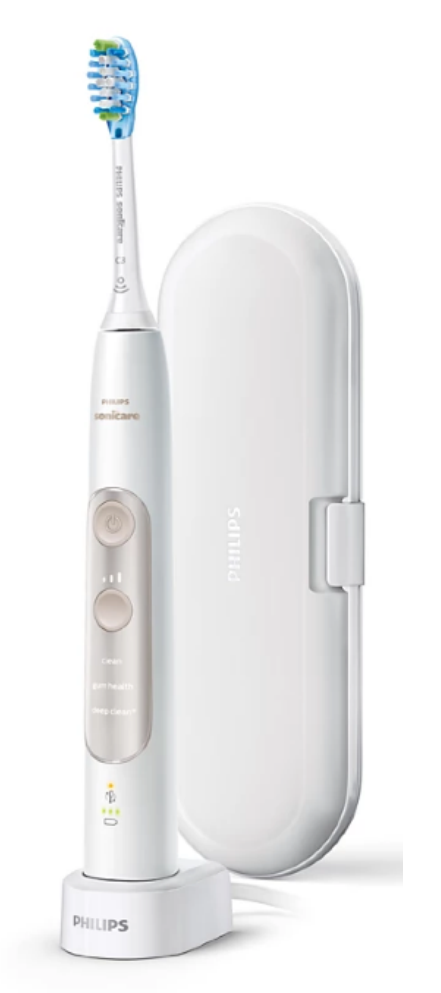
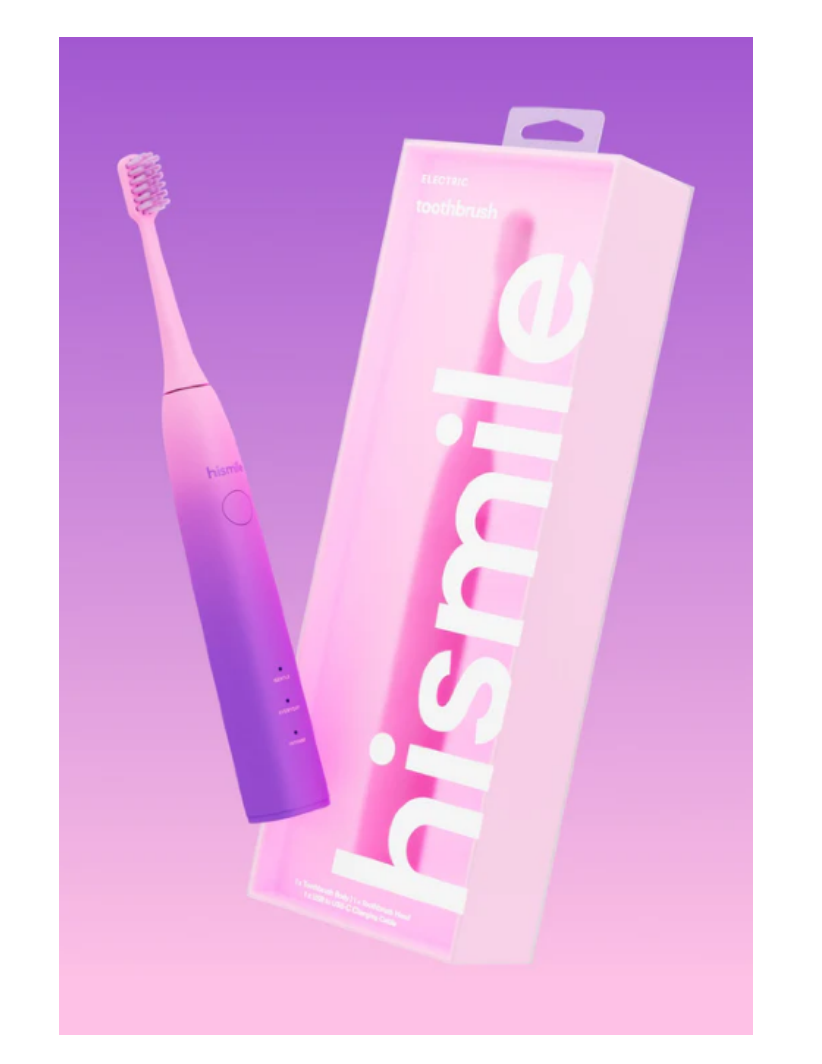
- Phillips Sonicare, HiSmile
- Not as effective as oscillating-rotating [van der Sluijs et al 2020]
Maintenance and General Conclusions35
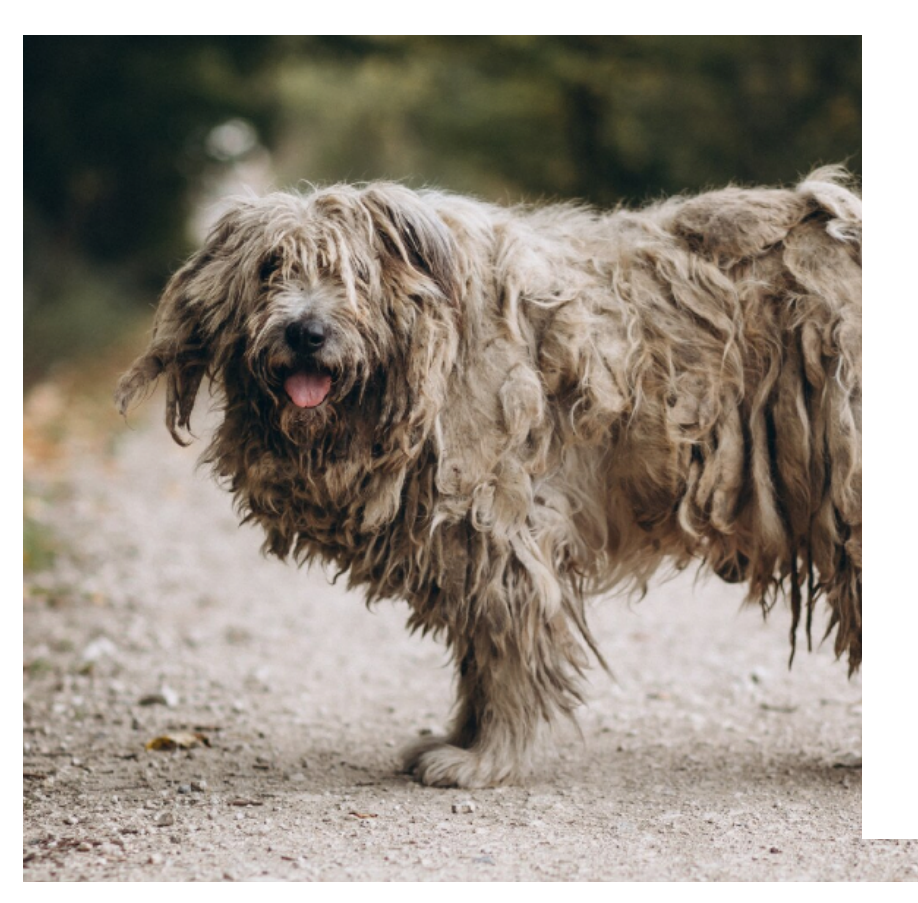
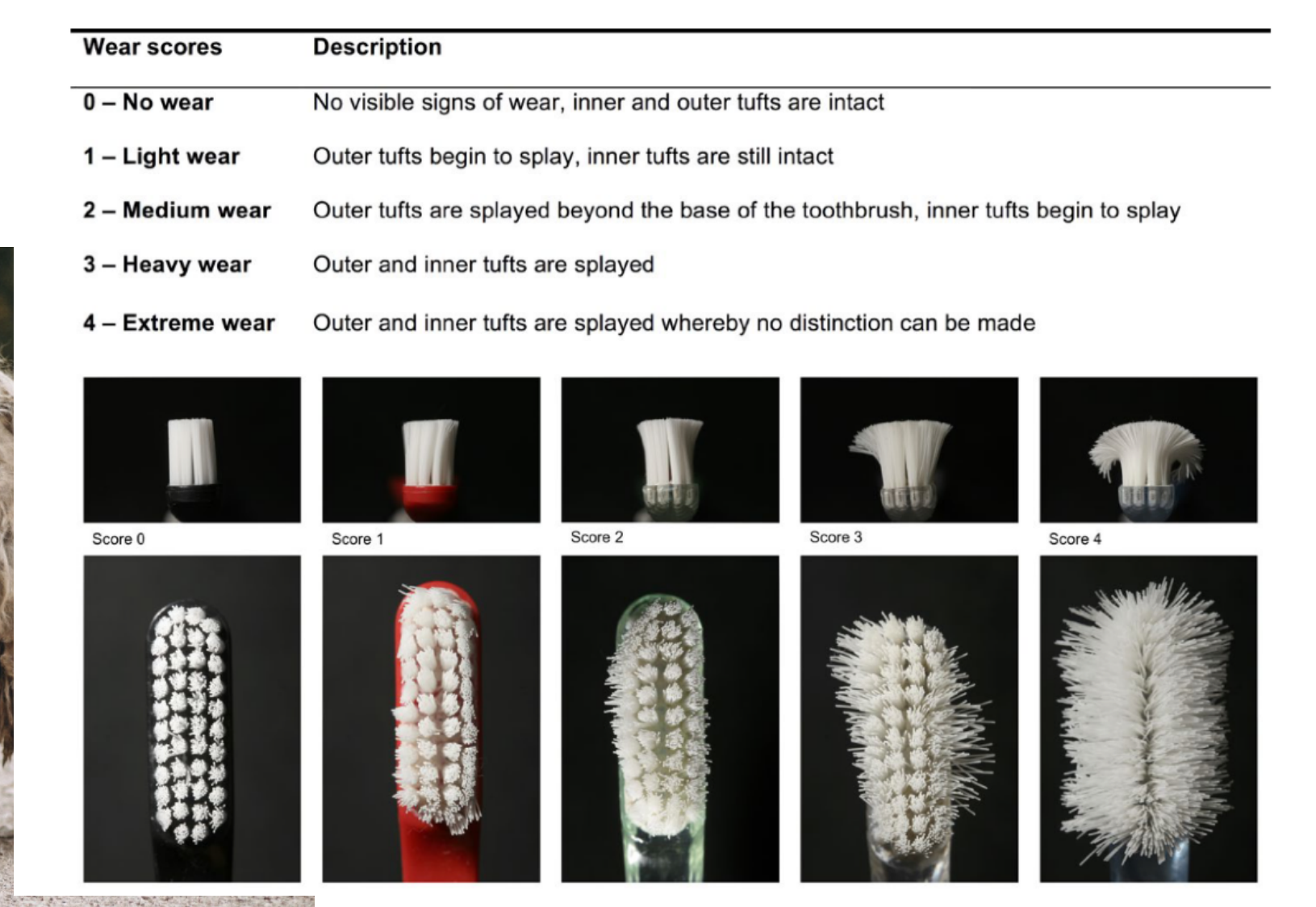
When to replace?36
- 3-monthly
- Or when it looks like this:
| Wear scores | Description |
|---|---|
| 0 – No wear | No visible signs of wear, inner and outer tufts are intact |
| 1 – Light wear | Outer tufts begin to splay, inner tufts are still intact |
| 2 – Medium wear | Outer tufts are splayed beyond the base of the toothbrush, inner tufts begin to splay |
| 3 – Heavy wear | Outer and inner tufts are splayed |
| 4 – Extreme wear | Outer and inner tufts are splayed whereby no distinction can be made |
- No 1 superior technique Hansen & Gjermo 1971
- Average time spent on toothbrushing between 30-60s, only 10% of that on lingual surfaces
- Bosman and Powell 1977 and Lang et al 1973 showed once daily or every other day thorough cleaning can reverse gingivitis in dental students
- Quality of cleaning more important than frequency Bjerctness 1991
- Brush twice daily, for at least 2 minutes with a fluoride toothpaste is the current recommendation
- Professional instruction is important
- No toothbrush can clean interproximally
 |  |
Interdental Cleaning37
- Toothbrushes do not reach interproximally.
- Residual plaque remains on the interproximal surfaces of premolars and molars after toothbrushing.
- Gingivitis, periodontitis and dental caries occur more frequently in the interdental region than on oral and facial surfaces.
- Choice of method should be personalised to each patient and each interdental space, and needs to be reviewed and possibly modified.
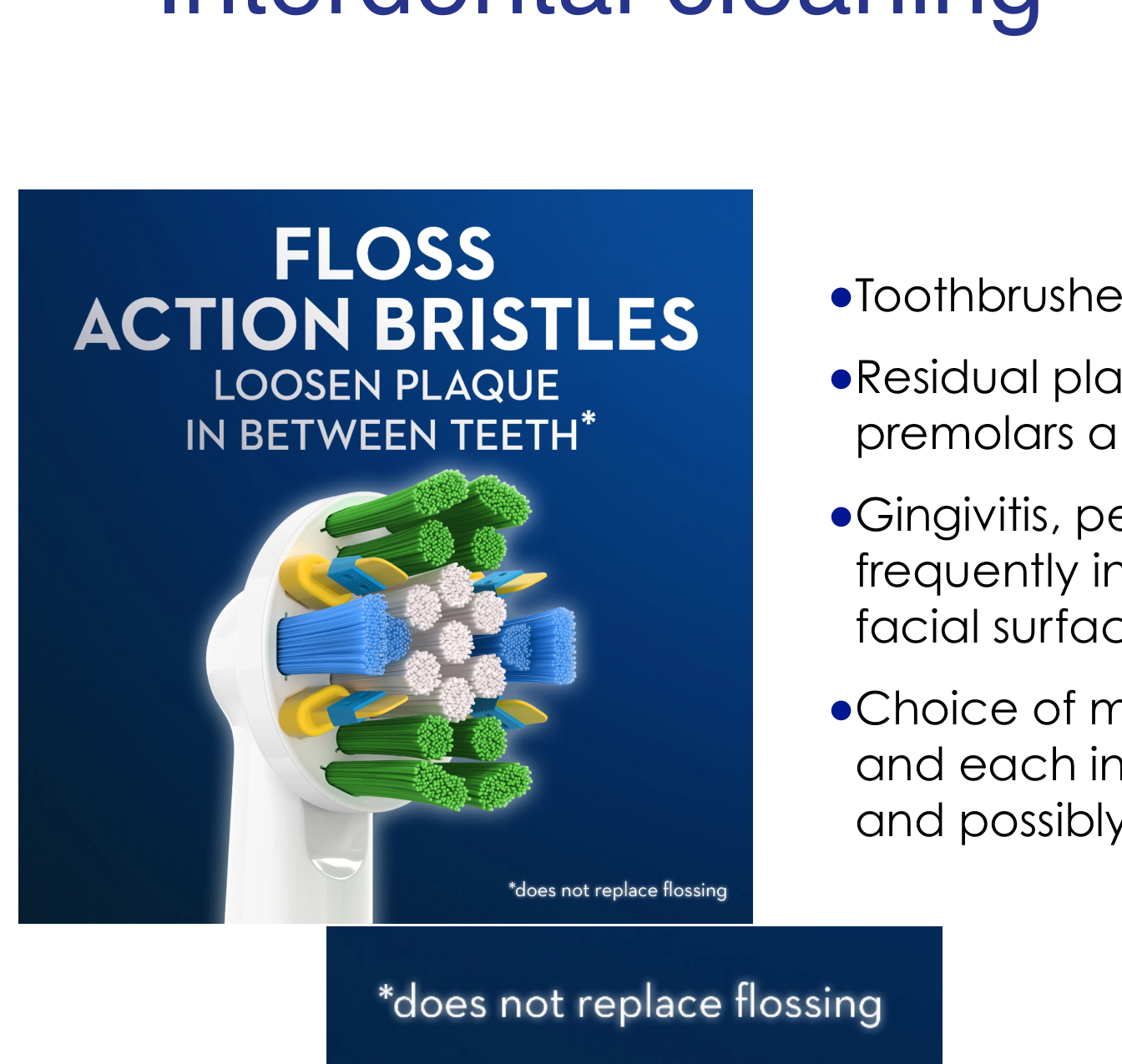
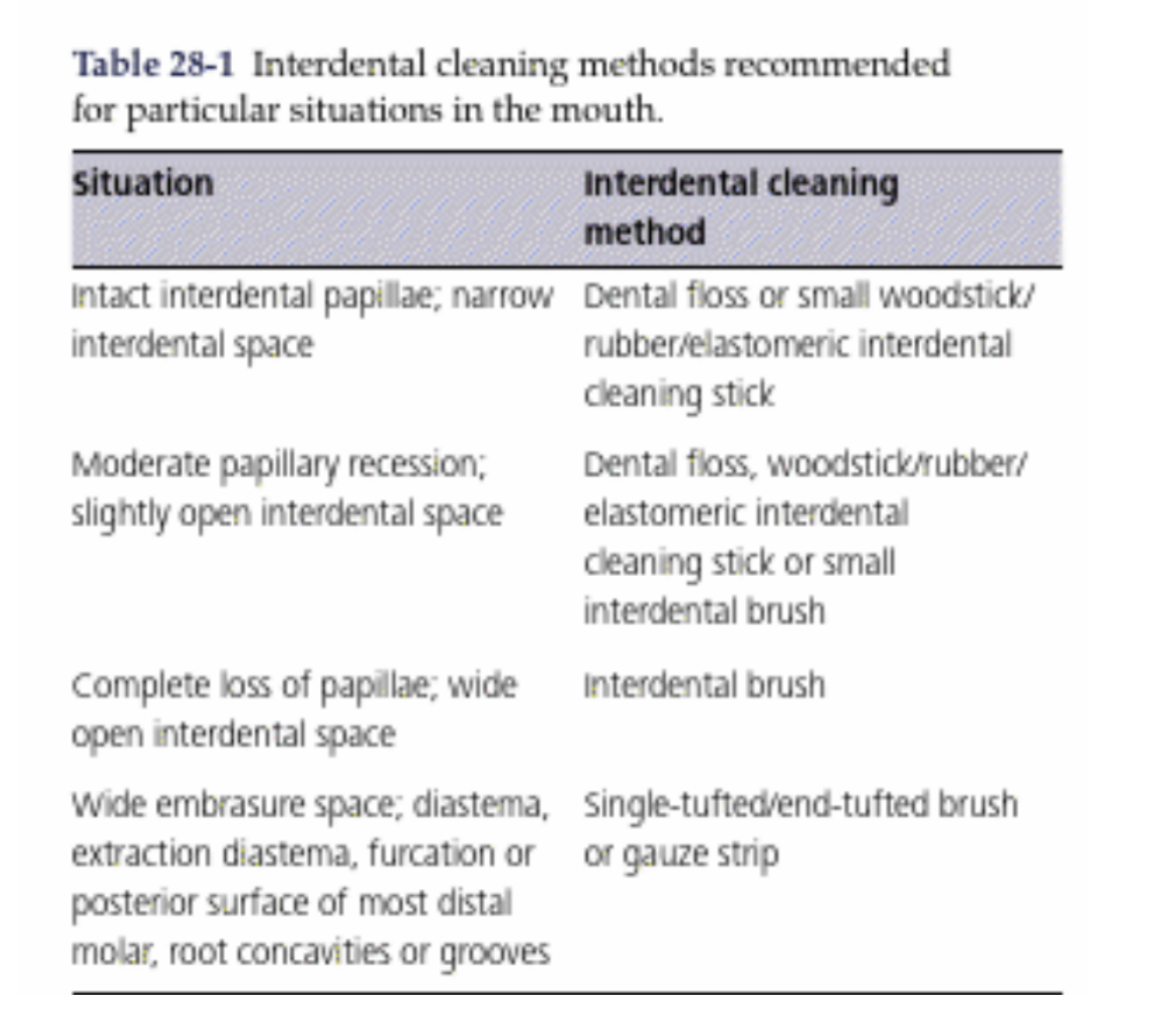
Table 28-1 Interdental cleaning methods recommended for particular situations in the mouth.38
| Situation | Interdental cleaning method |
|---|---|
| Intact interdental papillae; narrow interdental space | Dental floss or small woodstick/rubber/elastomeric interdental cleaning stick |
| Moderate papillary recession; slightly open interdental space | Dental floss, woodstick/rubber/elastomeric interdental cleaning stick or small interdental brush |
| Complete loss of papillae; wide open interdental space | Interdental brush |
| Wide embrasure space; diastema, extraction diastema, furcation or posterior surface of most distal molar, root concavities or grooves | Single-tufted/end-tufted brush or gauze strip |
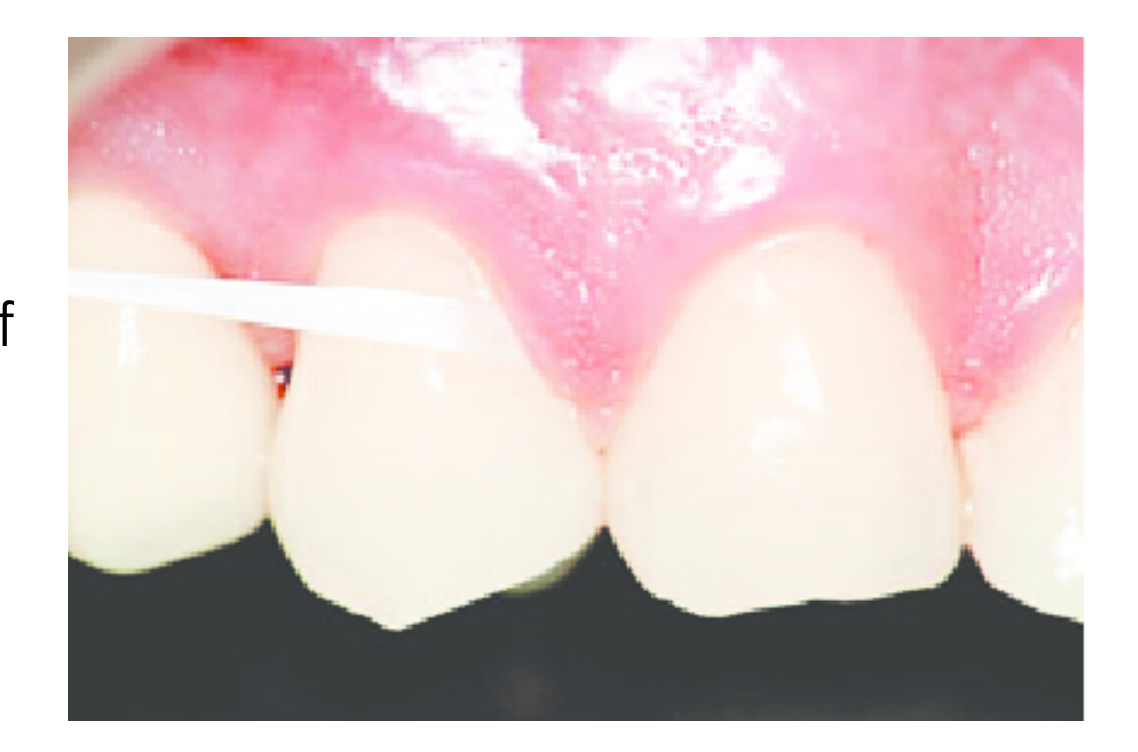
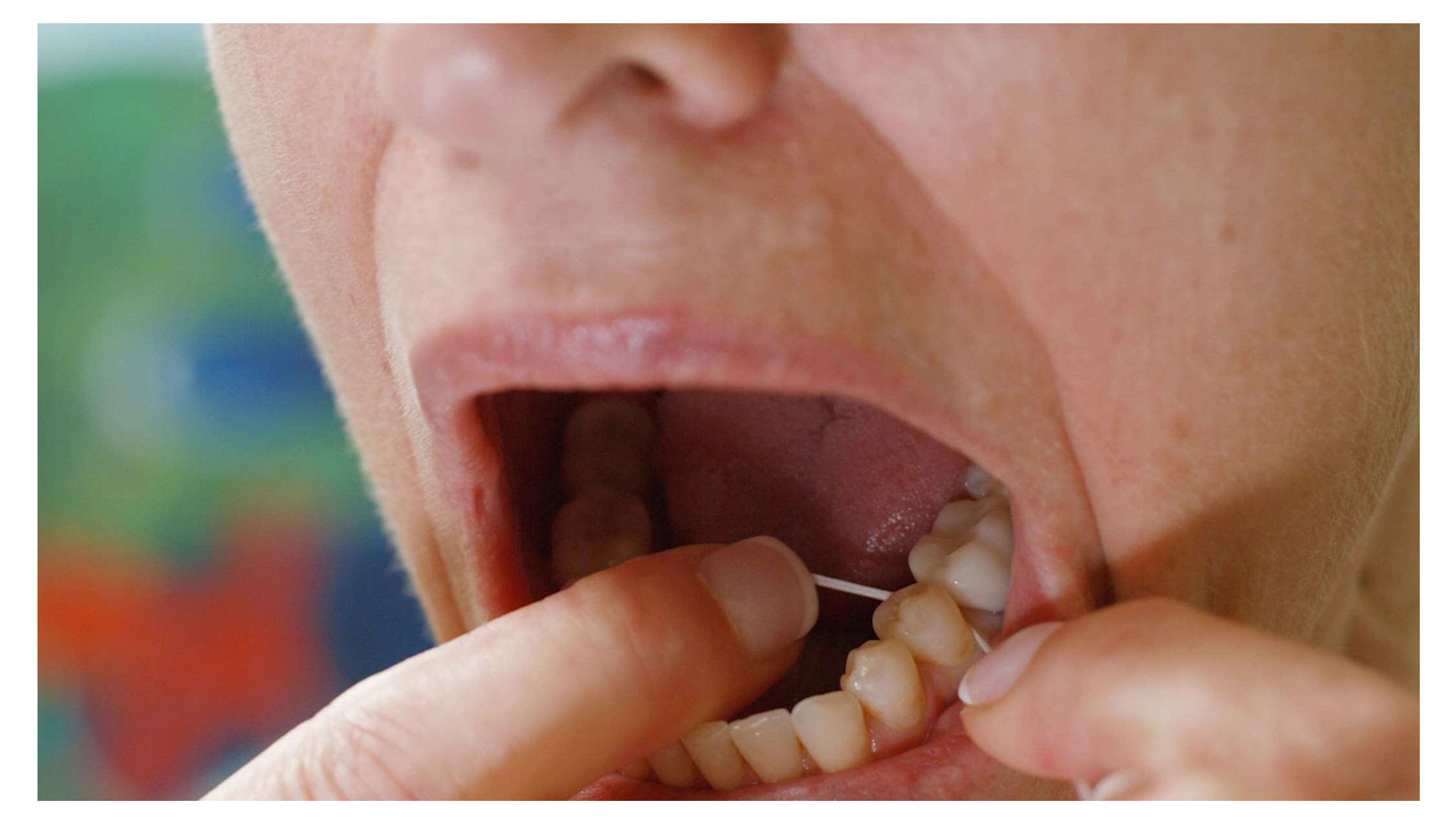
Dental Floss3940414243
“It’s low risk, low cost,” he said.
“We know there’s a possibility that it works, so we feel comfortable telling people to go ahead and do it.”
National Institutes of Health dentist Tim Iafolla Associated Press, 2021 https://apnews.com/article/f7e66079d9ba4b4985d7af350619a9e3
-
Most frequently recommended method
-
Ideal for crowded spaces and when the papillae fill the embrasure spaces.
-
When properly used can remove up to 80% of proximal plaque and can reach 2-3.5mm subgingivally. Carnio 2009
-
Waxed (tight contacts)
-
Unwaxed (solid contacts, thinnest and separates during use to cover a wider surface area)
-
Avoid using floss around exposed rough surfaces of dental implants Montevecchi et al 2016, Van Velzen et al 2016
-
Difficult to master, special holders available
-
Time consuming
-
Several systematic reviews and a meta-review have shown no benefit from flossing Sälzer et al 2015
-
Flossing was only shown to be effective in reducing interproximal caries (by 40%) when applied professionally although this benefit was not seen in self performed flossing and when fluoridated toothpaste was used. Hujoel et al 2006
-
Again, despite the weak evidence of benefit, self or parental-performed flossing should be a routine part of oral biofilm control if no other interdental cleaning devices can be used.
 |  |  |
 |  |
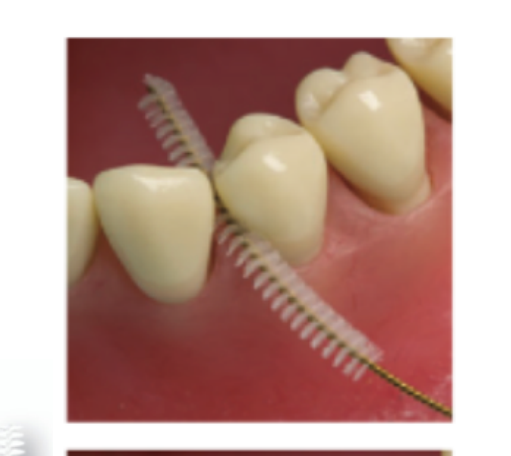
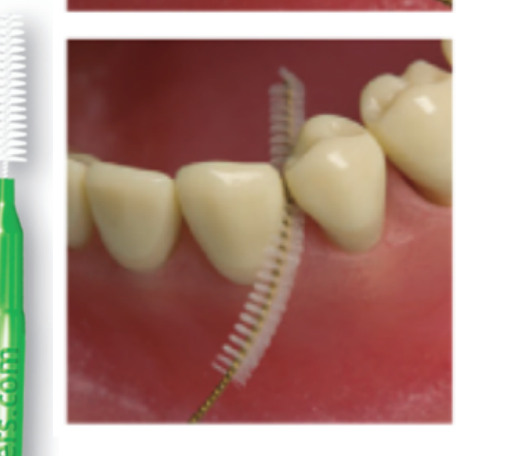
Interdental Brushes44
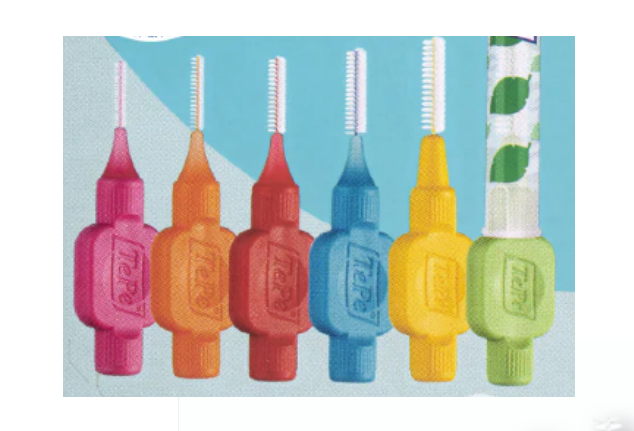
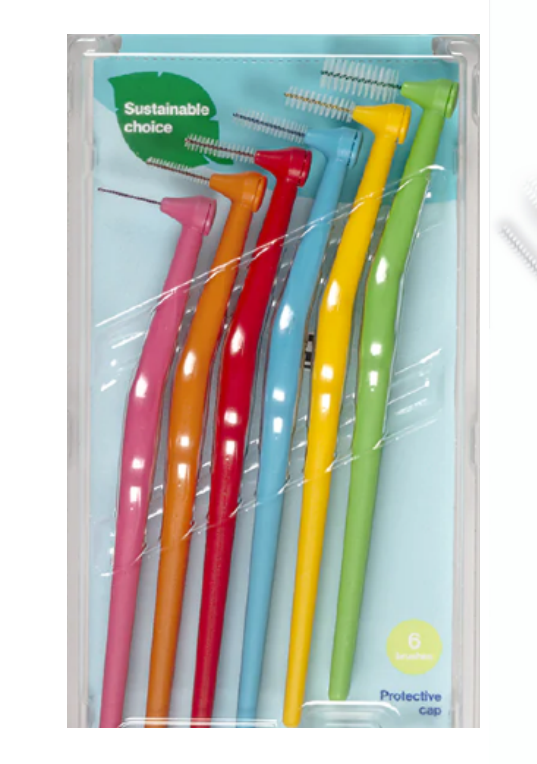
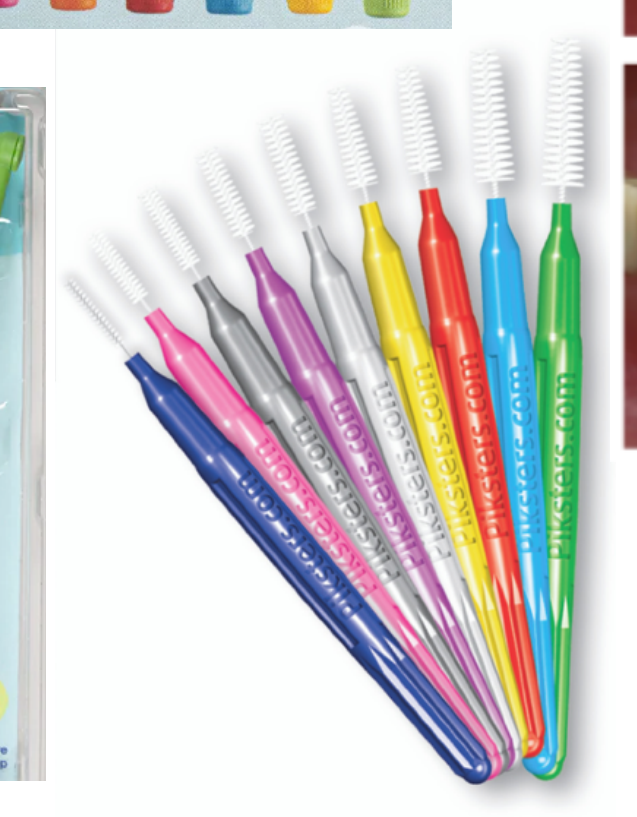
- Highly effective plaque removal especially where root concavities, grooves and for Gr III furcation defects
- Most effective interdental cleaning method Sälzer et al 2015
- Easy to use
- More effective than floss in plaque removal and pocket reduction
- Can clean 2-2.5mm subgingivally
- Caution - overuse/incorrect use can cause soft and hard tissue damage
- Wire can cause damage to implant surfaces
 |  |  |
 |  |
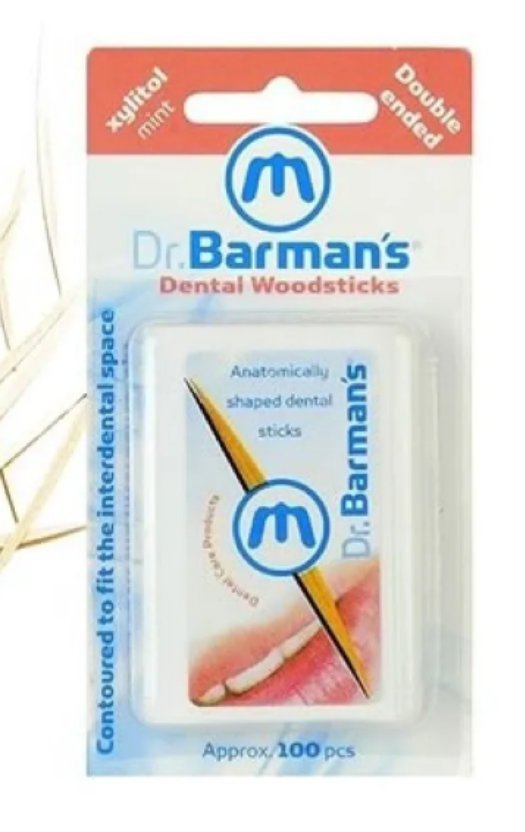
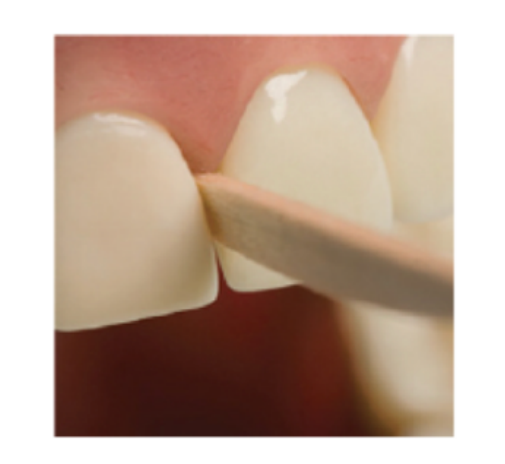
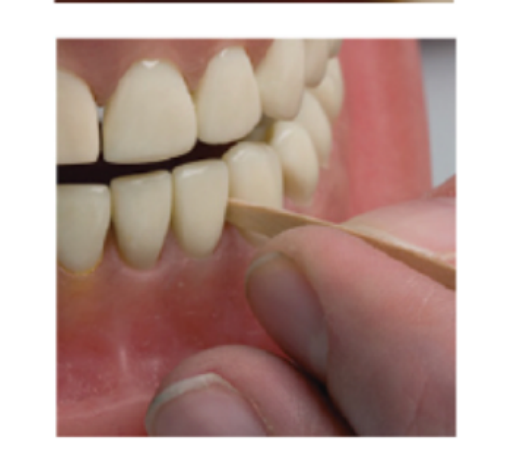
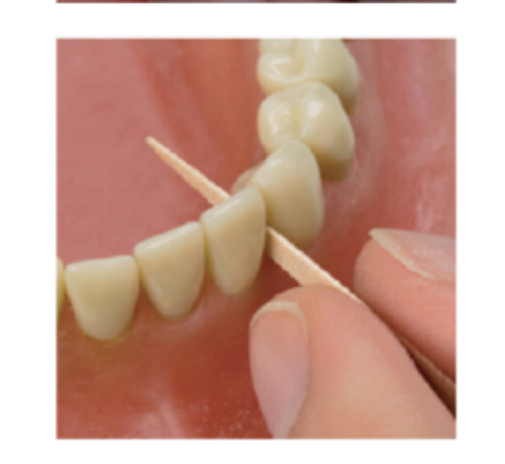
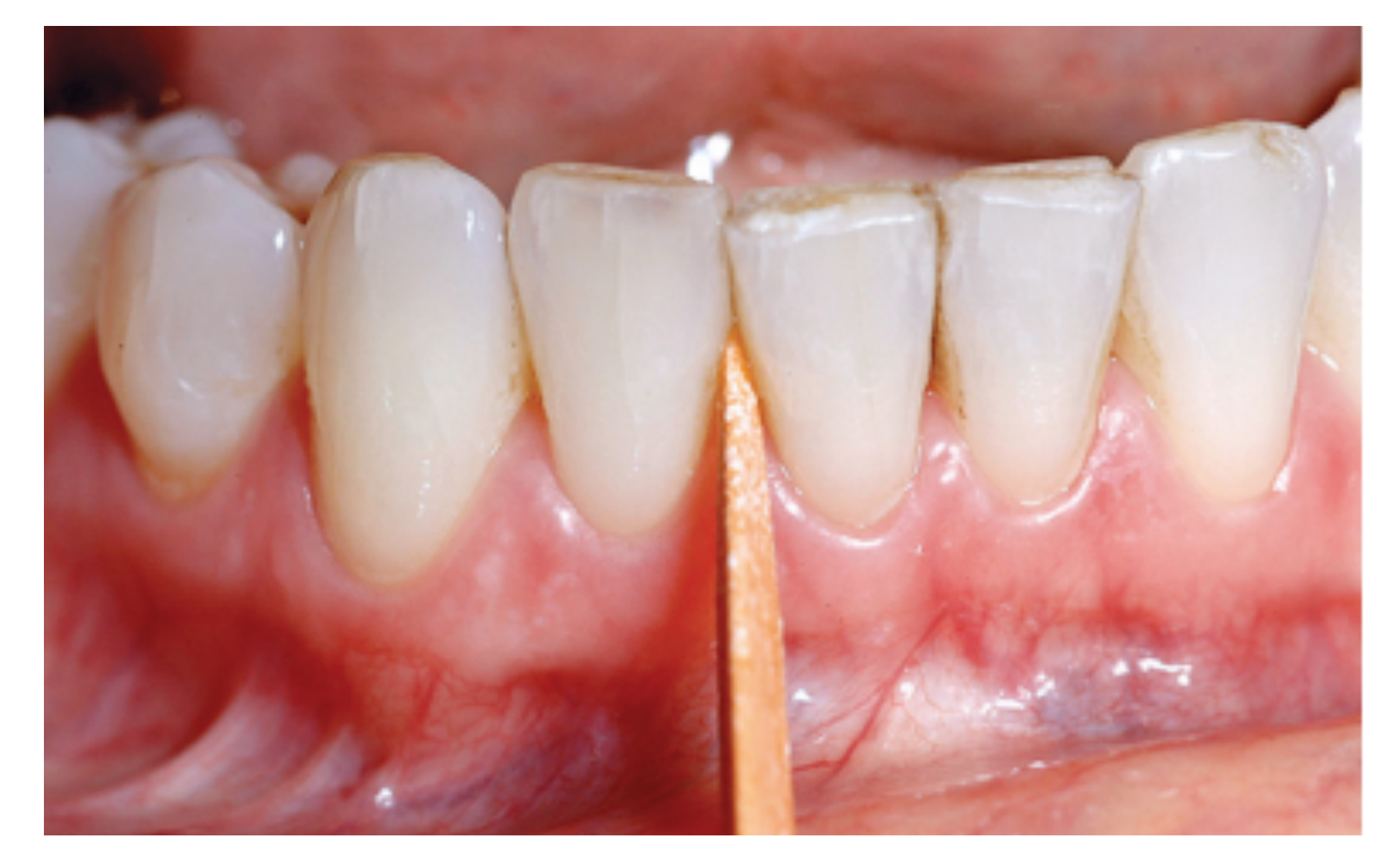
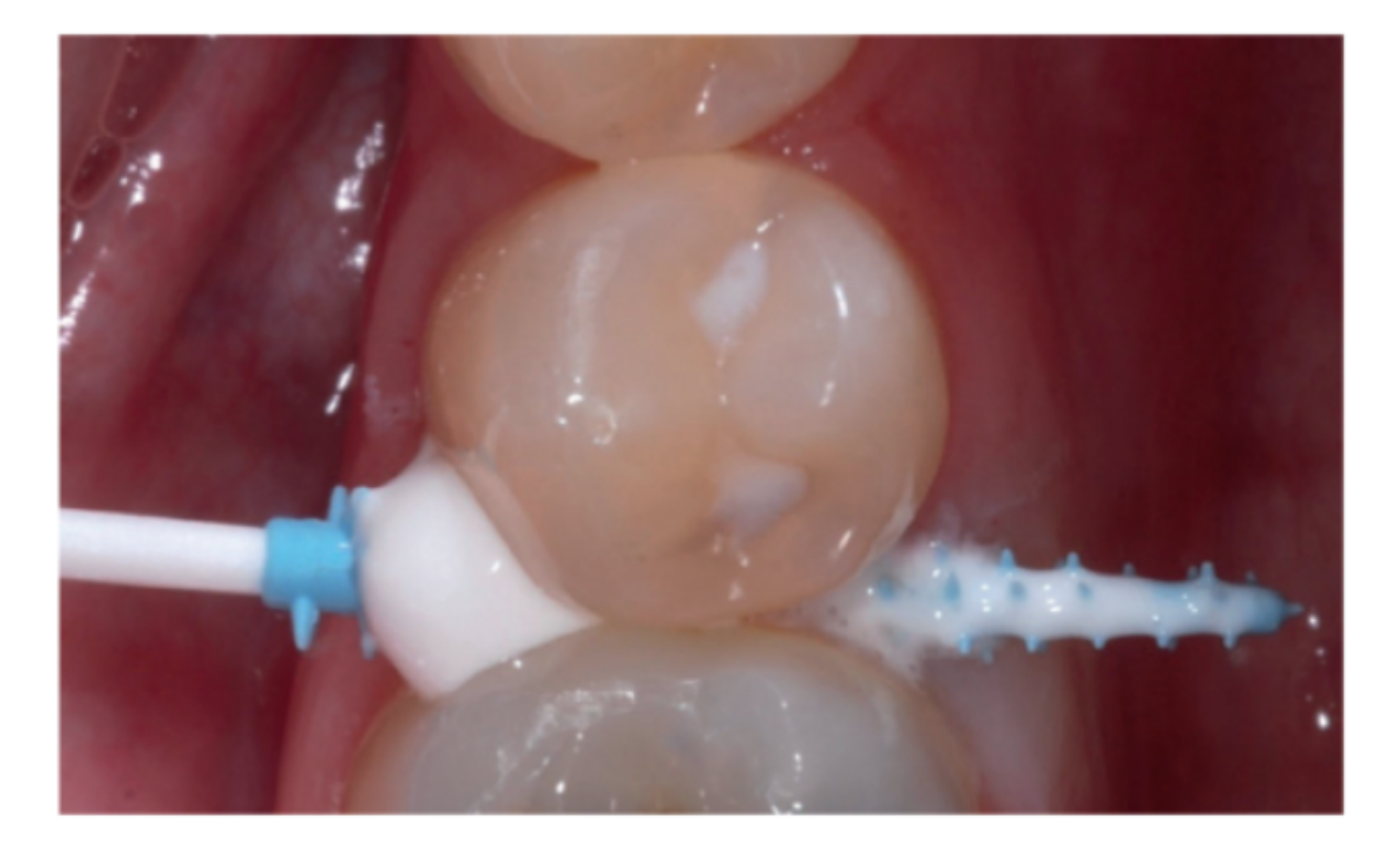
Wood and Rubber Sticks454647
-
Wooden sticks - one of humanities oldest interdental cleaners
-
Toothpicks - circular, for food debris
-
Wooden sticks - triangular, soft wood, easy to use, useful if there is enough space interproximally, can clean subgingival plaque but can traumatise papillae if incorrectly used
-
Elastomeric cleaning sticks
-
Massages gum, dislodges food
-
Few studies to date, mostly showing no reduction in plaque and gingivitis score
-
Safe and popular with patients
 |  |  |
 |  |  |
 |
Other Oral Hygiene Methods
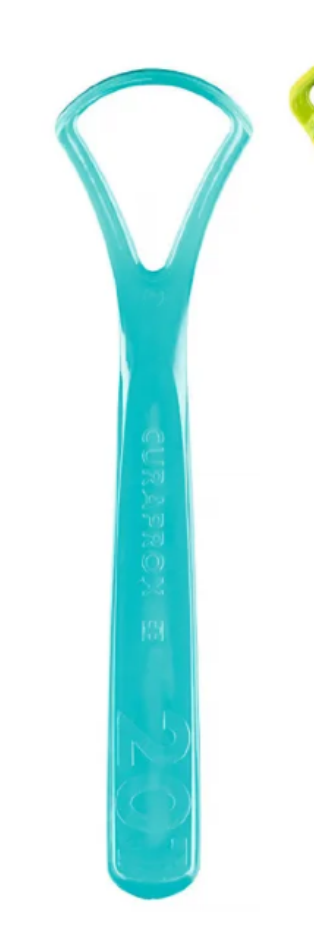
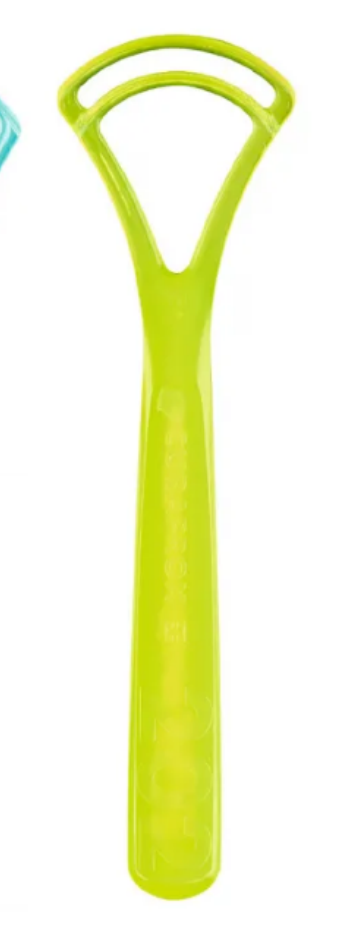
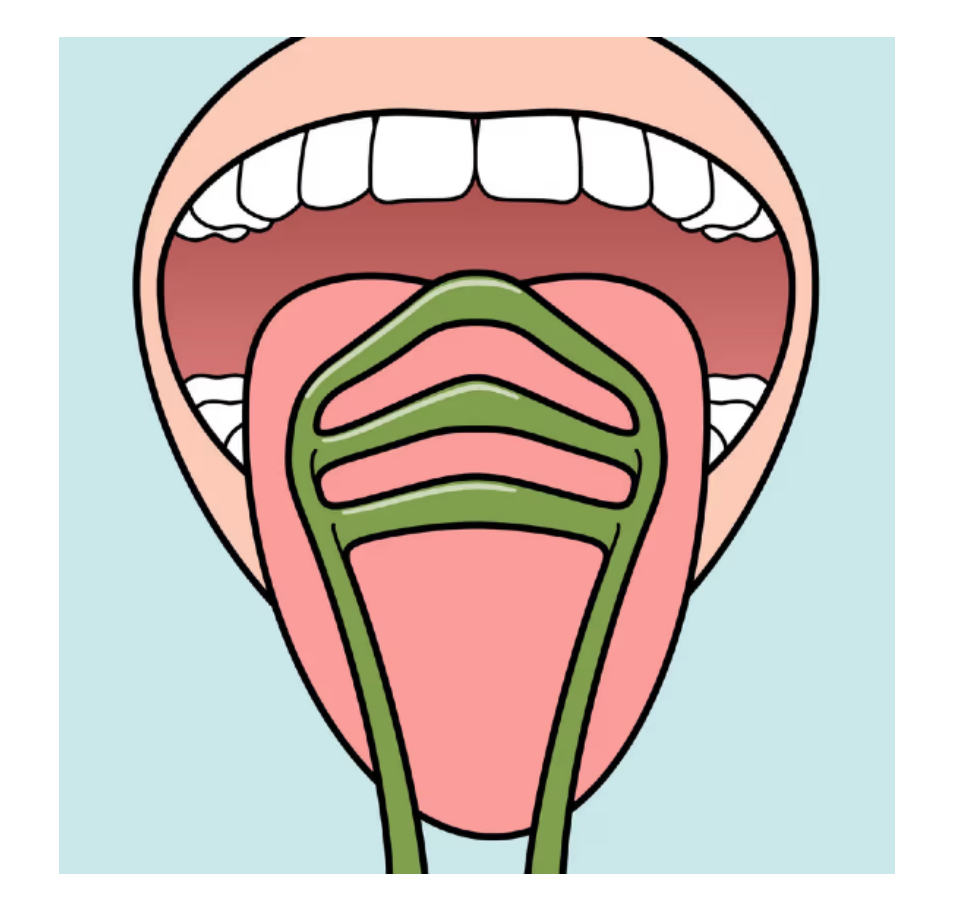
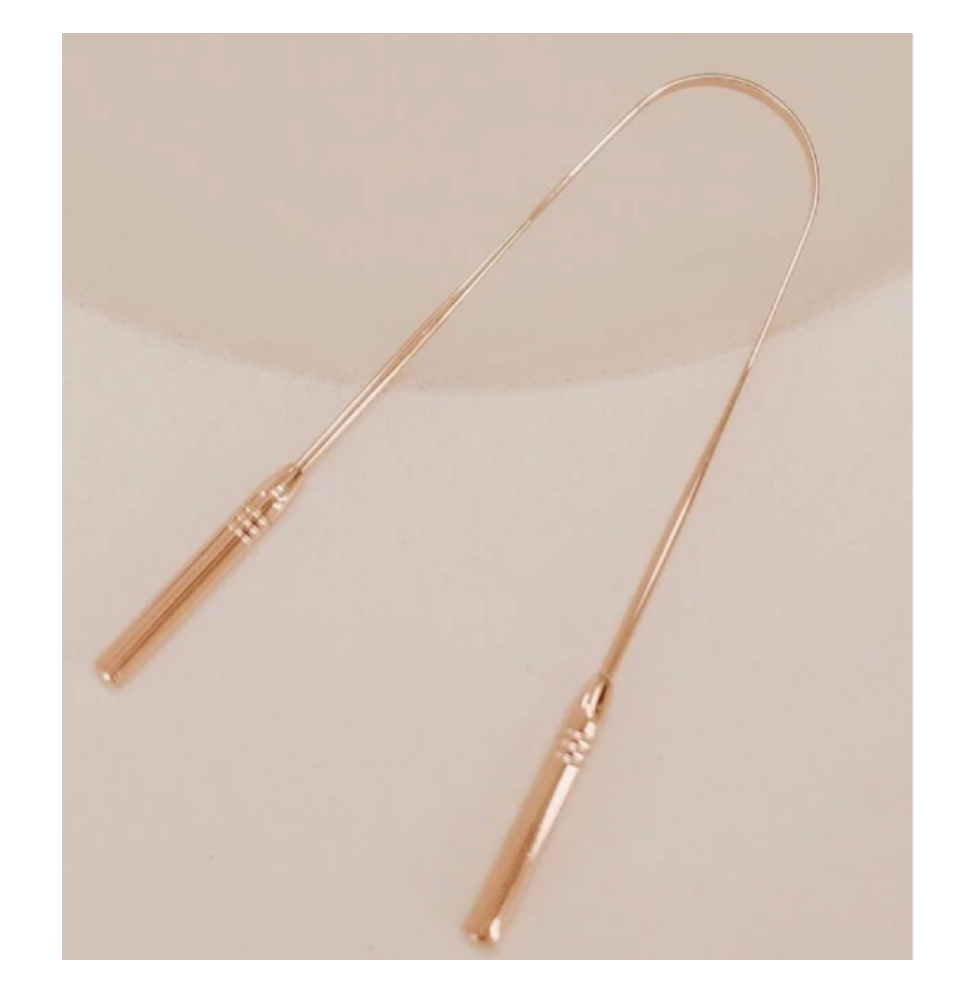
Tongue Cleaning4849
The dorsum of the tongue harbours a great number of microorganisms which can disseminate to other parts of the mouth.
Tongue microbes can contribute to bad breath.
Hence tongue brushing has been advocated as part of daily home care.
However, conflicting evidence on tongue brushing and new plaque formation — insufficient evidence to recommend frequency, duration or delivery (Kuo et al 2013).
THE UNIVERSITY OF WESTERN AUSTRALIA
 |  |
 |  |
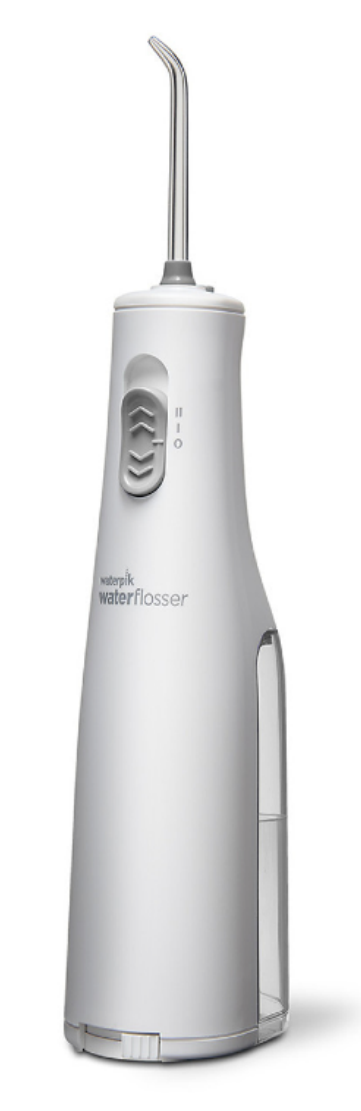
Water Flossers and Emerging Technologies50
- Uses water jet
- Conflicting evidence to show adjunctive benefit
- Removes food, debris, loose plaque
- Can be used to deliver antiseptic 3mm subgingivally
- Potential bacteraemia?
- Can be painful
- Useful around implants
- Messy
Full arch sonic toothbrushes51
World’s Only ADA-Accepted U-Shape Toothbrush 4.7/5.0 (16,860 Reviews)
Get up to 5.1X better clean in 30 seconds — up to 82% more plaque removal, up to 45% less gingivitis. Trusted by families, backed by experts.
[SHOP 30% OFF]
ADA Accepted® American Dental Association
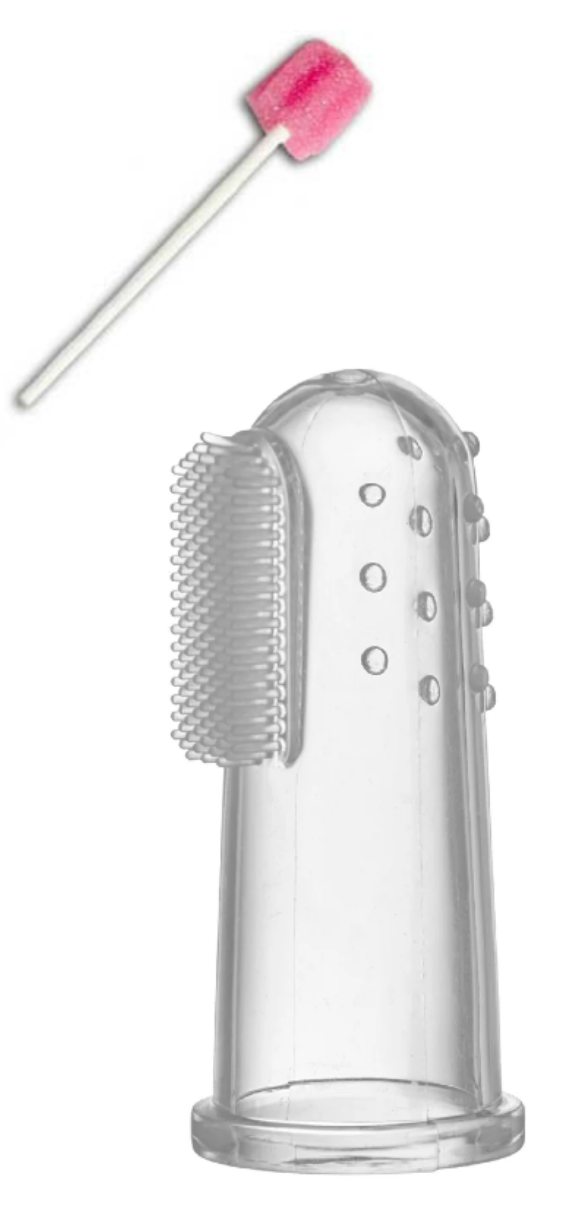
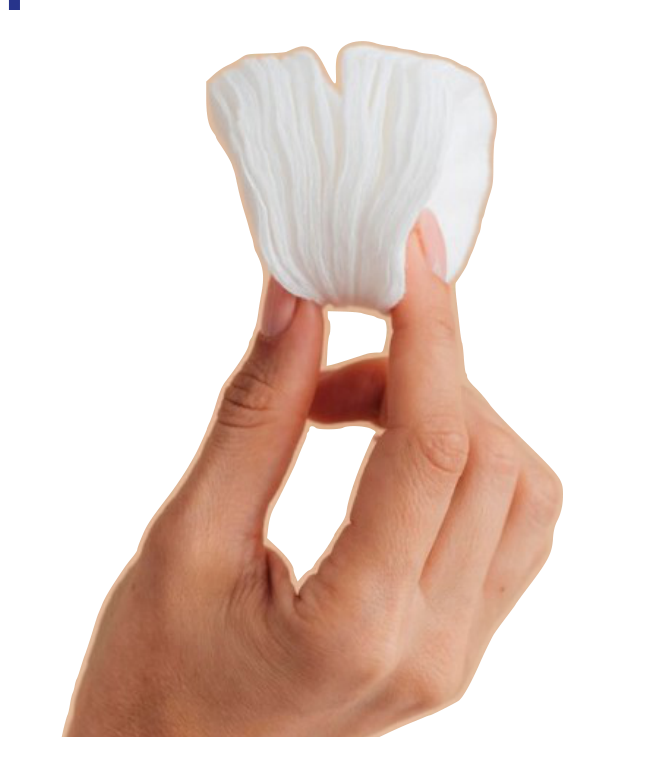
Low Technology Alternatives52
Used in hospital settings when toothbrushing cannot be performed adequately.
- Foam brushes/swabs
- Gauze
- Finger brushes
 |  |
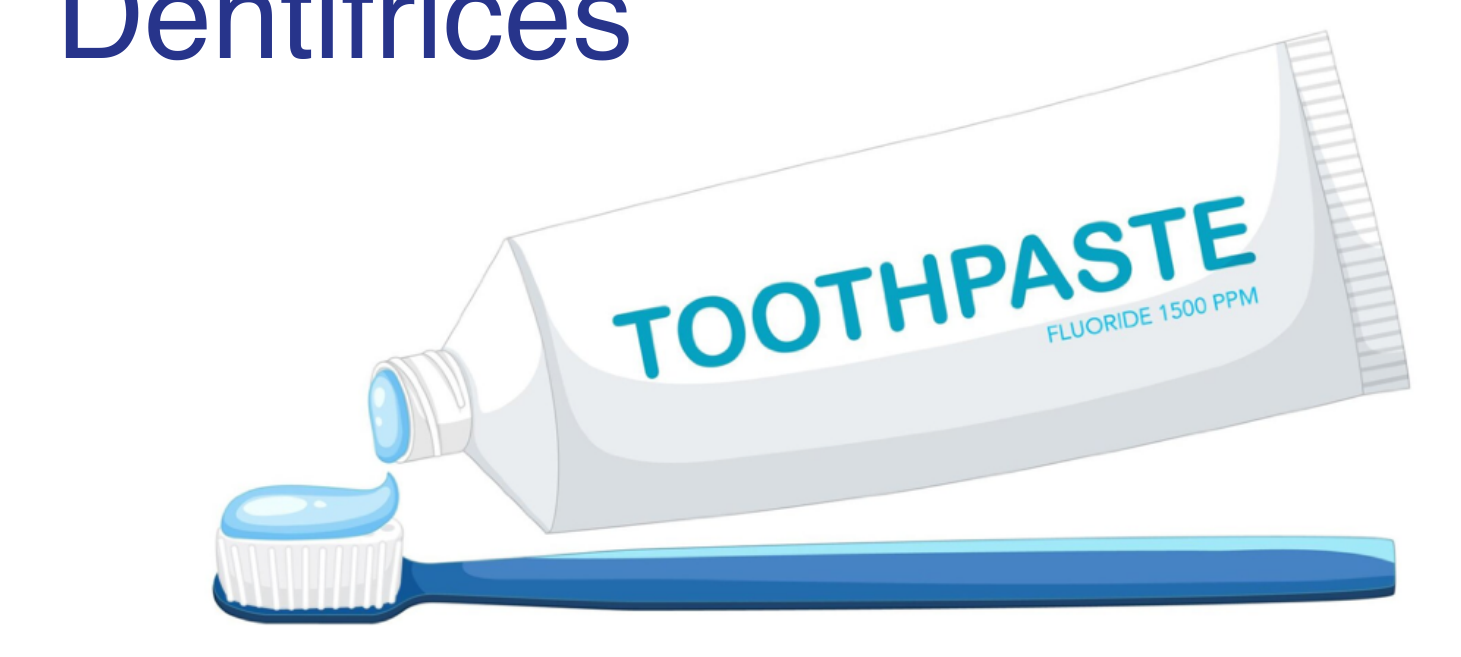
Dentifrices53
“a powder, paste, or liquid for cleaning the teeth”
- Plaque removal is dependent on mechanical contact of brush to teeth, rather than the abrasive nature of the toothpaste and more plaque can be removed without the use of toothpaste Paraskevas et al 2007 Jayakumar et al 2010
- Compliance to toothbrushing is much lower without toothpaste Dudding et al 1960
Active and Inactive Ingredients
Active ingredients54
- Anticaries
- Antimicrobial
- Triclosan
- Desensitizing agents
- Anticalculus
- Abrasives
- Paraskevas 2006
Inactive ingredients
- Flavouring
- Colouring
- Detergents/surfactants
- Humectants
- Thickening agents
Potential Allergens and Irritants55
Potential allergens/irritants
- Detergent
- Sodium Lauryl Sulphate (SLS)
- Preservatives
- Flavouring
- Essential oils
- Casein
- Gluten
- Xanthan gum
- H2O2
- CHX
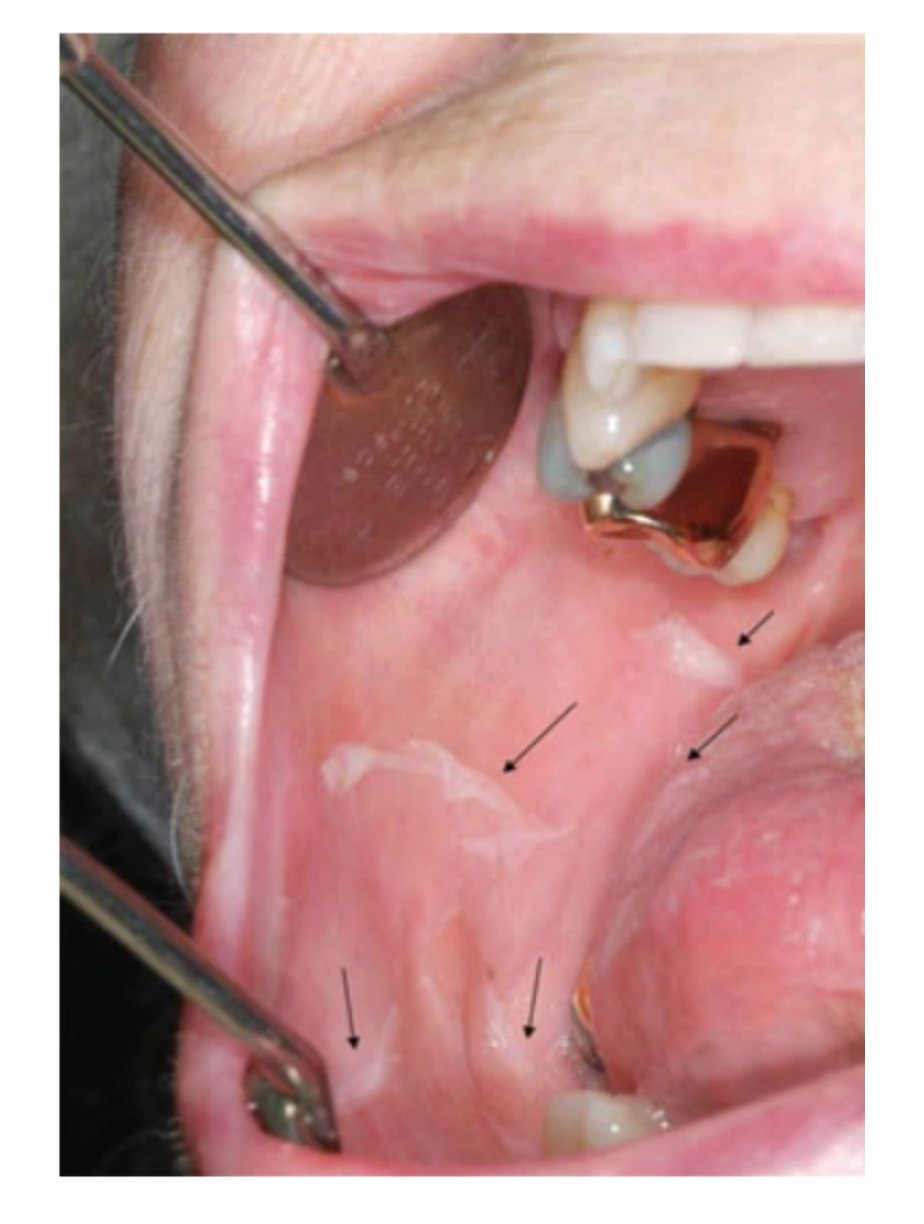
Oral Hygiene Instruction56
OHI: Oral Hygiene Instruction
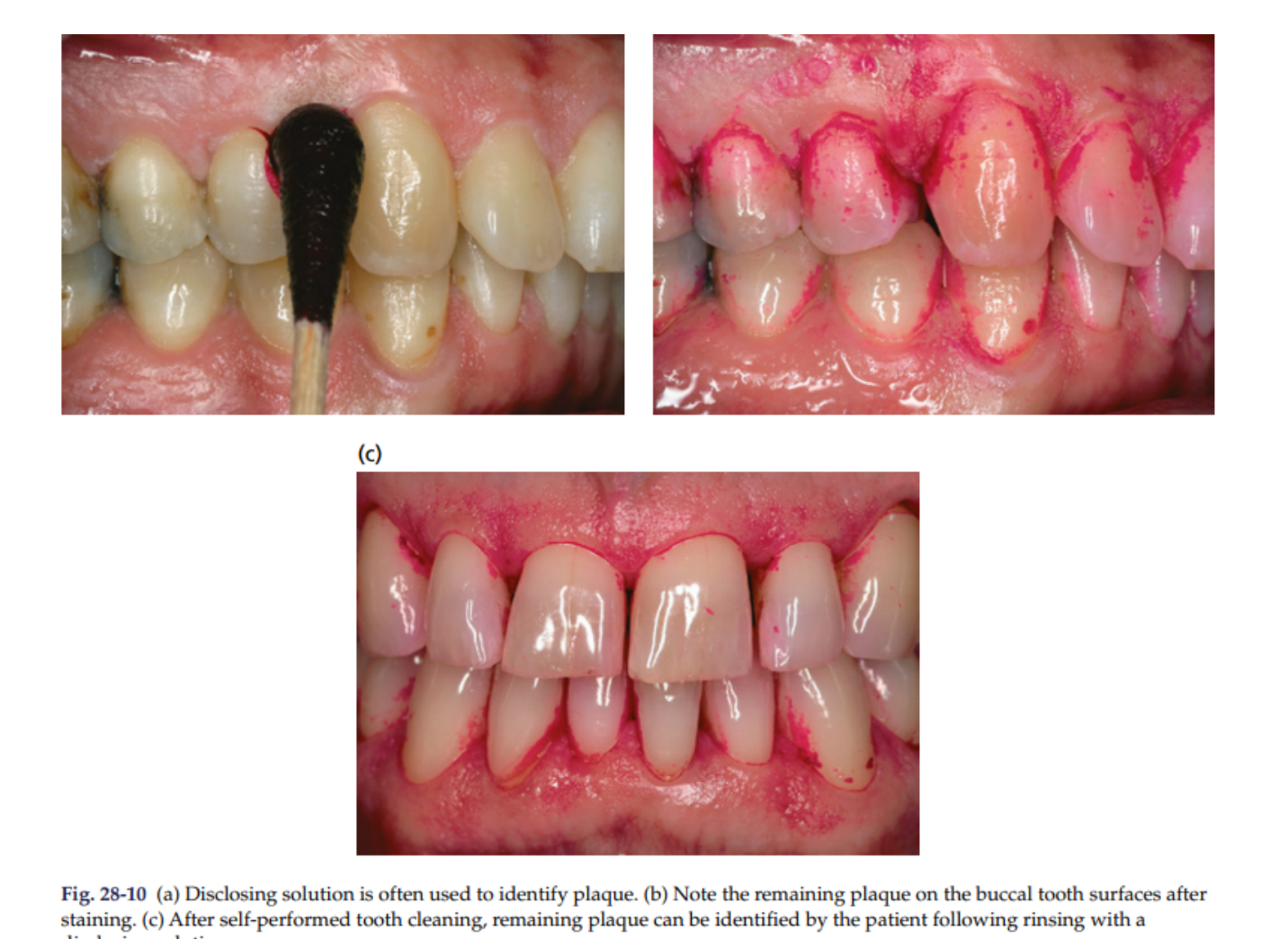
Plaque Disclosing and Patient Motivation57
OHI: Plaque disclosing
- Be polite and non-judgemental
- Educate
- Demonstrate
- Constant motivation/feedback
Fig. 28-10 (a) Disclosing solution is often used to identify plaque. (b) Note the remaining plaque on the buccal tooth surfaces after staining. (c) After self-performed tooth cleaning, remaining plaque can be identified by the patient following rinsing with a disclosing solution.
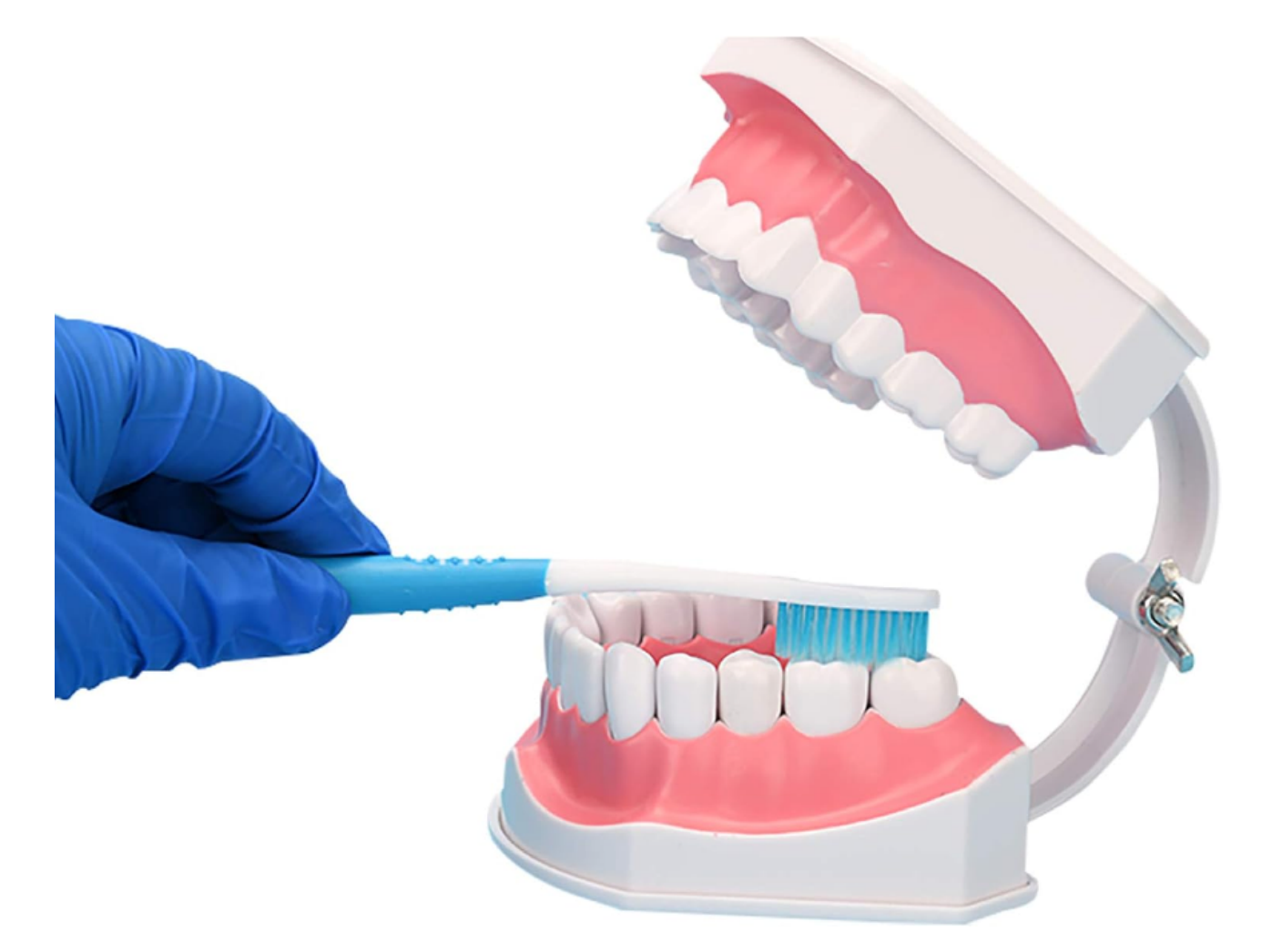
Developing a Customized Regime5859
OHI
- Customise
- Patient’s previous habits
- Dexterity
- Motivation
- Clinical condition
- Anatomical limitations
- Practise and refine your delivery
OHI: A customised regime
- Device
- Brush
- Interdental
- Duration
- Frequency
- Technique
- Dentifrice
- Adverse effects
The ideal technique is the one that allows for complete plaque removal.
The best device and product are the ones that get used!
 |  |
Product Reviews and Conclusion6061
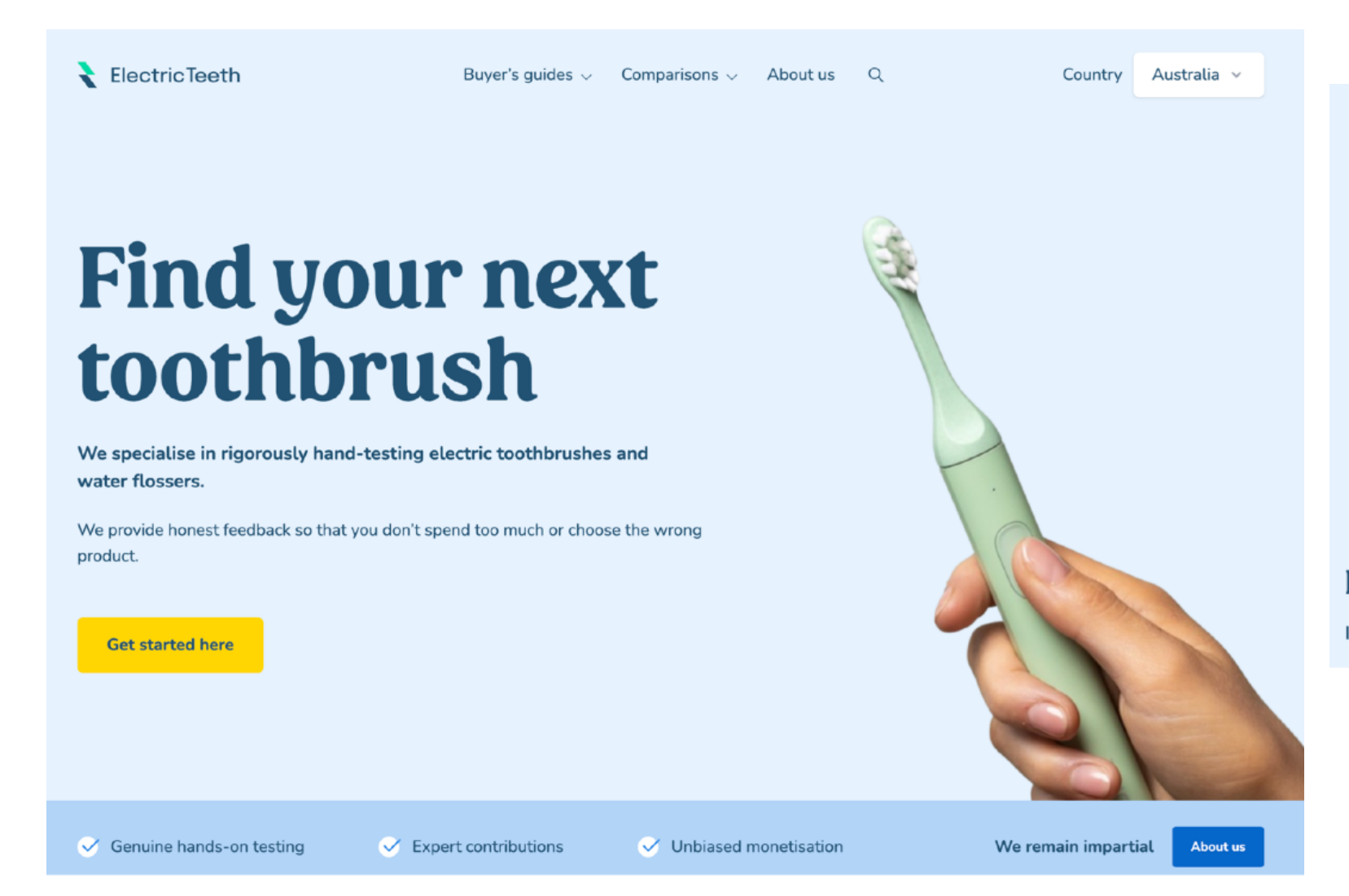
Product reviews
Questions?
emma.perry@uwa.edu.au pradeep.koppolu@uwa.edu.au
Images in presentation not otherwise credited are licence-free from https://www.freepik.com/
 |  |
 |  |
Footnotes
-
Original PDF page 1: L6 Mechanical Supragingival Biofilm Control 2025, p.1 ↩
-
Original PDF page 2: L6 Mechanical Supragingival Biofilm Control 2025, p.2 ↩
-
Original PDF page 3: L6 Mechanical Supragingival Biofilm Control 2025, p.3 ↩
-
Original PDF page 4: L6 Mechanical Supragingival Biofilm Control 2025, p.4 ↩
-
Original PDF page 5: L6 Mechanical Supragingival Biofilm Control 2025, p.5 ↩
-
Original PDF page 6: L6 Mechanical Supragingival Biofilm Control 2025, p.6 ↩
-
Original PDF page 7: L6 Mechanical Supragingival Biofilm Control 2025, p.7 ↩
-
Original PDF page 8: L6 Mechanical Supragingival Biofilm Control 2025, p.8 ↩
-
Original PDF page 9: L6 Mechanical Supragingival Biofilm Control 2025, p.9 ↩
-
Original PDF page 10: L6 Mechanical Supragingival Biofilm Control 2025, p.10 ↩
-
Original PDF page 11: L6 Mechanical Supragingival Biofilm Control 2025, p.11 ↩
-
Original PDF page 12: L6 Mechanical Supragingival Biofilm Control 2025, p.12 ↩
-
Original PDF page 13: L6 Mechanical Supragingival Biofilm Control 2025, p.13 ↩
-
Original PDF page 14: L6 Mechanical Supragingival Biofilm Control 2025, p.14 ↩
-
Original PDF page 15: L6 Mechanical Supragingival Biofilm Control 2025, p.15 ↩
-
Original PDF page 16: L6 Mechanical Supragingival Biofilm Control 2025, p.16 ↩
-
Original PDF page 17: L6 Mechanical Supragingival Biofilm Control 2025, p.17 ↩
-
Original PDF page 18: L6 Mechanical Supragingival Biofilm Control 2025, p.18 ↩
-
Original PDF page 19: L6 Mechanical Supragingival Biofilm Control 2025, p.19 ↩
-
Original PDF page 20: L6 Mechanical Supragingival Biofilm Control 2025, p.20 ↩
-
Original PDF page 21: L6 Mechanical Supragingival Biofilm Control 2025, p.21 ↩
-
Original PDF page 22: L6 Mechanical Supragingival Biofilm Control 2025, p.22 ↩
-
Original PDF page 23: L6 Mechanical Supragingival Biofilm Control 2025, p.23 ↩
-
Original PDF page 24: L6 Mechanical Supragingival Biofilm Control 2025, p.24 ↩
-
Original PDF page 25: L6 Mechanical Supragingival Biofilm Control 2025, p.25 ↩
-
Original PDF page 26: L6 Mechanical Supragingival Biofilm Control 2025, p.26 ↩
-
Original PDF page 27: L6 Mechanical Supragingival Biofilm Control 2025, p.27 ↩
-
Original PDF page 28: L6 Mechanical Supragingival Biofilm Control 2025, p.28 ↩
-
Original PDF page 29: L6 Mechanical Supragingival Biofilm Control 2025, p.29 ↩
-
Original PDF page 30: L6 Mechanical Supragingival Biofilm Control 2025, p.30 ↩
-
Original PDF page 31: L6 Mechanical Supragingival Biofilm Control 2025, p.31 ↩
-
Original PDF page 32: L6 Mechanical Supragingival Biofilm Control 2025, p.32 ↩
-
Original PDF page 34: L6 Mechanical Supragingival Biofilm Control 2025, p.34 ↩
-
Original PDF page 33: L6 Mechanical Supragingival Biofilm Control 2025, p.33 ↩
-
Original PDF page 36: L6 Mechanical Supragingival Biofilm Control 2025, p.36 ↩
-
Original PDF page 35: L6 Mechanical Supragingival Biofilm Control 2025, p.35 ↩
-
Original PDF page 37: L6 Mechanical Supragingival Biofilm Control 2025, p.37 ↩
-
Original PDF page 38: L6 Mechanical Supragingival Biofilm Control 2025, p.38 ↩
-
Original PDF page 39: L6 Mechanical Supragingival Biofilm Control 2025, p.39 ↩
-
Original PDF page 40: L6 Mechanical Supragingival Biofilm Control 2025, p.40 ↩
-
Original PDF page 41: L6 Mechanical Supragingival Biofilm Control 2025, p.41 ↩
-
Original PDF page 42: L6 Mechanical Supragingival Biofilm Control 2025, p.42 ↩
-
Original PDF page 43: L6 Mechanical Supragingival Biofilm Control 2025, p.43 ↩
-
Original PDF page 44: L6 Mechanical Supragingival Biofilm Control 2025, p.44 ↩
-
Original PDF page 45: L6 Mechanical Supragingival Biofilm Control 2025, p.45 ↩
-
Original PDF page 46: L6 Mechanical Supragingival Biofilm Control 2025, p.46 ↩
-
Original PDF page 47: L6 Mechanical Supragingival Biofilm Control 2025, p.47 ↩
-
Original PDF page 48: L6 Mechanical Supragingival Biofilm Control 2025, p.48 ↩
-
Original PDF page 49: L6 Mechanical Supragingival Biofilm Control 2025, p.49 ↩
-
Original PDF page 50: L6 Mechanical Supragingival Biofilm Control 2025, p.50 ↩
-
Original PDF page 51: L6 Mechanical Supragingival Biofilm Control 2025, p.51 ↩
-
Original PDF page 52: L6 Mechanical Supragingival Biofilm Control 2025, p.52 ↩
-
Original PDF page 53: L6 Mechanical Supragingival Biofilm Control 2025, p.53 ↩
-
Original PDF page 54: L6 Mechanical Supragingival Biofilm Control 2025, p.54 ↩
-
Original PDF page 55: L6 Mechanical Supragingival Biofilm Control 2025, p.55 ↩
-
Original PDF page 56: L6 Mechanical Supragingival Biofilm Control 2025, p.56 ↩
-
Original PDF page 57: L6 Mechanical Supragingival Biofilm Control 2025, p.57 ↩
-
Original PDF page 58: L6 Mechanical Supragingival Biofilm Control 2025, p.58 ↩
-
Original PDF page 59: L6 Mechanical Supragingival Biofilm Control 2025, p.59 ↩
-
Original PDF page 60: L6 Mechanical Supragingival Biofilm Control 2025, p.60 ↩
-
Original PDF page 61: L6 Mechanical Supragingival Biofilm Control 2025, p.61 ↩