Pain Control During Endodontic Treatment1
Importance of Pain Control During Treatment2
- Pain during treatment significantly impacts on the amount of post-op. pain
Info
The more pain a patient feels during treatment, the more pain they will experience after treatment.
Local Anaesthesia3
- Three goals of local anaesthesia:
- Anaesthesia during treatment
- Haemostasis during treatment
- Prolonged post-operative pain control
Local Anaesthesia3
Mechanisms of Pain Control
- Pain control from local anaesthetics - two mechanisms:
- Direct: Block discharges from peripheral nerves
- Duration: Minutes → Hours
- Indirect: Prolonged blocking of peripheral input reduces central sensitization
- Duration: Hours → Days
- Direct: Block discharges from peripheral nerves
Inadequate Local Anaesthesia
- Pain during treatment
- More post-operative pain
- Since prolonged exposure to sensory input increases allodynia and hyperalgesia
- Allodynia: Pain resulting from a stimulus that would not normally be painful.
- Hyperalgesia: An exaggerated pain response to a stimulus.
Anaesthetic efficacy of the supplemental intraosseous injection of 2% lidocaine with 1:100,000 epinephrine in irreversible pulpitis4
25 Maxillary Teeth
Nusstein et al JoE 1998
graph TD
    A[Bu Infiltration Injection<br>Lignocaine + 1:100,000 Adr] --> B[No Response to PT's 92 %]
    A --> C[Responded to PT's 8 %]
    B --> D[No Pain 68 %]
    B --> E[Pain in Dentine 4 %]
    B --> F[Pain in Pulp 20 %]
    C --> G[Need supplementary LA techniques]
    F --> G
Conclusion
Even with a successful buccal infiltration in the maxilla, a significant portion of patients (24%) still experience pain during treatment for irreversible pulpitis.
26 Mandibular Teeth5
IAN Block Injection Lignocaine + 1:100,000 Adr
- No Response to PT’s — 38 %
- Responded to PT’s — 62 %
- No Pain — 7 %
- Pain in Dentine — 12 %
- Pain in Pulp — 19 %
- Need supplementary LA techniques
Conclusion
The IAN block has a very high failure rate for mandibular molars with irreversible pulpitis.
Why Does Local Anaesthesia Not Work with Acute Irreversible Pulpitis?
- Various theories proposed — none proven
- Most commonly discussed:
- Inflammation activates nociceptors (pain receptors) and associated central pain mechanisms
- Inflammatory mediators reduce threshold of nociceptor activation → So minor stimuli fire the neurons
- Mediated by prostaglandins → Produced by arachidonic acid metabolism
- Prostaglandins sensitize nerve endings → Enhances pain and inflammation
- Inflamed pulps have high levels of both prostaglandins and arachidonic acid
Warning
However, most of these theories focus on local factors around the tooth and fail to adequately explain why a block injection, administered several centimetres away from the site of inflammation, would fail.
- LA unable to block conduction of all nerve impulses → When pain present - have more impulses than normal
- pH is more acidic in the presence of inflammation so LA is less effective
- Spread of inflammation along myelin sheaths may restrict absorption of the LA solution
- Increased vascularity increases blood flow and removes the LA more rapidly
- Periapically, there may be stasis - reduced blood flow
- Pain can neutralise the effects of LA in the CNS
Other Possible Causes
- Insufficient dose
- Incorrect injection site
- Incorrect technique
- Intravascular injection
- Individual variation - anatomy, dosage, etc.
- Variation in pain threshold and perceptions
- Inadequate time for LA to work
- This is a major factor. Dentists often wait only 3-5 minutes, but a block injection for a “hot” tooth may require up to 15 minutes to become fully effective.
Continued Pain After LA Injection6
- Three stages when pain may be felt:
- Pre-operative
- Dentine
- Pulp
**Strategies to Manage Acute Irreversible Pulpitis in a Lower Molar steps 1-3 out of 8 **7
- Pre-empt the difficult situation - i.e. Diagnosis !!
- Consider pre-medication with ibuprofen → Assuming no contra-indication
- Test tooth : triplex air + percussion during exam
The Effect of Premedication with Ibuprofen and Indomethacin on the Success of Inferior Alveolar Nerve Block for Teeth with Irreversible Pulpitis8
A randomized double-blind clinical trial investigated ibuprofen and indomethacin pre-medication for acute irreversible pulpitis in mandibular molars, focusing on an earlier stage of the condition.
Findings:
- Cold sensibility tests were not perfect predictors of anesthesia effectiveness.
- Ibuprofen and indomethacin significantly improved treatment success compared to placebo.
Discussion:
- NSAID pre-medication aids in pain control, with ibuprofen being more effective and safer than indomethacin.
- Efficacy hinges on the stage of pulpitis, with better results in earlier, less inflamed cases.
Acute Irreversible Pulpitis9
graph TD
    A[May or may not have pain to bite and percussion] --> B[?]
    B --> C[± Pain is spontaneous]
    B --> D[± Pain lying down]
    B --> E[± Pain wakes patient]
    B --> F[± Primary acute apical periodontitis]
    C --> G[Intense throbbing / aching pain; continuous or may come and go]
    D --> G
    E --> G
    F --> H[Pain to bite & tender to percussion]
    I[Pain with cold stimuli] --> J[Short, very sharp pain then lingering ache / throb]
    K[± Pain with heat] --> J
Conclusion of Premedication Study
- Pre-medication with a single dose of Ibuprofen can help with pain control during treatment of acute irreversible pulpitis in mandibular molars → If there is no spontaneous pain
- Highlights the need for a thorough history and diagnosis of the presenting complaint
Practical Challenge
The main practical challenge is scheduling the one-hour wait time for the premedication to take effect in a busy practice.
**Step 4: Gow Gates Block
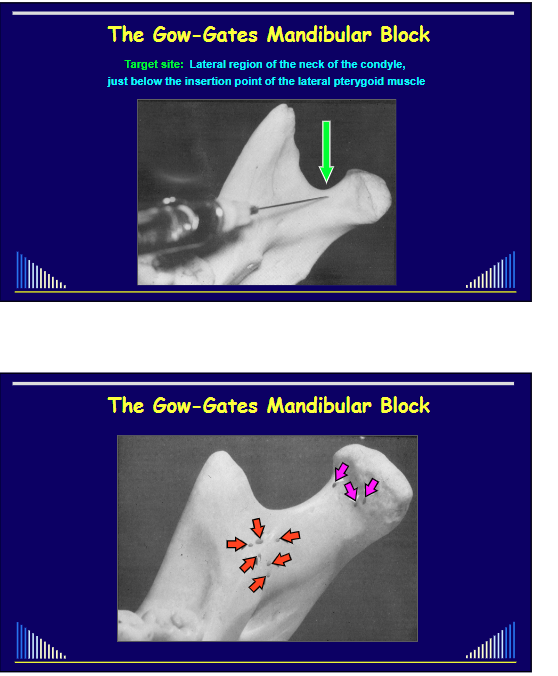
The Gow-Gates Mandibular Block
Technique and Landmarks10
Target site: Lateral region of the neck of the condyle, just below the insertion point of the lateral pterygoid muscle
Goal
To anaesthetise the entire mandibular nerve trunk after it exits the foramen ovale. This includes accessory branches that are often missed by a standard IAN block, which is why it is more effective.
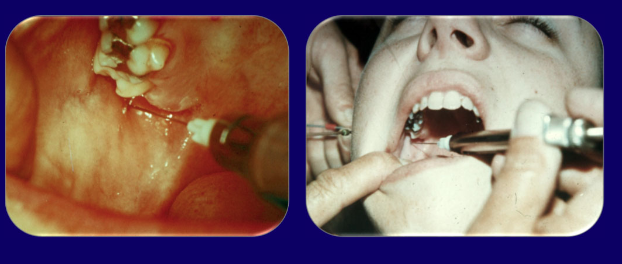
Entry point: Medial to the deep tendon of the temporalis muscle and slightly below the Palatal cusp of the UPPER 2nd molar
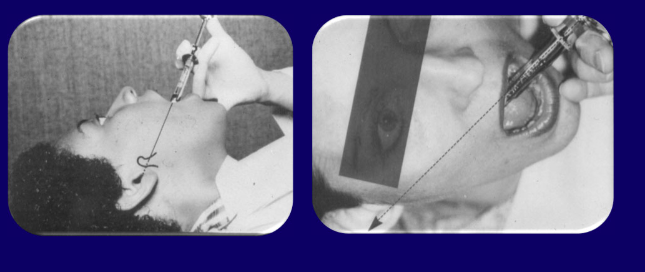
External landmarks: Apex of the intertragic notch and the lower border of the tragus through to opposite corner of the mouth
Advantages of the Gow-Gates Block1112
-
High success rate
- GG: 92 - 99 % vs - IAN: 65 - 85 %
-
No supplementary injections needed
- i.e. Do not need Long Buccal or Lingual nerve injections
-
Less muscle involved
-
Less painful
- Even though larger needle used!
-
Requires about 15 minutes to take full effect
- This waiting time can be productively used for patient consultation.
-
A safer technique
-
Less blood vessels at injection site
- Positive aspiration rate - negligible
-
No vaso-constrictor required
- Use plain Prilocaine (e.g. Citanest 4%)
- Only 1 carpule required (i.e. 2.2 ml)
Incidence of Grade “A” anaesthesia1314
Prilocaine , felyrpressin or just plain are all highly successful when doing a gow gates
**Step 5: Retesting after gow-gates block
- Re-test with triplex air and percussion → If no pain: place rubber dam and re-test !! → If still pain: Give IAN Block + Buccal Infiltration
Inferior Alveolar Nerve Block Hints15
Technique Tip
The most frequent mistake in the gg-block is placing the needle too far distally. Using a short needle with a slight bend can improve control and help target the correct area. The historical fear of needle breakage at the hub is obsolete with modern, single-piece needle manufacturing.
Efficacy of combining a buccal infiltration with an inferior alveolar nerve block for mandibular molars with irreversible pulpitis1617
Info
This indicates that adding a buccal infiltration is more effective than simply increasing the volume at the IAN block site. However, a 35% failure rate still exists.
Articaine vs. Lidocaine
A review of the literature shows no significant advantage in using 4% articaine over 2% lidocaine for block anaesthesia in these situations. While some studies show a benefit for infiltration, its use for IAN blocks is discouraged due to its higher concentration (4% vs 2%) and the associated, albeit debated, increased risk of lingual nerve paraesthesia.
** Gow-gates block Conclusions:**18
- More effective LA for acute irreversible pulpitis in lower molars when an IAN block is combined with a Bu infiltration
- However, some patients will still have pain !!
Supplementary Injections - Other Teeth19
-
Labial infiltration for lower anterior teeth
-
Palatal infiltration for upper molars
- This is a highly effective supplement to a buccal infiltration because it directly anaesthetises the palatal root, which is often missed by buccal-only approaches.
-
Palatal for upper premolars and anterior teeth
- Anterior middle superior alveolar (AMSA) nerve block
**step 8: re-test with triplex air and percussion
- 8. Re-test again with triplex air and percussion → If no pain: proceed with treatment
- Turn the H/S handpiece water off !! → If pain: give PDL injection and test again
- Can then normally cut enamel or restoration
Rubber Dam Cuff Technique20
Advantages:
- Enables PDL injections if required
- Full access to the entire tooth
- Better vision
Periodontal Ligament Injection21
Mechanism
The PDL injection is effectively an intraosseous injection that works very quickly (20-30 seconds). The anaesthetic is not intended to track down the ligament space. Instead, high pressure forces the solution through the porous cancellous bone of the socket wall to reach the apex.
Technique
- Place the needle into the gingival sulcus, angled into the PDL space.
- The bevel of the needle must face the bone, not the tooth root.
- Inject with firm, steady pressure at 4-6 points around the tooth (e.g., mesiobuccal, distobuccal, mesiolingual, distolingual corners).
- Only a very small amount of solution can be injected at each site.
Intra-osseous Injections22
Warning
While dedicated systems exist for direct intraosseous injection, they are less practical. They are difficult to use, cannot be administered with a rubber dam in place, and carry a risk of iatrogenic damage to the tooth root. The PDL injection is a simpler and safer alternative.
**Step 10 if pain is felt upon reaching pulp **
→ Intra-pulp injection
Intra-Pulp Injection23
Technique
This injection is most effective when administered through a very small pulp exposure. The small opening allows for the creation of back-pressure, which forces the anaesthetic solution into the pulp tissue, achieving profound anaesthesia. It is recommended to give an intra-pulp injection proactively as soon as a pinpoint exposure is made. If the pulp chamber is widely opened, the lack of back-pressure renders the technique ineffective.
**Step 11 : If patient is still in pain
→ Pulpotomy only - CS-AB dressing
-
The goal should shift from complete instrumentation to pain relief. Place a corticosteroid-antibiotic paste (e.g., Leder mix paste) over the canal orifices to control inflammation.
→ Re-appoint - 3-4 weeks later
Pain Relief after Pulpotomy24
Success
A pulpotomy is highly effective for pain relief. One study found that it can reduce pre-operative pain by an average of 82% (from 100% down to 18%).
Acute Irreversible Pulpitis - Lower Molar Tooth (Flowchart)
flowchart TD
    A[Discuss Diagnosis, Treatment Plan, etc] --> B[TEST - Cold, Percussion]
    B --> C[Gow-Gates Mandibular Block]
    C --> D[TEST - Cold, Percussion]
    D --> E[Inferior Alveolar Nerve Block + Buccal Infiltration]
    E --> F[TEST - Cold, Percussion]
    F --> G[Periodontal Ligament Injection]
    G --> H[TEST - Cold, Percussion]
    H --> I[Intra-Pulp Injection]
    I --> J[Pulpotomy + CS-AB Dressing]
And …25
❌ Do NOT prescribe antibiotics !!!
- AB’s are unnecessary and contra-indicated
- AB’s are not pain relieving medications
- AB’s do not help treat inflammation
- Pulpitis is an INFLAMMATORY condition
- Even though it is caused by the presence of bacteria in the tooth
- And a systemically-administered AB will not reach the bacteria in in the caries, crack, restoration/tooth interface, etc.
Danger
Prescribing antibiotics in this situation is inappropriate, ineffective (acting only as a placebo), and contributes to antibiotic resistance. Pain should be managed with analgesics and NSAIDs, not antibiotics.
Summary26
- Achieving adequate pain control is difficult, and unpredictable, when treating acute irreversible pulpitis
- Dentists need various strategies to ensure good pain control for their patients
- Before treatment
- During treatment
- After treatment
Summary of Management Strategy27
- Pre-empt the difficult situation
- Consider pre-medication
- Test tooth pre-op: → Triplex air + percussion
- Gow-Gates Block → Discuss treatment, etc.
- Re-test: triplex air + percussion → If no pain: proceed with treatm → Turn water off H/S handpiece → If still pain: Give IAN Block + Buccal Infiltration
- Allow more time for LA to work
- Place rubber dam - cuff tech.
- Re-test again: air + percussion → If no pain: proceed with treatm → Turn water off H/S handpiece → If pain: give PDL injection
- If pain felt on reaching dentine → PDL injection
- If pain felt on reaching the pulp → Intra-pulp injection
- If still pain → Pulpotomy - CS-AB dressing → Re-appoint - 3-4 weeks later
Post-Operative Follow-up
Timeline
- 3-4 weeks later
Additional Instructions
- Patients should be prescribed appropriate analgesics or anti-inflammatory agents (e.g., ibuprofen) for post-operative pain management.
- Patients should be explicitly told that antibiotics are not necessary or helpful for this condition.
Footnotes
-
Original PDF page 1: O1A Pain control During retreatment, p.1 ↩
-
Original PDF page 2: O1A Pain control During retreatment, p.2 ↩
-
Original PDF page 3: O1A Pain control During retreatment, p.3 ↩ ↩2
-
Original PDF page 4: O1A Pain control During retreatment, p.4 ↩
-
Original PDF page 5: O1A Pain control During retreatment, p.5 ↩
-
Original PDF page 7: O1A Pain control During retreatment, p.7 ↩
-
Original PDF page 14: O1A Pain control During retreatment, p.14 ↩
-
Original PDF page 8: O1A Pain control During retreatment, p.8 ↩
-
Original PDF page 13: O1A Pain control During retreatment, p.13 ↩
-
Original PDF page 15: O1A Pain control During retreatment, p.15 ↩
-
Original PDF page 16: O1A Pain control During retreatment, p.16 ↩
-
Original PDF page 17: O1A Pain control During retreatment, p.17 ↩
-
Original PDF page 18: O1A Pain control During retreatment, p.18 ↩
-
Original PDF page 19: O1A Pain control During retreatment, p.19 ↩
-
Original PDF page 20: O1A Pain control During retreatment, p.20 ↩
-
Original PDF page 21: O1A Pain control During retreatment, p.21 ↩
-
Original PDF page 22: O1A Pain control During retreatment, p.22 ↩
-
Original PDF page 28: O1A Pain control During retreatment, p.28 ↩
-
Original PDF page 29: O1A Pain control During retreatment, p.29 ↩
-
Original PDF page 30: O1A Pain control During retreatment, p.30 ↩
-
Original PDF page 31: O1A Pain control During retreatment, p.31 ↩
-
Original PDF page 35: O1A Pain control During retreatment, p.35 ↩
-
Original PDF page 36: O1A Pain control During retreatment, p.36 ↩
-
Original PDF page 37: O1A Pain control During retreatment, p.37 ↩
-
Original PDF page 38: O1A Pain control During retreatment, p.38 ↩
-
Original PDF page 39: O1A Pain control During retreatment, p.39 ↩
-
Original PDF page 40: O1A Pain control During retreatment, p.40 ↩