Management of Edentulism and the Terminal Dentition: Overdentures1
Clin A/Prof Glen Liddelow BDSc(WA), MScD(WA), DClinDent(Syd), MRACDS(Pros), FPFA, FICD, FRACDS
BRÅNEMARK CENTRE PERTH
Introduction to Overdentures
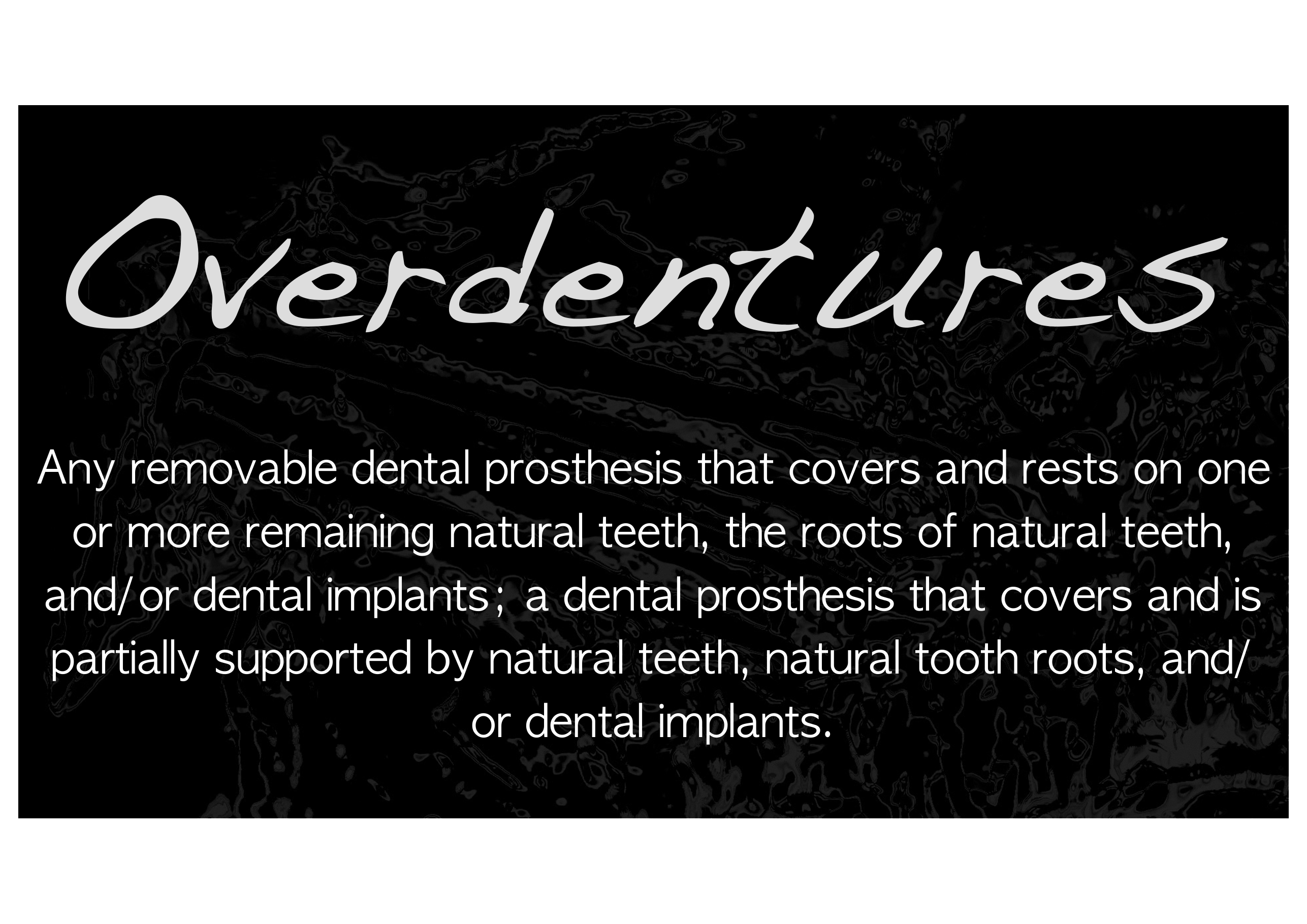
Definition of Overdentures2
Any removable dental prosthesis that covers and rests on one or more remaining natural teeth, the roots of natural teeth, and/or dental implants; a dental prosthesis that covers and is partially supported by natural teeth, natural tooth roots, and/or dental implants.
Lecturer — Overdenture Applications
Overdentures can be used in a wide range of clinical situations, and both the retained structure and the soft tissues contribute to support.
- A child with only a few retained deciduous teeth may receive an overdenture retained by those teeth.
- An elderly patient may retain mandibular canines to help preserve the residual ridge and improve denture retention.
- Implants may be used when additional retention and resistance to movement are required.
- A mandibular complete denture often has limited retention, so stability depends on maximising the denture base and extending the flanges into the mylohyoid and buccal regions.
- In the maxilla, suction can improve retention, while an implant attachment can hold the denture down onto the tissues and resist lateral movement.
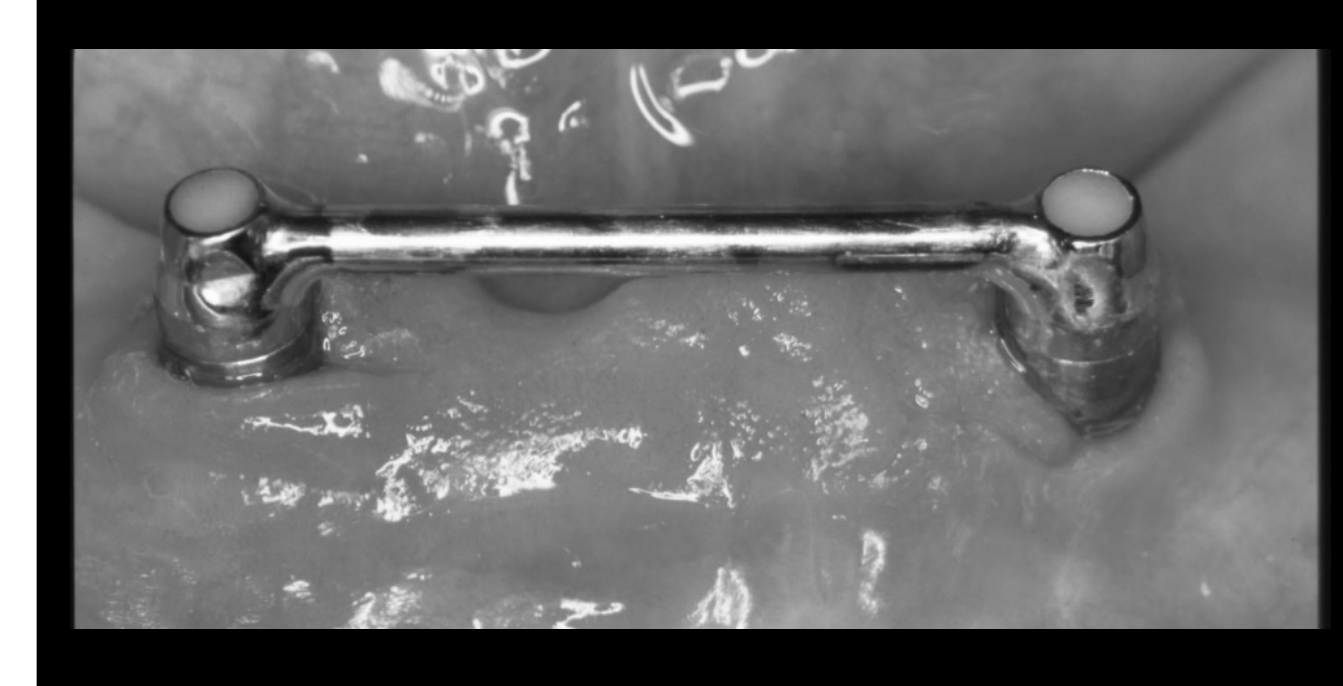
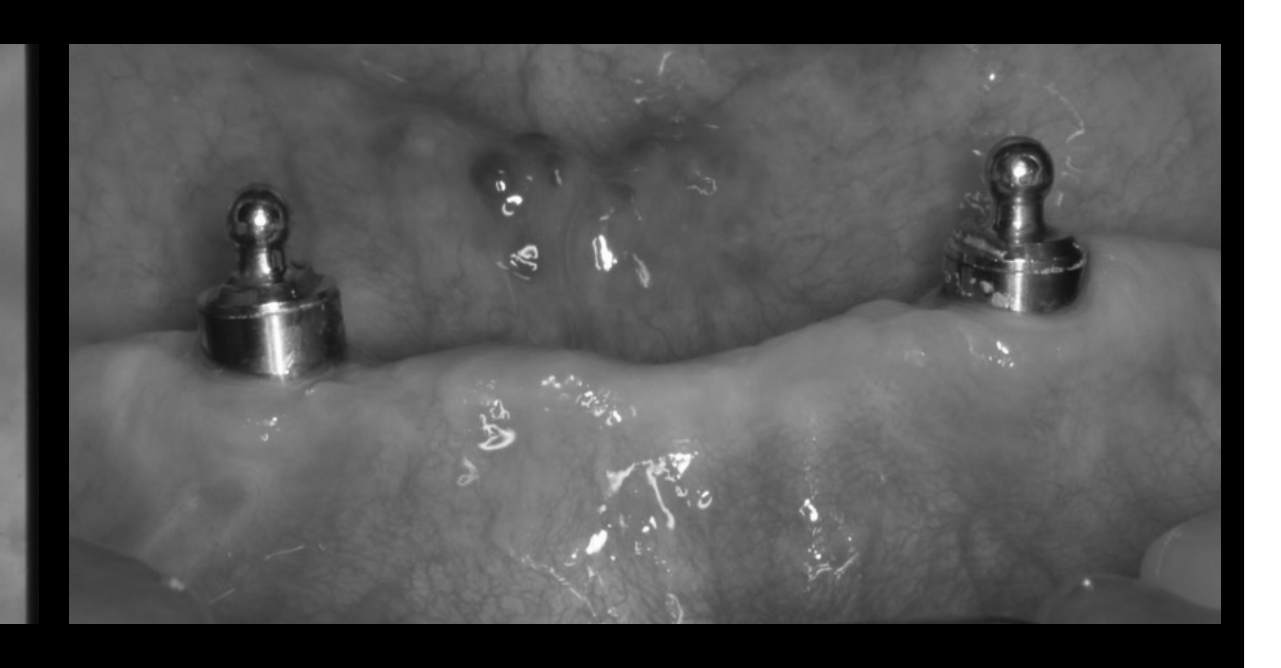
Two Implant Overdenture3
 |  |
McGill Consensus Statement4
“There is now overwhelming evidence that a two implant overdenture should become the first choice of treatment for the edentulous mandible.”
The McGill consensus statement on overdentures. Mandibular two-implant overdentures as first choice standard of care for edentulous patients. Montreal, Quebec, May 24–25, 2002. Feine JS, Carlsson GE, Awad MA, Chehade A, Duncan WJ, Gizani S, Head T, Lund JP, MacEntee M, Mericske-Stern R, Mojon P, Morais J, Naert I, Payne AG, Penrod J, Stoker GT, Tawse-Smith A, Taylor TD, Thomason JM, Thomson WM, Wismeijer D. Int J Oral Maxillofac Implants. 2002 Jul-Aug;17(4):601-2. Review.
Lecturer — Implant Overdenture Selection
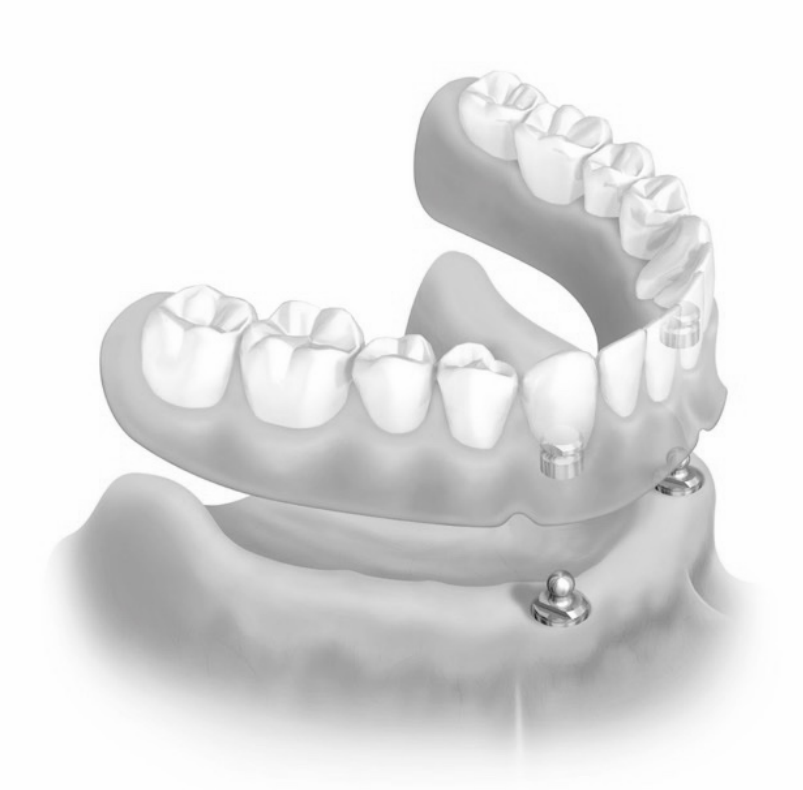
The classic mandibular implant overdenture uses two implants, commonly connected by a bar with clips, ball attachments, or locator-type attachments.
- Two-implant overdentures have been used since approximately the early to mid-1980s and are relatively inexpensive compared with treatment involving more implants and complex superstructures.
- The existing denture can often be modified and used as the basis for the overdenture.
- Two implants are generally used because the posterior portion of the overdenture remains tissue-supported; four implants with an overdenture may not provide a corresponding benefit relative to the additional cost.
- The lecturer agreed that an implant overdenture is generally much better than a complete denture without implants, but questioned describing the two-implant overdenture as the universal first choice or standard of care.
- Treating two implants as mandatory could imply that both conventional dentures and fixed bridges on four or more implants fail to meet the standard, with potential consequences for insurance, Veterans Affairs, and other funding systems.
- The statement was later retracted or qualified. Published evidence should be assessed critically by considering the authors, editors, conflicts of interest, abstract limitations, peer-review procedures, and publication source; a consensus formed mainly by clinicians and researchers who favour overdentures may not apply to every patient.
Prosthodontic Treatment5
Most complete denture wearers adapt and cope.
Some suffer substantially from chronic dysfunction, pain, low self-esteem and reduced OHRQOL — maladaptive.
Zarb GA. The edentulous predicament. In: Zarb GA, Bolender CL. Prosthodontic Treatment for Edentulous Patients. Mosby, Philadelphia, PA. 2004.
Treatment Principles
-
Safest
-
Least invasive
-
Least costly
-
Least complex
-
Overdentures are most applicable to patients who have worn dentures for a long time, accept a removable prosthesis, are elderly or medically compromised, or cannot practically or affordably receive a fixed solution.
-
Overdentures are less commonly selected for patients with a terminal dentition who have not previously adapted to dentures, because they often expect a fixed replacement.
-
Retaining natural teeth may be appropriate when they preserve bone, extraction carries substantial medical risk, or the patient has medical, anticoagulant, or bisphosphonate-related concerns.
-
A retained tooth may be covered with a root treatment or used beneath an overdenture.
-
The decision to retain teeth should consider their prognosis, treatment cost and complexity, patient expectations, and whether retention produces a rational overall plan.
-
Retaining every possible tooth is not always beneficial when extensive crowns, endodontic and periodontal procedures, and implants would leave a costly, compromised result.
-
Removing several teeth with poor prognosis may instead provide better aesthetics, occlusion, predictability, and cost-effectiveness through a simpler implant or prosthetic solution.
Reasonable needs and expectations
- Mechanical stability
- Biologic stability
- Longevity
- Low maintenance
Lecturer — Overdenture Design
Lower overdenture design is generally similar to conventional lower denture design.
- The denture should have good extension, with stability and retention remaining important.
- Implant placement may require local modification to create the attachment, but the denture should otherwise look similar from above.
- Occlusion is generally managed as for a conventional denture; there is not a large amount of research supporting a substantially different occlusal approach.
Fitzpatrick B. Standard of care for the edentulous mandible: A systematic review. J Prosthet Dent 2006;95:71-78.
Overdenture Complications and Maintenance
Complications Compared to Fixed Prostheses6
-
Overdenture complications higher than fixed
- ↑ peri-implant mucosal problems
- ↑ mechanical problems (attachments)
- ↓ phonetic problems
-
Repeated insertion and removal produces frictional wear and tear involving clasps, attachments, teeth, and restorations or crowns.
-
Fixed solutions generally provide better function and feel more like natural teeth than a removable prosthesis.
-
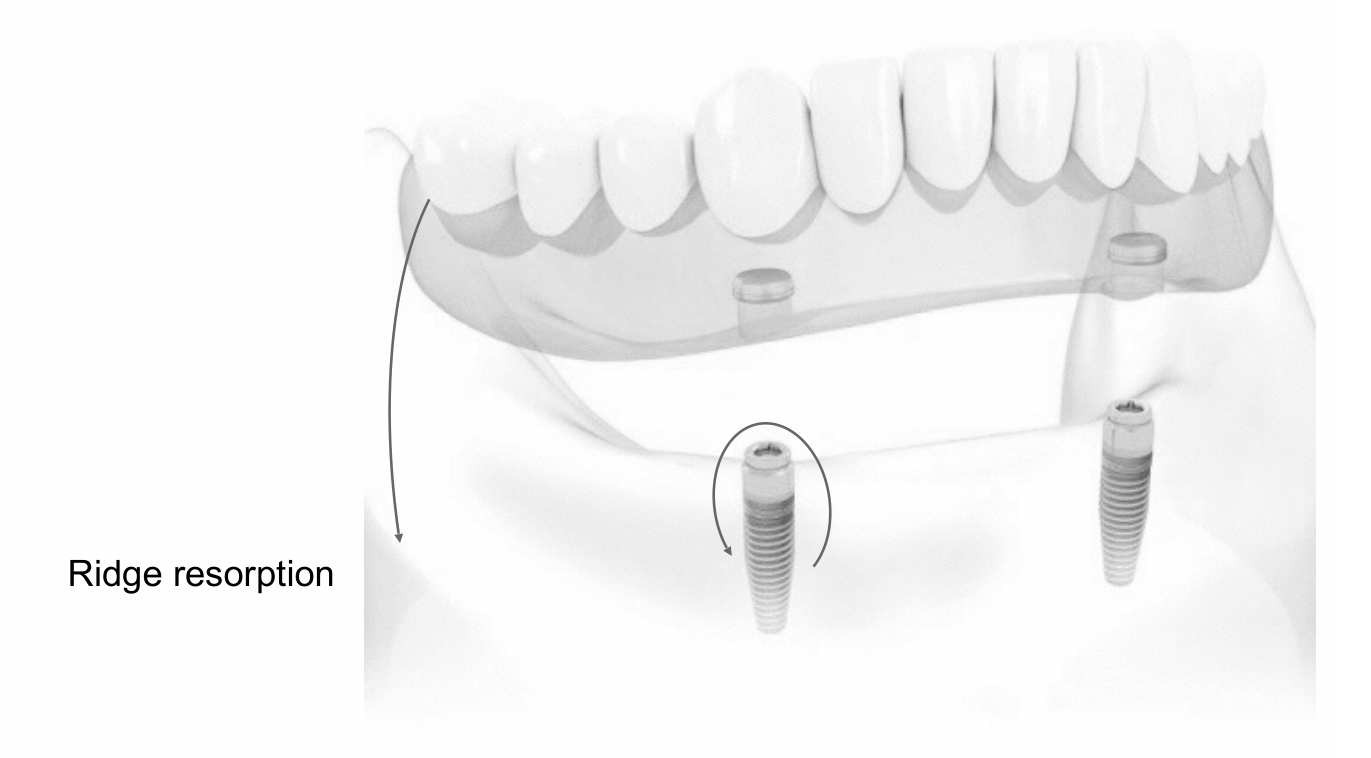
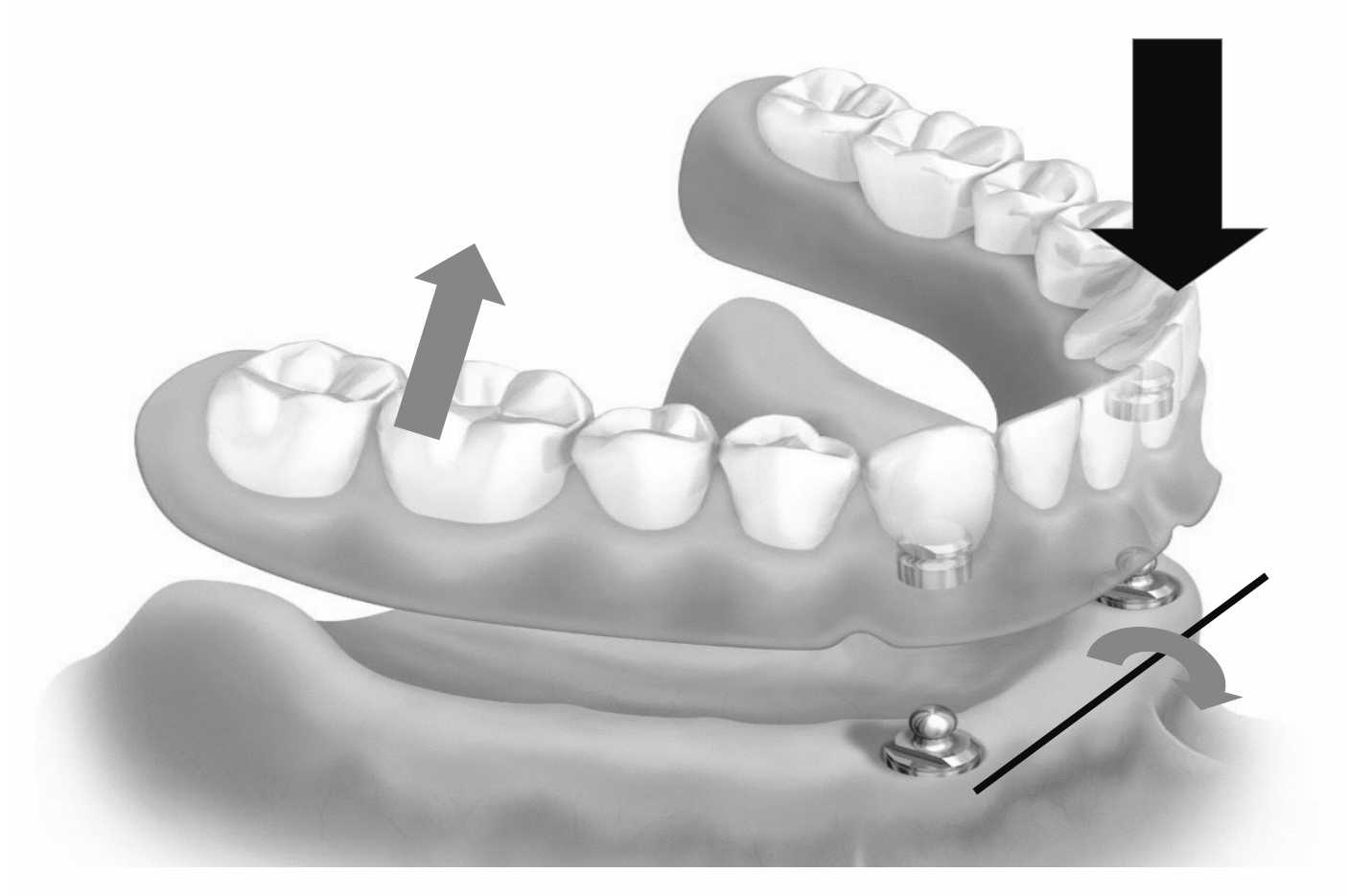
With an anteriorly retained overdenture, a long posterior cantilever can rotate around the implants, allowing food beneath the prosthesis and increasing implant forces.
-
Overdentures may be easier for patients or nursing-home carers to clean because the denture can be removed.
-
Despite easier access for cleaning, near-continuous wear can reduce salivary flushing and create an anaerobic, plaque-retentive environment with more pathogenic bacteria.
-
Occlusal pressure applied several centimetres posterior to an implant creates greater leverage on that implant than forces distributed through a well-spaced fixed bridge. Bergendal T, Enquist B. Implant supported overdentures: A longitudinal prospective study. IJOMI 1998;13:253.
Enquist B, Bergendal T, Kallus T. A retrospective multi-center evaluation of osseointegrated implants supporting overdentures. IJOMI 1998;3:129.
Adjustments and Repairs7
-
Significantly more post-placement adjustments and repairs than fixed
-
50% require adjustment or repair in the first 3 years
-
Repeated repairs significant
-
72–98 mins for maintenance during the first year
-
↑ mechanical problems with Mx OD cf Mn OD
-
Attachments loosen and wear because they repeatedly engage and disengage.
-
Ball attachments may use spring-like components that clamp onto the ball and can loosen or wear out.
-
Positioning implants as far anteriorly as possible reduces force and rotation.
-
An immediate postoperative denture may need relief around the implants, with viscogel used initially to accommodate soft-tissue swelling.
-
After approximately six weeks, the denture can be relined and the attachments incorporated more permanently.
-
Maintenance may be relatively low in selected single-implant cases, but ongoing adjustment remains necessary.
-
Maxillary attachments and bars require ongoing maintenance.
-
A magnet-retained design used a gold bar and matching denture magnets, requiring correct polarity; incorrect polarity could make the denture repel or behave improperly.
-
The magnet design was associated with substantial soft-tissue enlargement, while other designs incorporated locator attachments into a bar. Walton JN, MacEntee MI. A retrospective study on the maintenance and repair of implant-supported prostheses. Int J Prosthodont. 1993 Sep-Oct;6(5):451-5.
Watson GK, Payne AG, Purton DG, Thomson WM. Mandibular overdentures: professional time for prosthodontic maintenance during the first year of service using three different implant systems. Int J Prosthodont. 2002 Jul-Aug;15(4):379-84.
Watson RM, Jemt T, Chai J, Harnett J, Heath MR, Hutton JE, Johns RB, Lithner B, McKenna S, McNamara DC, Naert I, Taylor R. Prosthodontic treatment, patient response, and the need for maintenance of complete implant-supported overdentures: an appraisal of 5 years of prospective study. Int J Prosthodont. 1997 Jul-Aug;10(4):345-54.
Ridge Resorption and Nerve Compression8
-
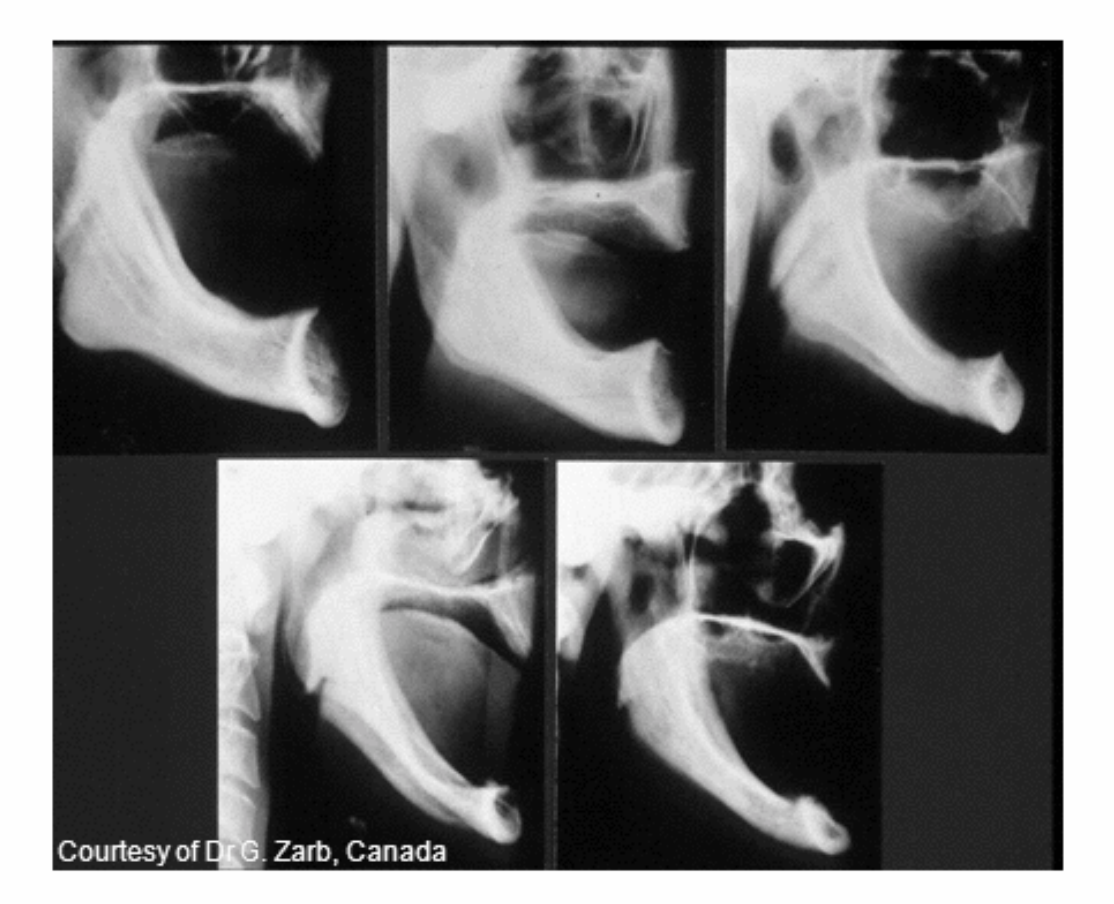
Ridge resorption
-
High Mental F — nerve compression
-
Continued mandibular resorption may expose the mental nerve at the crest of the residual ridge and produce neuropathic symptoms.
-
An overdenture can rotate around its attachments, contribute to further posterior resorption, and increase pressure on the mental nerve.
-
Severe jaw distortion with a risk of neuropathic compression is a contraindication to an overdenture. Ekfeldt A, Johansson LA, Isaksson S. Implant supported overdenture therapy: A retrospective study. Int J Pros 1997;10:366-374.
Watson R, Jemt T, Chai J, Harnett J et al. Prosthodontic treatment, patient response and the need for maintenance of complete implant supported overdentures; an appraisal of 5 years of prospective study. Int J Pros 1997;10:345-354.
Naert I, Gizani S van Steenberghe D. Rigidly splinted implants in the resorbed maxilla to retain a hinging overdenture: a series of clinical reports for up to 4 years. J Pros Dent 1998;79:156-164.
Follow-Up and Maintenance Requirements9
Follow-up and basic maintenance requirements of the edentulous patient
-
Follow-up: relining
-
Ridge resorption
-
Long-term follow-up should assess attachment wear, denture fit, soft-tissue health, plaque and food accumulation, peri-implant tissues, bone levels, patient comfort, and function.
-
Maintenance may depend particularly on carers when patients are elderly or cognitively impaired.
-
The prosthesis must be removed and cleaned regularly to reduce its anaerobic, plaque-retentive environment, even when cleaning is easier than beneath a fixed bridge. Tallgren A. The continuing reduction of the residual alveolar ridges in complete denture wearers: A mixed-longitudinal study covering 25 years. J Prosthet Dent 1972;27:120-32.
From: Courtesy of Dr G. Zarb, Canada.
 |  |
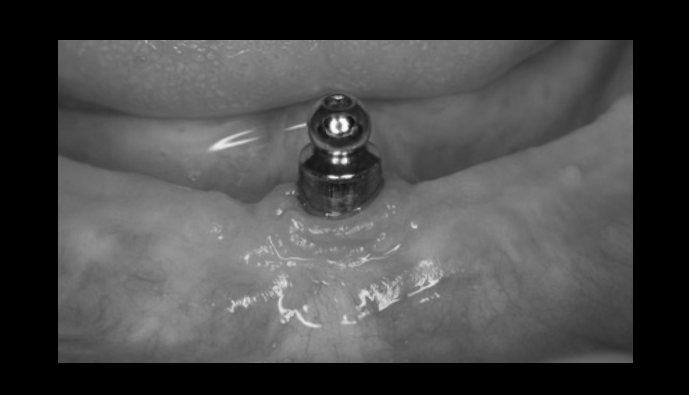
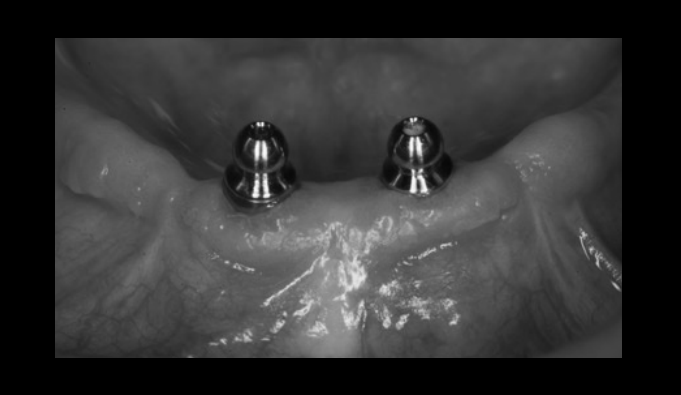
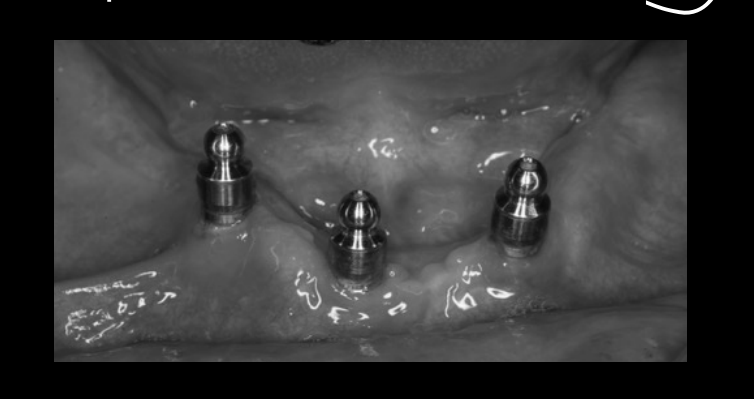
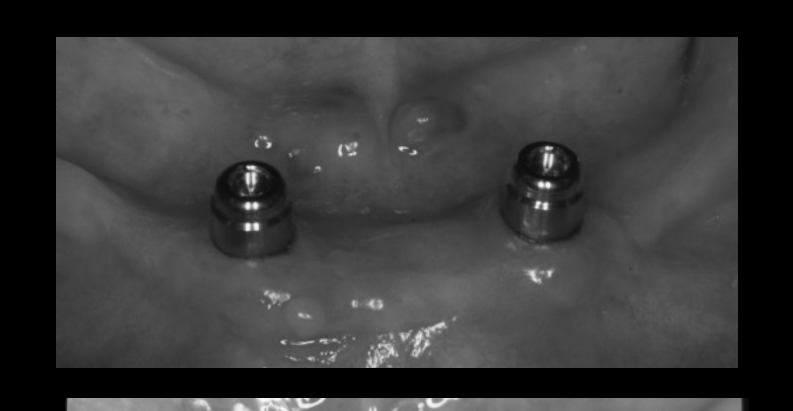
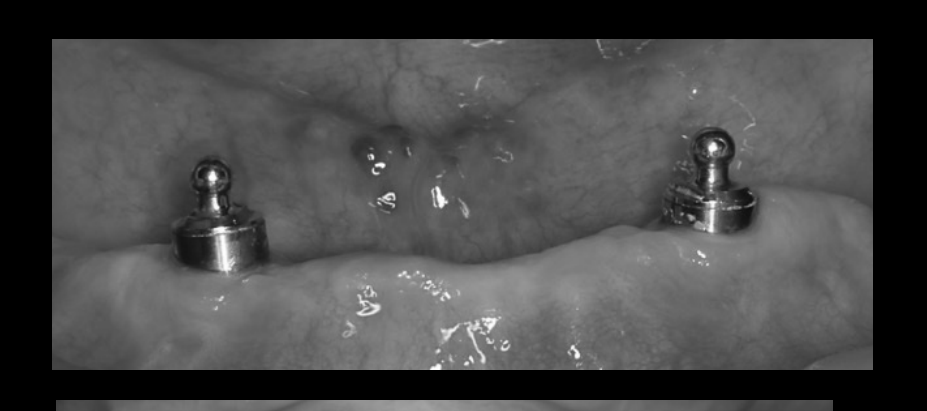
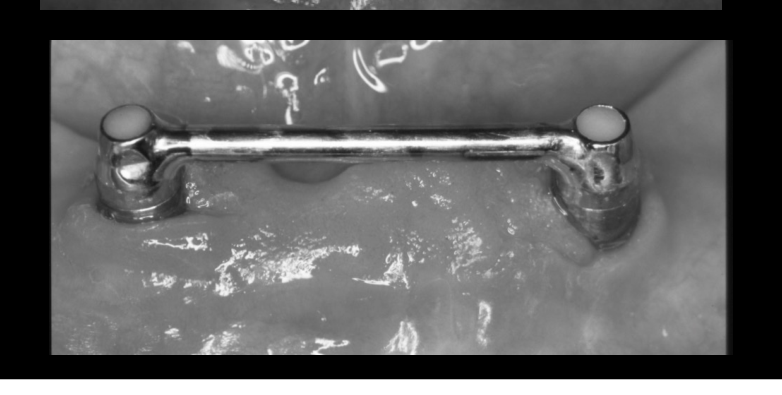
Attachments and Splinting10
 |  |  |
 |  |  |
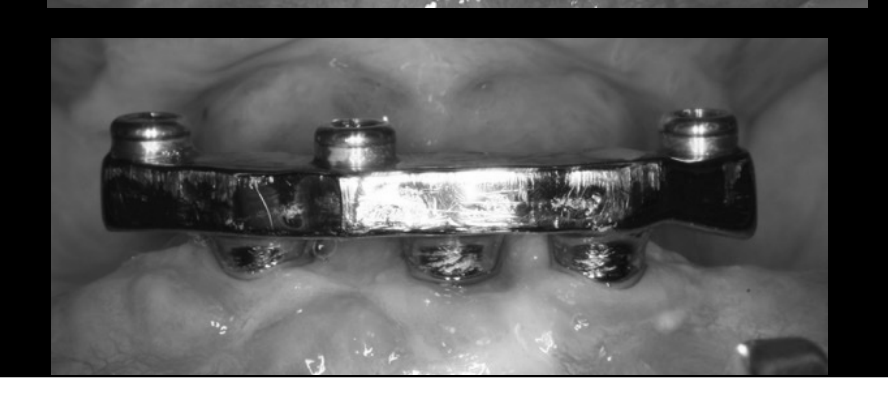 |
Historical Background of Attachment Mechanisms
Splinted vs Unsplinted11
Finite Element Testing
Meijer HJA, Kuiper JH, Starmans FJM, Bosman F. Stress distribution around dental implants: Influence of superstructure, length of implants, and height of mandible. JPD. 1992;68:96-102.
Lecturer — Splinted vs Unsplinted
Splinted and unsplinted mandibular implants were described as having broadly comparable outcomes in the situations discussed.
- Splinting can help distribute force, whereas unsplinted implants may be easier to clean.
- The mandible was considered sufficiently dense to tolerate forces with either arrangement.
- Photoelastic testing found less stress on a single implant than on two implants in the examined overdenture design, possibly because of the anterior implant position, reduced off-axis loading, and attachment resilience.
Survival Rates
Naert, Gizani, Vuylsteke, van Steenberghe. A 5yr randomised clinical trial on the influence of splinted and unsplinted oral implants in the mandibular overdenture therapy. ClinOralImplRes. 1998;9:170-177.
Lecturer — Long-Term Survival
Single-implant overdenture studies also reported high survival over long periods.
- A 20-year follow-up of one single-implant study recorded no implant failures.
- Deaths during the study were unrelated to the implants.
Prosthetic Complications12
Gotfredsen K, Holm B. Implant – Supported Mandibular Overdentures Retained with Ball or Bar Attachments: A Randomized Prospective 5 – Year Study. Int J Prosthodont 2000;13:125-130.
Lecturer — Prosthetic Maintenance
Prosthetic maintenance may involve replacement of worn attachment components, relining or replacing the denture, and adjustment for changes in the soft tissues.
- Resilient rubber O-ring attachments were associated with relatively little wear in the long-term single-implant study.
- The single implant also experienced less prosthetic force than a two-implant arrangement in that study.
Naert I, Gizani S, Vuylsteke M, van Steenberghe D. A 5yr prospective randomised clinical trial on the influence of splinted and unsplinted oral implants in the mandibular overdenture therapy. Part II Prosthetic aspects and patient satisfaction. J Oral Rehab 1999;26:195-202.
Andreiotelli M, Att W, Strub J. Prosthodontic complications with implant overdentures: A systematic literature review. Int J Pros 2010;23:195-203.
Still no consensus, variable studies with little consistency.
Advantages of Attachments13
- Inexpensive
- Removable
- Simple
- Good stabilisation
- Applicable to existing denture
- Large patient potential
Lecturer — Attachment Selection
Attachment design should be selected according to the clinical situation and the patient’s maintenance needs.
- Relevant considerations include implant position, available space, patient hygiene ability, desired resilience, and expected maintenance requirements.
- Attachments can improve retention and provide resistance to lateral movement.
Immediate Loading
Immediate Loading Studies14
| Study | Year | Journal | System | Points | Implants | Loading Protocol | Follow-up | CSR | Fixation |
|---|---|---|---|---|---|---|---|---|---|
| Chiapasco et al | 2001 | JOMI | Brånemark System | 10 pts | 40 impl | Within 3 days | >2 years | 97.5% | 4 bar |
| Chiapasco et al | 2003 | ClinImplDentRelRes | Brånemark | 82 pts | 328 impl | Day after surgery | 3 to 8 years | 96.1% | 4 bar |
| Payne et al | 2001 | ClinImplDentRelRes | Brånemark | 10 pts | 20 impl | After 2 weeks | 2 – 52 weeks | 100% | 2 ball |
| Raghoebar et al | 2003 | ClinImplDentRelRes | Brånemark | 30 pts | 120 impl | Within 6 weeks | 3 years | 93.0% | 4 bar |
| Rungcharassaeng | 2002 | JPD | HA, SteriOss | 5 pts | 20 impl | After 1–2 weeks | 1 year | 100% | 4 bar |
| Tawse-Smith et al | 2002 | ClinImplDentRelRes | SteriOss | 24 pts | 48 impl | After 6 weeks | 2 years | 95.8% | 2 ball |
| Southern Implants | — | — | — | 12 pts | 24 impl | After 6 weeks | 2 years | 100% | 2 ball |
Ma S, Payne A. Marginal bone loss with mandibular two-implant overdentures using different loading protocols: a systematic literature review. Int J Pros 2010;23:117-26.
Alsabeeha N, Atieh M, Payne AG. Loading protocols for mandibular implant overdentures: a systematic review with meta-analysis. Clin Impl Dent Rel Res 2010;12:28-38.
Lecturer — Immediate Loading
Immediate loading was described as working well in the anterior mandible and was defined as loading within approximately 72 hours, often on the following day.
- Systematic reviews discussed in the lecture showed very good success rates for immediate loading compared with non-immediate loading.
- The denture may be adjusted shortly after surgery and used to provide limited function while healing occurs.
Loading Protocols Evidence15
Alsabeeha N, Atieh M, Payne AG. Loading protocols for mandibular implant overdentures: A systematic review with meta analysis. Clin Implant Dent Relat Res. 2010;12:28-38.
- 10 studies, all short term
- No significant difference: immediate vs early vs conventional
Ma S, Payne A. Marginal bone loss with mandibular two-implant overdentures using different loading protocols: A systematic literature review. Int J Pros 2010;23:117-126.
- 25 studies — early and immediate loading only, short term
- Heterogeneity and differing measurement of bone levels starting at different times
- No detrimental effect on marginal bone levels
Lecturer — Implant Planning
Implant planning and the surgical approach should ensure that the implants and attachments can be accommodated without creating excessive pressure or an unsuitable denture contour.
- Position the implants within the body of the denture and avoid angulation that creates a bulge.
- Position the implants appropriately for the intended attachment.
- The lecturer did not support a “hunch” technique that leaves very little keratinised tissue around the implants.
- Raise a flap, position the implants while avoiding important vessels in the floor of the mouth, place the abutments, and suture.
- Relieve the denture to avoid excessive immediate pressure, and use a soft reline material initially if needed.
- After soft-tissue healing at approximately six weeks, reline the denture and incorporate the attachments.
Surgical Complications
Life-Threatening Haemorrhage1617
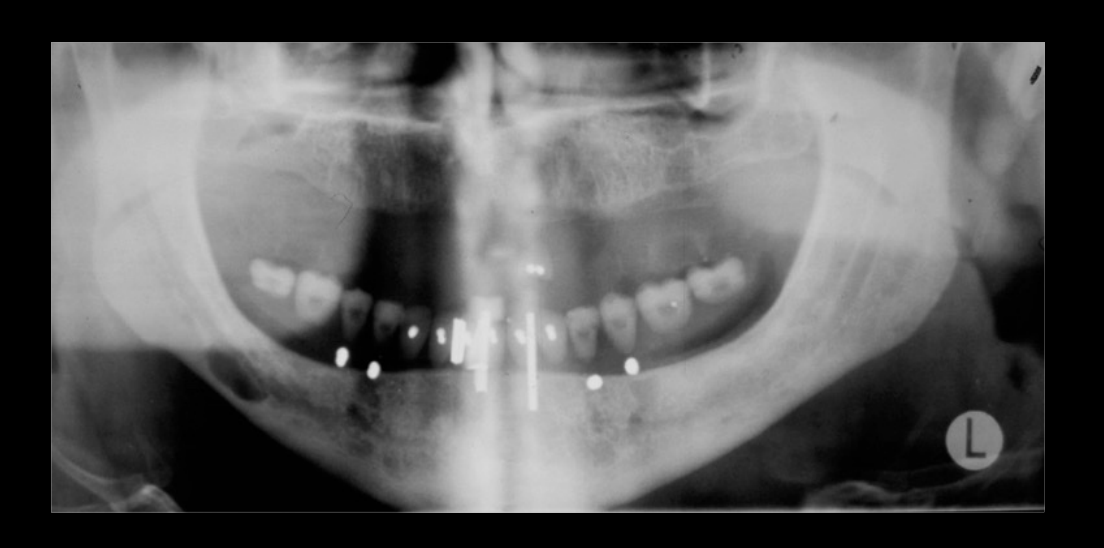
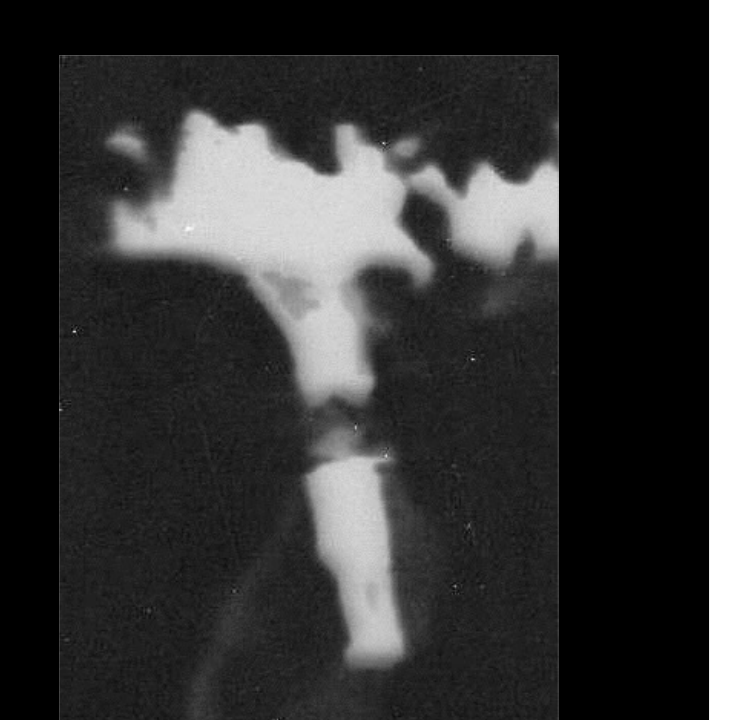
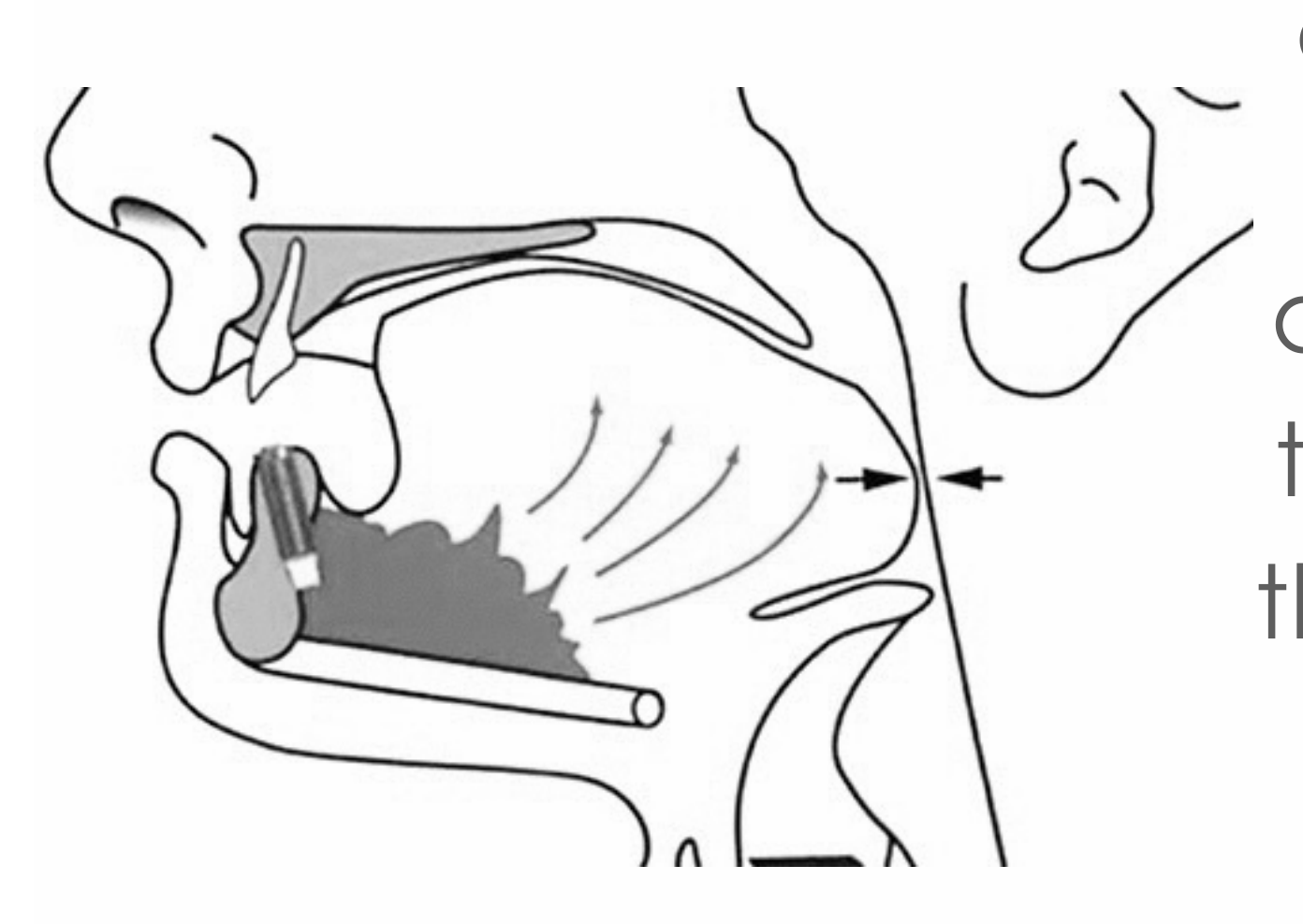
Perforation of the lingual plate of the anterior mandible can damage small branches of local arteries — the terminal branches of the submental artery or the mylohyoid artery.
Bleeding may not be immediately apparent.
 |  |
Airway Compromise from Post-Operative Bleeding18
Slow progressive post-operative bleeding may result in distension of the soft tissues of the floor of the mouth, elevation of the tongue, and compromise of the patient’s airway.
Mason ME, Triplett RG, Alfonso WF. Life threatening hemorrhage from placement of a dental implant. J Oral Maxillofac Surg 1990; 48(2):201–204.
Laboda G. Life threatening hemorrhage after placement of an endosseous implant. JADA 1990; 121:599–600.
Ten Bruggenkate CM, Krekeler G, Kraaijenhagen HA, Foitzik C, Oosterbeek HS. Hemorrhage of the floor of the mouth resulting from lingual perforation during implant placement. Int J Oral Maxillofac Implants 1993; 8(3):329–334.
Lecturer — Lateral Incisor Placement
Although implants have historically been placed in the canine region, the lateral incisor region was recommended for many cases.
- The canine region was historically used because canines were often the last teeth lost, were considered robust, and formed the basis for existing canine-supported overdenture techniques.
- Lateral incisor placement provides more anterior implants and reduces rotation around the anterior axis.
- It leaves space for possible future conversion to a fixed bridge or an all-on-four-type treatment.
- In patients who have worn dentures for a long time, sufficient alveolar bone reduction may already have occurred for appropriate lateral incisor placement.
- In patients transitioning directly from terminal dentition to implants without adequate bone reduction, bundle-bone resorption may expose implant threads and require further treatment or removal and repositioning of the implants.
Mordenfeld A, Andersson L, Bergstrom B. Haemorrhage in the floor of the mouth during implant placement in the edentulous mandible: A case report. Int J Oral Maxillofac Implants 1997; 12:558–561.
Lecturer — Implant Position
Implant position affects the amount of rotation and leverage on the overdenture.
- More anterior placement reduces rotation around the implant axis.
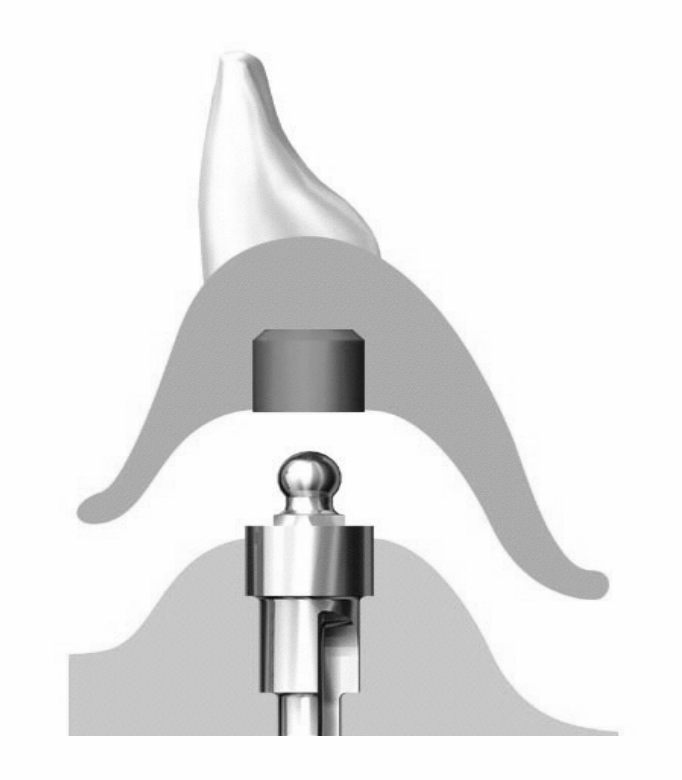
- The attachment should be contained within the denture rather than projecting through it.
- The anterior mandible was described as the principal region for overdenture implants.
Kalpidis CD, Setayesh RM. Haemorrhaging associated with endosseous implant placement in the anterior mandible: A review of the literature. J Periodontol. 2004; 75:63.
Implant Positioning19
Position of the implants?
 |  |
Challenges in Class II Situations2021
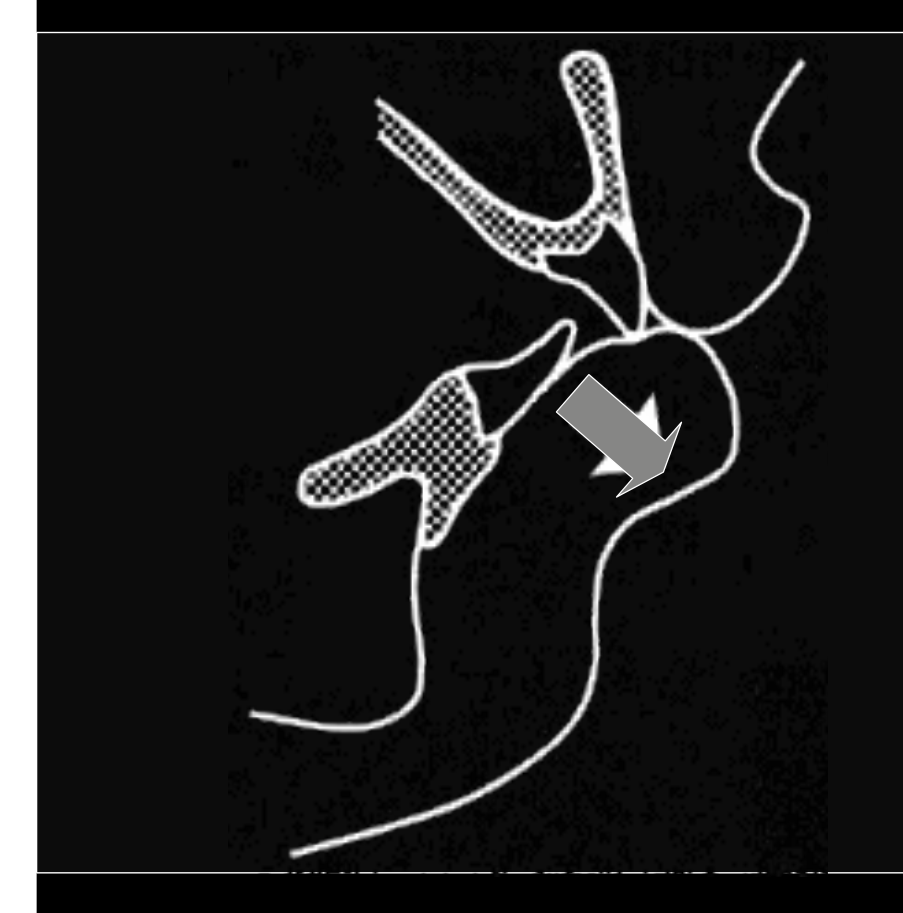
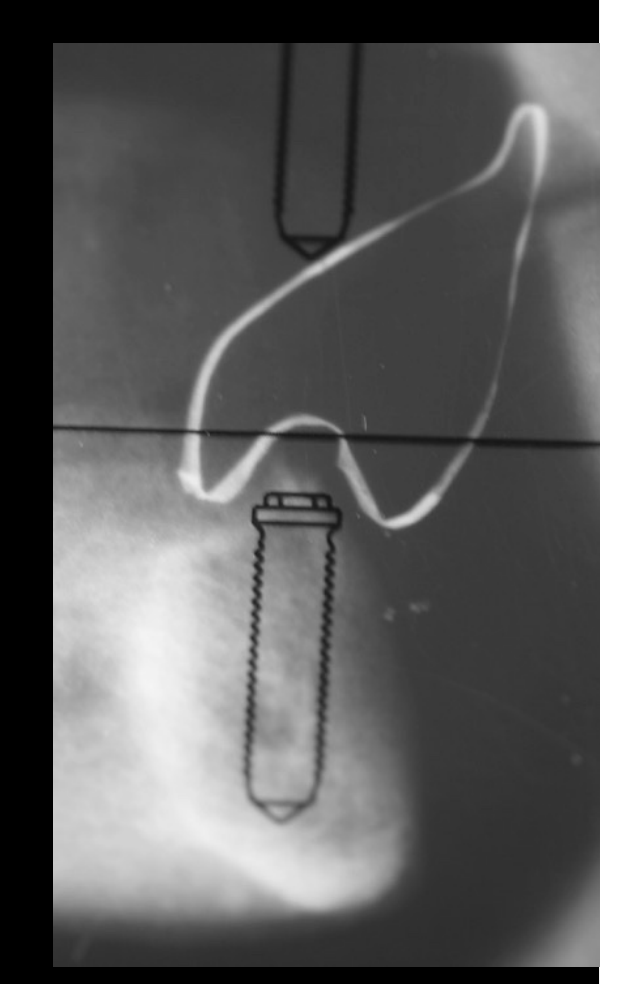
Difficult situation: Angle Class II
 |  |
Placing the Implants in the Lateral Incisor Region22
Placing the implants in the lateral incisor region allows for:
- ↓ lifting during incising
- Antero-posterior stability
- ↓ attachment wear
- Allow for upgrading
Occlusion for Overdentures
Occlusal Concepts and Mastication
Occlusion – overdenture
Tissue borne / implant retained — extrapolated from denture studies.
Lecturer — Overdenture Occlusion
The occlusion for an overdenture is generally similar to that for a conventional denture.
- There is not a large body of research supporting a substantially different occlusal approach for overdentures.
- Simplicity was recommended when selecting and managing the occlusion.
Occlusal Concepts: Mastication, Swallowing and Parafunction23
Masticatory Ability Studies
-
Many studies concentrate on masticatory efficiency
-
Not influenced by occlusal scheme
-
Patient function with a fixed solution is generally better than with an overdenture; the posterior cantilever effect of an anteriorly retained overdenture can reduce function and permit movement or food accumulation beneath the prosthesis.
Patient Satisfaction
- Weak evidence for lingualised occlusion compared to 0° teeth or bilateral balanced articulation.
- Peroz et al — canine guidance gave greater satisfaction than balanced articulation.
Lecturer — Satisfaction and Adaptation
Patients are generally happier with fixed prostheses because they feel more like natural teeth, but overdentures can still produce substantial long-term improvements in satisfaction.
- In a long-term study of single-implant overdentures, satisfaction increased from approximately 20–25% before treatment to approximately 85–90% after treatment, and remained relatively stable over follow-up.
- Satisfaction with a denture is not necessarily closely related to its technical quality.
- Adaptation requires changes in the soft tissues and neuromuscular adaptation of the tongue, cheeks, and oral musculature for speech and denture positioning.
- Older patients may have less neuroplasticity and may take longer to adapt.
- Even a technically improved denture can cause problems if it substantially changes the position or vertical dimension of the teeth.
References
Lang BR. J Prosthet Dent 1994;72:538-542.
Kapur K, Soman S. J Prosthet Dent 1965;15:662-670.
Clough HE, Knodle JM, Leeper SH, Pudwill ML, Taylor DT. J Prosthet Dent. 1983 Aug;50(2):176-9.
Kimoto S et al. Int J Prosthodont. 2006 19(1):103-9.
Peroz I, Leuenberg A, Haustein I, Lange KP. Quintessence Int. 2003 Sep;34(8):607-12.
Occlusal Scheme Selection
Occlusion – overdenture
- Least complicated approach
- Satisfy comfort, aesthetics and function
- Functional and non-functional
- Maximum intercuspation to coincide with CR at acceptable OVD
- Occlusal scheme dependent on patient variables
- Lingualised balanced occlusion
References24
Klineberg I, Kingston D, Murray G. Clin. Oral Impl. Res. 2007;18:151-167.
Lang BR. Dent Clin North Am. 2004 Jul;48(3):641-65.
Hobkirk J (in) Klineberg I, Jagger R. 2004 Occlusion and clinical practice: An evidence-based approach. Wright, Oxford.
Wennerberg A, Carlsson GE, Jemt T. Int J Prosthodont. 2001;14(6):550-5.
Payne AG, Tawes-Smith A, Kumara R, Thomson WM. Clin Impl Dent & Related Res 2001;3:9-19.
Feine J, Carlsson G. Implant overdentures: The standard of care for edentulous patients 2003 Quintessence, Ill.
Single Implant Overdenture
Ten Year Review25
a 10 year review.
Liddelow GJ, Henry PJ. A prospective study of immediately loaded single implant-retained mandibular overdentures: Preliminary one-year results. J Prosthet Dent 2007;97:126-137.
Liddelow GJ, Henry PJ. The immediately loaded single implant retained mandibular overdenture: A 36-month prospective study. Int J Prosthodont 2010;23:13-21.
Lecturer — Long-Term Review
The study was initially reported as a 15-year review and had reached approximately 20 years at the time of the lecture.
- Participants were completely edentulous, able to receive an implant approximately 10 mm long, and generally accepting of a removable prosthesis.
- Dentures needed acceptable fit, appearance, and occlusion; very poor dentures were improved before or during treatment.
- If primary stability was insufficient, a two-stage approach was used.
- The later protocol relieved the denture around the implant, used viscogel temporarily, and incorporated the attachment after approximately six weeks because postoperative swelling made immediate insertion painful or difficult.
- At approximately 20 years, no implant failures were reported, bone loss appeared relatively low, and denture replacement occurred about every five years, similar to conventional denture patients.
- Oral hygiene ranged from very good to poor, particularly among elderly participants dependent on carers, and some mucosal problems occurred when a soft liner was not used.
Single Versus Two Implants26
Single vs Two
-
Maeda et al. (2008)
-
Liu et al. (2013)
-
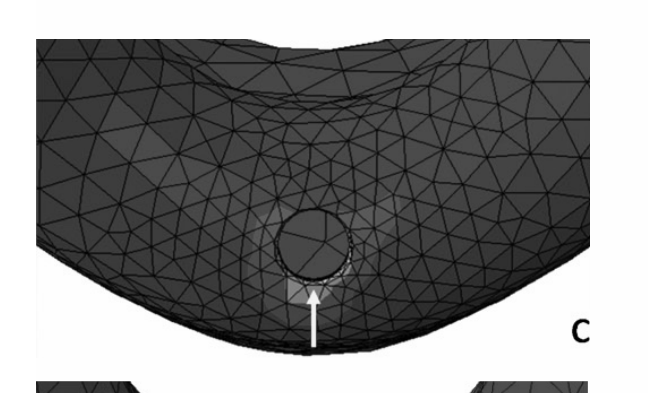
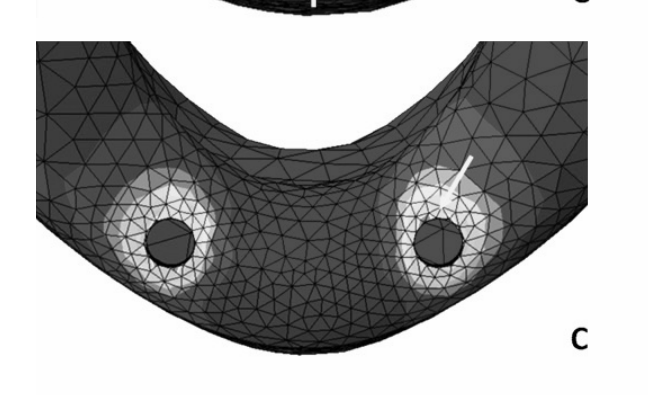
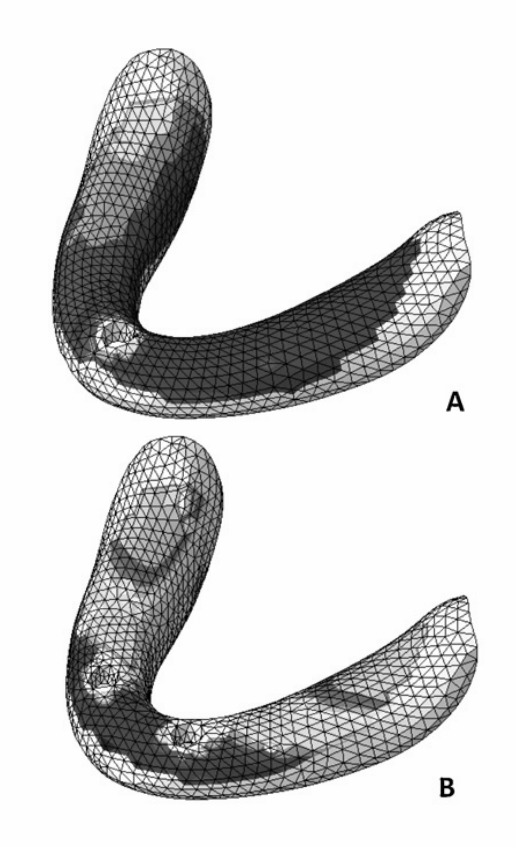
Similar lateral forces to abutments and denture base movements under molar functional loads comparing SIOD and 2IOD
-
5X stress on abutments with 2IOD under incisal load compared with SIOD
-
Greater rotation around 2IOD and loss of mucosal contact with incisal load
Maeda Y, Horisaka M, Kaztomo Y. Biomechanical rationale for a single implant-retained mandibular overdenture: An in vitro study. Clin Oral Impl Res 2008;19:271-275.
Liu J, Pan S, Dong J, Mo Z, Fan Y, Feng H. Influence of implant number on the biomechanical behaviour of mandibular implant-retained/supported overdentures: a three-dimensional finite element analysis. J Dent. 2013;41:241-9.
 |  |
 |
Biomechanics of the Single Implant
The Single Implant27
Similar lateral forces to abutments and denture base movements under molar functional loads comparing SIOD and 2IOD.
Maeda Y, Horisaka M, Kaztomo Y. Biomechanical rationale for a single implant-retained mandibular overdenture: An in vitro study. Clin Oral Impl Res 2008;19:271-275.
Lecturer — Posterior Support
A single anterior implant can retain an overdenture while the posterior denture remains tissue-supported.
- The posterior denture base remains important for support and stability.
- A soft liner may improve comfort, particularly in elderly patients.
Attachment Systems for the Single Implant
The Single Implant28
- No off-axis loading of attachments cf 2IOD
- Resilient matrices and large ball attachments systems of TiN coated patrices provide highest retention and longest service
Alsabeeha N, Swain M, Payne A. Clinical performance and material properties of single-implant overdenture attachment systems. Int J Prosthodont 2011;24:247-254.
Alsabeeha N, Atieh M, Swain M, Payne A. Attachment systems for mandibular single-implant overdentures: An in-vitro retention force investigation on different designs. Int J Prosthodont 2010;23:160-166.
- The resilient attachment incorporated a rubber O-ring, allowing the denture to rotate and move while remaining retained on the implant, with limited wear over the long follow-up period.
One Year Clinical Results
The Single Implant29
1 year results of 36 patients — 6 week delayed loading:
- Southern regular — 75%** — Standard Ball (2.25 and Gold matrix)
- Southern Wide — 100%** — Large ball (5.9 and Plastic matrix)
- Neoss Regular — 100%** — Locator (4mm and nylon insert)
Sig greater maintenance with standard ball and Locator.
Large ball and plastic matrix recommended.
ALSABEEHA N, PAYNE A, DE SILVA R, THOMSON W. MANDIBULAR SINGLE IMPLANT OVERDENTURES: PRELIMINARY RESULTS OF A RANDOMISED-CONTROL TRIAL ON EARLY LOADING WITH DIFFERENT IMPLANT DIAMETERS AND ATTACHMENT SYSTEMS. CLIN ORAL IMPL RES 0011;22:330–337.
ALSABEEHA NH, SWAIN MV, PAYNE AG. CLINICAL PERFORMANCE AND MATERIAL PROPERTIES OF SINGLE-IMPLANT OVERDENTURE ATTACHMENT SYSTEMS. INT J PROSTHODONT. 0011;24:247-54.
Lecturer — Delayed Incorporation
The later clinical protocol accommodated postoperative swelling by relieving the denture around the implant and using viscogel during healing.
- The attachment was definitively incorporated after approximately six weeks.
- This avoided excessive postoperative pressure and made denture insertion more comfortable.
One or Two Implants: Comparative Trials3031
One or two?
- 85 subjects reviewed at one year
- Randomised pre-treat to SIOD or 2IOD
- Single stage, standard ball and relined at 6 weeks
- 5 implant failures prior to loading — all 2IOD
- VAS score improvement of ~44 for both groups
- Median VAS: SIOD 93, 2IOD 94 at one year — no sig difference in satisfaction
- Component cost: SIOD 1679
- Pros maintenance time similar
- SIOD — ↓ component costs, ↓ surgery, ↓ post-surg maintenance, ↓ relined time
Walton J, Glick N, Macentee M. A randomized clinical trial comparing patient satisfaction and prosthetic outcomes with mandibular overdentures retained by one or two implants. Int J Prosthodont 2009;22:331-339.
One or two?
- 36 subjects reviewed at one year
- Randomised pretreat to SIOD or 2IOD
- Single stage, TiUnite Branemark 2.25 ball and reline day of surgery
- Implant survival rate 81.8% — no difference for 1 or 2
- No requirement for high implant stability — 8/10 failures had initial insert torque of 30 Ncm although all had ISQ 69-79
- 28 replacements of O-rings
Kronstrom M, Davis B, Loney R, Gerrow J, Hollender L. A prospective randomised study on the immediate loading of mandibular overdentures supported by one or two implants: A 12 month follow-up report. IJOMI 2010;25:181-188.
Lecturer — Comparative Evidence
Across the comparative studies discussed, one implant generally produced similar satisfaction and survival to two implants.
- A five-year randomised controlled trial found no difference between one and two implants.
- A systematic review also found broadly similar survival rates and patient satisfaction.
- Results may be affected by attachment design, implant stability, implant position, and the quality and fit of the denture.
- The principal practical advantage of one implant is substantially lower cost, making it appropriate for selected elderly patients.
Atieh MA, Alsabeeha NH, Payne AG. Can resonance frequency analysis predict failure risk of immediately loaded implants? Int J Prosthodont. 2012;25:326-39.
Current and Future Directions
Manual Skill and Visual Acuity32
Nursing Homes and Oral Hygiene
- 91yo F
- Dementia
- 10yr SIOD
- 1 reline
Lecturer — Nursing Home Care
In nursing-home settings, removable dentures and a small number of implants may be easier for carers to clean than a fixed bridge.
- The prosthesis must still be removed and cleaned to limit plaque, food accumulation, and anaerobic conditions.
- Patient management and comfort are particularly important when a denture rests on tissues and receives functional loading.
- In the 91-year-old patient with dementia, carers maintained the denture relatively well, helping preserve quality of life.
Maxillary Overdentures
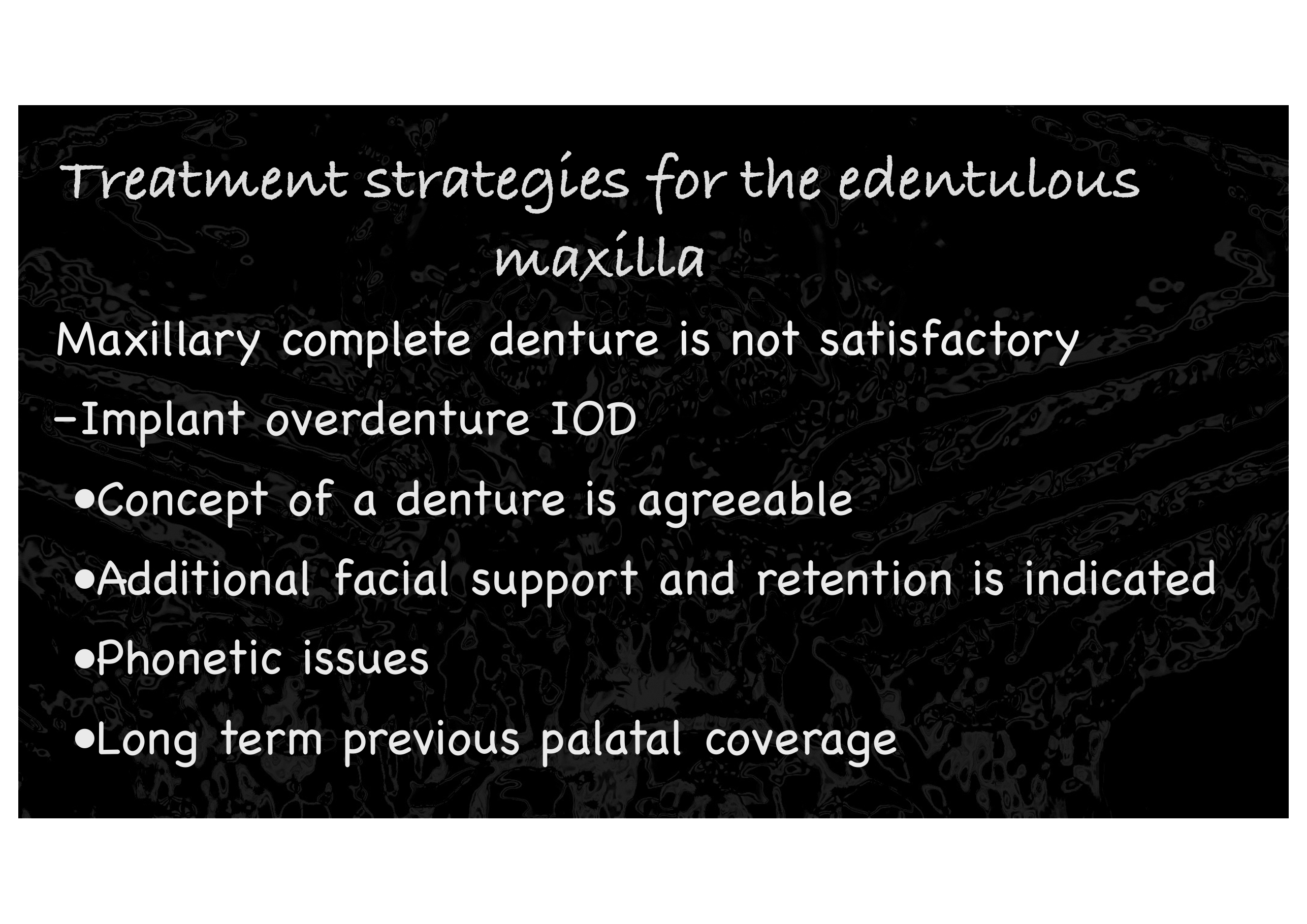
Treatment Strategies for the Edentulous Maxilla33
The maxillary complete denture is not satisfactory in many cases. An implant overdenture (IOD) is indicated when:
- The concept of a denture is agreeable to the patient
- Additional facial support and retention is indicated
- Phonetic issues are present
- There is long-term previous palatal coverage
Lecturer — Maxillary Treatment Choice
Maxillary overdentures are generally rescue or fallback treatments because the maxilla is softer, less dense, and less able to resist loading.
- Many patients are satisfied with conventional upper dentures because they can provide good suction, good aesthetics, and relatively economical treatment.
- When implants are used in the maxilla, patients often prefer a fixed bridge.
Implant Detachable Prosthesis34
- Implant supported
- Palate not covered
- Facilitates plaque control
- May facilitate maintenance
- May facilitate technical procedures
Often a fallback strategy where facial support with a denture flange is indicated.
Unfavourable Implant Angulation
Implants placed by another provider emerged with unfavourable angulation, and a previous fixed bridge did not provide adequate lip support.
- The implants were splinted with a gold bar, and a detachable prosthesis with a flange was made to improve lip support.
- In another case, a patient who had used the prosthesis comfortably for a long period received a replacement approximately ten years later and eventually received fixed bridges.
Survival and Complications35
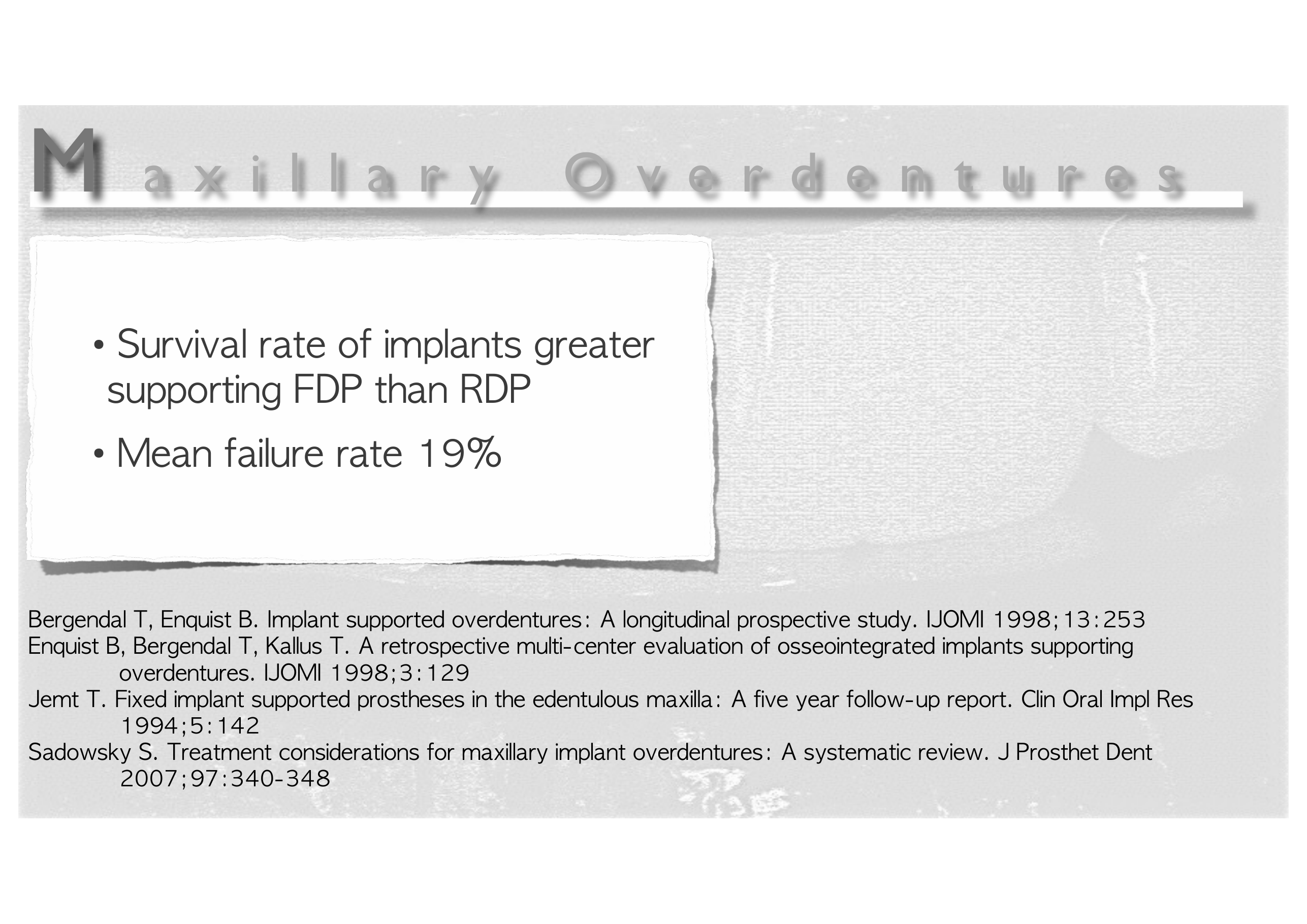
- Survival rate of implant (mandibular) supported FDP > RDP
- Mean failure rate 13%
Bergendal T, Enquist B. Implant supported overdentures: A longitudinal prospective study. IJOMI 1998;13:253.
Enquist B, Bergendal T, Kallus T. A retrospective multi-center evaluation of osseointegrated implants supporting overdentures. IJOMI 1998;3:129.
Jemt T. Fixed implant supported prostheses in the edentulous maxilla: A five year follow-up report. Clin Oral Implants Dent 1994;5:142.
Sadowsky S. Treatment considerations for maxillary implant overdentures: A systematic review. J Prosthet Dent 2007;97:340-348.
Overdenture complications are higher than with fixed prostheses:
-
↑ Peri-implant problems
-
↑ Mechanical problems (attachments)
-
↓ Phonetic problems
-
Implant failure was described as approximately 20% with overdentures compared with approximately 3% for fixed bridges. Bergendal T, Enquist B. Implant supported overdentures: A longitudinal prospective study. IJOMI 1998;13:253.
Enquist B, Bergendal T, Kallus T. A retrospective multi-center evaluation of osseointegrated implants supporting overdentures. IJOMI 1998;3:129.
Jemt T. Failures and complications in 92 consecutively inserted overdentures supported by Brånemark implants in severely resorbed edentulous maxillae: a study from prosthetic treatment to first annual check-up. Fixed implant supported prostheses in the edentulous maxilla: A five year follow-up report. IJOMI 1992;7:162–167.
Lecturer — Complication Mechanisms
The lecturer attributed the complication burden to the combination of soft maxillary bone, overdenture loading, poor hygiene beneath the prosthesis, and movement and pressure around the implants.
- Maxillary overdentures may also have more mucosal complications and more bone loss than fixed bridges.
Adjustments and Repairs36
- Significantly more post-placement adjustments and repairs than fixed prostheses
- 50% require adjustment or repair in the first 3 years
- Repeated repairs are significant
- 72–98 minutes for maintenance during the first year
- ↑ Mechanical problems with maxillary overdentures vs mandibular overdentures
- Walton JN, MacEntee MI. A retrospective study on the maintenance and repair of implant-supported prostheses. Int J Prosthodont. 1993 Sep-Oct; 6(5): 451-5.
- Watson GK, Payne AG, Purton DG, Thomson WM. Mandibular overdentures: professional time for prosthodontic maintenance during the first year of service using three different implant systems. Int J Prosthodont. 2002 Jul-Aug; 15(4): 379-84.
- Watson RM, Jemt T, Chai J, Harnett J, Heath MR, Hutton JE, Johns RB, Lithner B, McKenna S, McNamara DC, Naert I, Taylor R. Prosthodontic treatment, patient response, and the need for maintenance of complete implant-supported overdentures: an appraisal of 5 years of prospective study. Int J Prosthodont. 1997 Jul-Aug; 10(4): 345-54.
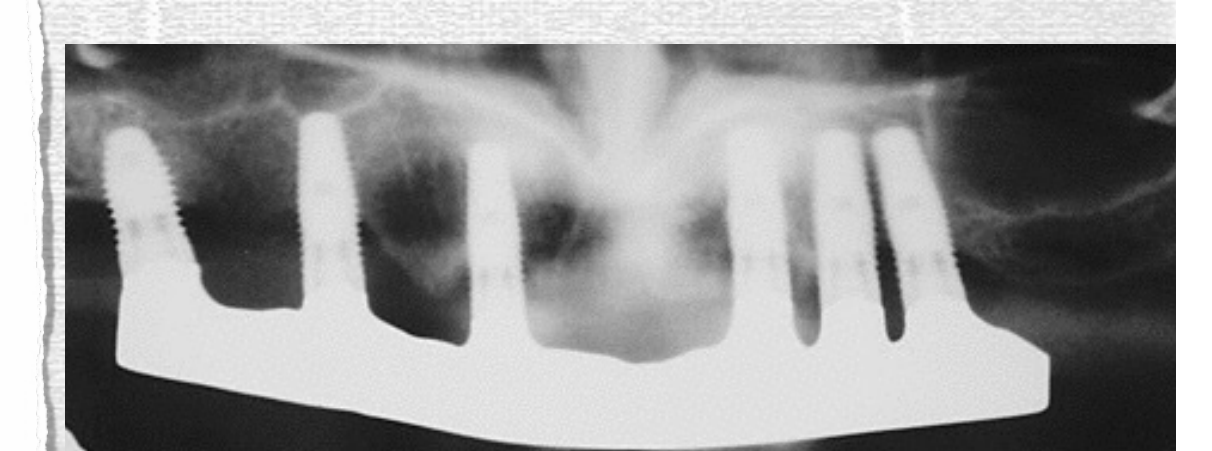
Design Criteria37
-
Established criteria for IOD design are lacking
-
Minimum of 4 implants, well spaced
-
2–3× greater risk of failure with each increment of worse bone quality
-
Treatment selection must also consider lip support, implant angulation, patient expectations, hygiene capacity, cost, and acceptance of a removable prosthesis. Bergendal T, Enquist B. Implant supported overdentures: A longitudinal prospective study. IJOMI 1998;13:253.
Enquist B, Bergendal T, Kallus T. A retrospective multi-center evaluation of osseointegrated implants supporting overdentures. IJOMI 1998;3:129.
Jemt T. Failures and complications in 92 consecutively inserted overdentures supported by Brånemark implants in severely resorbed edentulous maxillae: A study from prosthetic treatment to first annual check-up. Fixed implant supported prostheses in the edentulous maxilla: A five year follow-up report. IJOMI 1992;7:162-167.
Sadowsky S. Treatment considerations for maxillary implant overdentures: A systematic review. J Prosthet Dent 2007;97:340-348.
Connection of Implants38
-
Greater bone loss around non-splinted implants (small studies)
-
Increased bone loss with overdentures anyway, but often clustered
-
Splinting may improve force distribution and provide a more stable attachment platform.
-
Bars may be combined with clips, locator attachments, or other attachment mechanisms. Quirynen M, Naert I, van Steenberghe D, Teerlinck J, Dekeyser C, Theuniers G. Periodontal aspects of osseointegrated fixtures supporting an overdenture. A 4-year retrospective study. J Clin Periodontol. 1991;18(10):719-28.
Naert I, Quirynen M, Theuniers G, van Steenberghe D. Prosthetic aspects of osseointegrated fixtures supporting overdentures. A 4-year report. J Prosthet Dent. 1991;65(5):671-80.
Närhi TO, Hevinga M, Voorsmit RA, Kalk W. Maxillary overdentures retained by splinted and unsplinted implants: a retrospective study. Int J Oral Maxillofac Implants. 2001;16(2):259-66.
Mericske-Stern R, Oetterli M, Kiener P, Mericske E. A follow-up study of maxillary implants supporting an overdenture: clinical and radiographic results. Int J Oral Maxillofac Implants. 2002;17(5):678-86.
Sadowsky S. Treatment considerations for maxillary implant overdentures: A systematic review. J Prosthet Dent 2007;97:340-348.
Stoumpis C, Kohal J. To splint or not to splint oral implants in implant supported overdenture therapy? A systematic review. J Oral Rehab 2011;38:857-869.
Bar Design Recommendations39
- Maxillary overdentures should be supported by at least 4 implants, evenly distributed and connected by a bar
- 1–2 mm space between bar and mucosa
- Height as small as possible for comfort and strength of the prosthesis
Mericske-Stern R. Treatment outcomes with implant-supported overdentures: clinical considerations. J Prosthet Dent. 1998;79(1):66-73. Review.
Mericske-Stern R. Prosthodontic management of maxillary and mandibular overdentures. In Feine J, Carlsson G (eds) Implant overdentures. The standard of care for edentulous patients. Quintessence. 2003.
Hemmings KW, Welfare RD. A technique for the replacement of implant-retained overdentures. J Prosthet Dent. 1994 Aug;72(2):219-21.
Sadovsky S. Treatment considerations for maxillary implant overdentures: A systematic review. J Prosthet Dent 2007;97:340-348.
Andreiotelli M, Att W, Strub J. Prosthodontic complications with implant overdentures: A systematic review. Int J Pros 2010;23:195-203.
Lecturer — Mucosal Environment
Reduced saliva circulation and persistent coverage beneath bars or covered areas can promote an anaerobic environment with plaque and food accumulation.
- This may increase pathogenic bacteria and inflammation.
- The mucosa should be monitored during follow-up, and the prosthesis may require adjustment to relieve pressure.
Mucosal Complications40
- Mucosal enlargement common — up to 64%
- Denture stomatitis 31%
- Negative pressure gradient
- Acidogenic environment
Ekfeldt A, Johansson LA, Isaksson S. Implant supported overdenture therapy: A retrospective study. Int J Pros 1997;10:366-374.
Watson R, Jemt T, Chai J, Harnett J et al. Prosthodontic treatment, patient response and the need for maintenance of complete implant supported overdentures; an appraisal of 5 years of prospective study. Int J Pros 1997;10:345-354.
Naert I, Gizani S, van Steenberghe D. Rigidly splinted implants in the resorbed maxilla to retain a hinging overdenture: a series of clinical reports for up to 4 years. J Pros Dent 1998;79:156-164.
Bone Considerations in the Maxilla41
-
50% of ridge width lost in the 1st year
-
Mean thickness inferior to floor of sinus: 6.1 ± 2.8 mm
-
↓ Bone quality in the posterior maxilla → ↓ implant survival rate
-
A single implant was not considered suitable for maxillary overdenture support in the situations discussed. Schropp L, Wenzel A, Kostopoulos L. Bone healing and soft tissue contour changes following tooth extraction. I J Perio Rest Dent 2003;23:313.
Razavi R, Zena R, Khan Z. Anatomic site evaluation of the edentulous maxilla for dental implant placement. J Pros 1995;4:90.
Tolstunov L. Implant zones of the jaws: Implant location and related success rate. J Oral Implantol 2007;33:211.
The Edentulous Predicament42
Diagram illustrating the edentulous predicament, comparing optimised management with acceptable management, over a dental X-ray background.
Optimised management
- State of the art
- Aesthetic demand
Acceptable management
- Public health
- Consequences of tooth loss
Lecturer — Treatment Planning
Treatment should distinguish between what is optimal, what is acceptable, and what the patient can tolerate medically, functionally, and financially.
- Conventional dentures remain effective for many patients, while implant overdentures may substantially help selected elderly denture wearers who are struggling but accept a removable prosthesis.
- Fixed solutions generally provide better function and patient satisfaction but may be more expensive and technically demanding.
- Planning should account for patient expectations, the prognosis of remaining teeth, medical risk, hygiene support, cost-benefit considerations, and long-term maintenance.
- The lecturer stressed that complex implant procedures require appropriate training, mentorship, case volume, and evaluation; clinicians should progress gradually rather than adopting advanced treatments based primarily on marketing or online demonstrations.
Clinical Cases
Case: Prosthodontic rehabilitation for a child with few remaining teeth
Question
Scenario: A 5-year-old child with dysplasia who has approximately four deciduous teeth remaining.
What’s shown: The clinical situation of a young patient with very few remaining primary teeth.
Consider: What type of prosthesis is appropriate to restore function and aesthetics for this patient?
Answer
Observations:
- The child has only about four deciduous teeth remaining due to dysplasia.
Reasoning: An overdenture can be designed to cover or rest over these remaining deciduous teeth. The primary teeth provide retention for the prosthesis while preserving the alveolar bone.
Takeaway: Overdentures can be utilized at the extreme end of age and dentition, such as in young children with severe tooth dysplasia, by retaining the prosthesis over the few remaining deciduous teeth.
Case: Soft tissue reaction around an implant overdenture bar
Question
Scenario: A patient with an implant-supported mandibular overdenture.
What’s shown: An intraoral view showing mucosa that appears enlarged and is almost contacting the underlying metal bar.
Consider: What is causing this soft tissue enlargement and what are the implications for peri-implant health?
Answer
Observations:
- The mucosa is enlarged and nearly hitting the bar.
- The tissue appears to be in an anaerobic environment.
Reasoning: When a denture covers the tissue over a bar, it reduces oxygen and limits the flushing action of saliva. This creates an acidogenic environment that promotes anaerobic bacteria, leading to mucosal enlargement and a higher incidence of peri-implant disease compared to fixed options.
Takeaway: Removable overdentures covering implant bars create an environment prone to plaque accumulation and anaerobic bacterial growth, leading to increased mucosal inflammation and peri-implant disease.
Case: Mandibular implant overdenture conversion
Question
Scenario: A male patient who has worn dentures for a long period and is satisfied with the concept of a removable prosthesis.
What’s shown: The sequence of placing implants in the lateral incisor positions, adjusting the existing denture, and later incorporating attachments.
Consider: What are the surgical and prosthetic steps to transition this patient to an implant-retained overdenture?
Answer
Observations:
- Implants are placed in the lateral incisor positions within the body of the denture.
- The denture is adjusted and relined with a soft material initially.
- After soft tissue healing, the denture is converted to incorporate attachments.
Reasoning: Placing implants in the lateral incisor region minimizes rotation and keeps the attachments within the denture base. A soft reline allows for tissue swelling post-surgery. Once healed, the denture is converted to clip onto the attachments, providing retention while maintaining tissue support.
Takeaway: For patients happy with removable prostheses, placing two implants in the anterior mandible and converting the existing denture with a soft liner followed by attachments is a practical and cost-effective overdenture approach.
Case: Long-term single-implant overdenture in an elderly patient
Question
Scenario: A 91-year-old lady with dementia who has been using a single-implant overdenture for approximately 10 years.
What’s shown: The long-term clinical outcome of the prosthesis, which is maintained by her carers.
Consider: How does this treatment modality perform in elderly, medically compromised patients over a long period?
Answer
Observations:
- The patient has had the single-implant overdenture for 10 years.
- The prosthesis is kept clean by carers.
- The patient maintains a decent quality of life despite having dementia.
Reasoning: A single implant in the anterior mandible can significantly improve the stability and function of a lower denture. In geriatric patients where complex fixed prostheses or extensive hygiene routines are unfeasible, a simple overdenture maintained by carers provides a highly satisfactory and functional outcome.
Takeaway: Single-implant retained overdentures are a highly applicable and maintainable treatment option for elderly or medically compromised patients, offering improved quality of life with manageable hygiene requirements.
Case: Maxillary overdenture anchored in the canine fossa
Question
Scenario: A female patient who has had a maxillary overdenture for a long period and is happy with the treatment.
What’s shown: The prosthesis anchored in the canine fossa region.
Consider: How is retention achieved for this maxillary overdenture?
Answer
Observations:
- The overdenture is anchored basically in the canine fossa.
- The patient has been happy with the prosthesis for a long period.
Reasoning: The maxilla generally allows for good suction and aesthetics with conventional dentures. When implants are used, anchoring in the canine fossa provides additional retention and stability for the overdenture, serving as a reliable long-term solution for patients satisfied with removable options.
Takeaway: Maxillary overdentures can be successfully anchored in the canine fossa, providing excellent retention for patients who are happy with the removable nature of their prosthesis.
Case: Management of poorly angled maxillary implants with a detachable bridge
Question
Scenario: A patient with maxillary implants placed by another provider that have poor angulation, resulting in a fixed bridge with inadequate lip support.
What’s shown: Implants angling out the top of the ridge and a proposed treatment using a gold bar.
Consider: How can this fallback situation be managed to restore proper lip support and aesthetics?
Answer
Observations:
- Implants have poor angulation, emerging too far superiorly.
- The previous fixed bridge lacked adequate lip support.
- A gold bar is used to splint the implants.
Reasoning: By splinting the poorly angled implants with a gold bar, a detachable bridge (overdenture) can be fabricated. This design allows for the addition of an acrylic flange to replace the lost hard and soft tissue, thereby restoring the necessary lip support and aesthetics that the fixed bridge could not provide.
Takeaway: When maxillary implants are poorly angled and result in a lack of lip support with a fixed bridge, converting to a detachable bar-retained overdenture allows for flange addition to restore facial aesthetics.
Case: Maxillary overdenture retained by magnets
Question
Scenario: A maxillary overdenture case utilizing magnetic attachments for retention.
What’s shown: A gold bar containing magnets that attach to corresponding magnets in the prosthesis.
Consider: What are the mechanics and considerations of using magnets in this overdenture design?
Answer
Observations:
- A gold bar incorporates magnets.
- These magnets attach to corresponding magnets in the overdenture.
Reasoning: Magnets can provide retention for overdentures. However, careful attention must be paid to the polarization of the magnets to ensure the denture seats correctly and does not get dislodged or “spilled.”
Takeaway: Magnetic attachments incorporated into a gold bar can be used to retain maxillary overdentures, though correct polarization is critical for proper seating.
Case: Trefoil concept with a preformed bar for patients of varying heights
Question
Scenario: Two patients, one 130 cm tall and the other 210 cm tall, treated with a standardized implant concept.
What’s shown: Both patients receiving the exact same triangle spread of three implants and a preformed bar.
Consider: How can a standardized, non-customized implant framework be successfully applied to patients with vastly different anatomical dimensions?
Answer
Observations:
- Both patients received the same triangle spread of three implants in the anterior mandible.
- A preformed bar was used for both patients.
- The concept fits approximately 85% of patients.
Reasoning: The Trefoil concept utilizes a pre-manufactured bar and a standardized surgical guide to place three implants in the anterior mandible. Because the anterior mandible’s anatomy between the mental foramina is relatively consistent across different patient heights, the same preformed bar can be used, significantly reducing laboratory costs and surgical time compared to custom-milled frameworks.
Takeaway: Standardized, preformed implant frameworks can be successfully used across patients of varying heights by relying on the consistent anatomical landmarks of the anterior mandible, offering a cost-effective alternative to custom frameworks.
Footnotes
-
Original PDF page 1: L4 Overdentures, p.1 ↩
-
Original PDF page 2: L4 Overdentures, p.2 ↩
-
Original PDF page 3: L4 Overdentures, p.3 ↩
-
Original PDF page 4: L4 Overdentures, p.4 ↩
-
Original PDF page 5: L4 Overdentures, p.5 ↩
-
Original PDF page 7: L4 Overdentures, p.7 ↩
-
Original PDF page 8: L4 Overdentures, p.8 ↩
-
Original PDF page 9: L4 Overdentures, p.9 ↩
-
Original PDF page 10: L4 Overdentures, p.10 ↩
-
Original PDF page 11: L4 Overdentures, p.11 ↩
-
Original PDF page 12: L4 Overdentures, p.12 ↩
-
Original PDF page 13: L4 Overdentures, p.13 ↩
-
Original PDF page 14: L4 Overdentures, p.14 ↩
-
Original PDF page 15: L4 Overdentures, p.15 ↩
-
Original PDF page 16: L4 Overdentures, p.16 ↩
-
Original PDF page 17: L4 Overdentures, p.17 ↩
-
Original PDF page 19: L4 Overdentures, p.19 ↩
-
Original PDF page 18: L4 Overdentures, p.18 ↩
-
Original PDF page 20: L4 Overdentures, p.20 ↩
-
Original PDF page 21: L4 Overdentures, p.21 ↩
-
Original PDF page 22: L4 Overdentures, p.22 ↩
-
Original PDF page 23: L4 Overdentures, p.23 ↩
-
Original PDF page 24: L4 Overdentures, p.24 ↩
-
Original PDF page 25: L4 Overdentures, p.25 ↩
-
Original PDF page 26: L4 Overdentures, p.26 ↩
-
Original PDF page 27: L4 Overdentures, p.27 ↩
-
Original PDF page 28: L4 Overdentures, p.28 ↩
-
Original PDF page 29: L4 Overdentures, p.29 ↩
-
Original PDF page 30: L4 Overdentures, p.30 ↩
-
Original PDF page 31: L4 Overdentures, p.31 ↩
-
Original PDF page 32: L4 Overdentures, p.32 ↩
-
Original PDF page 33: L4 Overdentures, p.33 ↩
-
Original PDF page 34: L4 Overdentures, p.34 ↩
-
Original PDF page 35: L4 Overdentures, p.35 ↩
-
Original PDF page 37: L4 Overdentures, p.37 ↩
-
Original PDF page 38: L4 Overdentures, p.38 ↩
-
Original PDF page 39: L4 Overdentures, p.39 ↩
-
Original PDF page 40: L4 Overdentures, p.40 ↩
-
Original PDF page 41: L4 Overdentures, p.41 ↩
-
Original PDF page 42: L4 Overdentures, p.42 ↩
-
Original PDF page 43: L4 Overdentures, p.43 ↩
-
Original PDF page 44: L4 Overdentures, p.44 ↩