Interdisciplinary Dentofacial Therapy1
J. Mike Razza, BS, DDS, Cert Orthod
Associate Professor - Orthodontics
University of Western Australia
School of Dentistry
Dental And Dentofacial Therapies2
- Unidisciplinary Therapy
- Multidisciplinary Therapy
- Interdisciplinary Therapy
Unidisciplinary Therapy3
- Diagnosis
- Treatment Planning
- Therapy and Maintenance
All provided by the same clinician
Disadvantages4
-
Often yields compromised results
-
Treatment plan dependent on individuals’ capabilities
-
May use restorative means only to address a problem
-
If attempts to deliver care from a specialty area – limited skills and knowledge
-
Patients may not be offered treatment options outside the clinician’s skills, such as dental implants if the clinician does not place them.
-
A restorative approach may be used instead of orthodontic treatment; an anterior crossbite could be treated by preparing and reducing teeth, resulting in more heavily restored teeth.
-
Different professional viewpoints are not necessarily obtained.
Multidisciplinary Therapy5
-
Major advantage over Unidisciplinary
-
Uses specialists in a haphazard role
-
Poor communication as to where the treatment is going and when
-
Rarely yields ideal results
-
Specialists may be consulted only after treatment has already been completed.
Interdisciplinary Therapy6
-
Excellent communication between clinicians with several backgrounds
-
Treatment plan established collectively
-
Treatment leader established sequencing of activities
-
The general dentist should initiate the process and direct the patient toward appropriate care.
-
Different specialists contribute their evaluations and recommendations.
-
The team must determine which clinicians should be involved, when they should become involved, the treatment order, and how treatments will interact.
-
The general dentist remains involved in coordinating and monitoring treatment.
Overview Of The IDT Phases
Interdisciplinary Dentofacial Therapy Flow Chart7
- Preliminary Therapy: Prelude to IDT
- Diagnostics: Phase I of IDT
- Treatment Planning: Phase II of IDT
- Definitive Therapy: Phase III of IDT
- Maintenance: Phase IV of IDT
- The flow of treatment depends on the patient’s needs, so a patient may proceed through several treatment areas or require only some of them.
- The patient first presents to a general dentist or a specialist.
- Initial care includes relief of pain and management of urgent problems.
- The patient receives preliminary dentofacial counseling about possible treatment options.
- The patient may decline complex treatment and remain in maintenance, receive routine treatment, or continue with compromised unidisciplinary treatment.
- Patients who enter interdisciplinary therapy proceed through diagnostics, treatment planning, definitive therapy, and maintenance, with order and timing determined by their specific problems.
Preliminary Therapy: Prelude To IDT
INITIAL DENTOFACIAL COUNSELING
Decision Not to Enter Interdisciplinary Therapy8
-
Unidisciplinary Compromised Therapy
-
Maintenance Only with Continuing Dentofacial Counseling
-
The patient may choose no treatment.
-
The patient may remain under maintenance observation.
-
The patient may receive routine treatment, such as cleaning or small restorations.
-
The patient may decide not to enter treatment immediately but continue discussing and monitoring the problem.
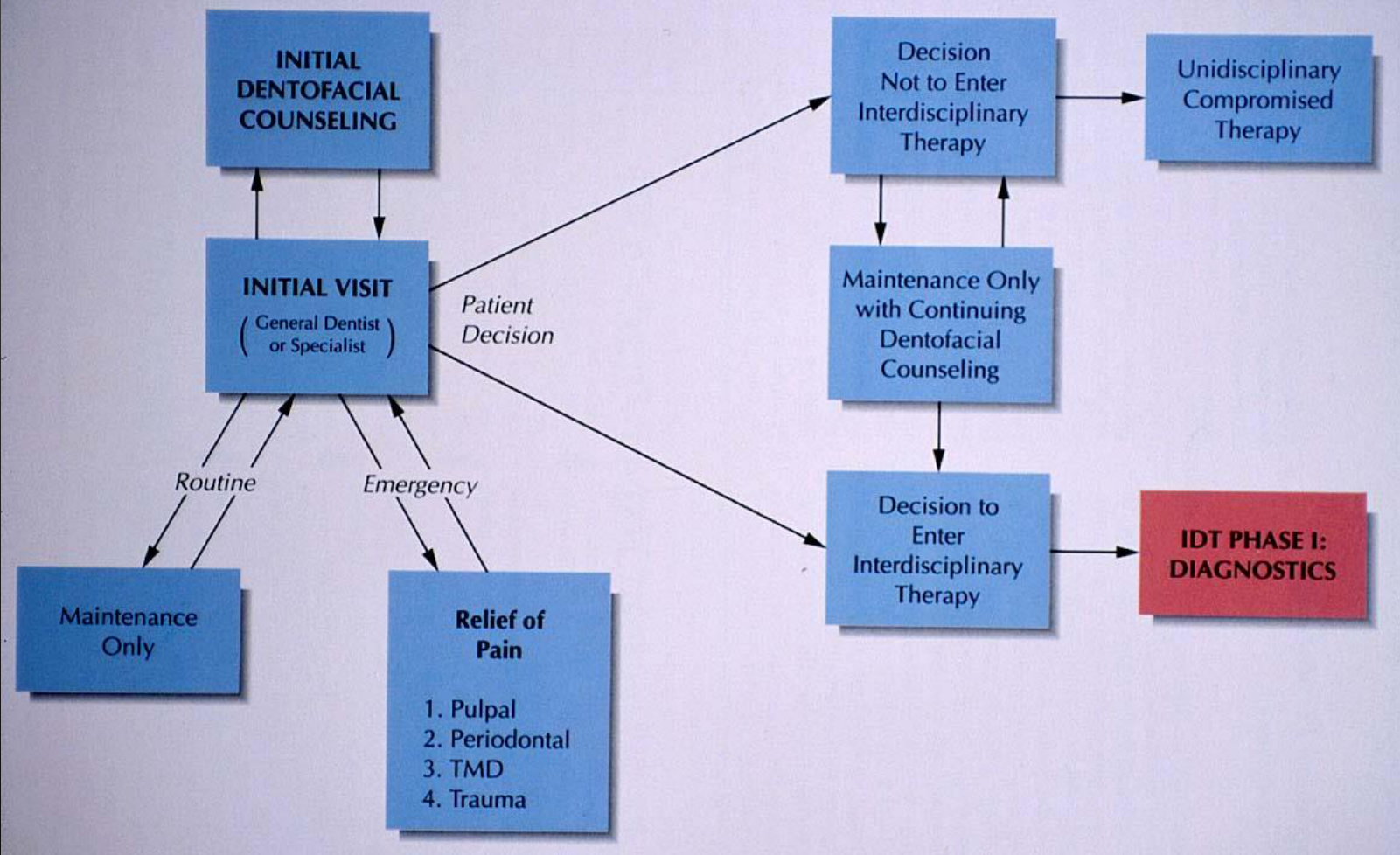
Initial Visit (General Dentist or Specialist)
Patient Decision:
- Routine
- Emergency
- Maintenance Only
Initial Visit And Patient Decision
Relief of Pain:
- Pulpal
- Periodontal
- TMD
- Trauma
Lecturer — Initial Visit Counseling
Pain and emergency problems must be managed at the first visit, and urgent needs should not be postponed while complex treatment is discussed.
- Preliminary dentofacial counseling should explain possible treatment options, including possible solutions for a severe Class 3 relationship, an anterior crossbite, or an underlying skeletal problem.
- The clinician should discuss ways to resolve the problem without assuming that the patient will accept complex treatment.
Decision to Enter Interdisciplinary Therapy
IDT PHASE I: DIAGNOSTICS
Lecturer — Entering Interdisciplinary Therapy
The patient’s decision determines whether treatment proceeds toward interdisciplinary therapy.
- The preliminary discussion is not yet a complete diagnostic assessment.
- Further evaluation is required before a definitive plan can be established.
Interdisciplinary Dentofacial Therapy, A Comprehensive Approach to Optimal Patient Care, R.D. Roblee
Diagnostics: Phase I Of IDT
Diagnostics Phase I of IDT
- General Dentofacial Evaluation
- Patient History
- Clinical Examination
- Analysis of Diagnostic Records
Lecturer — Diagnostic Purpose
The diagnostic phase establishes the patient’s general dentofacial status and identifies problems requiring further evaluation.
General Dentofacial Evaluation9
Preliminary Problem List Worksheet
Diagnostics Phase I of IDT
IDT Preliminary Problem List Worksheet10
PATIENT: ___________________________________ DATE: ________________
I. CHIEF CONCERN/MOTIVATION/EXPECTATIONS/SPECIAL CONCERNS
II. HISTORY (PERSONAL, MEDICAL, DENTAL AND TEMPOROMANDIBULAR)
III. FACIAL/SKELETAL
IV. TEMPOROMANDIBULAR
V. OCCLUSAL (RELATIONSHIPS AND FUNCTION)
VI. PERIODONTAL
VII. DENTAL/IMPLANT
Specialized Evaluations (N = Needed, C = Completed, S = Screened during general evaluation and not indicated)
Lecturer — Medical Evaluation
Medical findings may require additional medical evaluation before complex restorative treatment begins.
- A patient with severely worn or eroded teeth may need assessment by a gastroenterologist when gastric reflux is suspected.
- The underlying medical problem should be addressed before complex restorative treatment.
- RESTORATIVE ________________ PERIODONTAL ________________ ORTHODONTIC ________________
- ENDODONTIC ________________ IMPLANT ________________ MEDICAL ________________
- ORAL AND MAXILLOFACIAL SURGICAL ________________ OTHER ________________
Preliminary Database And Patient Conference111213
- Preliminary Database
- Preliminary Problem List
- Preliminary Treatment Plan(s)
Preliminary Patient Conference
- Referrals to Team Members
Lecturer — Patient Conference
The preliminary database integrates relevant dental, facial, medical, and functional findings to support treatment planning.
- The patient’s preferences, ability to cope with treatment, and willingness to consider different options must be considered.
- The patient should be informed about the possible need for several clinicians.
Specialized Evaluation By Team Members14
Specialized Evaluation
- Prosthodontist
- Restorative Dentist
- Periodontist
- Orthodontist
- Oral and Maxillofacial Surgeon
- Endodontist
- Craniofacial Pain Specialist
- Paediatric Dentist
- Physician
- Lab Technician
- Psychiatrist
- ENT Specialist
- Plastic Surgeon
Lecturer — Team Collaboration
Team members should be selected according to the patient’s needs and their ability to communicate, collaborate, and provide the required treatment.
- Specialists return findings to the interdisciplinary team.
- The team considers how each problem affects the others, and additional diagnostic procedures may be needed before finalizing the plan.
- A diagnostic setup may be required to determine whether the proposed treatment will fit together and work properly.
Unidisciplinary Databases15
Initial Therapy16
- Periodontal
- Pulpal
- TMD
- Psychological
- Systemic Diseases
Lecturer — Individual Databases
Separate databases provide the information needed for the interdisciplinary problem list and treatment-planning process.
Lecturer — Initial Therapy
Initial therapy addresses problems that must be managed before complex treatment begins.
- Emergency problems and pain are treated first.
- Active periodontal disease must be controlled before orthodontic tooth movement, with periodontal inflammation and bleeding on probing minimized as much as possible.
- A periodontal problem need not be completely resolved, but it should be under control.
- Treatment timing must be considered before placing bridges, implants, or other restorations.
Treatment Planning: Phase II Of IDT
Multidisciplinary Database → Interdisciplinary Problem List
Team Conferencing And Problem Prioritization171819
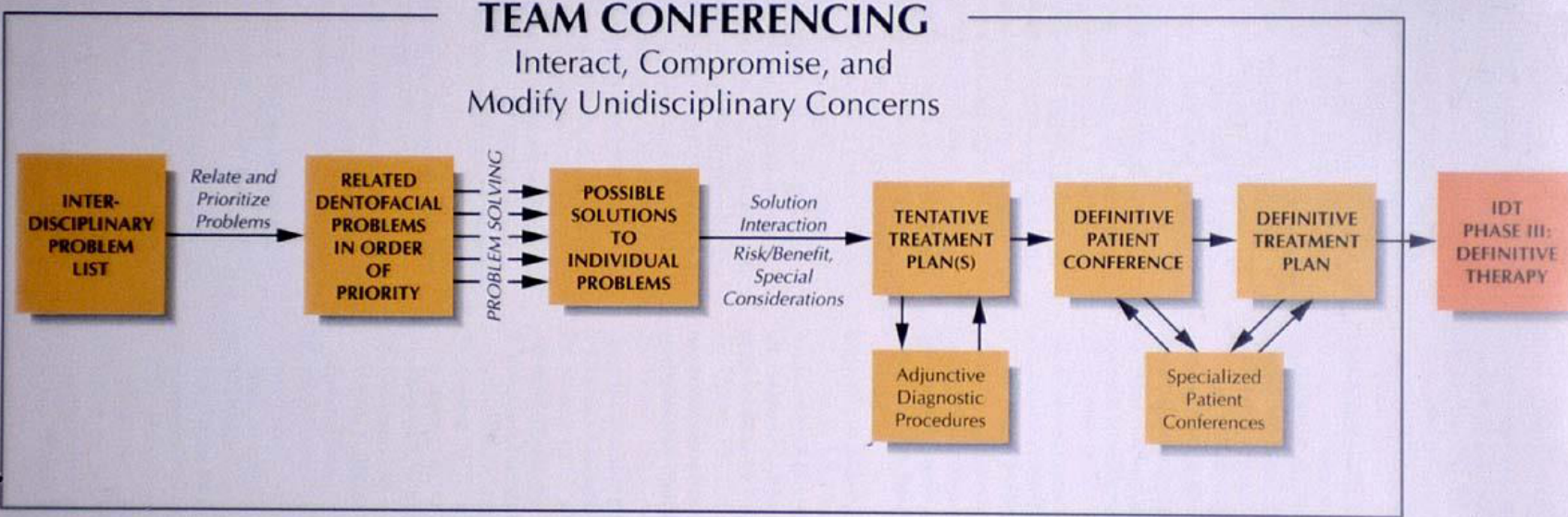
Team Conferencing — Interact, Compromise, and Modify Unidisciplinary Concerns
- INTERDISCIPLINARY PROBLEM LIST → Relate and Prioritize Problems → RELATED DENTOFACIAL PROBLEMS IN ORDER OF PRIORITY
- PROBLEM SOLVING → POSSIBLE SOLUTIONS TO INDIVIDUAL PROBLEMS → Solution Interaction: Risk/Benefit, Special Considerations
- TENTATIVE TREATMENT PLAN(S) → Adjunctive Diagnostic Procedures
- DEFINITIVE PATIENT CONFERENCE → Specialized Patient Conferences
- DEFINITIVE TREATMENT PLAN
- IDT PHASE III: DEFINITIVE THERAPY
Skeletal Class 2 Treatment Feasibility
A skeletal Class 2 problem may not be correctable when the patient is unwilling to consider surgery. The team must assess whether the patient will accept surgery or other complex procedures before finalizing the treatment approach.
Interdisciplinary Dentofacial Therapy, A Comprehensive Approach to Optimal Patient Care, R.D. Roblee
 | |
Preliminary Treatment Planning Worksheet
PATIENT: ______________________ DATE: __________
I. Diagnostic and Treatment Planning Phases20
- GENERAL EVALUATION (DATE COMPLETED, AREAS ONLY SCREENED AND RECORDS NOT MADE): ______________________
- SPECIALIZED EVALUATIONS BY INTERDISCIPLINARY TEAM MEMBERS (INCLUDING DATE AND ANY RECORDS NEEDED): ______________________
- INITIAL THERAPY: ______________________
- REEVALUATION AFTER INITIAL THERAPY: ______________________
- MISCELLANEOUS: ______________________
II. Definitive Therapy Phase
- SUPPORTIVE PERIODONTAL AND DENTAL THERAPY: ______________________
- SPECIAL CONSIDERATIONS FOR TEAM MONITORING: ______________________
- PREPARATORY THERAPY: ______________________
- DEFINITIVE THERAPY: ______________________
- MISCELLANEOUS: ______________________
III. Maintenance Phase
- SUPPORTIVE PERIODONTAL AND DENTAL THERAPY: ______________________
- MISCELLANEOUS (RETENTION, SPECIAL CONSIDERATIONS, ETC.): ______________________
Lecturer — Treatment Sequencing
The treatment plan should specify the objectives, sequence, clinician, and timing for each procedure.
- Active periodontal disease should be controlled before orthodontic treatment.
- Orthodontic treatment is generally completed or well advanced before implant placement.
- Third molars may need removal before orthognathic surgery, and orthodontic decompensation and surgical preparation may follow appropriate extractions.
- A bridge should not be placed if it would prevent future orthodontic tooth movement.
- The definitive therapy phase begins after the patient has discussed and accepted the plan and the team has established treatment timing.
- During maintenance, regular reevaluation continues so that changes or complications can be addressed and specialists can be consulted again when needed.
Definitive Therapy: Phase III Of IDT
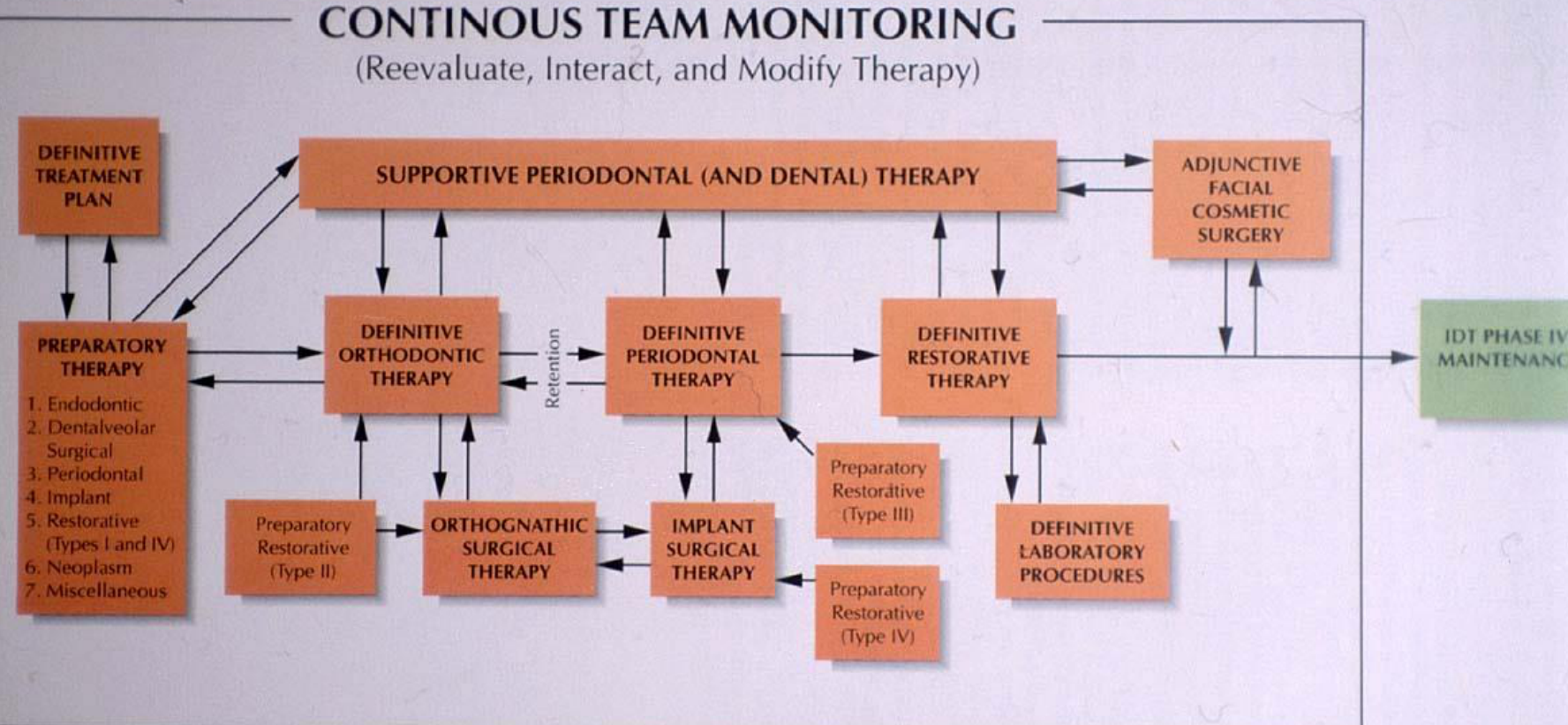
The Phase III flowchart is organized around continuous team monitoring (reevaluate, interact, and modify therapy), which oversees the definitive treatment plan.
Definitive Treatment Plan21
- Supportive periodontal (and dental) therapy
- Adjunctive facial cosmetic surgery
- Preparatory therapy:
- Endodontic
- Dentoalveolar surgical
- Periodontal
- Implant
- Restorative (Types I and IV)
- Neoplasm
- Miscellaneous
- Definitive orthodontic therapy → retention
- Definitive periodontal therapy
- Definitive restorative therapy
- Orthognathic surgical therapy
- Implant surgical therapy
- Preparatory restorative (Type II)
- Preparatory restorative (Type III)
- Preparatory restorative (Type IV)
- Definitive laboratory procedures
- IDT Phase IV: Maintenance
Lecturer — Treatment Planning
The definitive plan must identify how the procedures fit together.
- The treatment sequence.
- The clinicians involved.
- The timing of each procedure.
- The relationship between orthodontic, periodontal, restorative, surgical, endodontic, implant, and laboratory procedures.
- The maintenance arrangements after treatment is completed.
Definitive Treatment Plan And Preparatory Therapy
Definitive Treatment Plan22
- Preparatory therapy:
- Endodontic
- Dentoalveolar surgery
- Periodontal
- Implant
- Restorative
- Neoplasm
- Miscellaneous
Definitive Orthodontic, Periodontal, And Restorative Therapy23
- Ongoing supportive periodontal and dental therapy
- Definitive periodontal therapy
- Definitive orthodontic therapy
- Orthognathic surgical therapy
- Implant surgical therapy
- Definitive restorative therapy
- Definitive laboratory procedures
- Adjunctive facial cosmetic therapy
Lecturer — Treatment Sequence
The sequence of care is determined by the patient’s needs.
- Periodontal stability is required before orthodontic treatment.
- Orthodontic treatment may be needed before restorative treatment.
- Orthodontic treatment is usually completed or substantially advanced before implant placement.
- Surgical procedures may need to occur at a specific point in the orthodontic sequence.
- Supportive periodontal and dental therapy continues throughout the treatment of complex adult patients.
Maintenance: Phase IV Of IDT2425
-
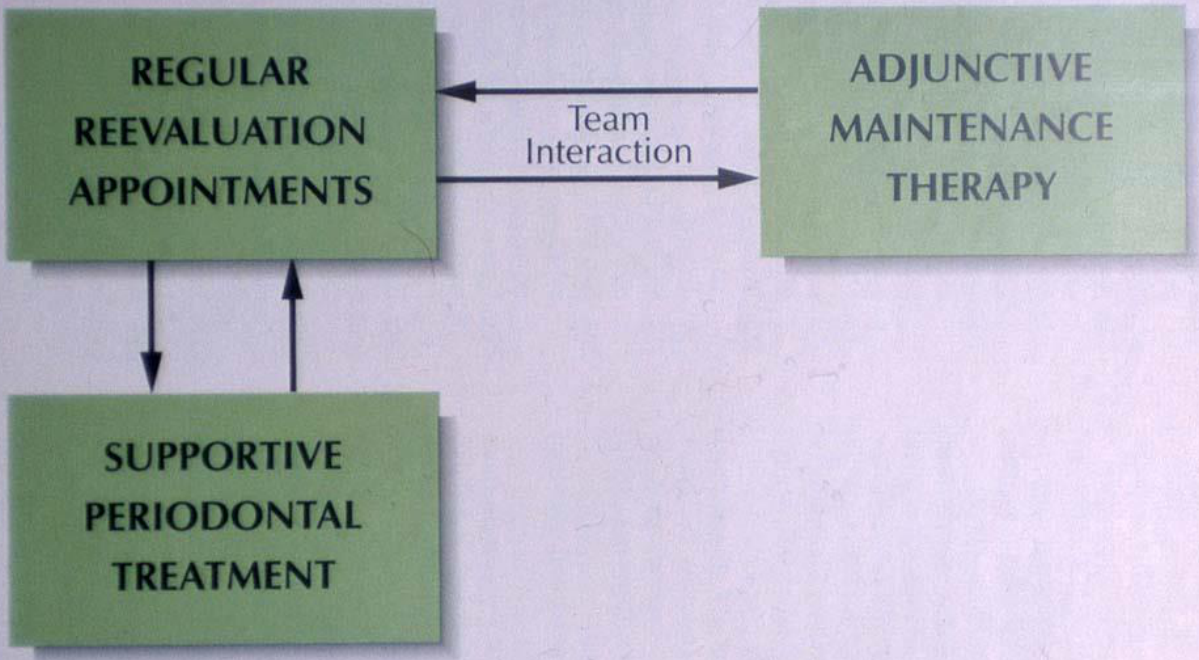
Supportive periodontal treatment
-
Regular reevaluation appointments
-
Team interaction
-
Adjunctive maintenance therapy
-
Dental conditions and restorations are monitored.
-
The general dentist monitors the overall progress of treatment.
-
A prosthodontist or other specialist may periodically review complex restorations.
-
Questions or changes may be referred back to the appropriate specialist.
-
Additional periodontal grafting, restorations, or other maintenance procedures may be required. The Phase IV maintenance diagram centers on team interaction, connecting:
-
Regular reevaluation appointments
-
Supportive periodontal treatment
-
Adjunctive maintenance therapy
Clinical Case Examples
Unidisciplinary Therapy Disadvantages26
Comparing Therapy Approaches In Cases27
Case moved — see Case: Class III malocclusion treated with restorations only
Interdisciplinary Treatment28
- Excellent communication between clinicians with several backgrounds
- Treatment plan established collectively
- Treatment leader established sequencing of activities
Lecturer — Coordinated Treatment
Aesthetic appearance alone is not sufficient; function must also be restored.
- The skeletal, occlusal, periodontal, restorative, and surgical aspects must be considered together.
- The proposed treatment must be realistic and deliverable, with its limitations explained before treatment begins.
Preliminary Therapy Case Examples293031323334
Definitive Therapy Case Examples3536373839
Maintenance Case Example40
Maintenance: Phase IV of IDT
- Regular reevaluation appointments
- Team interaction
- Adjunctive maintenance therapy
- Supportive periodontal treatment
Interdisciplinary Dentofacial Therapy, A Comprehensive Approach to Optimal Patient Care, R.D. Roblee
Final Examination Information41
- Yes, material from DENT5310 and previous years will be included as all builds on required knowledge
- Red and Blue Pencils
- Small protractor (available from office works $0.45)
- 30% MCQ and 70% Short Answer
- Answering short answer questions
Lecturer — Examination Responses
Short-answer responses should identify the specific diagnostic problem being asked about rather than provide an unnecessary complete facial or occlusal analysis.
- If asked for the three most significant orthodontic problems, list those problems and omit normal findings unless requested.
- Students may be asked to draw an appliance design, using red for acrylic and blue for metal; a protractor may help with angles, including lateral views.
Clinical Cases
Case: Class III malocclusion treated with restorations only
Question
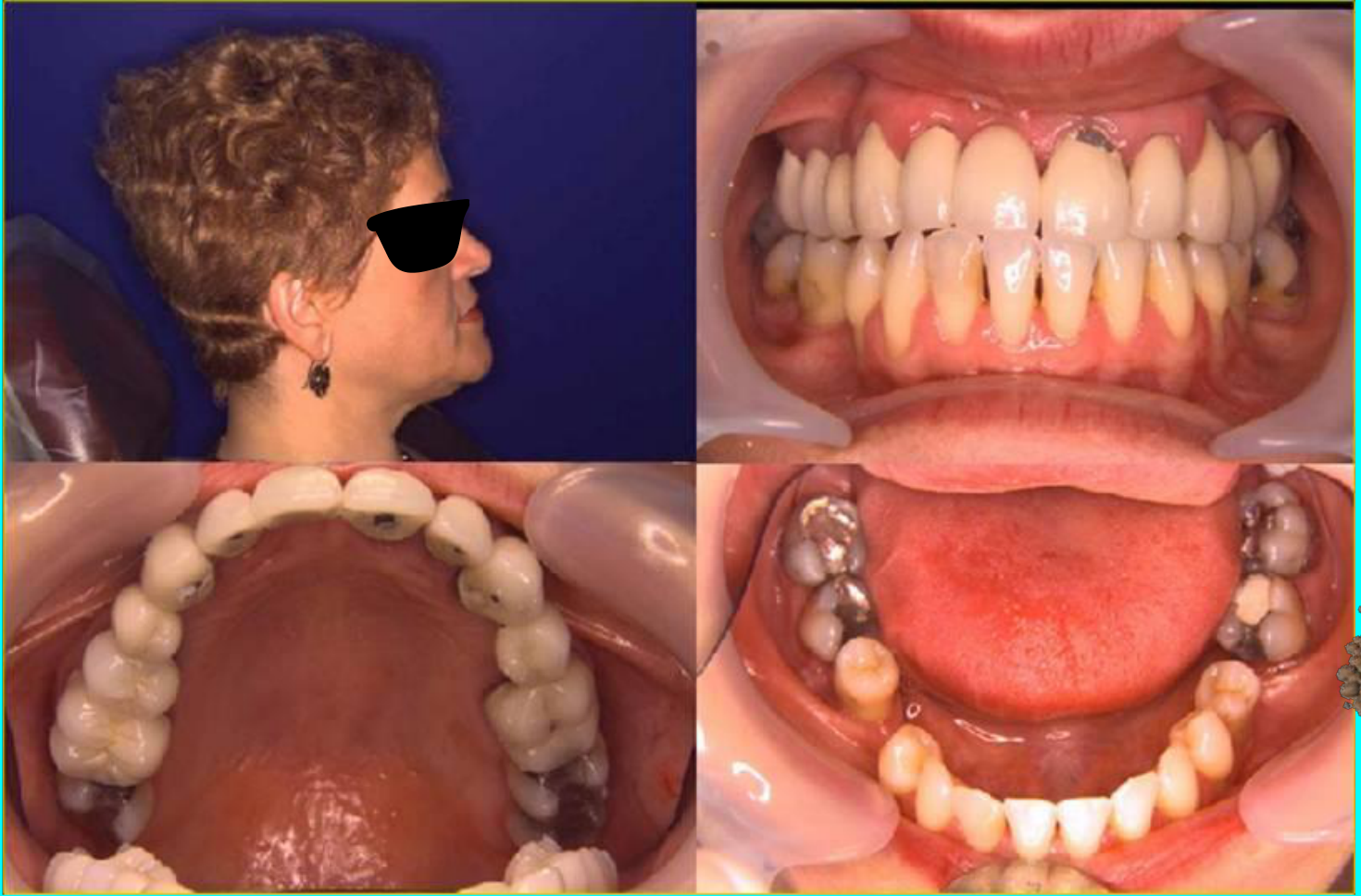
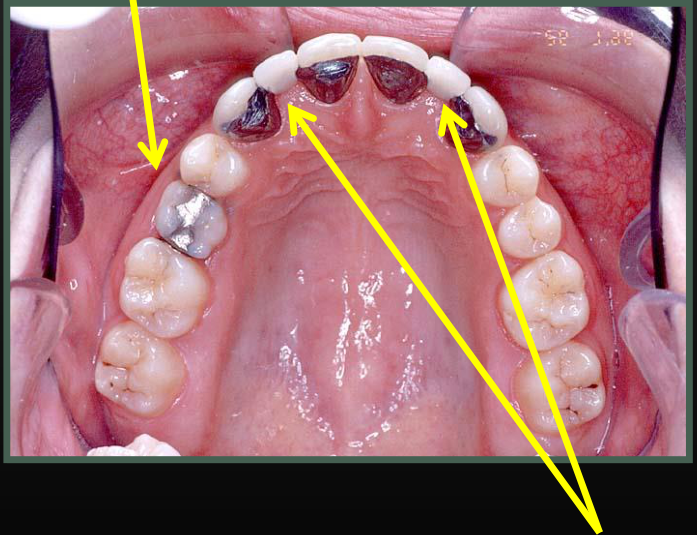
Scenario: A patient with a class III skeletal relationship and malocclusion was treated by a restorative dentist without prior orthodontic treatment.
What’s shown: Clinical photographs showing restorations that are beginning to fail, with abfraction defects occurring in the crowns.
Consider: What are the problems with this unidisciplinary treatment approach and what is the likely outcome?
Answer
Observations:
- Restorations are failing not at the incisal edges, but higher up on the crowns.
- Abfraction defects are present due to occlusal stress on the crowns.
Reasoning: The patient has a class III skeletal relationship that was treated solely with restorations to tip the teeth forward, without adequate orthodontic tooth movement. This places excessive stress on the restorations, leading to abfraction and eventual failure. Aesthetics alone are insufficient; function must also be restored.
Outcome: The restorations are expected to fail eventually over time, resulting in a poor outcome for the patient.
Takeaway: Unidisciplinary restorative treatment for skeletal malocclusions without addressing the underlying skeletal and orthodontic issues can lead to biomechanical failure of the restorations.
From the lecture slides
- Often yields compromised results
- Treatment plan dependent on individuals’ capabilities
- May use restorative means only to address a problem
- If attempts to deliver care from a specialty area – limited skills and knowledge
Class III compensated with restorative dentistry
Skeletal Class III Restorative Failure
A patient with a skeletal Class III relationship and Class III malocclusion was treated restoratively without addressing function.
- The teeth were tipped further forward with restorations that initially appeared aesthetic.
- Over time, the restorations failed in the crown area, and an abfraction defect developed from occlusal stress.
- Orthodontic treatment or tooth movement should have been considered before definitive restorative treatment.
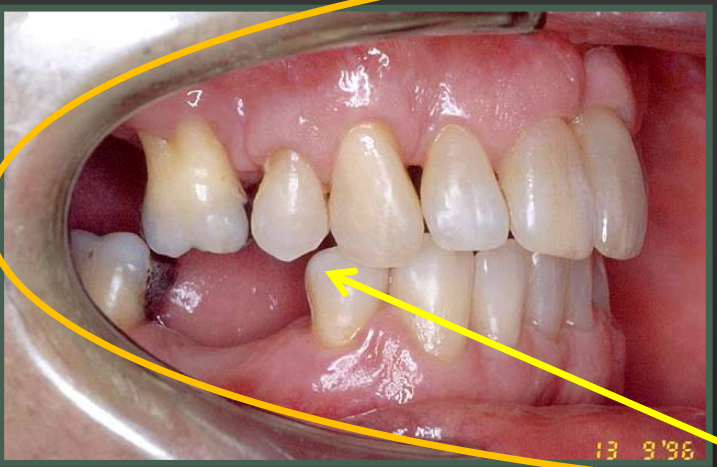
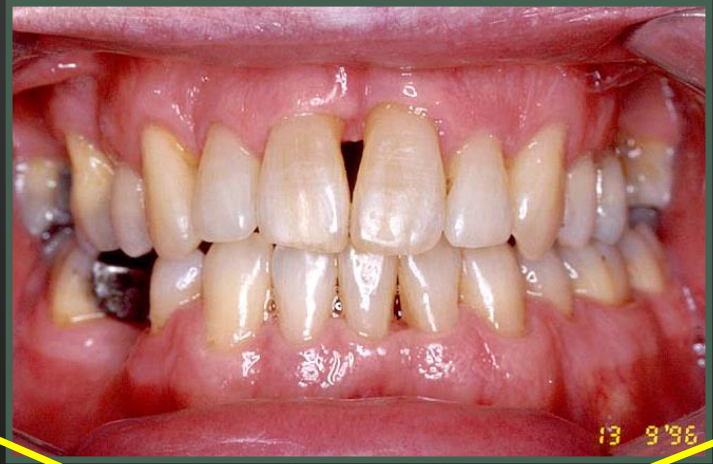
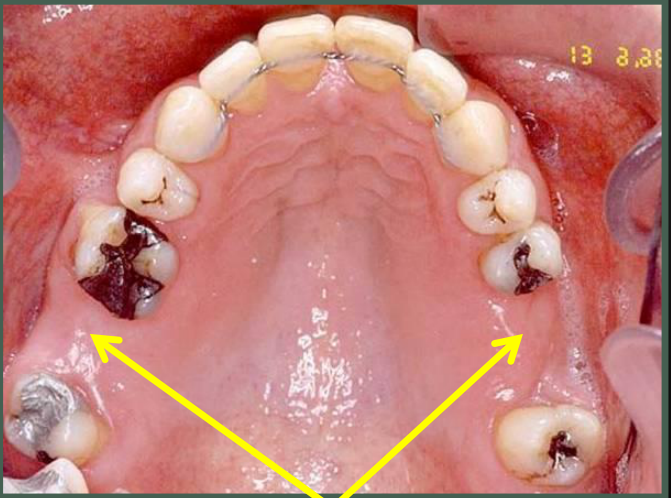
Case: Female patient with palatally displaced canines and missing molars
Question
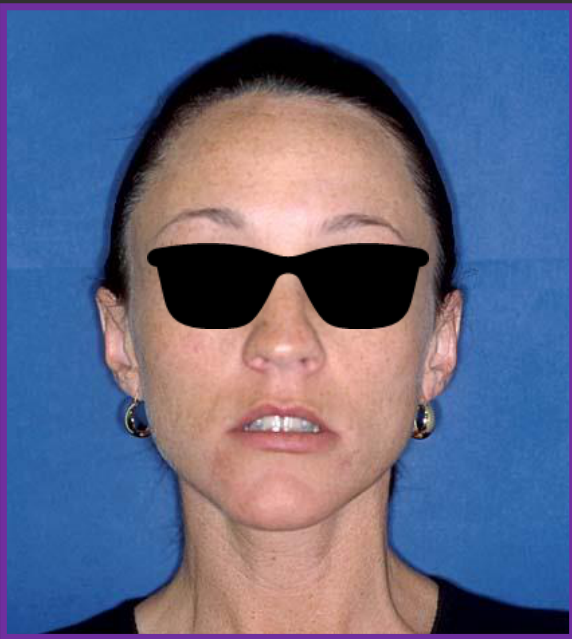
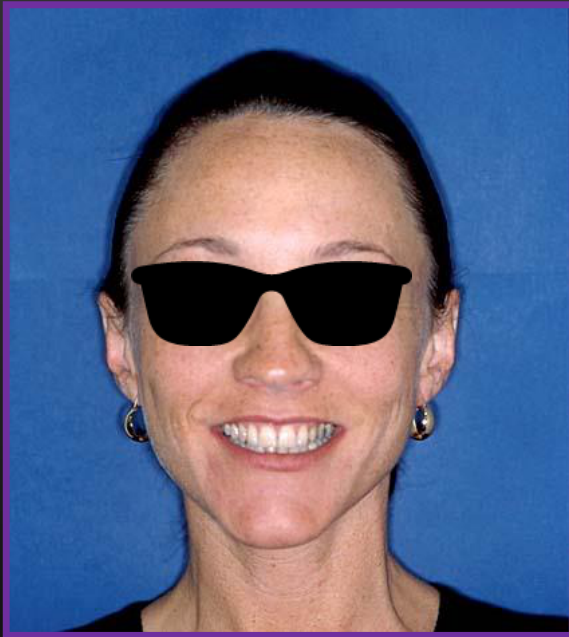
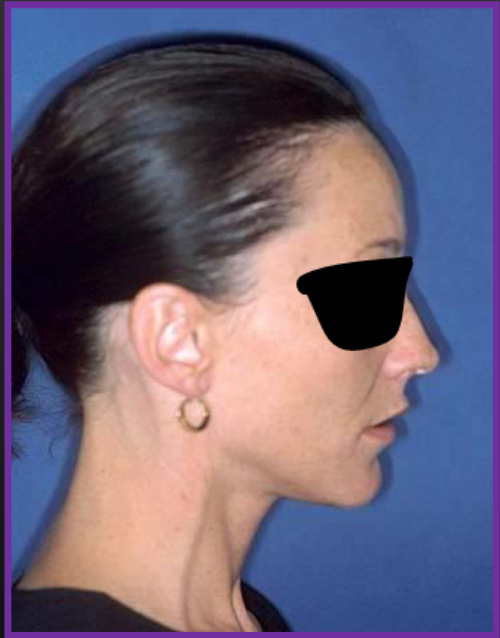
Scenario: A female patient presented for an initial visit, concerned about her dark teeth and retained deciduous canines, unaware that her permanent canines were palatally displaced.
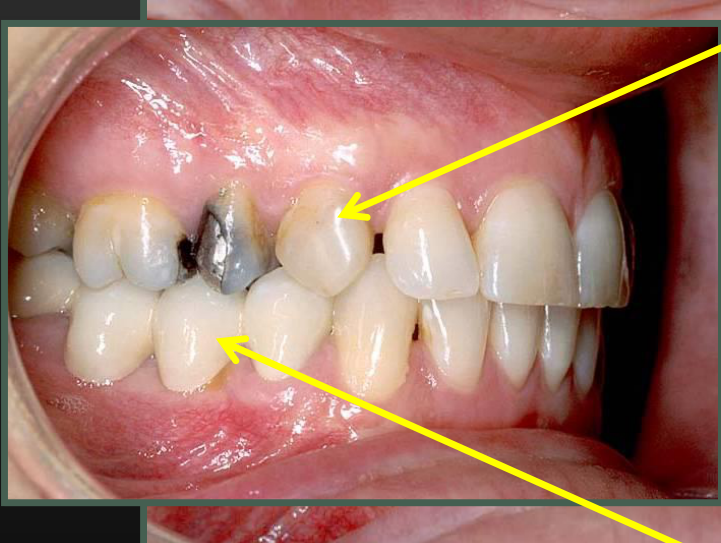
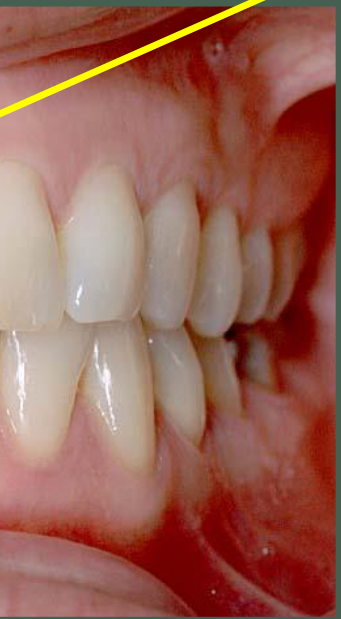
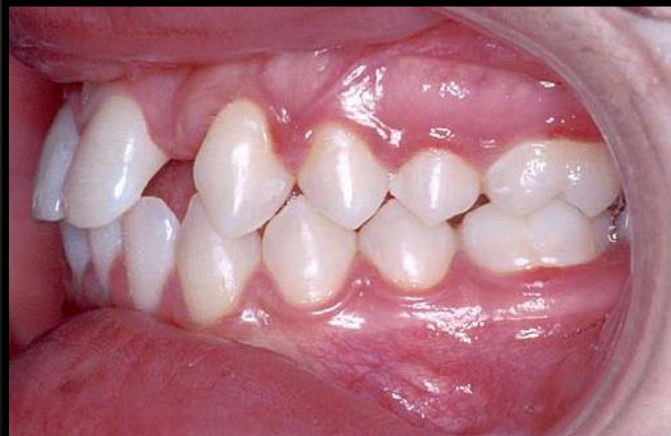
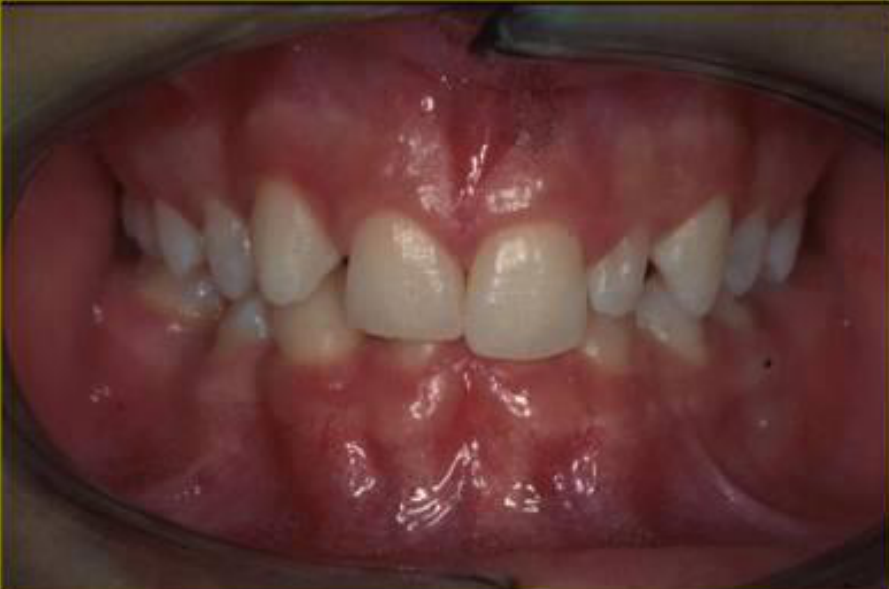
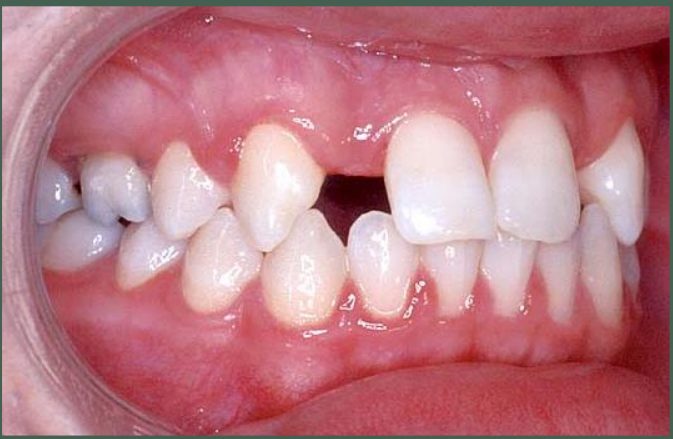
What’s shown: Clinical photographs showing a class I malocclusion with palatally displaced maxillary canines, retained deciduous canines, and missing molars with super-eruption of the opposing molar.
Consider: What are the specific findings and what treatment is required to address this complex presentation?
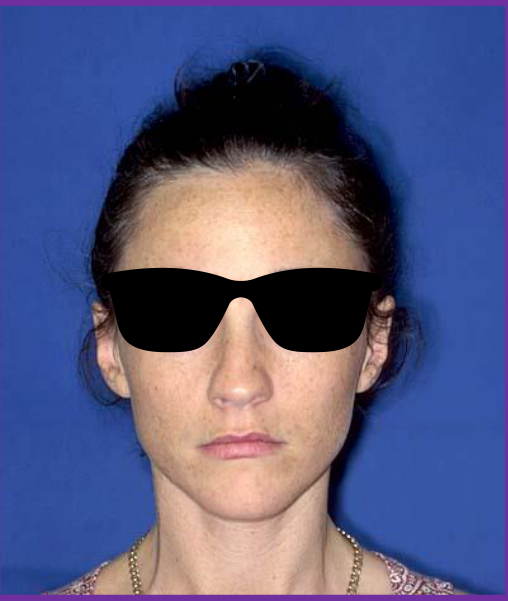
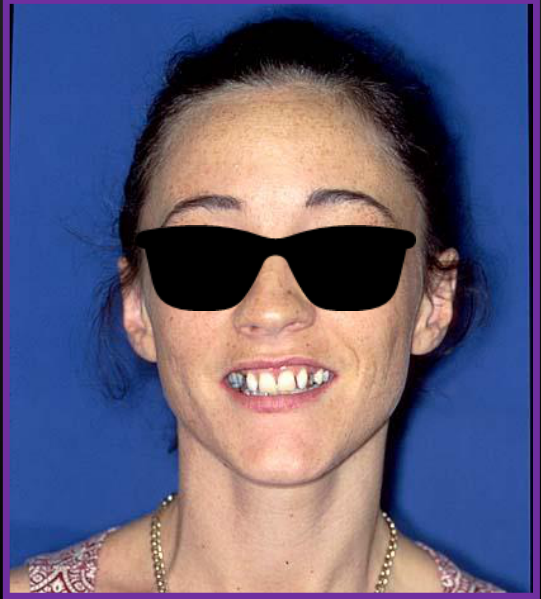
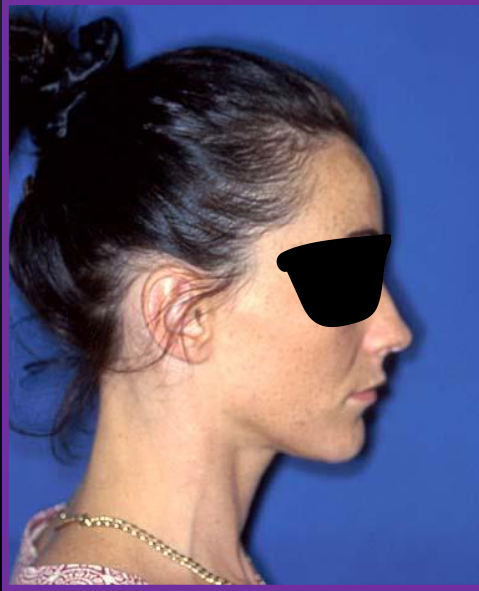
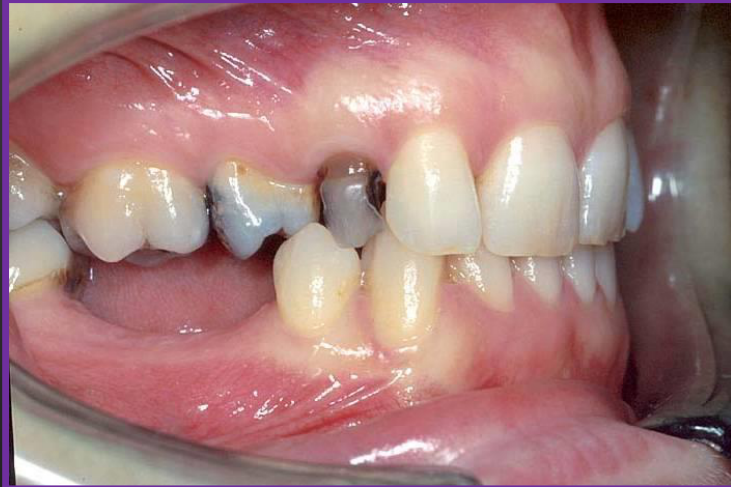
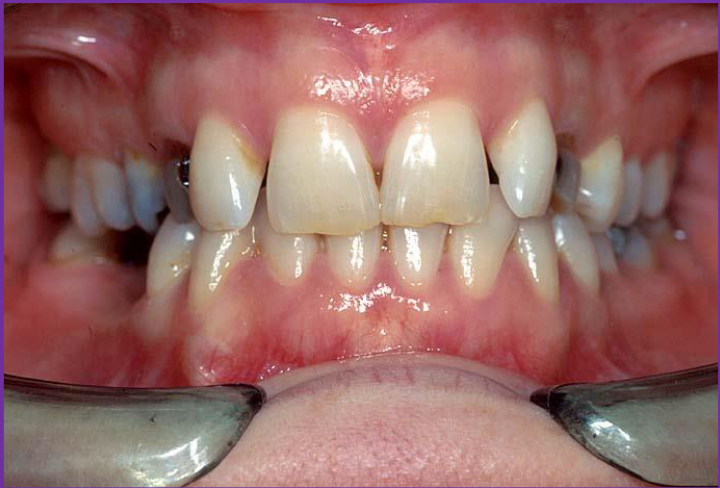
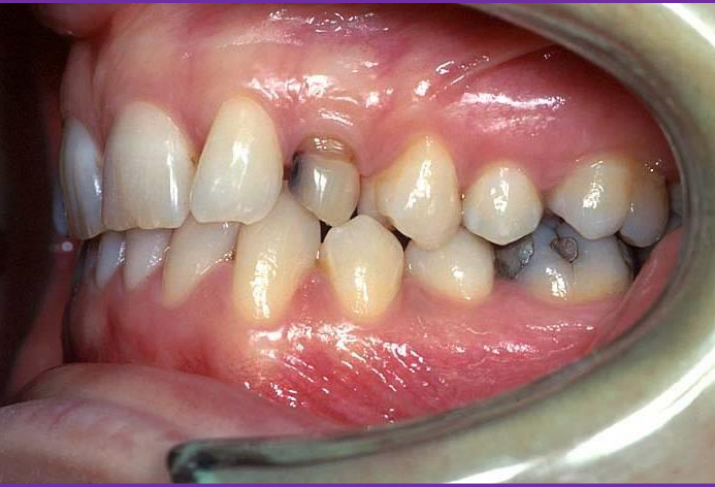
Answer
Observations:
- Class I malocclusion with palatally displaced maxillary right and left canines (nearly touching in the palate).
- Retained maxillary right and left deciduous canines.
- Missing maxillary and mandibular right second bicuspids (second premolars).
- Missing mandibular right first molar with super-eruption of the maxillary right first molar.
Reasoning: The large spaces and missing teeth require a comprehensive interdisciplinary approach. Treatment must include intruding the super-erupted molar, opening space to draw the palatal canines into the arch, and managing the large edentulous spans (potentially reducing a large span to a single tooth replacement rather than two).
Outcome: The treatment plan requires orthodontic intrusion, space opening for the canines, and careful management of the edentulous spaces.
Takeaway: Complex malocclusions with displaced teeth, retained deciduous teeth, and missing posterior teeth require interdisciplinary treatment planning to address space management, occlusion, and tooth alignment.
From the lecture slides
Preliminary Therapy: Prelude to IDT
- Initial Visit
- General Dentist or Specialist
- “I don’t like the dark teeth”
Preliminary Therapy: Prelude to IDT
Class I malocclusion with palatally displaced maxillary right and left canines and retained maxillary right and left deciduous canines. Missing maxillary and mandibular right second bicuspids and missing mandibular right first molar with supraeruption of the maxillary right first molar.
Definitive Therapy: Phase III of IDT
Definitive Therapy: Phase III of IDT
- Palatally displaced canines delivered into dental arch
- Three-unit bridge to replace missing mandibular right first molar
- Note: design of bridge modified to best suit patient’s occlusion
Lecturer — Canine Case Sequencing
The palatally displaced canines were treated by intruding the supererupted molar and opening space to bring the canines into position.
- A large space was reduced to a span that could potentially be replaced by one tooth rather than two.
- The canines were brought into occlusion, the space was closed on one side, and the bridge was reshaped to accommodate the occlusion.
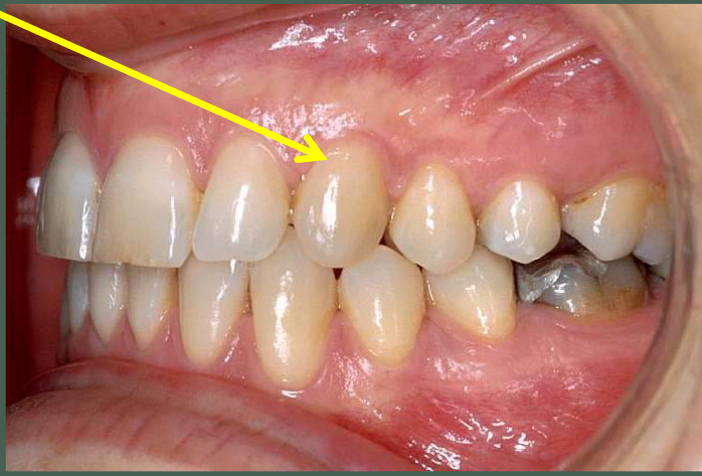
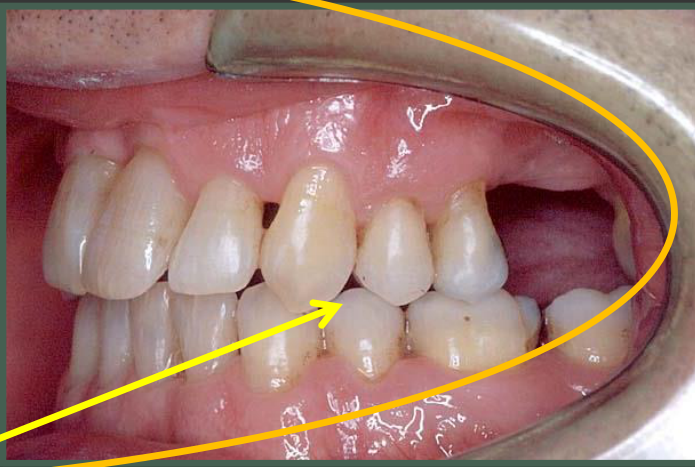
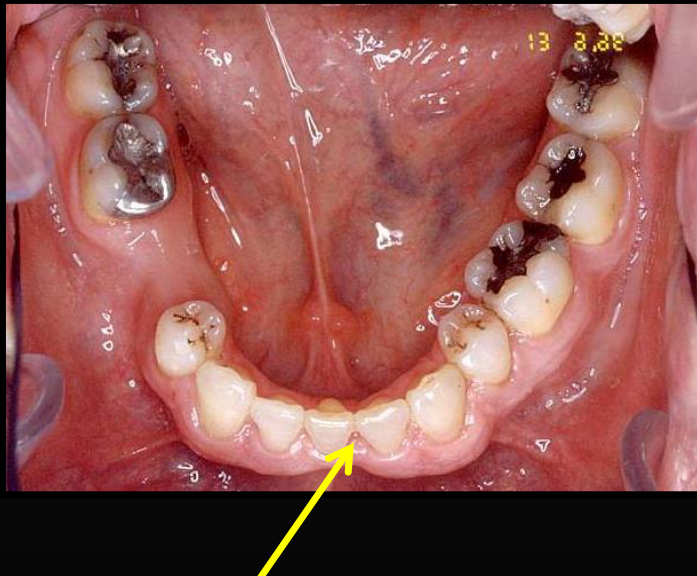
Case: Gentleman with periodontal problems, missing teeth, and crowding
Question
Scenario: An older gentleman presented with significant periodontal issues, multiple missing teeth, and severe crowding.
What’s shown: Clinical photographs showing a mutilated malocclusion with active periodontal pocketing, recession, anterior crowding, and multiple missing teeth including retained deciduous teeth.
Consider: What are the initial problems identified and how were they managed to stabilize the patient?
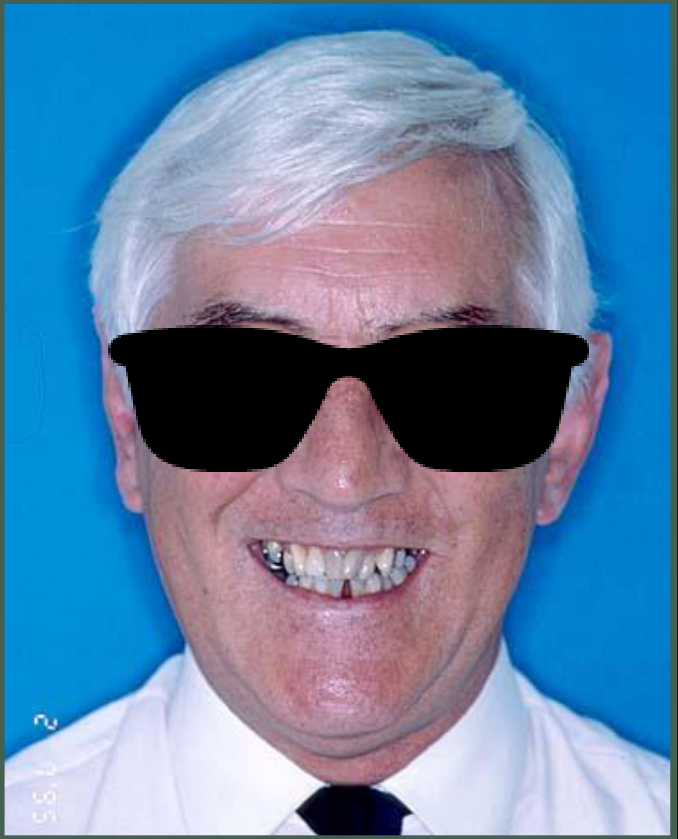
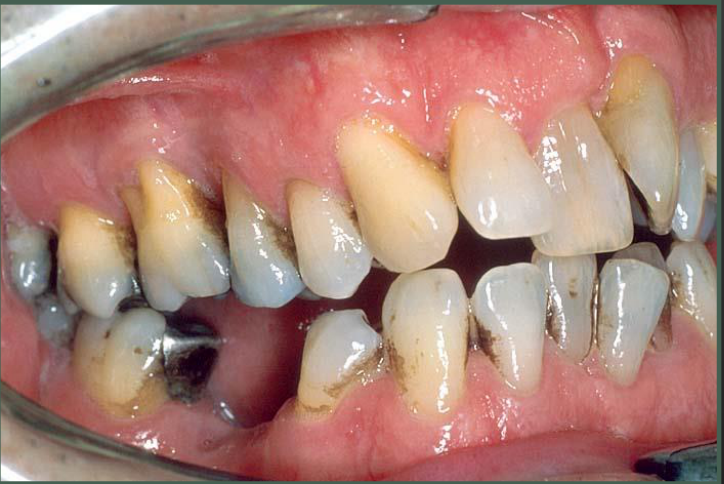
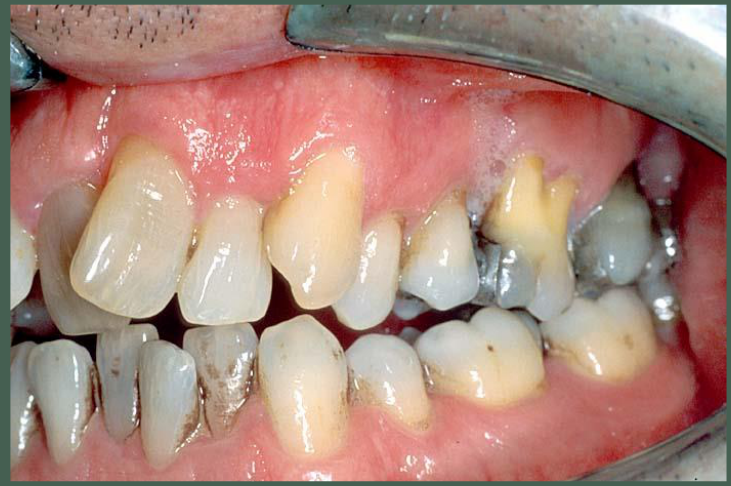
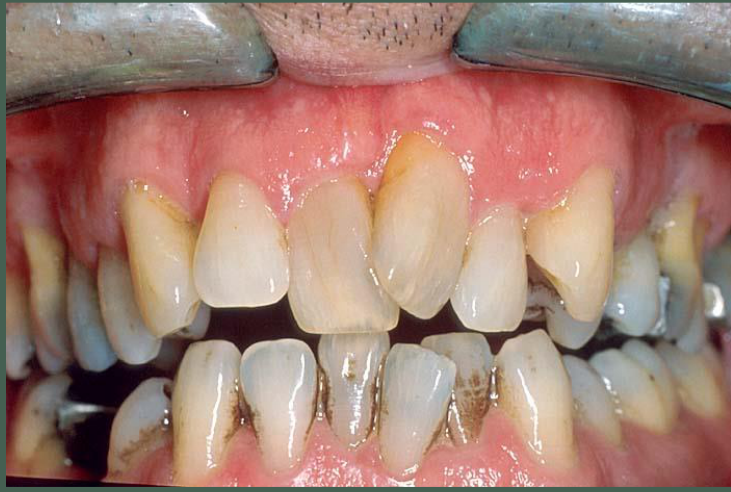
Answer
Observations:
- Significant periodontal issues including active pocketing and recession.
- Mutilated malocclusion with multiple missing teeth and retained deciduous teeth.
- Anterior crowding and malalignment.
- Hopeless teeth and a lower anterior tooth contributing to crowding.
Reasoning: Before any orthodontic or restorative treatment can be considered, the periodontal condition must be stabilized. Teeth with a hopeless prognosis were extracted, and a lower anterior tooth was extracted to resolve the crowding.
Outcome: The periodontal condition was stabilized, and a functional occlusion was established through selective extractions.
Takeaway: In complex cases with active periodontal disease and severe crowding, preliminary therapy must focus on periodontal stabilization and extracting hopeless teeth before any definitive orthodontic or restorative treatment.
From the lecture slides
Preliminary Therapy: Prelude to IDT
- Initial Visit
- General Dentist or Specialist
Preliminary Therapy: Prelude to IDT
Class IV type malocclusion with multiple missing teeth (3.5, 4.5, 4.6), significant periodontal issues including active periodontal pocketing and recession and anterior crowding and malalignment.
Lecturer — Periodontal Stabilization
The malocclusion could not be classified as Class I, Class II, or Class III because the teeth required for classification were absent.
- Periodontal problems had to be stabilized before orthodontic treatment.
- Teeth with a hopeless prognosis were extracted, including a lower anterior tooth to resolve lower anterior crowding.
Definitive Therapy: Phase III of IDT
- Periodontal condition stabilised
- Functional occlusion established
- Teeth with hopeless prognosis extracted
Case: Patient with hypodontia, narrow maxilla, and telescoping roots
Question
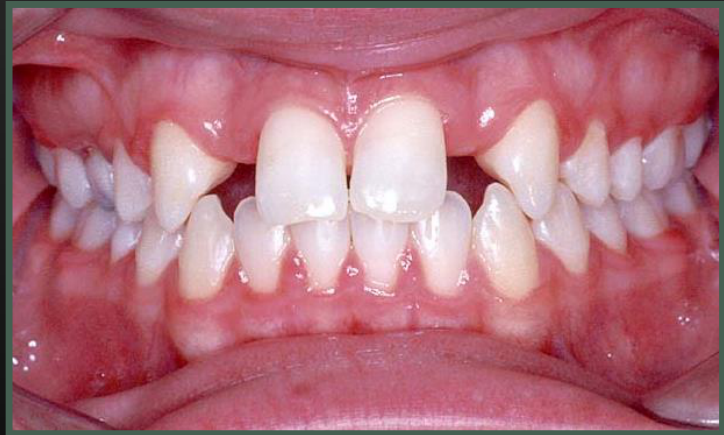
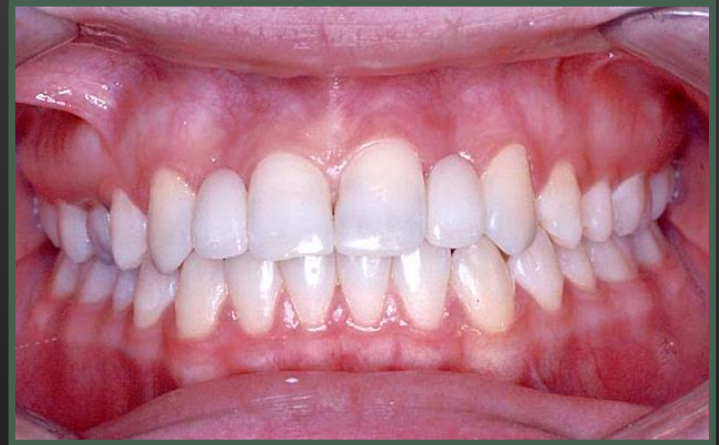
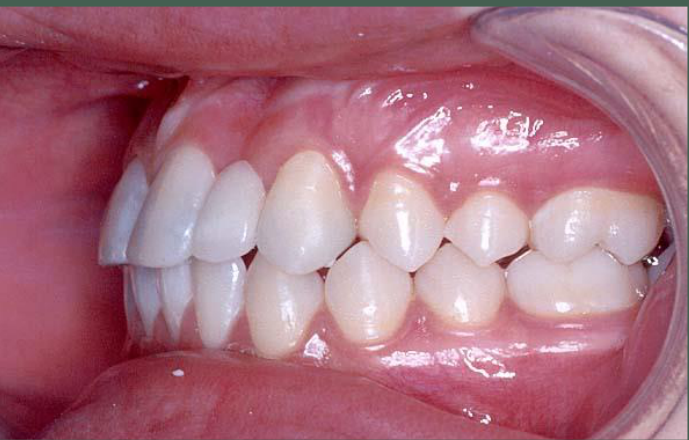
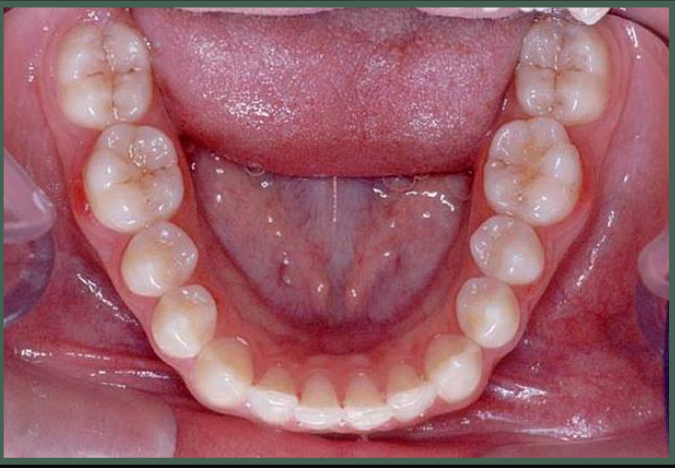
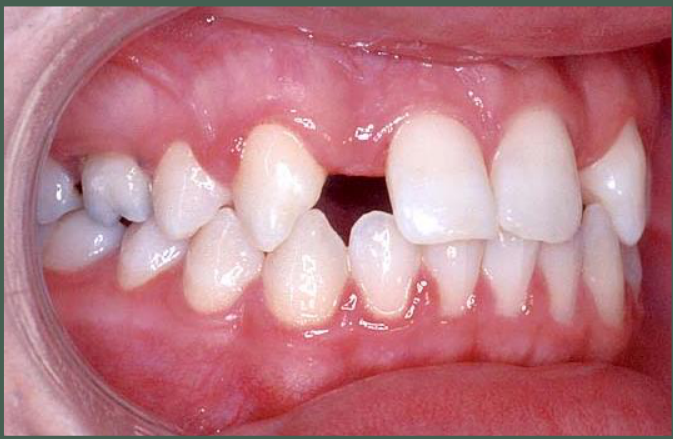
Scenario: A patient with hypodontia presented with a small lateral incisor, missing teeth, and a retained deciduous second molar (5.5).
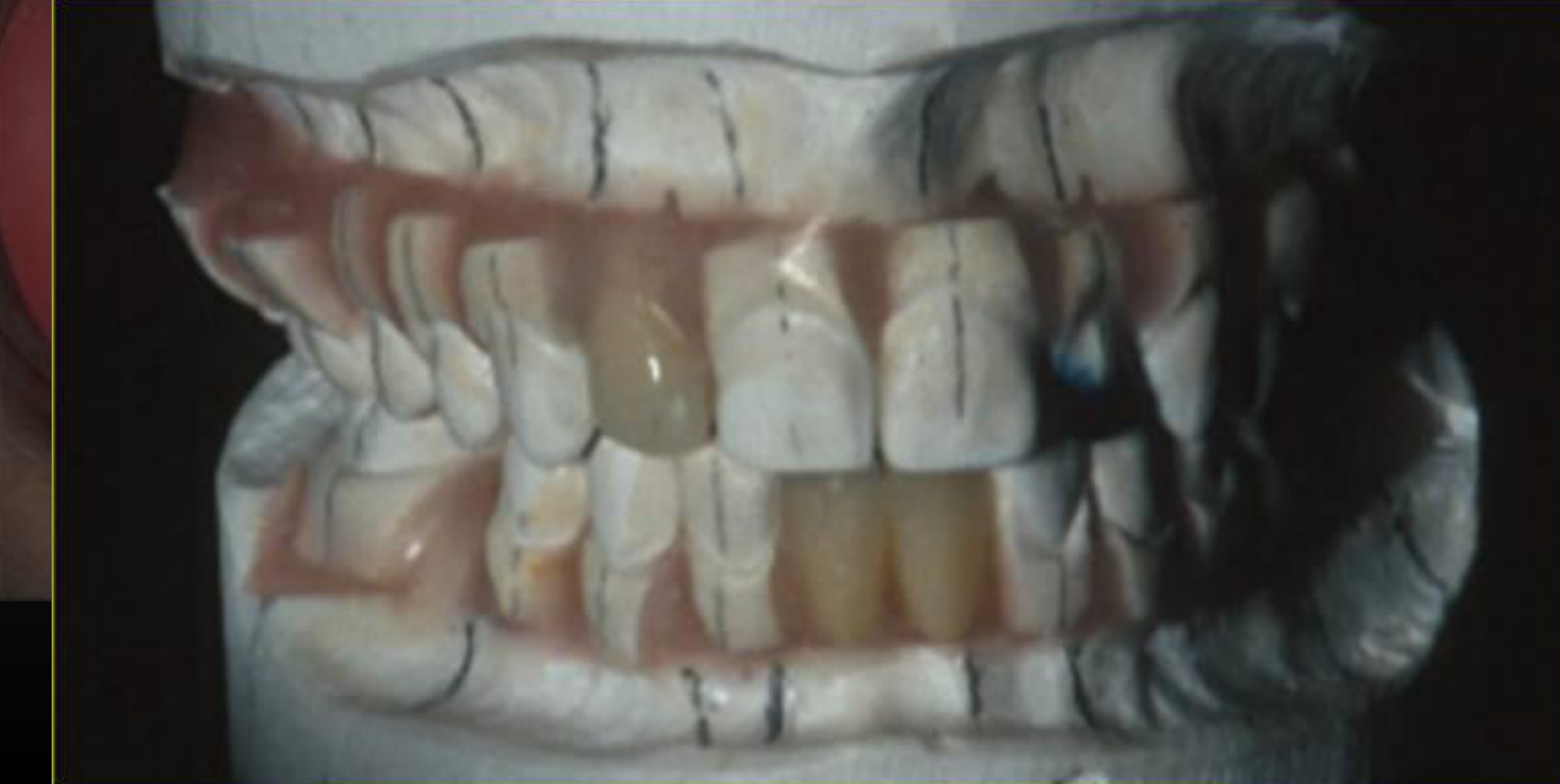
What’s shown: Clinical photographs and study models showing a narrow maxilla with a telescoping arch (roots converging inward), small teeth, and missing spaces. Post-treatment photos show resin-bonded bridges in place.
Consider: Why were dental implants not the ideal outcome for this patient, and what was the final treatment provided?
Answer
Observations:
- Hypodontia with extremely small teeth and missing teeth.
- Very narrow maxilla with a telescoping arch where the roots converge inward, leaving inadequate space at the root apices for implants.
- Retained deciduous tooth 5.5.
Reasoning: Although dental implants might seem ideal for missing teeth, the pre-treatment diagnostic setup and radiographs revealed that the narrow maxilla and converging roots made implant placement impossible without risking damage to adjacent roots. Therefore, a resin-bonded bridge was chosen, and the retained 5.5 was maintained and reshaped.
Outcome: The patient was treated with two three-unit resin-bonded bridges to replace the missing teeth, with the retained 5.5 maintained and reshaped.
Takeaway: Pre-treatment diagnostic setups and radiographs are crucial to identify anatomical limitations like a narrow maxilla and converging roots, which may contraindicate implants and necessitate alternative restorative options like resin-bonded bridges.
From the lecture slides
Preliminary Therapy: Prelude to IDT
- Initial Visit
- General Dentist or Specialist
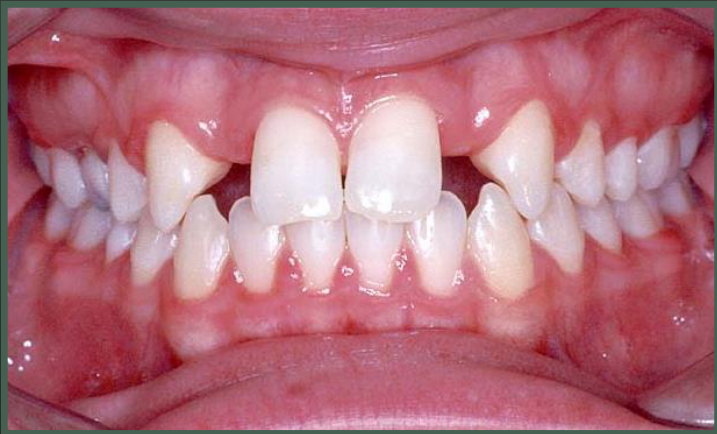
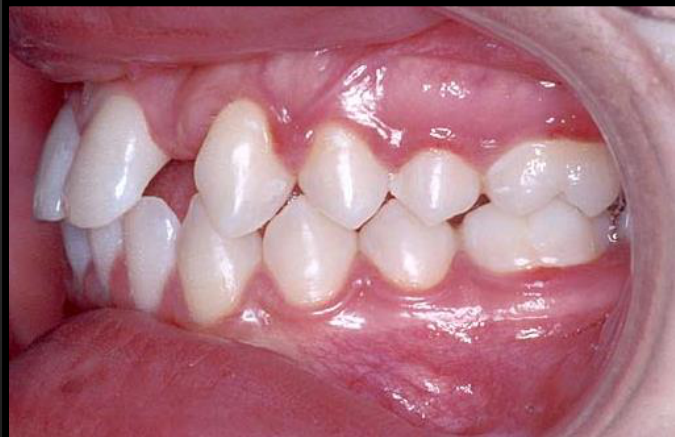
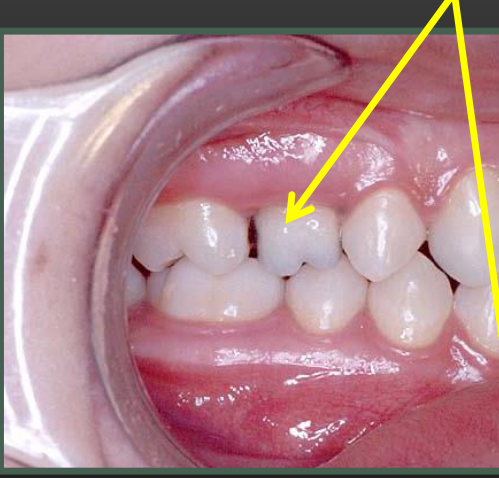
Class I malocclusion with missing 1.2, 2.2 and 1.5 with retained 5.5
Preliminary Therapy: Prelude to IDT
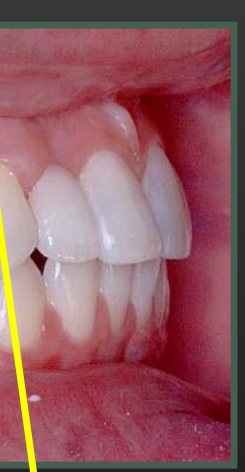
Hypodontia and very small teeth. Tooth 1.2 approx 5 mm wide.
Lecturer — Small Lateral Incisor
Treatment options included building up the very small lateral incisor or replacing it with an implant or bridge.
- Orthodontic treatment would need to be assessed to determine whether the required space could be created.
- The relationship between the crowns and roots had to be evaluated before promising implant treatment.
Don’t promise what you can’t deliver.
Preliminary Therapy: Prelude to IDT
Pre-treatment diagnostic set-up and radiographs indicated that implant placement not possible – space inadequate.
Lecturer — Root-Level Implant Space
Although the crowns appeared to have adequate space, the roots moved inward toward each other in the very narrow maxilla.
- The root apices were too close together for safe implant placement.
- An implant risked damaging the central incisor or canine root, so a resin-bonded bridge was used instead.
Definitive Therapy: Phase III of IDT
- Maintained and reshaped (5.5)
- Placement of two three-unit resin bonded bridges
Lecturer — Maintenance Responsibilities
After interdisciplinary treatment, the patient enters supportive periodontal and dental maintenance.
- Complex restorations may continue to be reviewed by the prosthodontist while the general dentist monitors the overall result.
- Any change, failure, or new problem may require referral back to a specialist, and further periodontal grafting or restorative treatment may be needed.
Footnotes
-
Original PDF page 1: L10 Interdisciplinary Treatment, p.1 ↩
-
Original PDF page 2: L10 Interdisciplinary Treatment, p.2 ↩
-
Original PDF page 3: L10 Interdisciplinary Treatment, p.3 ↩
-
Original PDF page 4: L10 Interdisciplinary Treatment, p.4 ↩
-
Original PDF page 5: L10 Interdisciplinary Treatment, p.5 ↩
-
Original PDF page 6: L10 Interdisciplinary Treatment, p.6 ↩
-
Original PDF page 7: L10 Interdisciplinary Treatment, p.7 ↩
-
Original PDF page 8: L10 Interdisciplinary Treatment, p.8 ↩
-
Original PDF page 9: L10 Interdisciplinary Treatment, p.9 ↩
-
Original PDF page 10: L10 Interdisciplinary Treatment, p.10 ↩
-
Original PDF page 11: L10 Interdisciplinary Treatment, p.11 ↩
-
Original PDF page 12: L10 Interdisciplinary Treatment, p.12 ↩
-
Original PDF page 13: L10 Interdisciplinary Treatment, p.13 ↩
-
Original PDF page 14: L10 Interdisciplinary Treatment, p.14 ↩
-
Original PDF page 15: L10 Interdisciplinary Treatment, p.15 ↩
-
Original PDF page 16: L10 Interdisciplinary Treatment, p.16 ↩
-
Original PDF page 17: L10 Interdisciplinary Treatment, p.17 ↩
-
Original PDF page 18: L10 Interdisciplinary Treatment, p.18 ↩
-
Original PDF page 20: L10 Interdisciplinary Treatment, p.20 ↩
-
Original PDF page 19: L10 Interdisciplinary Treatment, p.19 ↩
-
Original PDF page 21: L10 Interdisciplinary Treatment, p.21 ↩
-
Original PDF page 22: L10 Interdisciplinary Treatment, p.22 ↩
-
Original PDF page 23: L10 Interdisciplinary Treatment, p.23 ↩
-
Original PDF page 25: L10 Interdisciplinary Treatment, p.25 ↩
-
Original PDF page 26: L10 Interdisciplinary Treatment, p.26 ↩
-
Original PDF page 27: L10 Interdisciplinary Treatment, p.27 ↩
-
Original PDF page 28: L10 Interdisciplinary Treatment, p.28 ↩
-
Original PDF page 29: L10 Interdisciplinary Treatment, p.29 ↩
-
Original PDF page 30: L10 Interdisciplinary Treatment, p.30 ↩
-
Original PDF page 31: L10 Interdisciplinary Treatment, p.31 ↩
-
Original PDF page 32: L10 Interdisciplinary Treatment, p.32 ↩
-
Original PDF page 33: L10 Interdisciplinary Treatment, p.33 ↩
-
Original PDF page 34: L10 Interdisciplinary Treatment, p.34 ↩
-
Original PDF page 35: L10 Interdisciplinary Treatment, p.35 ↩
-
Original PDF page 36: L10 Interdisciplinary Treatment, p.36 ↩
-
Original PDF page 37: L10 Interdisciplinary Treatment, p.37 ↩
-
Original PDF page 38: L10 Interdisciplinary Treatment, p.38 ↩
-
Original PDF page 39: L10 Interdisciplinary Treatment, p.39 ↩
-
Original PDF page 40: L10 Interdisciplinary Treatment, p.40 ↩
-
Original PDF page 41: L10 Interdisciplinary Treatment, p.41 ↩
-
Original PDF page 42: L10 Interdisciplinary Treatment, p.42 ↩