General Practitioners Role In Orthodontic Treatment In Western Australia1
Introduction2
Your Role once you’ve left the safety of the School of Dentistry
Lecturer — Rural Orthodontic Care
The role of a general practitioner in orthodontic treatment depends partly on practice location.
- General dentists in rural or remote environments may need to provide some orthodontic treatment themselves.
- The university can assist dentists outside metropolitan areas with selecting appropriate orthodontic treatment and managing orthodontic patients in rural environments.
- Western Australia generally has orthodontists in major rural centres; the greatest lack of orthodontic coverage is in very remote areas.
- General practitioners need to understand how to manage orthodontic needs safely within general practice after leaving dental school.
Career Decisions And Selecting A Practice34
Decisions to be made:
- Solo practice - rarely occurs
- Government practice
- Associate within a private practice - Australia and abroad
- General Practice Residency abroad
- Specialization
Lecturer — Early Career Development
Entering solo practice immediately after dental school is uncommon because graduates generally benefit from gaining experience and undertaking substantial clinical work first.
- A general practice residency overseas may provide an additional year or two of supervised clinical experience.
- In Australia, dentists must complete two years of general practice before beginning specialty training.
- Dentists seeking specialist registration must follow the requirements of AHPRA and the Dental Board of Australia.
- Demographics
- McDonalds - fast food outlets
- Shopping Malls
Lecturer — Practice Selection
Local demographics should inform the choice of practice location.
- Areas selected by large fast-food businesses may already have demographic information indicating the presence of young families and children.
- Locations near shopping malls may attract substantial numbers of people and provide useful demographic advantages.
- A general dentist has an ethical, moral, and legal responsibility to provide the same standard of care as peers, including specialist practitioners.
- Being a general dentist does not justify providing a lower standard of treatment than an orthodontist in the same vicinity.
Primary Responsibilities To Your Patients567
What do you need to know?
Philosophy and AHPRAS Requirement
- One is ethically, morally and legally responsible for delivering the same standard of care as your peers.
- And that includes Specialist practitioners.
Primary responsibilities to your patients are:
- Diagnosis - this is our focus
- Counseling - this is important
- Intervention at the appropriate time - this is critical
- Active role in retention
Diagnosis8
-
Be able to better recognise and diagnose orthodontic problems
-
Participate in multi-disciplinary treatment planning with specialists
-
Failure to identify an orthodontic problem may create medical-legal responsibility if the condition progresses or complications occur.
-
Multidisciplinary planning may determine treatment sequence, the need for periodontal or pain management, and whether endodontic, periodontal, orthodontic, or oral surgical care is required.
Counselling9
- Learn the importance of appropriate referral and timing for referral of orthodontic patients
- Learn the full scope of what is entailed in the practice of orthodontics
- See how cases are managed by specialists; and to see how an Orthodontist helps general dentists achieve a high standard of oral care for their patients.
Requested Lateral Incisor Space
A patient may be referred with a request to open space for replacement of a lateral incisor with a dental implant.
- The request may not be feasible when the incisors are already proclined, insufficient space exists, and the upper arch cannot be distalized because the patient is already Class I.
- The referring dentist needs to understand whether the requested orthodontic objective can actually be accomplished.
Intervention At The Appropriate Time10
Understand how, when and why most cases should be referred to specialists
Impacted Canine Referral Delay
An inappropriate delay may result in a patient reaching 17 or 18 years of age with an impacted canine.
- This creates a difficult discussion with the patient and parent when the patient has attended the same general dentist for many years and the problem was not identified earlier.
Clinical Guidelines And Treatment Need
Berk N.W., Bush, H.D. et. al. (2002). Perception of orthodontic treatment need: opinion comparisons of orthodontists, pediatric dentists and general practitioners. Journal of Orthodontics 29, 287-91.
Perception Of Orthodontic Treatment Need1112
This study found a high level of agreement between pediatric dentists, orthodontists and general practitioners with regards to orthodontic treatment need.
Berk N.W., Bush, H.D. et. al. (2002). Perception of orthodontic treatment need: opinion comparisons of orthodontists, pediatric dentists and general practitioners. Journal of Orthodontics 29, 287-91.
Lecturer — Referral Recognition
There was no major difference among the three professional groups in recognizing when a patient required orthodontic treatment. This supports the importance of general dentists being able to identify orthodontic problems and make appropriate referrals.
Cases To Avoid13
If you do choose to practice orthodontic treatment — Cases to Avoid. If you don’t know, ask!
-
Class III’s
-
Hyperdivergent skeletal patterns (Open Bites)
-
Moderate to severe skeletal patterns
-
Very complex or difficult treatments
-
These cautions apply whether treatment is planned with Invisalign or other clear aligners, orthodontic brackets, or other orthodontic appliances.
-
A particularly challenging combination is a Class III, hyperdivergent patient with an open bite.
-
These cases may be difficult even for practitioners who have experience with Invisalign.
-
Do not accept a case merely because of experience with a particular appliance or treatment system.
Should General Dentists Be Providing Orthodontic Care14
Should General Dentists be providing Orthodontic Care?
- Demand or Availability of Orthodontic Care
- Adequate training of General Practitioners
- Financial motivation
- Quality of Care
Demand And Availability Of Orthodontic Care15
Should General Dentists be providing Orthodontic Care?
- Demand or Availability of Orthodontic Care
- Adequate training of General Practitioners
- Financial motivation
- Quality of Care
Competition And Dentist Supply1617
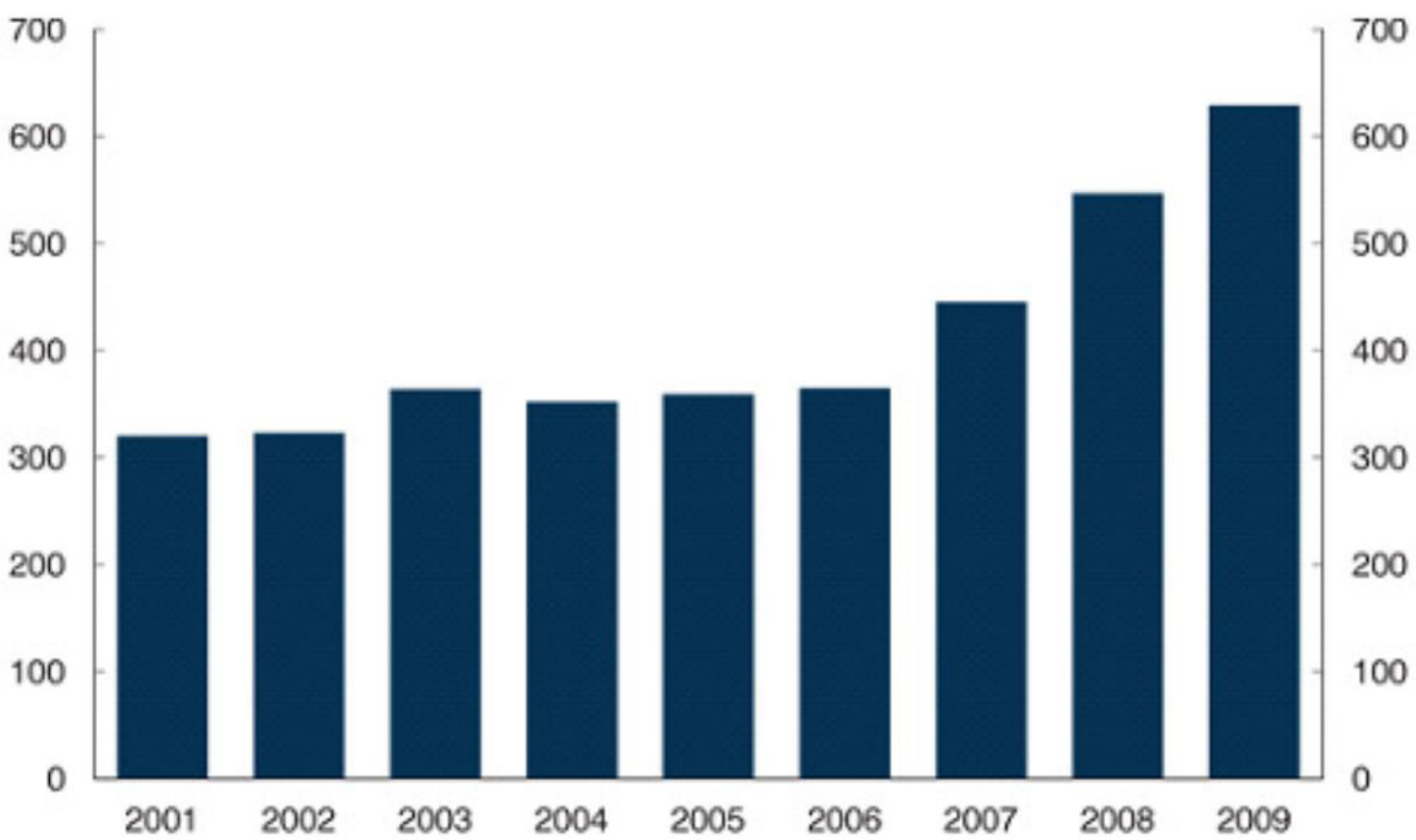
Competition18
Patients <<< >>> Dollars
| Year | Graduates (approx.) |
|---|---|
| 2001 | 320 |
| 2002 | 320 |
| 2003 | 360 |
| 2004 | 350 |
| 2005 | 360 |
| 2006 | 365 |
| 2007 | 450 |
| 2008 | 550 |
| 2009 | 630 |
Total Employed Dentists (2012–2015)19
- 2012: 14,903
- 2013: 15,411
- 2014: 16,087
- 2015: 16,451
Source: http://www.dentalboard.gov.au/About-the-Board/Statistics.aspx
With these graphs you can see the impact of overseas dentists completing ADC examination.
As you can see the number of dentists is increasing at a greater rate than the population.
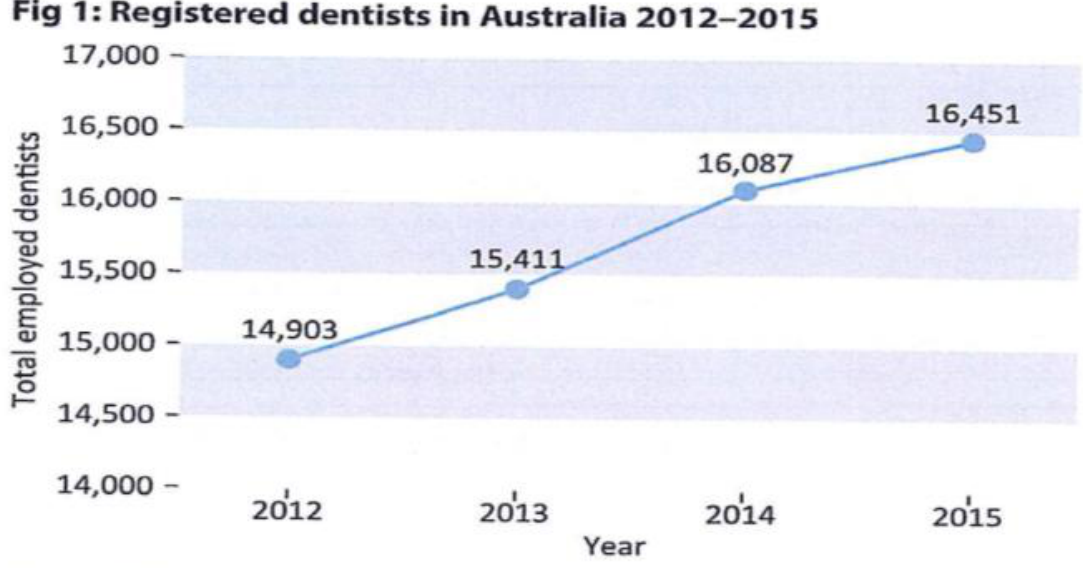 | 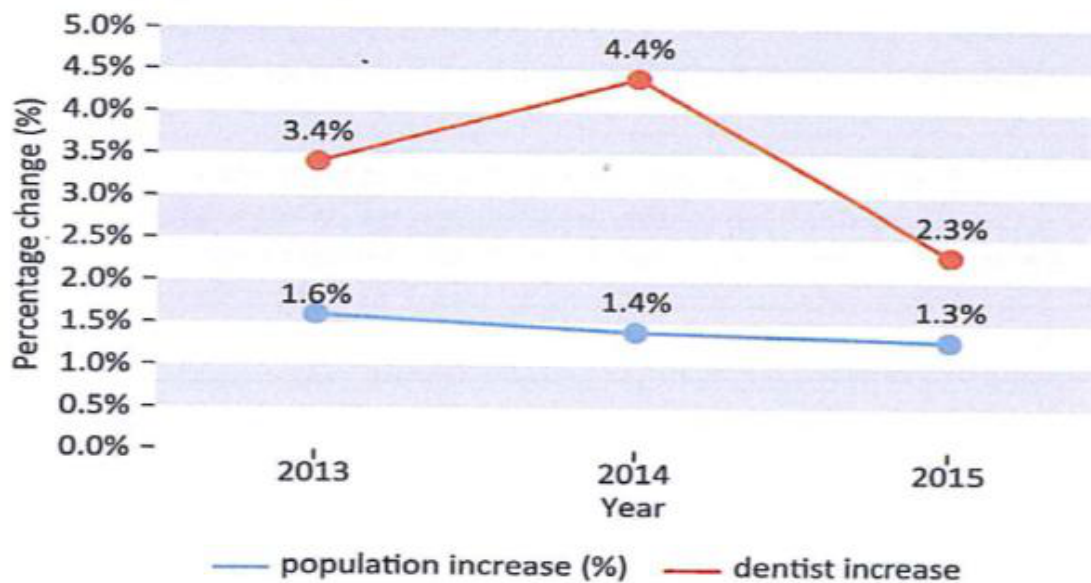 |
Fig 2. Percentage Increase in Australian Population and Dentist Numbers 2013–2015
Percentage change (%):
- 2013: population increase 1.6%, dentist increase 1.3%
- 2014: population increase 2.3%, dentist increase 1.4%
- 2015: population increase 3.4%, dentist increase 4.4%
Sources: http://www.dentalboard.gov.au/About-the-Board/Statistics.aspx; 3101.0 – Australian Demographic Statistics, Sep 2015.
Thanks to the lobbying of the ADA to the Federal and State Governments the 457 Visa for Dentists has been removed.
The outlook is better and is now expected to improve for recent graduates.
Lecturer — Competition and Orthodontics
Increasing competition for patients and practice income may encourage general dentists to extend their services into orthodontic treatment. Rising dentist numbers may lead practitioners to undertake treatment they might not otherwise have provided.
GradStats Data
“Removing dentists from the Skilled Occupation List has made some difference. However the deregulation of university placements significantly contributes to the existing oversupply and impacts on the likelihood of new graduates securing a job in a reasonable time frame after completion of their studies.”
— Former Australian Dental Association President, Dr Rick Olive AM RFD
Adequate Training Of General Practitioners20
- Demand or Availability of Orthodontic Care
- Adequate training of General Practitioners
- Financial motivation
- Quality of Care
Education And Standard Of Care21
- One is ethically, morally and legally responsible for delivering the same standard of care as your peers.
- And that includes Specialist practitioners.
 | 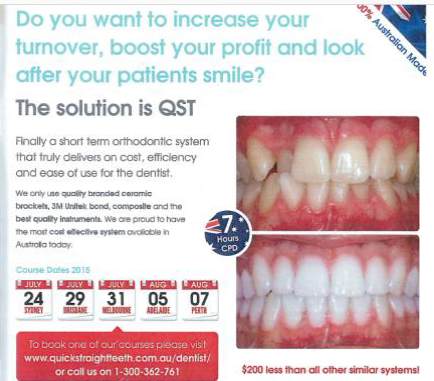 |
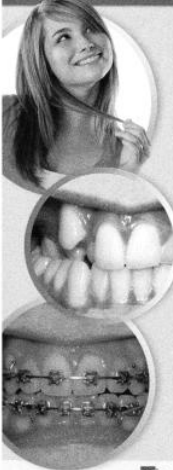 |  |
Scope Of Practice Registration Standard22
- All dental practitioners are members of the dental team who exercise autonomous decision making within their particular areas of education, training and competence, to provide the best possible care for their patients.
- Dental practitioners must only perform dental treatment:
- a. for which they have been educated and trained in programs of study approved by the National Board, and
- b. in which they are competent.
Lecturer — General Dentist Scope
Nothing inherently prevents a general dentist from providing orthodontic treatment. The ability to provide it is linked to the practitioner’s education, training, and competence.
Evidence Review On Service Provision
Marriott, A., Harding, W., Devlin, N. and Benwell, G. (2001). The delivery of orthodontic care in New Zealand. Part I and II: Analysis of a census of orthodontists, New Zealand Dental Journal, 97, 87-92 and 120-127.
Delivery Of Orthodontic Care In New Zealand23242526
This study was a questionnaire sent to dentists in New Zealand to ascertain the amount and variety of orthodontic services supplied by general practitioners.
Marriott, A., Harding, W., Devlin, N. and Benwell, G. (2001). The delivery of orthodontic care in New Zealand. Part I and II: Analysis of a census of orthodontists, New Zealand Dental Journal, 97, 87-92 and 120-127.
The majority of dentists carried out some form of orthodontic treatment, predominantly of a minor nature. A small number provided significant amounts of treatment, both simple and complex.
The majority of orthodontic treatment and the majority of comprehensive fixed-appliance treatment were undertaken by orthodontists. One-quarter of all orthodontic patients in New Zealand were treated by dentists, irrespective of the complexity of treatment.
Standard Of Care In City And Country Practice2728
In the city where specialists are readily available …
You must complete your procedures to the same standard of care as a specialist.
In the country/bush where you may be on your own …
You must do no harm and the patient must be better off following treatment.
Profiling Providers Of Orthodontic Services293031
Jacobs, R. M., Bishara, S.E. and Jakobsen (1991). Profiling providers of orthodontic services in general dental practice, American Journal of Orthodontics and Dentofacial Orthopedics, 99, 269-275.
Iowa, U.S.A. This study was designed to ascertain whether general practitioners who provide some orthodontic treatment to a relatively large proportion of their patients tend to limit themselves to the treatment of simple cases while they continue to refer more difficult cases, or whether a high volume of orthodontic treatment is linked to an expanded scope of treatment and fewer referrals.
This study indicated that providers of a high volume of orthodontic treatment:
- performed the same amount of limited orthodontic treatment as providers of a low volume of orthodontic treatment;
- performed significantly more major orthodontic treatment;
- used significantly more fixed appliances, functional appliances, and headgears, but not removable appliances;
- took significantly more hours of continuing education in orthodontics; and
- referred significantly fewer patients to orthodontic specialists.
Distribution Of Orthodontic Services And Fees3233343536
Huang, G.J., del Aguila, M.A. (2003). Distribution of orthodontic services and fees in an insured population Washington, American Journal of Orthodontics and Dentofacial Orthopediecs, 124, 366-72.
All orthodontic claims allowed by Washington Dental Service in 2001 were retrieved, along with treatment codes, fees, and demographic information for both patients and providers. A total of 102,948 orthodontic claims were included in the study.
General dentists submitted 7% of these claims, orthodontists submitted 90.9%, and pedodontists submitted 1.9%.
Orthodontists submitted higher average fees for space maintainers, first payments, and records.
The percentage of orthodontic treatment provided by general dentists and pedodontists in this claims-based study was substantially less than what has been previously reported in survey-based studies.
Additionally, a smaller percentage of general dentists and pedodontists in this study performed comprehensive treatment, compared with previous studies.
This study illustrates the value of insurance claims data to assess the provision of orthodontic care.
Provision Of Orthodontic Services By General Dental Practitioners37383940
Lawrence, A.J., Wright, F.A. and D’Adamo, S.P. (1995). The provision of orthodontic services by general dental practitioners. 2. Factors influencing variation in service provision, Australian Dental Journal, 40, 360-364.
The aims of this survey were to identify practitioner characteristics that account for variations in the level of orthodontic services provided and which distinguished providers and non-providers of orthodontic services. (Victoria, Australia)
Multiple regression analysis revealed that four practitioner characteristics explained 41% of the variance in the number of orthodontic patients treated.
The four characteristics of dentists who provide more orthodontic treatment were:
- treated more general practice patients;
- frequently used multiple sources to keep up to date in orthodontics;
- perceived their patient base to contain more children; and
- were more likely to have attended a short orthodontic course.
Financial Motivation41
Should General Dentists be providing Orthodontic Care?
- Demand or Availability of Orthodontic Care
- Adequate training of General Practitioners
- Financial motivation
- Quality of Care
General Practitioners Role In Orthodontic Treatment in Western Australia
Commercial Marketing Of Orthodontic Products4243
Australia’s business, technology & lifestyle magazine for the dental professional
AUSTRALASIAN DENTIST
- Subscription $99.00 per annum
- No.50 July-August 2013
TrollByte Kimera
- digital sensor
- image plate
- analogue
It can be that easy
TrollDental
INVISALIGN® NOW OFFERS MORE
Invisalign® stands as one of the most exciting breakthroughs in orthodontics in 30 years. Its latest advancement — Invisalign® i7 — is set to significantly expand the aesthetic options available to general dentists.

Invisalign® i744
Introducing the newest addition to the Invisalign product family. Invisalign i7 is a low-cost and convenient treatment solution for patients with very minor teeth straightening issues, such as very mild spacing, crowding and orthodontic relapse, providing results in as little as 3 months. Invisalign i7 offers the high-quality Invisalign features you expect at a price your patients can accept.
“Many patients simply want to correct a little crowding or other minor malocclusion. i7 gives doctors a new option for these patients, at a price consistent with minor fixes.” Dr David Penn, Southern Cross Dental Laboratories
SCDL’s Invisalign Education Courses
- 2-Day and 5-Day Courses in Australia & NZ — 2014 dates soon to be released
- 1-Day Update Courses — interactive sessions focused on latest advancements
- Co-ordinator Courses — designed to train your auxiliary staff
Visit www.scdl-education.com.au for course dates/venues and to register.
SOUTHERN CROSS DENTAL LABORATORIES
Make every smile an Invisalign® smile
SUITABLE FOR A WIDER RANGE OF PATIENTS
Recent developments to the Invisalign product portfolio mean that treatment options have expanded to include solutions for very minor tooth movements, through to more complex cases — making this market-leading technology more applicable to a wider range of patients. Discover why more than 2 million patients worldwide have chosen to improve their smiles with Invisalign — and how you can leverage this new technology to grow your practice.
Invisalign® Lite45
Invisalign Lite operates on the same principles as Invisalign Full, but is a shorter-duration treatment option. Lite treatment can be used for minor crowding or spacing treatments, pre-restorative treatments and partial/combination treatments to improve smiles in 14 or fewer stages.
“Invisalign really ticks all the boxes. We can use Invisalign either to correct many orthodontic issues, or as a partial treatment prior to pre-restorative work.” Dr Peter Wroth, Accent Dental — Perth
Invisalign® Full
Invisalign Full is Align Technology’s foundation treatment option and allows for maximum flexibility to treat a wide range of malocclusion.
“Constant product improvements mean that Invisalign can effectively treat a wide range of complex cases.” Dr Subin Dutta, Signature Smiles Dental — Gungahlin
SOUTHERN CROSS DENTAL LABORATORIES
DECEMBER 2013/JANUARY 2014 $5.95 INC GST
Bite — Better business for dentists
- SPECIAL REPORT — Bite’s annual guide to the best web, email and online services available today
- Into the depths — Meet the dentist who swims with sharks
- Trim or boost? — What’s the best way to increase revenue in your practice?
- 10 signs that your practice is in trouble — And what to do next
- In trusts we trust — The benefits and pitfalls of setting up a trust
- The inspiration — Despite battling her own serious challenges, Liz Dawson is determined to leave a legacy of decent oral health to the ACT’s neediest residents
Short-Term Orthodontic Courses And Programs
Straightwire Orthodontics for the General Dental Practitioner
- Course 1: 8/9 Feb 2014
- Course 2: 24/25 May 2014
- Course 3: 26 May 2014 (clinical)
- Course 4: 20/21 Sep 2014
- Course 5: 22 Sep 2014 (clinical)
These five courses will run through the diagnosis and treatment planning of various malocclusions. Course 1 will deal with Class I crowding, followed by Course 2 with Class II deep-bite and vertical. Course 4 will be dedicated to Class III of open-bites and deep-bites, as well as orthodontic case finishing and retention.
Doctors will learn which prescription to use, which malocclusion and which biomechanics will give the most efficient result, such as the elastic type, two-bite turbo and first-second-third order wire bands.
EODO guarantees compliance with Section 4 of the Dental Board of Australia’s Guidelines on Continuing Professional Development.
Course Fee46
- $990 (plus GST) per course (1, 2 or 4)
- $700 (plus GST) per clinical day
- Discounts available
For further information please contact EODO: www.eodo.com | Email: courses@eodo.com | Phone: +61 2 9398 8338
NATIONAL ASSOCIATION FOR ORTHODONTICS — Academy of Clinical Dentistry — PACE — ADA CERP® | Continuing Education Recognition Program
Excellence in Orthodontics and Dentofacial Orthopedics is an ADA CERP Recognized Provider. ADA CERP is a service of the American Dental Association to assist dental professionals in identifying quality providers of continuing dental education. ADA CERP does not approve or endorse individual courses or instructors, nor does it imply acceptance of credit hours by boards of dentistry.
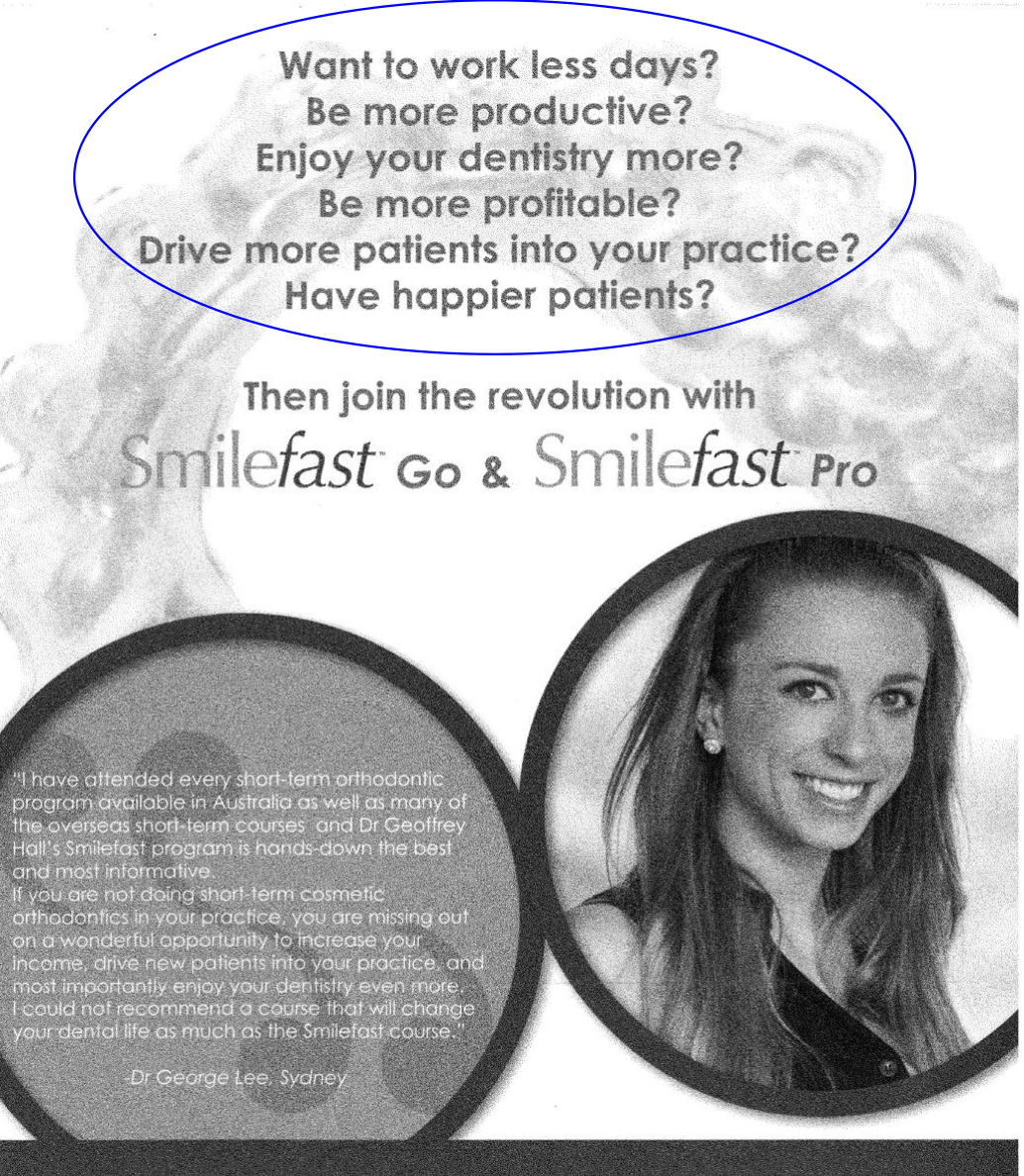
Want to work less days? Be more productive? Enjoy your dentistry more? Be more profitable? Drive more patients into your practice? Have happier patients?
Then join the revolution with Smilefast Go & Smilefast Pro
“I have attended every short-term orthodontic program available in Australia as well as many of the overseas short-term courses and Dr Geoffrey Hall’s Smilefast program is hands-down the best and most informative. If you are not doing short-term cosmetic orthodontics in your practice, you are missing out on a wonderful opportunity to increase your income, drive new patients into your practice, and most importantly enjoy your dentistry even more. I could not recommend a course that will change your dental life as much as the Smilefast course.” — Dr George Lee, Sydney
Smilefast MAGIC BRACES™ — Cosmetic treatment with sound orthodontic principles
PREDICTABLE. PATIENT PREFERRED. PROFITABLE.
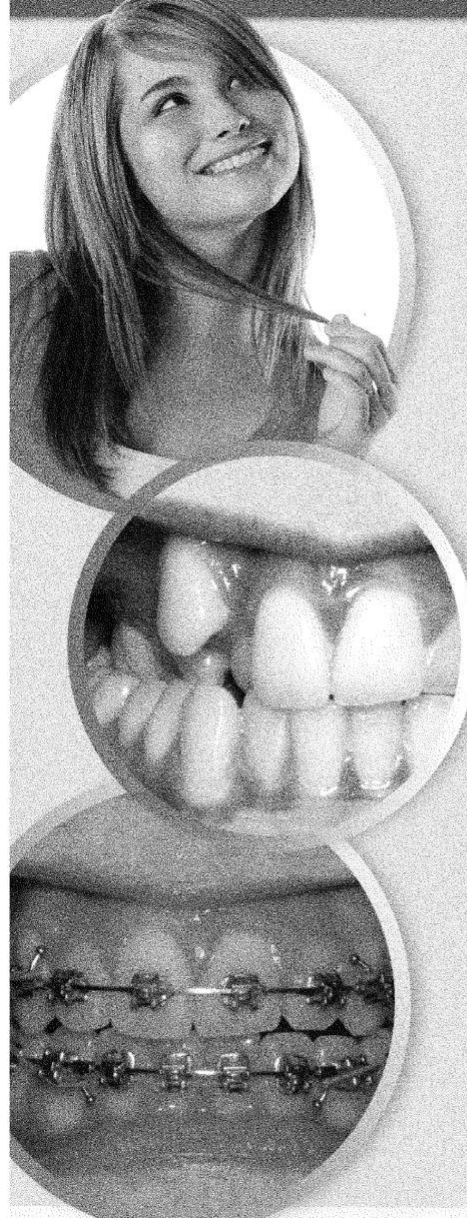 |  |
 |
About Smilefast™ Magic Braces™47
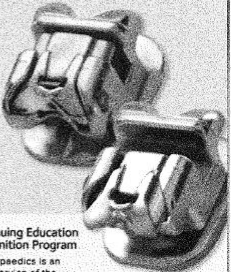
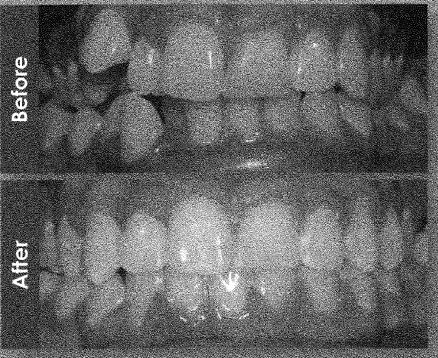
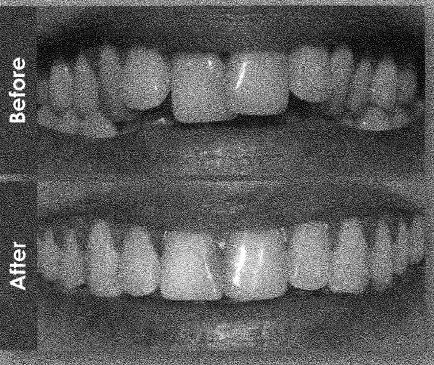
Smilefast™ Magic Braces™ is a technique any general dentist can easily learn. Using discreet clear braces it provides your adult patients with high quality aesthetic treatment by combining simple orthodontic principles to align the teeth and improve the smile in only 6-9 months.
General Dentists continue to choose Smilefast Magic Braces as this technique provides quality training, better treatment outcomes, more patients for the practice and the potential for significantly increased revenue and profit.
 |  |
 |
Training Course Options
Smilefast Go — Dentists 300+GST — 1 Day Course
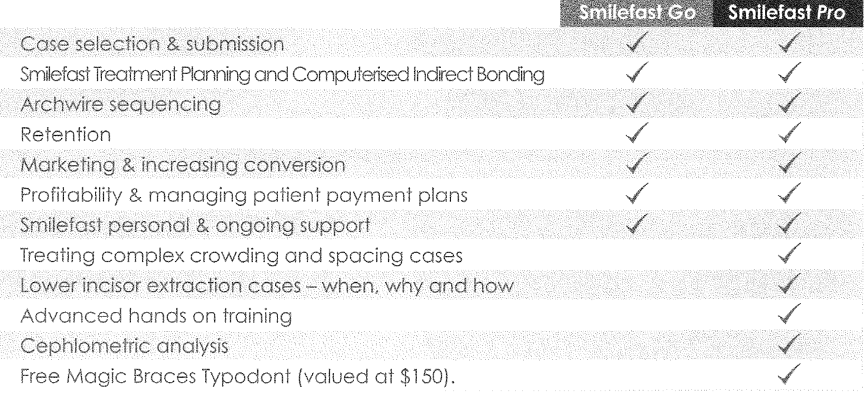
This 1 day course is the perfect introduction to the Smilefast Magic Braces system. Using our streamlined treatment planning and computerised indirect bonding services, you will be confident to treat the most common cases immediately. The ideal choice for those who want patients in the chair NOW.
Smilefast Pro — Dentists 500+GST — 2 Day Course
Master the Smilefast technique with this comprehensive 2 day course. Incorporating what’s covered in the 1 day course, you’ll also learn how to treat more complex crowding and spacing cases, as well as receive more advanced hands-on training. The ideal choice for those looking to master all aspects of the Smilefast system in one course.
| Smilefast Go | Smilefast Pro | |
|---|---|---|
| Case selection & submission | ✔ | ✔ |
| Smilefast Treatment Planning and Computerised Indirect Bonding | ✔ | ✔ |
| Archwire sequencing | ✔ | ✔ |
| Retention | ✔ | ✔ |
| Marketing & increasing conversion | ✔ | ✔ |
| Profitability & managing patient payment plans | ✔ | ✔ |
| Smilefast personal & ongoing support | ✔ | |
| Treating complex crowding and spacing cases | ✔ | |
| Lower incisor extraction cases – when, why and how | ✔ | |
| Advanced hands on training | ✔ | |
| Cephilometric analysis | ✔ | |
| Free Magic Braces Typodont (valued at $150) | ✔ |
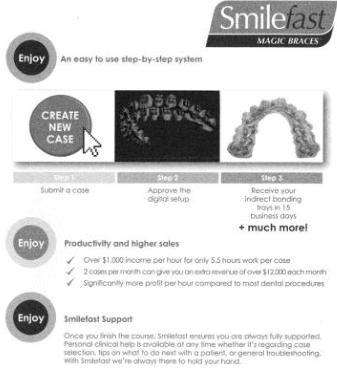
Smilefast MAGIC BRACES™ — Enjoy an easy to use step-by-step system
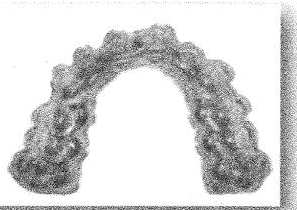
Step-by-Step Process48
- Submit a case
- Approve the digital setup
- Receive your indirect bonding trays in 15 business days
- much more!
 |  |  |
 |  |
Productivity and Higher Sales
- Over $1,000 income per hour for only 5.5 hours work per case
- 2 cases per month can give you an extra revenue of over $12,000 each month
- Significantly more profit per hour compared to most dental procedures
Smilefast Support
Once you finish the course, Smilefast ensures you are always fully supported. Personal clinical help is available at any time whether it’s regarding case selection, tips on what to do next with a patient, or general troubleshooting. With Smilefast we’re always there to hold your hand.
Don’t risk your money with other systems run overseas that can’t provide adequate ongoing support. Invest in a system where you are assured of the finest expertise and support from an Australian Specialist Orthodontist.
Upcoming Course Dates
| City | Smilefast Go | Smilefast Pro |
|---|---|---|
| Adelaide | 21 Feb | – |
| Melbourne | 06 Mar | 29-30 May |
| Gold Coast | 08 Mar | 12-13 June |
| Sydney | 03 Apr | 01-02 May |
Register at www.smilefast.com.au/page/courses — Limited Places
Before / After — 6 Month Treatment, Male, 25
Before / After — 9 Month Treatment, Female, 28
“No other course has had such an instant impact on my practice. Averaging 10 cases a month…dentistry has never been so much fun. The patients are flowing through the door, the staff are loving it, and our profitability has never been higher. This course is the best investment I ever made.” — Dr Robbie Sehmi, Sydney
…himself apart by offering the expertise, experience and local training that others cannot.
Register now at smilefast.com.au/page/courses
P: 1300 447 448 | F: 03 9532 8532 | E: enquiries@smilefast.com.au
5/875 Glenhuntly Road, South Caulfield Vic 3162
Quality Of Care49
- Demand or Availability of Orthodontic Care
- Adequate training of General Practitioners
- Financial motivation
- Quality of Care
Comparing Treatment Outcomes Of Orthodontists And General Dentists505152
Yumi, A., Suchitra, N., Amberman, D. and Hans, M.G. (2004). Comparing orthodontic treatment outcome between orthodontists and general dentists with the ABO index. American Journal of Orthodontics and Dentofacial Orthopedics, 126, 544-8.
In this sample, a significantly lower ABOI score (lower is better) was found for patients treated by orthodontic specialists compared with patients treated by general practitioners.
- There was no difference in the VAS scores; patients did not see any difference in the outcome of treatment based on the provider.
Legal Indemnity And Scope Of Practice53
Western Articulator, August 2012, Vol 29 No 7. The Australian Dental Association Western Australian Branch Inc.
Indemnity Matters
Dr Rob Bower
An Introspective Brief Note54
Each month Peter McKerracher and I sit down with a blank sheet of paper; well, computer screen, to come up with a short essay on a topic pertaining to professional indemnity insurance; a “Brief Note”. This is my 29th such essay. Writing them has increased my already healthy respect for the late Neil Burman and for Barry Gillings, who could each come up with an interesting, witty and informative essay at an even shorter interval.
This month I have almost finished an essay with the working title “AHPRA – A sheepdog with distemper” but after re-reading my efforts, I have decided not to waste some of my remaining days fighting litigation or fear of being behind bars. If this essay ever sees the light of day it will need to be cleared by the Dental Cases Panel’s solicitors and by MDA’s lawyers.
I also have a draft for an essay on “Amateur Orthodontics” which highlights the perils of general practitioners taking on complex orthodontic treatment. The nub of the solution lies in diagnosis, but with friends on either side of the orthodontic line in the sand, this one is also destined to stay on the hard drive.
…the standard of care to be expected as a recognised standard of acceptable professional practice (the Bolam Test), ie. what risks would a dental or medical professional usually disclose in the circumstances. Arguably, this is “sufficient consent” rather than “informed consent”.
In Australia, a more patient-centred approach applies, encompassed by the phrase “informed consent”. Informed consent in our jurisdiction requires that significant risks be disclosed, as well as risks which would be of particular importance to that individual patient. This approach combines an objective (the reasonable patient) and subjective (this particular patient) approach.
But Enore Panetta is far better qualified than I to deal with the issue of consent in his “Legal Aspects”!
So dear Reader, there you have my problem; a relatively narrow subject and the possibility of over exposure. The distempered sheepdog is looking more attractive for next month.
 |  |
Your Scope Of Practice And Referrals55
Dr Peter McKerracher, Consultant, Dental Cases Panel
Referral And The Standard Of Care56
With the recent publication of the ADAWA Dental Specialist Directory and also the policy of the Dental Board of about both of these topics.
The referral of patients to ensure the highest standard is an important part of practice-building because their particular problem may require with particular expertise which the general dental practitioner does not have. ‘has a go’ rather than referring, the appointment book is not full, to the patient when the treatment fails, and to refer appropriately is unjustifiable. justified criticism and potential.
No patient enjoys feeling treatment or believing that they were treated by someone who was working beyond their scope. Should such a patient lodge a Notification as of whether the practitioner was working within their Scope of Practice will certainly be asked and should it be shown that they were not, it is notice that penalties will certainly follow if allegations are found proven.
If your patient requires a treatment in which you have not been adequately trained and in which you are not competent, they must be referred or you risk an adverse finding by the Board. Both of these criteria must be satisfied to ensure that you are working within your Scope of Practice.

Using The ADAWA Specialist Directory
With the ADAWA Specialist Directory now in the hands of every member, there is a comprehensive list of suitably trained and competent practitioners in each of the specialties. The geographic listing provides every convenience for dentists and patients alike. There is no excuse for failing to refer!
It is important to note however that some practitioners who are not registered specialists limit their practice and will willingly accept referrals. Referring to such practitioners places the general dentist in the position of warranting the competence of such practitioners without the assurance of an advanced qualification and a specialist registration.
It is also misleading for a patient to be referred to a practitioner who is not a registered specialist without clearly specifying this fact. Following complaints to the Dental Cases Panel, it often transpires that a patient has assumed that their referral is to a specialist. They are, not surprisingly, annoyed when they find that such is not the case at all.
Indemnity Policy Implications
It is important to be aware that the MDA National professional indemnity policy states:
“14. We will not indemnify you under this policy when:
14.7 the matter for which you seek indemnity arises in any way out of providing dental services that you were not permitted to provide…or you acted outside of, or did not comply with the terms, limitations or requirements of your registration.”
By operating beyond your scope of practice, you may be jeopardising your policy of insurance, should a claim be brought against you.
Note also that the Dental Board of Australia’s Scope of Practice Registration Standard specifically prohibits any dental practitioner from directing another person to provide dental treatment or give advice outside that person’s education or competence.
Health Fund Direction Of Members
Regrettably, some of the health funds try to direct their members to preferred providers who may or may not possess advanced training or competence. Although they will argue that this direction is for economic reasons, ADAWA is well known that counter to the member’s best interests. This is contrary to the express wish of the patient and the general dental practitioner; it is tantamount to third party interference in the practice of dentistry. Evidence of such behaviour should be referred immediately to the CEO of ADAWA.
Building A Referral Network
When referring, it is best to specifically refer a patient to a particular named specialist. It is not acceptable to hand a patient a list of specialists and tell them to make their own choice and find their own specialist. The general dentist has a responsibility to refer their patient to a specialist clinician whom they know will be best suited to the patient or management for their particular problem. It can reasonably be expected of a professional that they know their patients and they know specialists in your area; it is not difficult to build up a network of a few specialists whom you trust.
It is strongly recommended that you develop your own preferences for specialists in each of the fields, or consult the new ADAWA Specialist Directory.
Once you have identified specialists, contact should be made, particularly with those who are located near you. As one becomes better known with one’s specialist colleagues, a meaningful working relationship can be developed. This relationship can be most useful when a complex situation arises or where a clinical emergency demands some extraordinary assistance.
It is important to be aware that the MDA National professional indemnity policy states:
“14. We will not indemnify you under this policy when:
14.7 the matter for which you seek indemnity arises in any way out of providing dental services that you were not permitted to provide…or you acted outside of, or did not comply with the terms, limitations or requirements of your registration.”
By operating beyond your scope of practice, you may be jeopardising your policy of insurance, should a claim be brought against you.
Note also that the Dental Board of Australia’s Scope of Practice Registration Standard specifically prohibits any dental practitioner from directing another person to provide dental treatment or give advice outside that person’s education or competence.
It is important to be aware that the MDA National professional indemnity policy states:
“14. We will not indemnify you under this policy when:
14.7 the matter for which you seek indemnity arises in any way out of providing dental services that you were not permitted to provide…or you acted outside of, or did not comply with the terms, limitations or requirements of your registration.”
By operating beyond your scope of practice, you may be jeopardising your policy of insurance, should a claim be brought against you.
Note also that the Dental Board of Australia’s Scope of Practice Registration Standard specifically prohibits any dental practitioner from directing another person to provide dental treatment or give advice outside that person’s education or competence.
Dr Peter McKerracher, Consultant Dental Cases Panel
Conclusion57
Firstly … Do No Harm …58
One is ethically, morally and legally responsible for delivering the same standard of care as your peers. And that includes Specialist practitioners.
Lecturer — Orthodontic Training
Many courses are available to general practitioners who want to undertake orthodontic treatment, but their quality varies.
- Some courses may provide limited benefit, while others may be relatively useless.
- None qualifies a dentist to provide comprehensive orthodontic treatment at specialist level because these are not three-year specialist programs.
- Many courses promote a particular appliance or product rather than teaching orthodontics through multiple appliances and treatment approaches.
- A limited number of courses may help a dentist understand orthodontics better after gaining experience in general practice.
At the end of the Orthodontic course, you have neither the didactic or clinical knowledge to provide comprehensive orthodontic treatment.
Lecturer — Rural Orthodontic Care
General practitioners may have a role in orthodontic care, particularly in rural or remote environments.
- That role requires accurate diagnosis, appropriate counselling, timely referral, and understanding the limits of treatment.
- Practitioners must recognise complex cases that should be avoided and base treatment on their education, training, and competence.
- Patient safety and appropriate care must remain central rather than relying solely on available courses, competitive pressures, or a particular appliance.
Footnotes
-
Original PDF page 1: L2 General Practitioners Role in Orthodontics in Western Australia, p.1 ↩
-
Original PDF page 2: L2 General Practitioners Role in Orthodontics in Western Australia, p.2 ↩
-
Original PDF page 3: L2 General Practitioners Role in Orthodontics in Western Australia, p.3 ↩
-
Original PDF page 4: L2 General Practitioners Role in Orthodontics in Western Australia, p.4 ↩
-
Original PDF page 5: L2 General Practitioners Role in Orthodontics in Western Australia, p.5 ↩
-
Original PDF page 6: L2 General Practitioners Role in Orthodontics in Western Australia, p.6 ↩
-
Original PDF page 7: L2 General Practitioners Role in Orthodontics in Western Australia, p.7 ↩
-
Original PDF page 8: L2 General Practitioners Role in Orthodontics in Western Australia, p.8 ↩
-
Original PDF page 9: L2 General Practitioners Role in Orthodontics in Western Australia, p.9 ↩
-
Original PDF page 10: L2 General Practitioners Role in Orthodontics in Western Australia, p.10 ↩
-
Original PDF page 11: L2 General Practitioners Role in Orthodontics in Western Australia, p.11 ↩
-
Original PDF page 12: L2 General Practitioners Role in Orthodontics in Western Australia, p.12 ↩
-
Original PDF page 13: L2 General Practitioners Role in Orthodontics in Western Australia, p.13 ↩
-
Original PDF page 14: L2 General Practitioners Role in Orthodontics in Western Australia, p.14 ↩
-
Original PDF page 15: L2 General Practitioners Role in Orthodontics in Western Australia, p.15 ↩
-
Original PDF page 18: L2 General Practitioners Role in Orthodontics in Western Australia, p.18 ↩
-
Original PDF page 19: L2 General Practitioners Role in Orthodontics in Western Australia, p.19 ↩
-
Original PDF page 16: L2 General Practitioners Role in Orthodontics in Western Australia, p.16 ↩
-
Original PDF page 17: L2 General Practitioners Role in Orthodontics in Western Australia, p.17 ↩
-
Original PDF page 20: L2 General Practitioners Role in Orthodontics in Western Australia, p.20 ↩
-
Original PDF page 21: L2 General Practitioners Role in Orthodontics in Western Australia, p.21 ↩
-
Original PDF page 22: L2 General Practitioners Role in Orthodontics in Western Australia, p.22 ↩
-
Original PDF page 23: L2 General Practitioners Role in Orthodontics in Western Australia, p.23 ↩
-
Original PDF page 24: L2 General Practitioners Role in Orthodontics in Western Australia, p.24 ↩
-
Original PDF page 25: L2 General Practitioners Role in Orthodontics in Western Australia, p.25 ↩
-
Original PDF page 26: L2 General Practitioners Role in Orthodontics in Western Australia, p.26 ↩
-
Original PDF page 27: L2 General Practitioners Role in Orthodontics in Western Australia, p.27 ↩
-
Original PDF page 28: L2 General Practitioners Role in Orthodontics in Western Australia, p.28 ↩
-
Original PDF page 29: L2 General Practitioners Role in Orthodontics in Western Australia, p.29 ↩
-
Original PDF page 30: L2 General Practitioners Role in Orthodontics in Western Australia, p.30 ↩
-
Original PDF page 31: L2 General Practitioners Role in Orthodontics in Western Australia, p.31 ↩
-
Original PDF page 32: L2 General Practitioners Role in Orthodontics in Western Australia, p.32 ↩
-
Original PDF page 33: L2 General Practitioners Role in Orthodontics in Western Australia, p.33 ↩
-
Original PDF page 34: L2 General Practitioners Role in Orthodontics in Western Australia, p.34 ↩
-
Original PDF page 35: L2 General Practitioners Role in Orthodontics in Western Australia, p.35 ↩
-
Original PDF page 36: L2 General Practitioners Role in Orthodontics in Western Australia, p.36 ↩
-
Original PDF page 37: L2 General Practitioners Role in Orthodontics in Western Australia, p.37 ↩
-
Original PDF page 38: L2 General Practitioners Role in Orthodontics in Western Australia, p.38 ↩
-
Original PDF page 39: L2 General Practitioners Role in Orthodontics in Western Australia, p.39 ↩
-
Original PDF page 40: L2 General Practitioners Role in Orthodontics in Western Australia, p.40 ↩
-
Original PDF page 41: L2 General Practitioners Role in Orthodontics in Western Australia, p.41 ↩
-
Original PDF page 42: L2 General Practitioners Role in Orthodontics in Western Australia, p.42 ↩
-
Original PDF page 45: L2 General Practitioners Role in Orthodontics in Western Australia, p.45 ↩
-
Original PDF page 43: L2 General Practitioners Role in Orthodontics in Western Australia, p.43 ↩
-
Original PDF page 44: L2 General Practitioners Role in Orthodontics in Western Australia, p.44 ↩
-
Original PDF page 46: L2 General Practitioners Role in Orthodontics in Western Australia, p.46 ↩
-
Original PDF page 47: L2 General Practitioners Role in Orthodontics in Western Australia, p.47 ↩
-
Original PDF page 48: L2 General Practitioners Role in Orthodontics in Western Australia, p.48 ↩
-
Original PDF page 49: L2 General Practitioners Role in Orthodontics in Western Australia, p.49 ↩
-
Original PDF page 50: L2 General Practitioners Role in Orthodontics in Western Australia, p.50 ↩
-
Original PDF page 51: L2 General Practitioners Role in Orthodontics in Western Australia, p.51 ↩
-
Original PDF page 52: L2 General Practitioners Role in Orthodontics in Western Australia, p.52 ↩
-
Original PDF page 53: L2 General Practitioners Role in Orthodontics in Western Australia, p.53 ↩
-
Original PDF page 54: L2 General Practitioners Role in Orthodontics in Western Australia, p.54 ↩
-
Original PDF page 56: L2 General Practitioners Role in Orthodontics in Western Australia, p.56 ↩
-
Original PDF page 55: L2 General Practitioners Role in Orthodontics in Western Australia, p.55 ↩
-
Original PDF page 58: L2 General Practitioners Role in Orthodontics in Western Australia, p.58 ↩
-
Original PDF page 57: L2 General Practitioners Role in Orthodontics in Western Australia, p.57 ↩