Development and Components of Contemporary Fixed Appliances
Development of Fixed Appliances1
- Early fixed appliances were simple bands with soldered attachments.
- Modern appliances use pre-adjusted brackets, molar tubes, and archwires.
- Early systems required clinicians to manually bend first, second, and third-order compensations into every archwire.
- Modern “straight wire” systems have these compensations built directly into the bracket slots, saving clinical time.
- Advances in materials (e.g., nickel-titanium alloys) allow more efficient tooth movement.
- The transition from soldering metallic attachments with hand torches to modern bonding systems has increased efficiency and expanded the types of tooth movements possible.
Components of Fixed Appliances
-
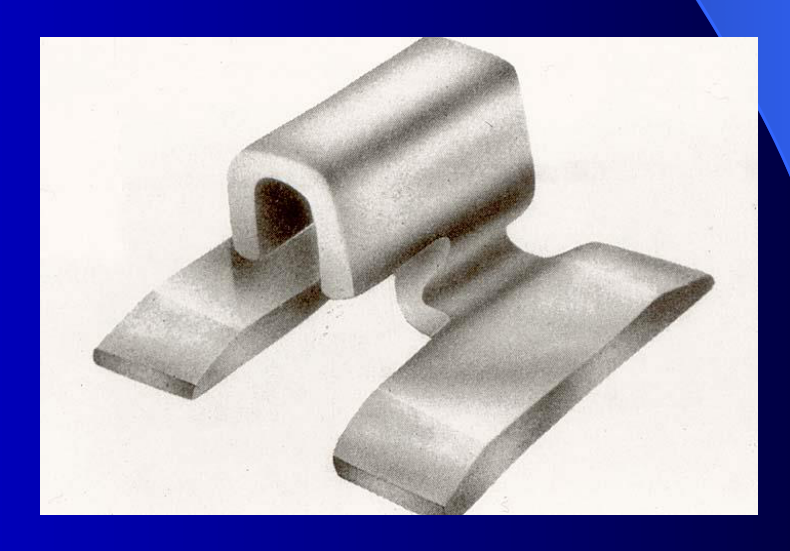
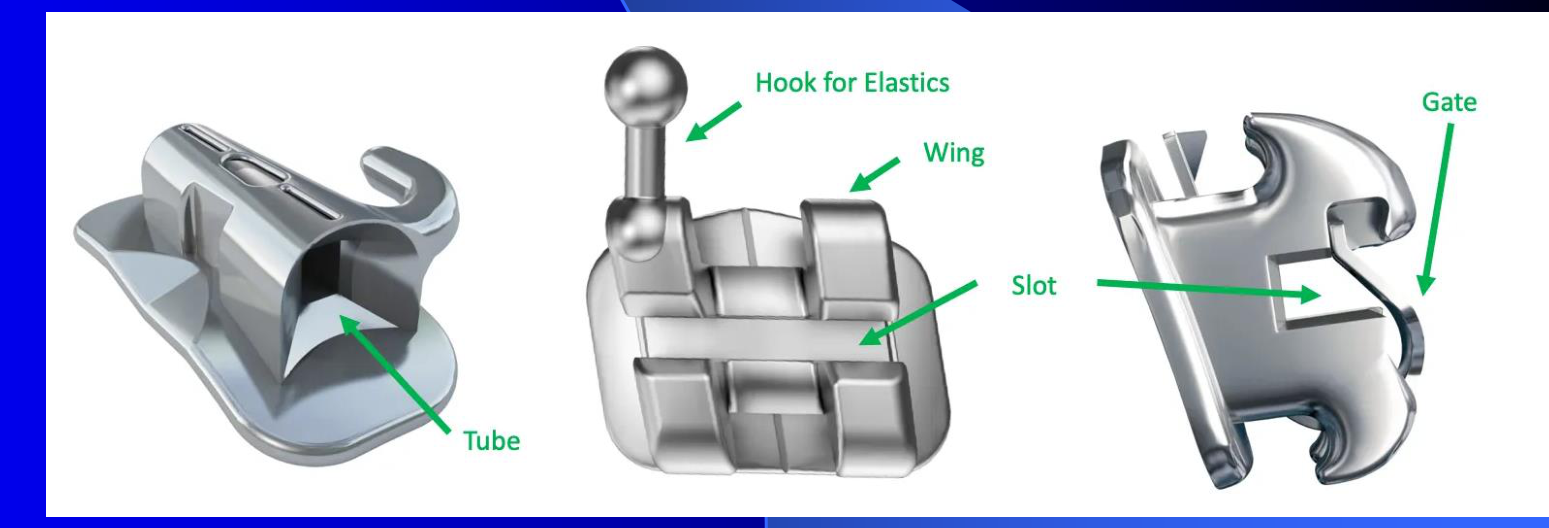
Brackets: Bonded to teeth; available in metal, ceramic, or plastic.
-
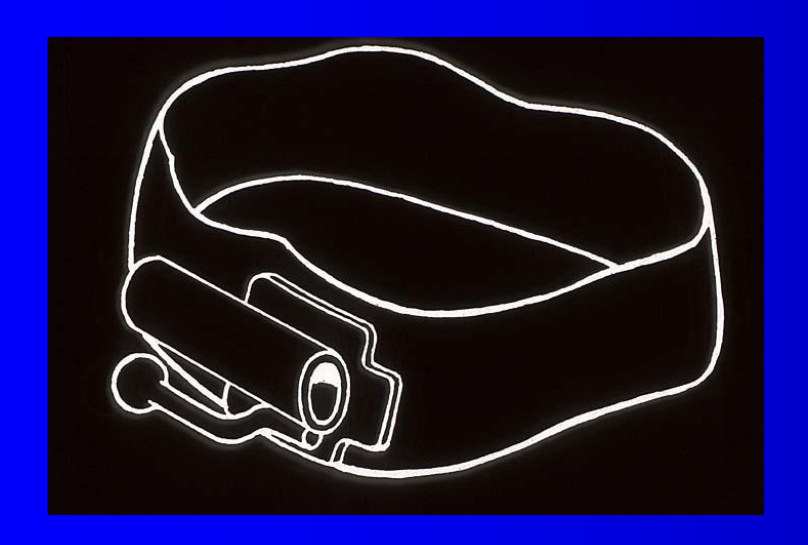
Bands: Placed on molars; may have buccal tubes or hooks.
-
Archwires: Engage brackets; provide force for tooth movement.
-
Elastics: Used for interarch or intraarch forces.
-
Auxiliaries: Springs, hooks, and other attachments for specific movements
- Auxiliary elements also include lingual arches, coils, and elastomeric components.
-
Angle’s Progression to the Edgewise Appliance
-
Other Early Appliance Systems
-
Begg Appliance
-
Contemporary Edgewise: The Modern Appliance
Historical Development of Fixed Appliances2
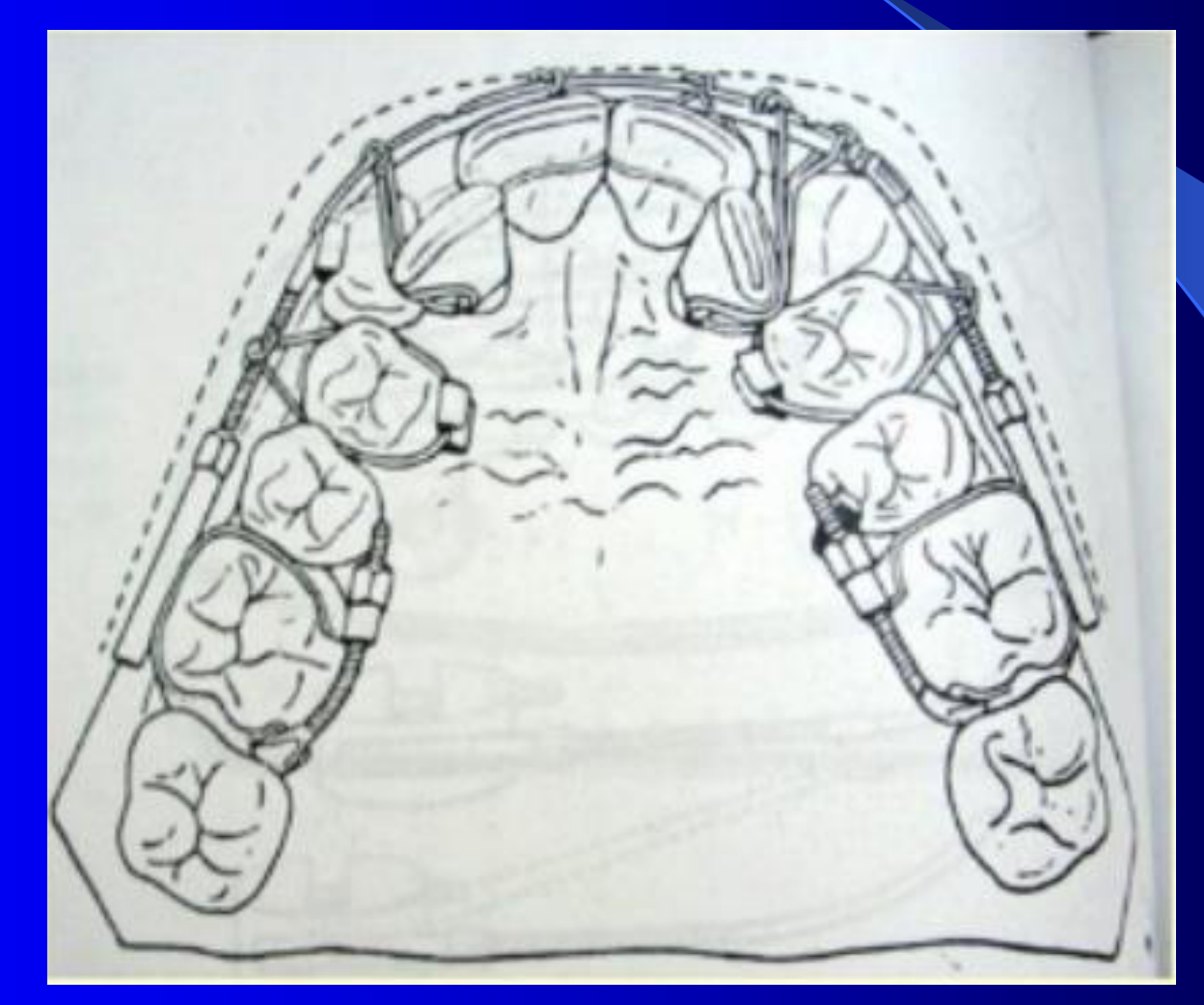
Angle’s Progression to the Edgewise Appliance34567
- The E-Arch
- Pin and Tube
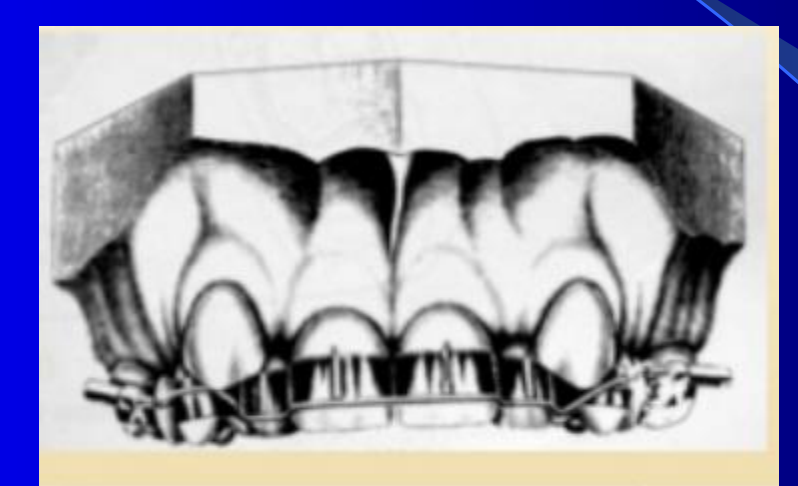
- Ribbon Arch
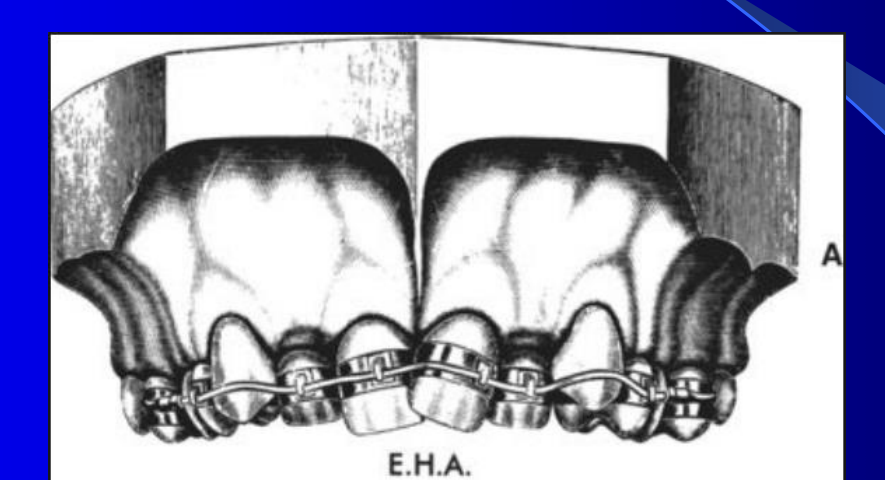
- Edgewise
E-Arch 1900
- In the early 1900s, systems used screws to tighten bands with a buccal-labial arch. Force was delivered by lacing teeth to the arch to correct rotations, though biomechanics were limited.
Pin and Tube 1910
- This system used pins attached to bands on every tooth; because bonding did not exist, every tooth required a cemented band.
Ribbon Arch 1915
A
 |  |
 |  |
Other Early Appliance Systems8910
- Crozat Appliance
- Labio-Lingual Appliance
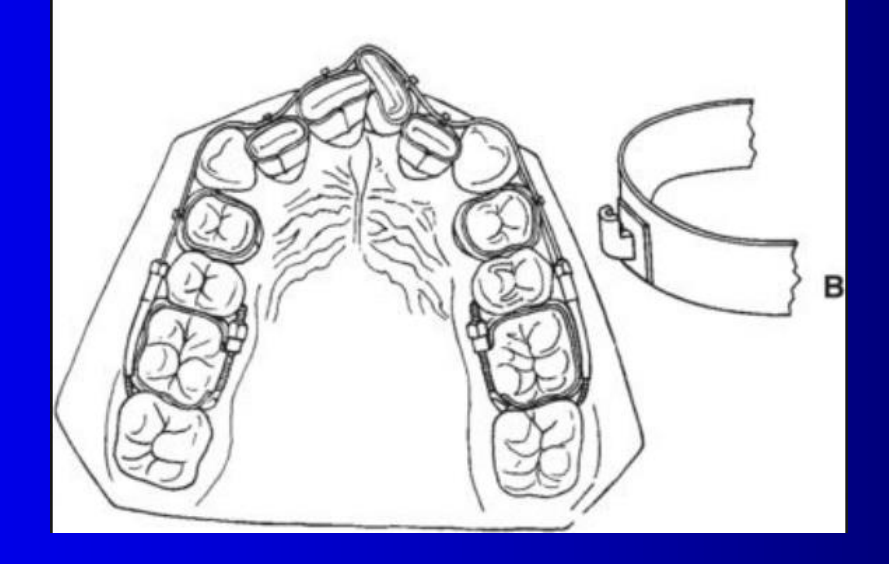
- Johnson Twin-wire Appliance
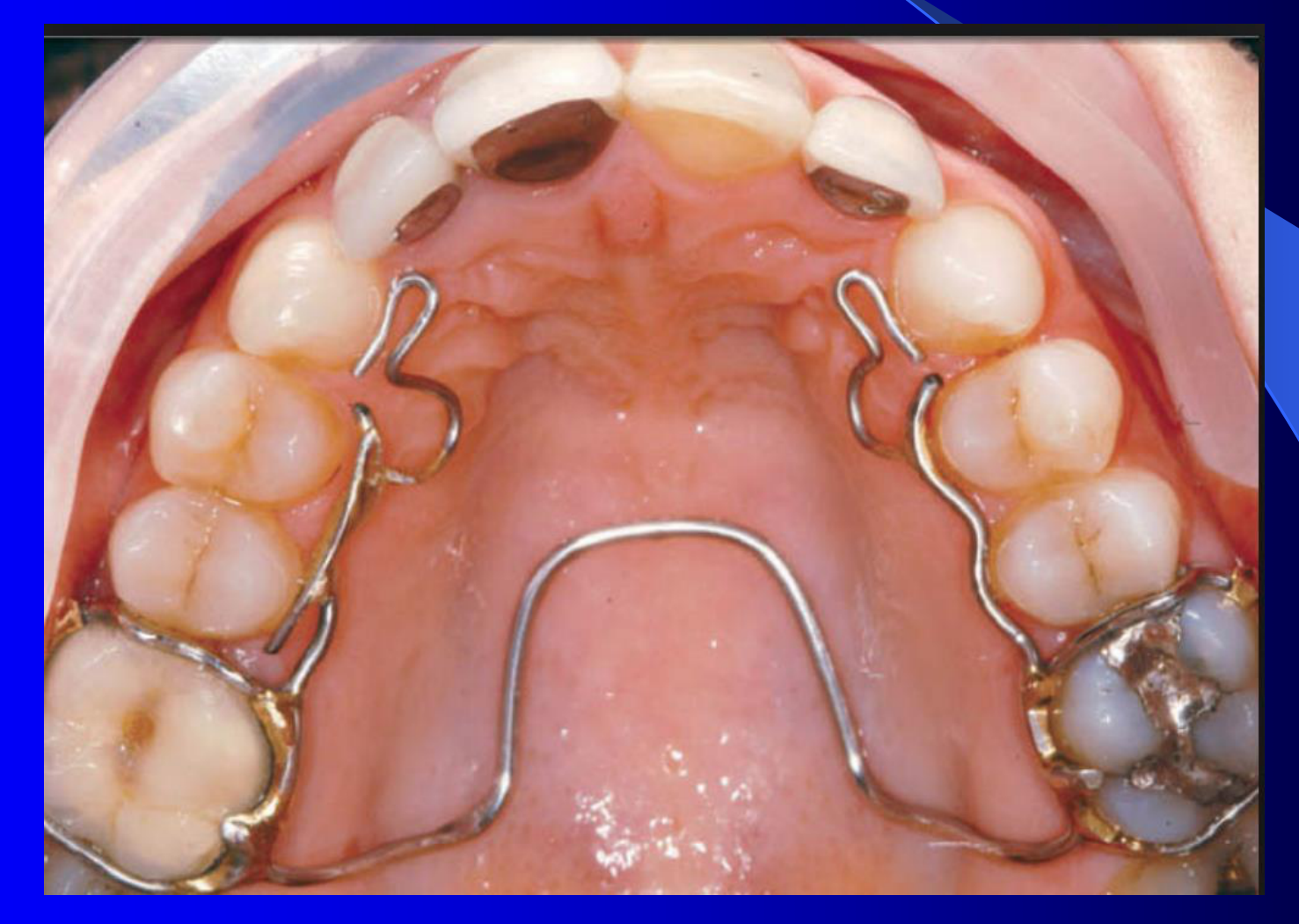
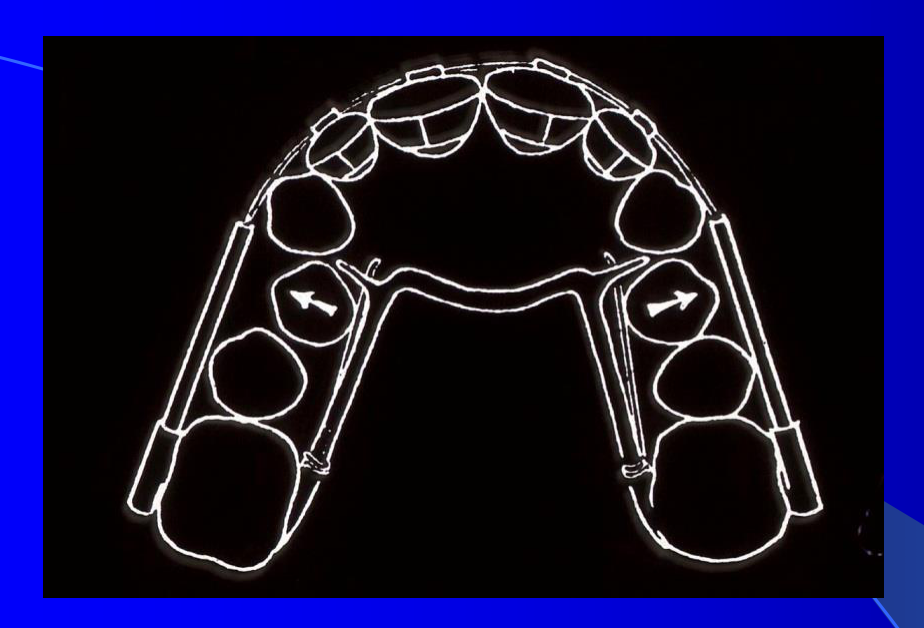
Crozat 1920
- Also known as the Crusade System, this was a rudimentary system used to correct posterior crossbites using springs and activations rather than traditional bends.
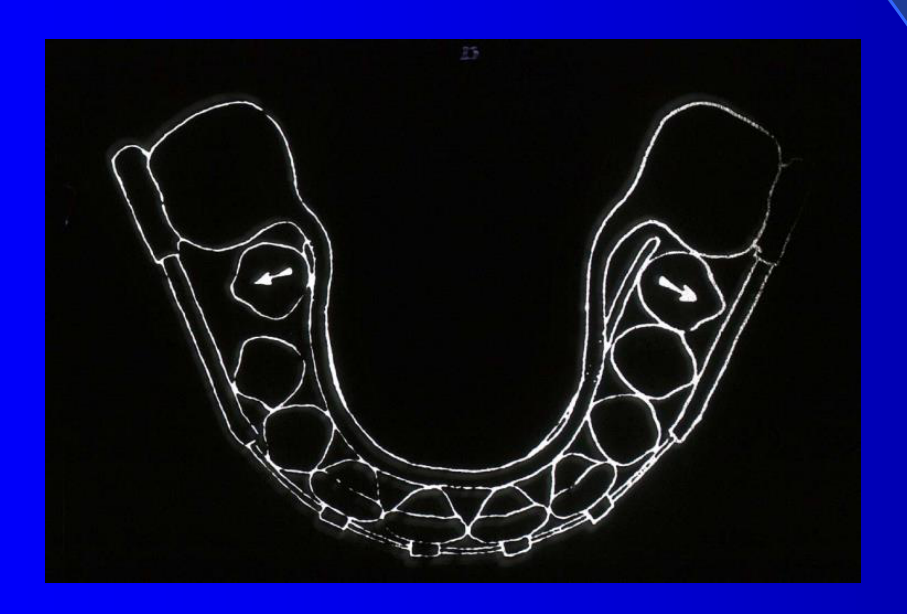
Twin Wire 1930
- Utilized double wires instead of a single wire to achieve different types of movement.
A
B
 |  |
 |  |
The Begg Appliance11121314
Begg Appliance
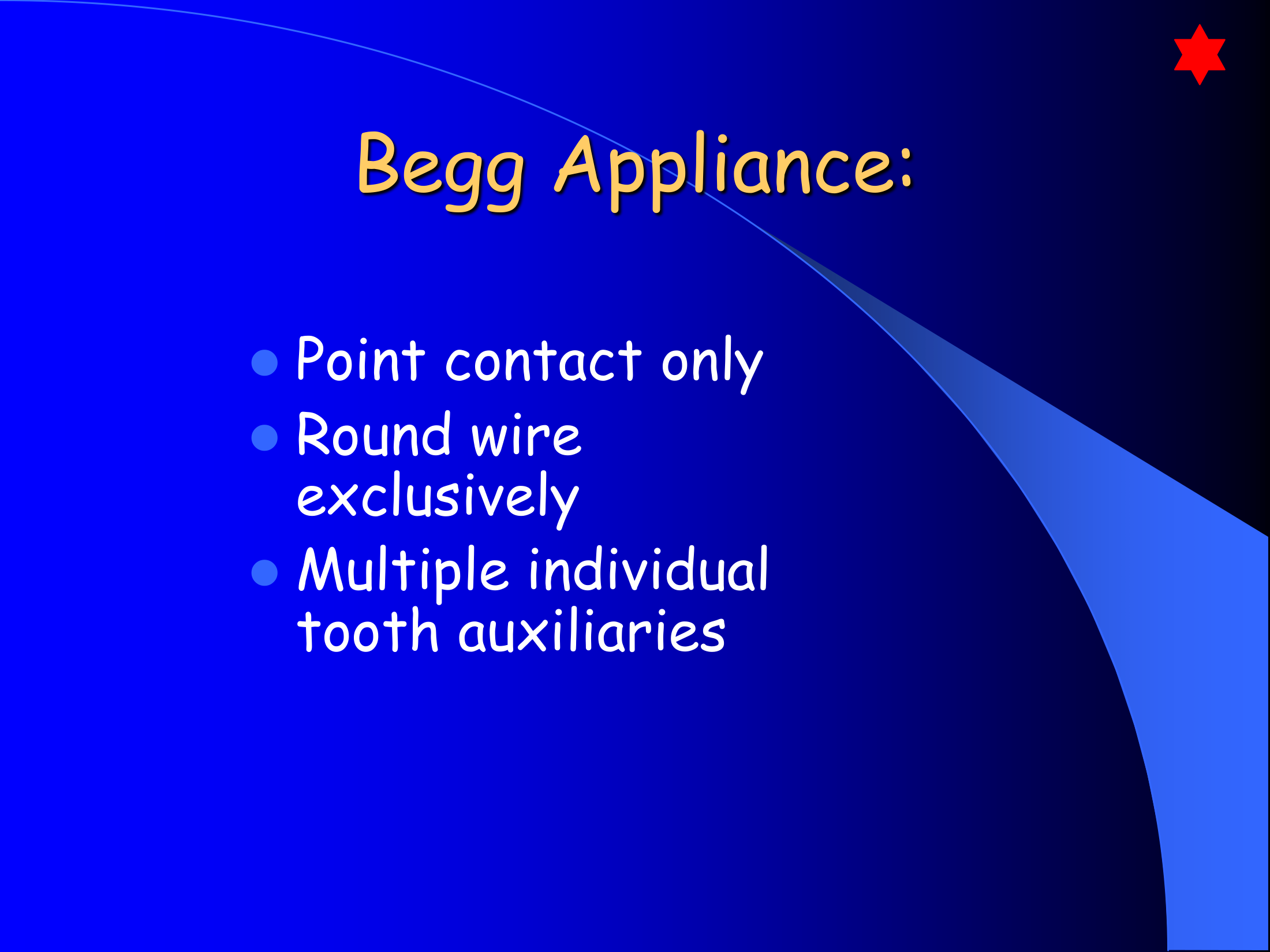
Begg Appliance:
- Point contact only
- Round wire exclusively
- Multiple individual tooth auxiliaries
- Used vertical pins to connect archwires to brackets.
- Had limited third-order (torque) control compared to rectangular slots, though it utilized elastics to achieve similar results.
- It is largely no longer in use.
Begg Appliance
Origins
Developed by P.R. Begg in Australia, this system was a significant departure from the edgewise system.
Molar Tube (round or oval)
Bracket (pin and tube)
*Edgewise
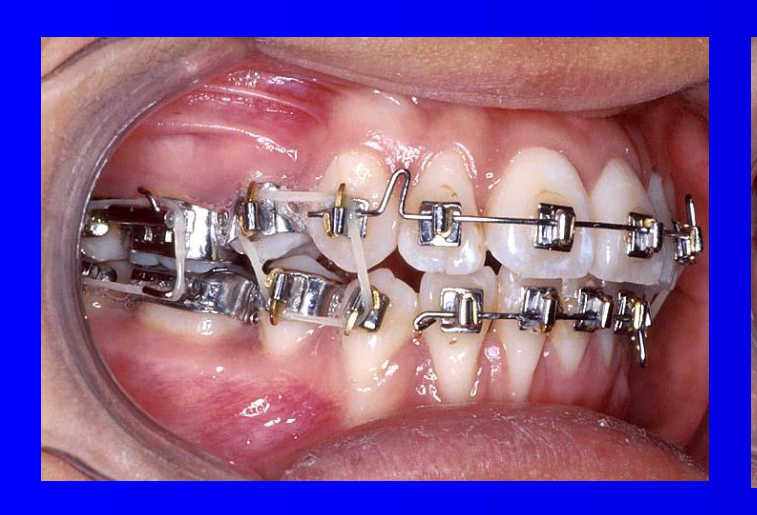
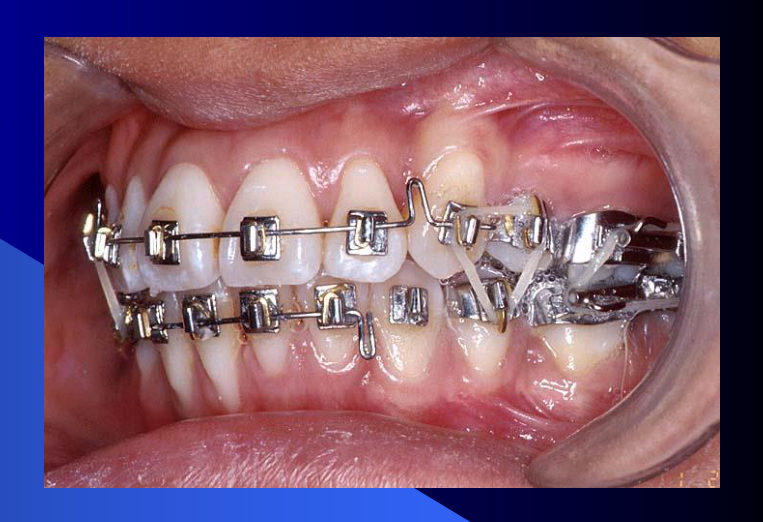
- Introduced in 1925, this featured a rectangular slot. Brackets had no built-in angles, requiring clinicians to hand-bend all first, second, and third-order (torque) compensations into the wires. Appliance*
This is the:
“Contemporary Fixed Appliance”
 |  |
 |  |
Orthodontics Market Overview15
3M Unitek
Dentsply Sirona
TOMY INTERNATIONAL INC.
RMO Synergistic Solutions for Progressive Orthodontics
Market Trends
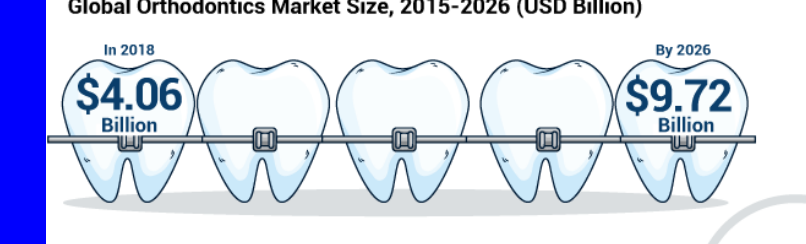
The current market is characterized by intense competition among manufacturers to develop antimicrobial materials to fight white spot lesions and technological advances in bonding systems, archwires, and self-ligating technology.
Global Orthodontics Market Size, 2015-2026 (USD Billion)
In 2018: 9.72 Billion
**Global Orthodontics Market Share By Product Type, 2018
- Antimicrobial Materials: A major trend aimed at fighting white spot lesions, for which orthodontists in some regions (like the US) are being held legally responsible.
- Technological Advances: Improvements in bonding systems (moisture-controlled primers), high-performance archwires, and self-ligating technology.**
- Instruments
- Supplies
North America Orthodontics Market Size, 2018
USD 1.84 Billion
AMERICAN ORTHODONTICS
HENRY SCHEIN® ORTHODONTICS
Ormco™
OSE ORTHODONTIC SUPPLY & EQUIPMENT CO., INC.
TP Orthodontics, Inc.
 |  |
Major Elements of Contemporary Fixed Appliances1617
- Bands / Bonded Brackets (Attachments)
- Archwire (in main bracket slot)
- Auxiliary Elements (lingual arch and labial auxiliary elements, etc.)
Contemporary Edgewise Appliance:
- Horizontal Rectangular Slot
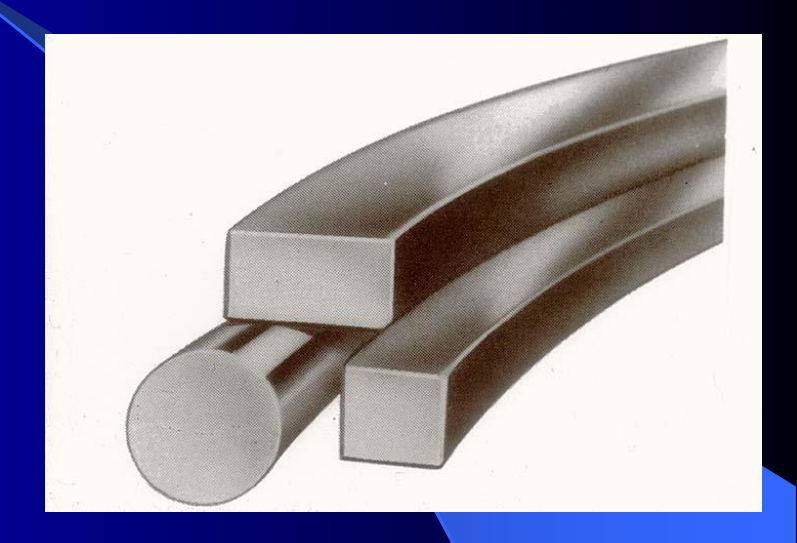
- Round, Square or Rectangular Wire
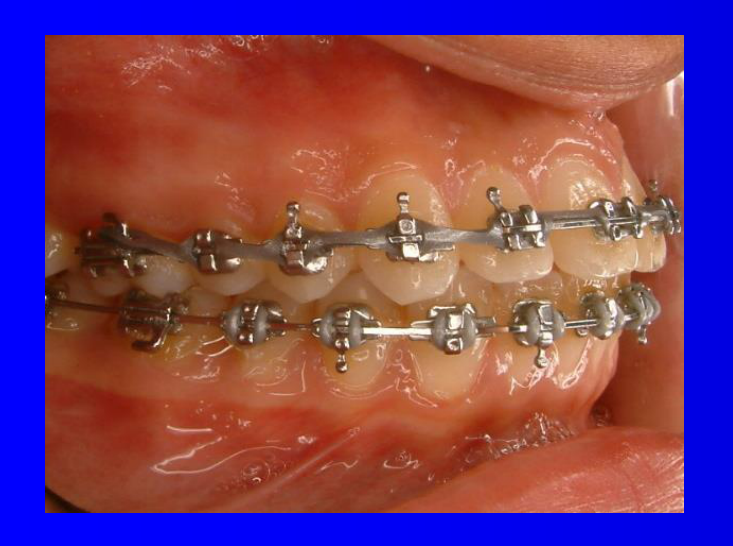
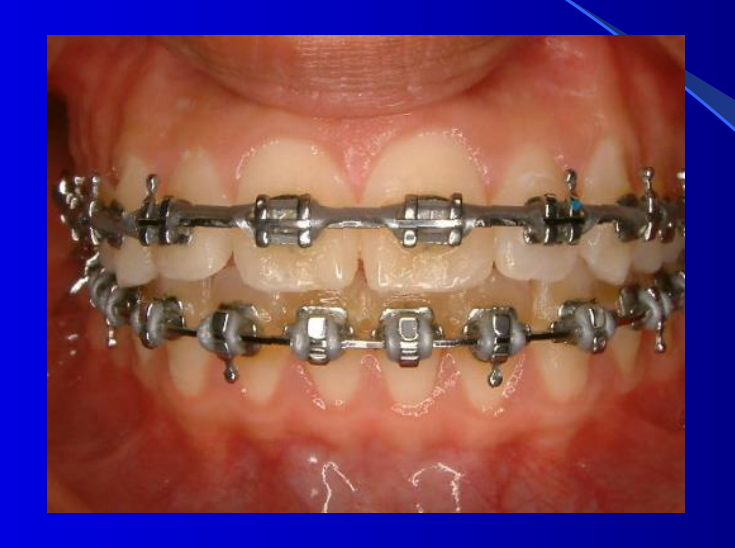
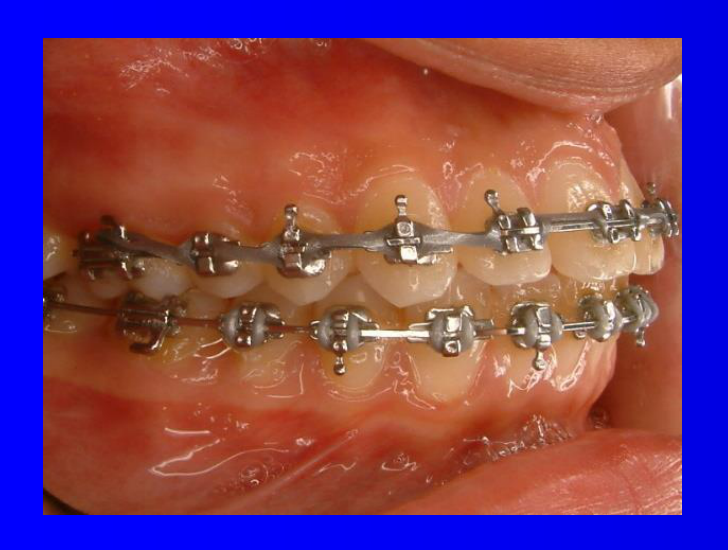
Bracket Types and Materials18192021222324
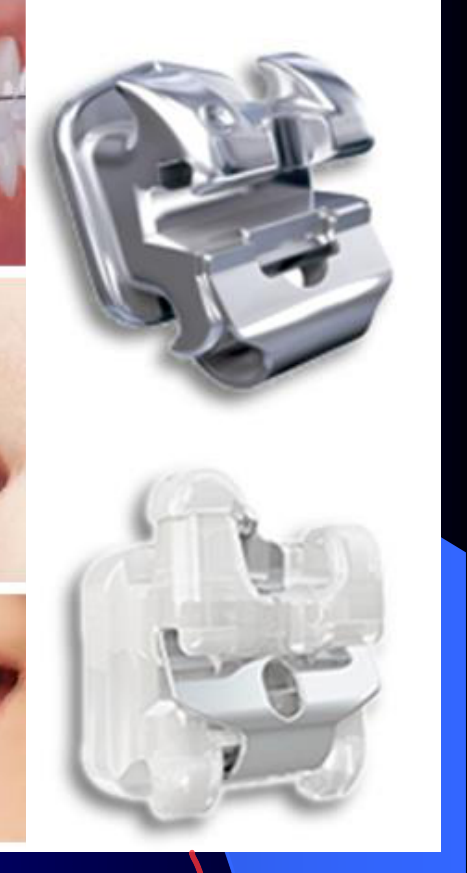
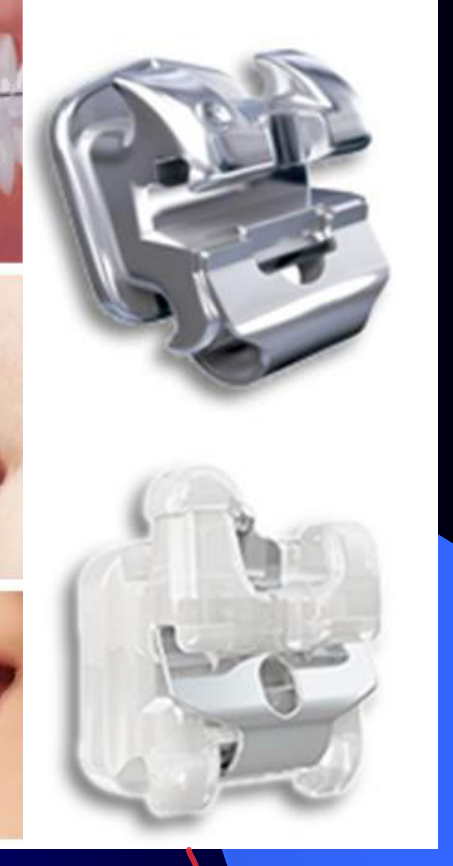
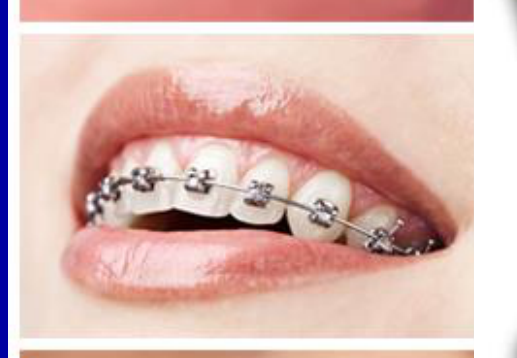
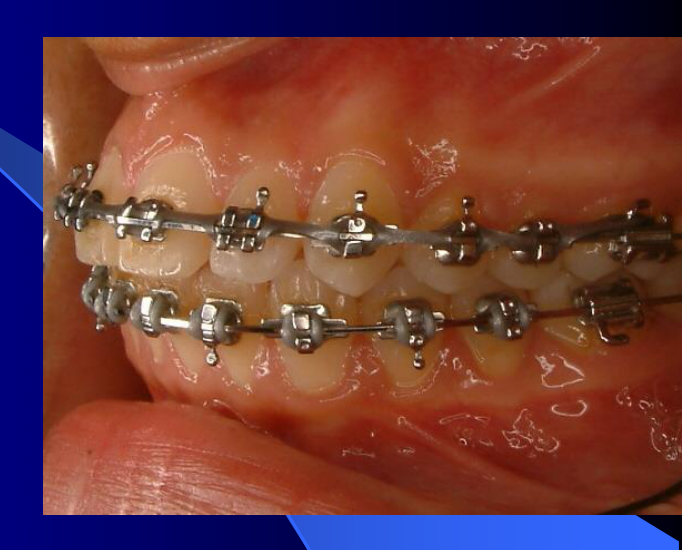
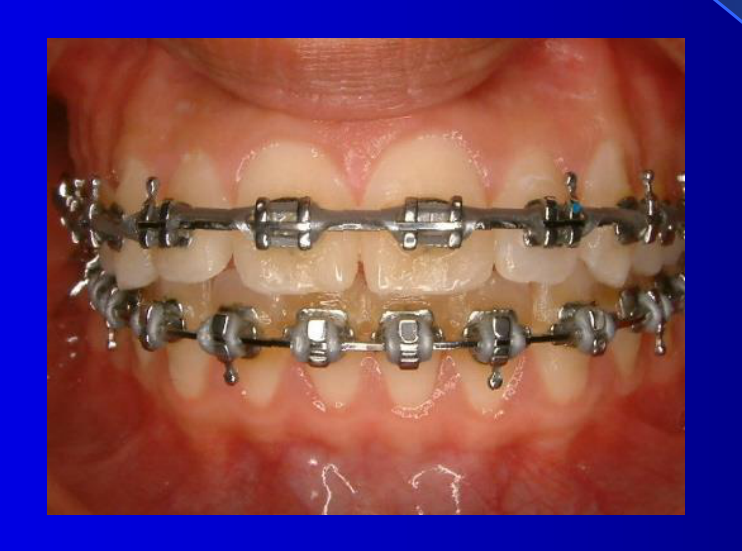
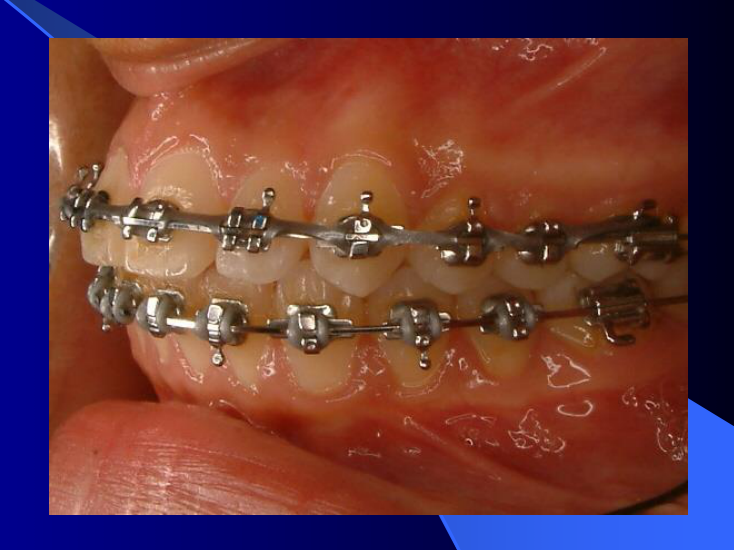
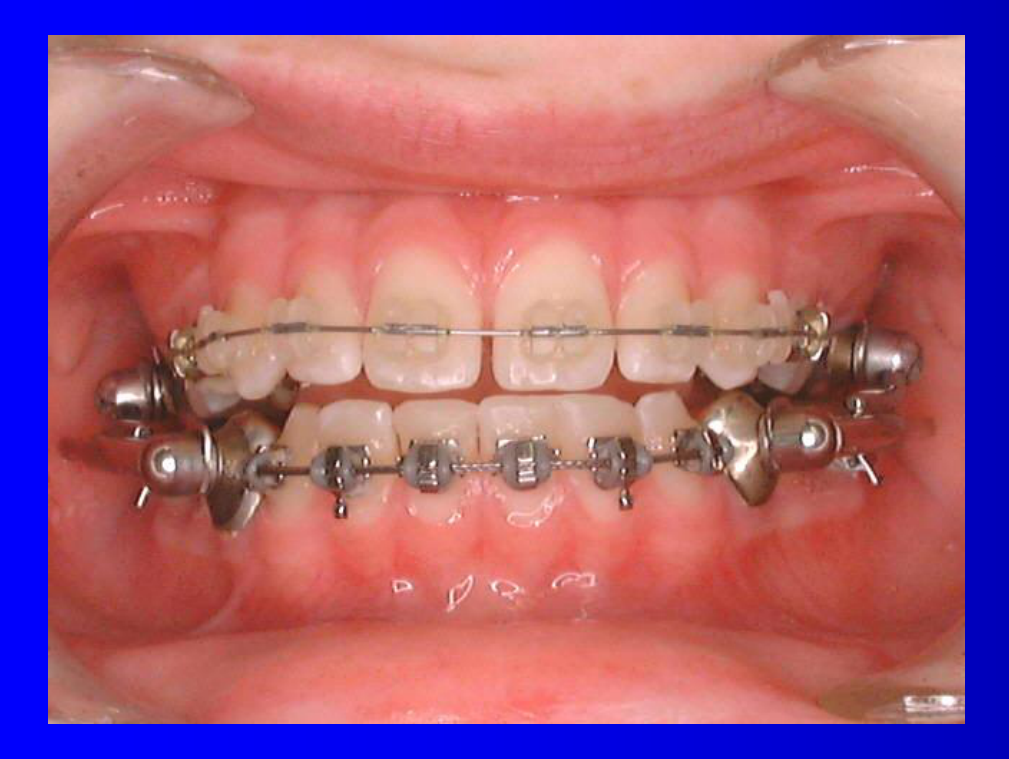
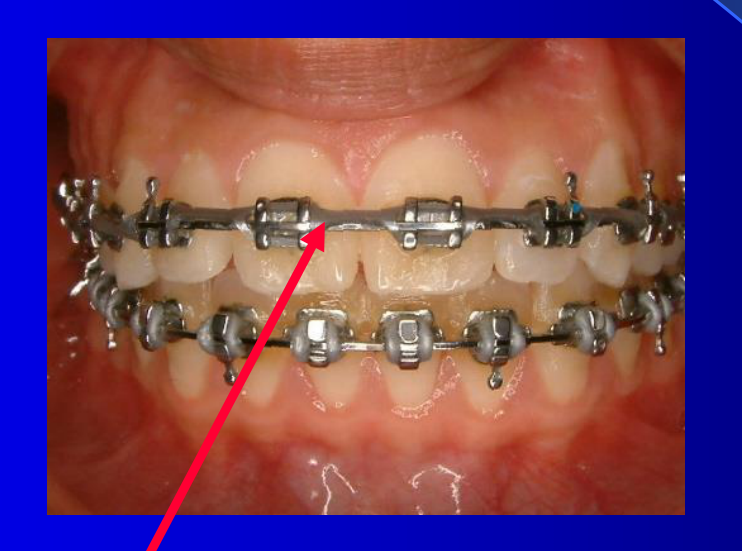
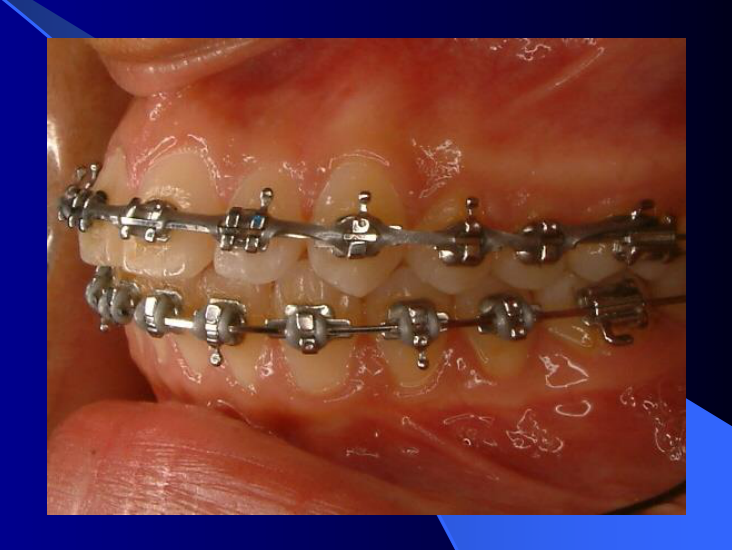
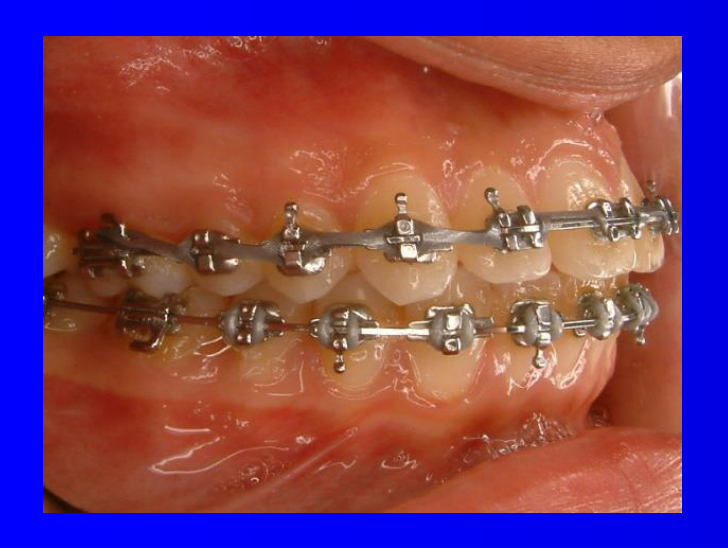
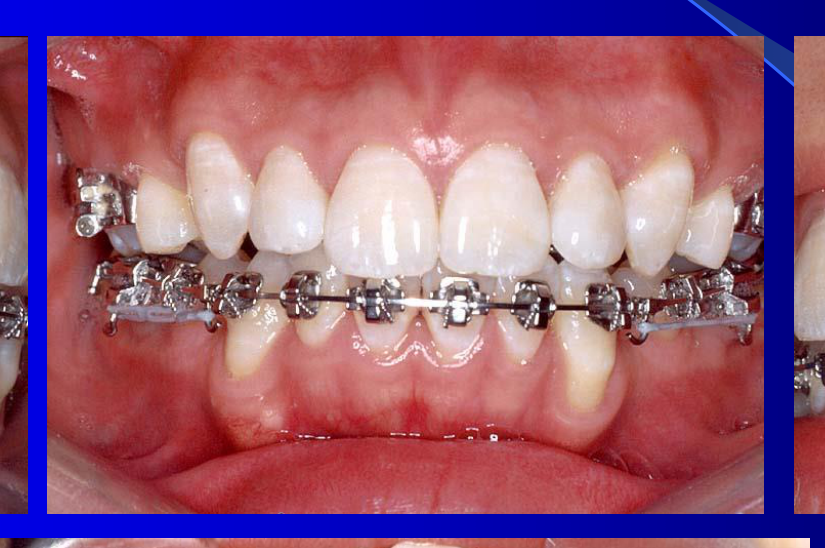
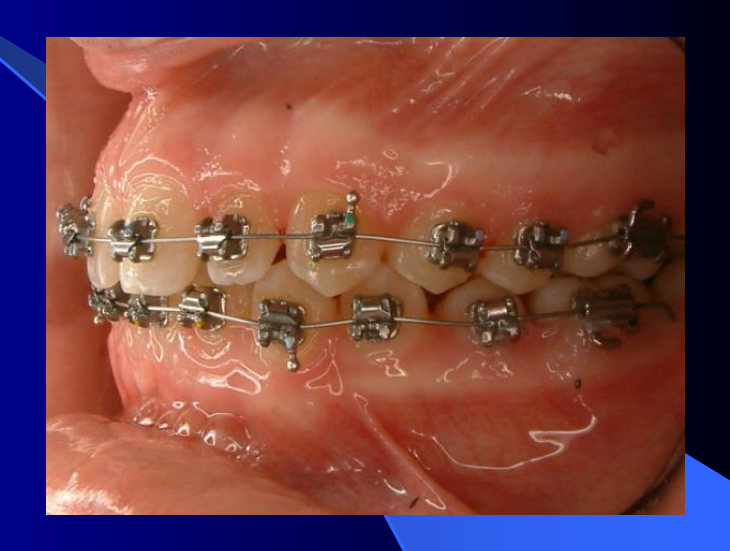
Typically for anterior teeth and bicuspids.
-
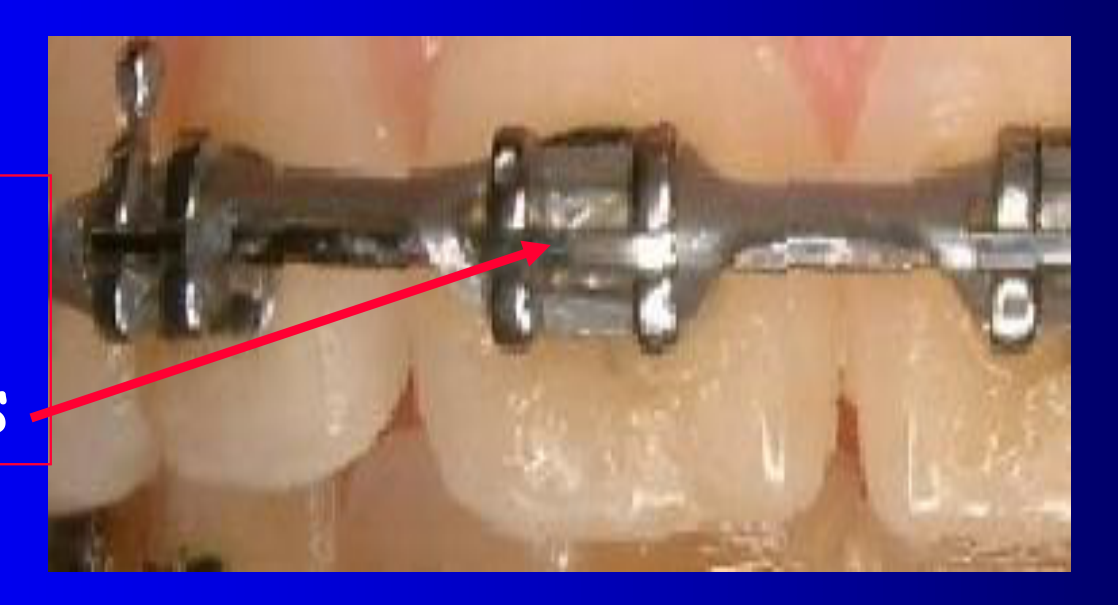
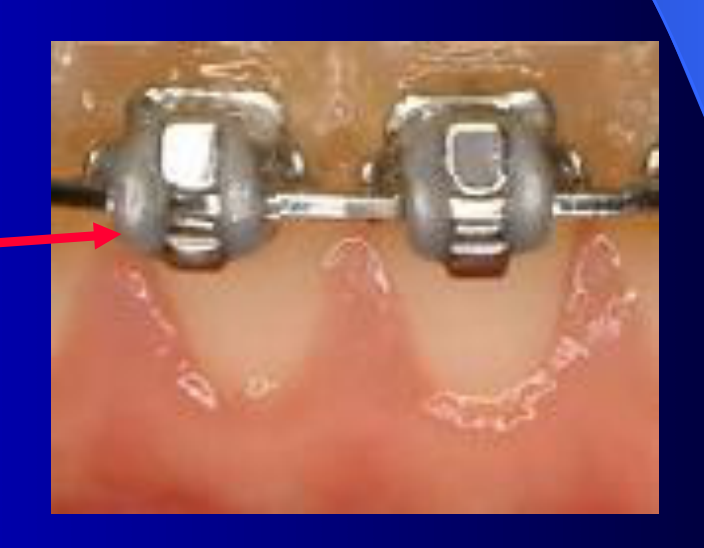
Wings - twin or single
-
All have horizontal slot
-
Many variations in materials and size of the attachment depending upon the manufacturer
-
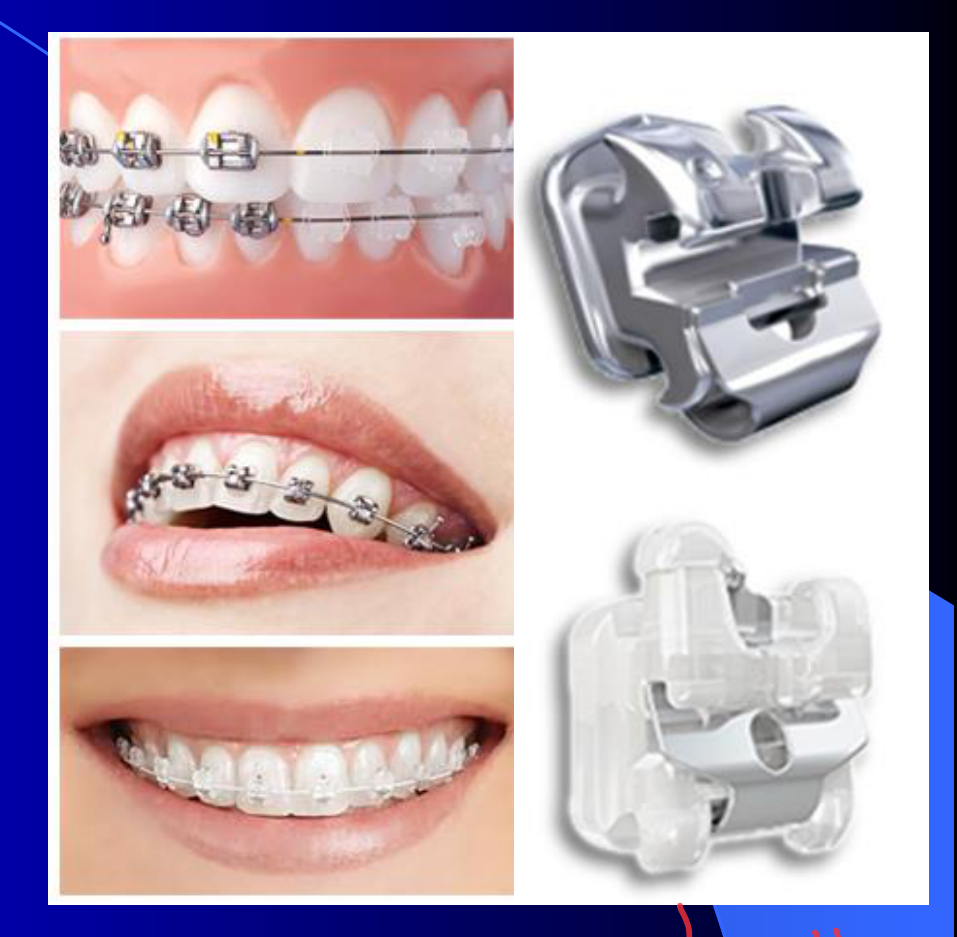
Metal (Stainless Steel)
-
Clear or Tooth Colored (Ceramic or Plastic) - higher friction with ceramic brackets
- Ceramic brackets offer high aesthetics (single crystal brackets are clear like glass) but are brittle. Some designs use a metallic slot insert to reduce the high friction between the wire and slot.
-
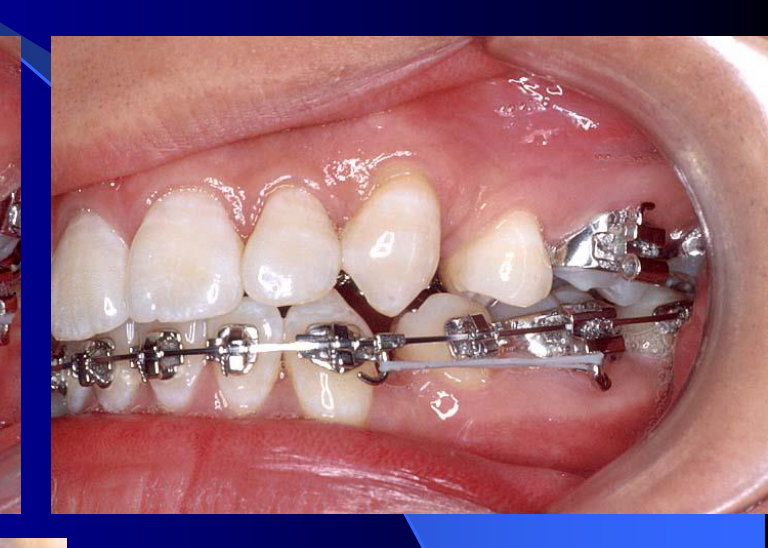
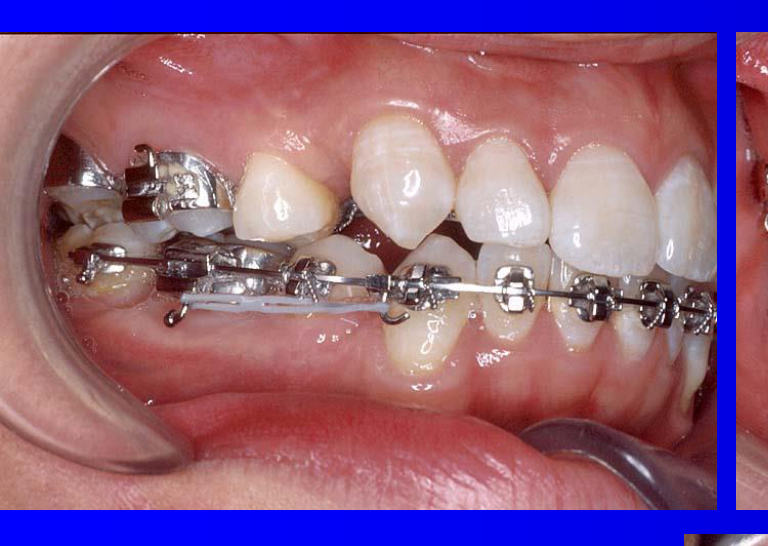
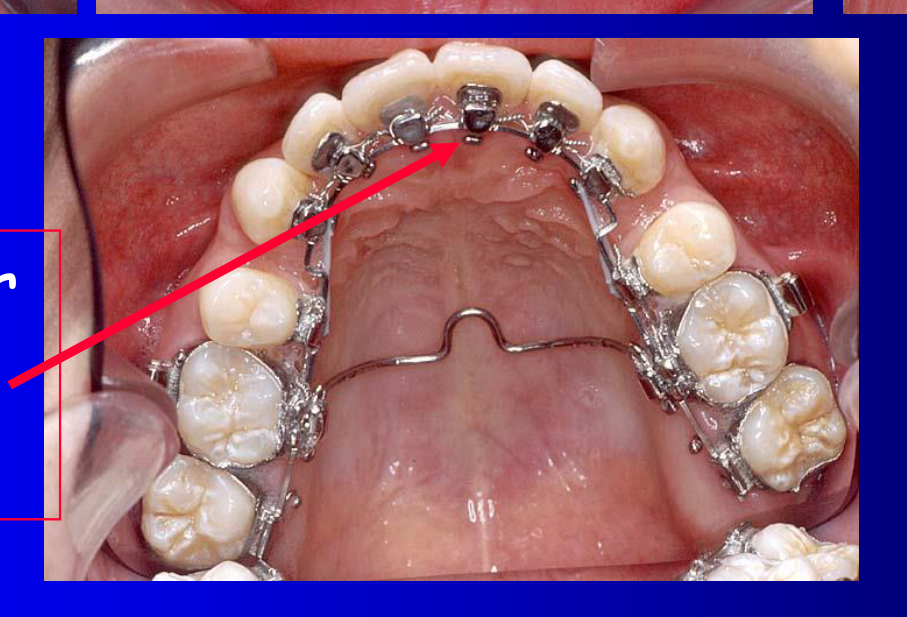
Lingual (Stainless Steel or Gold)
- Lingual brackets are placed on the tongue side for maximum aesthetics, though they can be difficult for patients to adapt to.
-
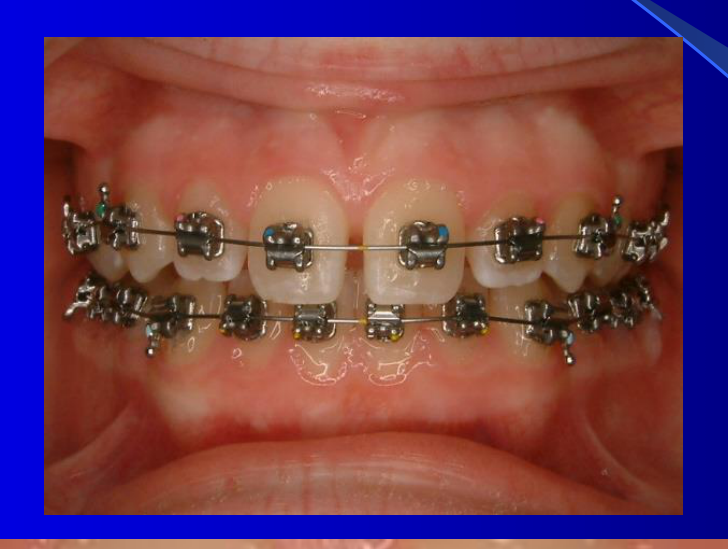
Self-Ligating (Stainless Steel and combination of Ceramic and Stainless Steel) - become yellow in 2 weeks
On upper central and lateral incisors
On canines, bicuspids and lower incisors.
L → single system = more narrow = more interbracket distance = ↓ force ↓ ctrl
- Twin brackets have double wings, providing two points of contact for better control but reducing the distance between brackets, which increases force levels.
- Single brackets are narrower, increasing the inter-bracket distance, which increases resilience and lowers force levels, but offers less control.
In this case on the upper anterior teeth.
You should ensure you do this at least once or twice for a patient.
Lingual Brackets
 |  |  |
 |  |  |
 |  |  |
 |  |  |
 |  |  |
 |  |  |
 |  |  |
 |
Self-Ligating Brackets2526
Mechanism
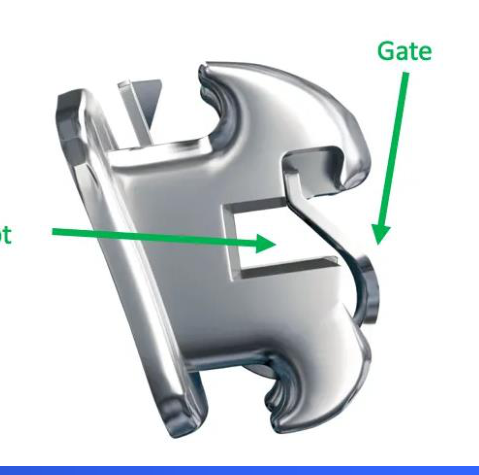
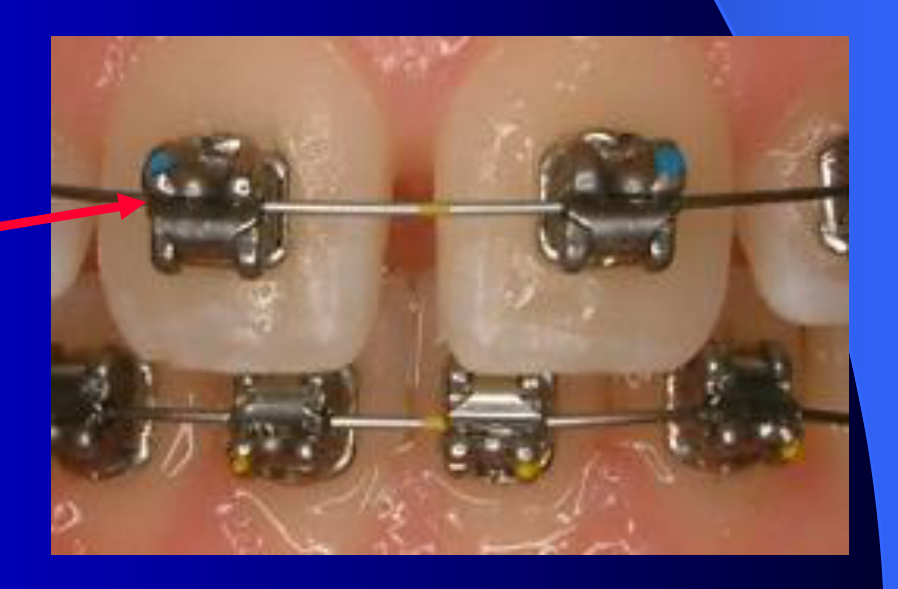
These brackets feature a built-in “lid” or “gate” to hold the wire, replacing elastomeric O-rings.
- Advantages: They save clinical time and avoid the degradation, staining, and biofilm buildup associated with polymeric elastics.
- Disadvantages: Calculus can build up around the gate, causing it to get stuck if hygiene is poor, potentially requiring bracket replacement.
In this case on the bicuspids, canines and incisors.
You should ensure you do this at least once or twice for a patient.
 | 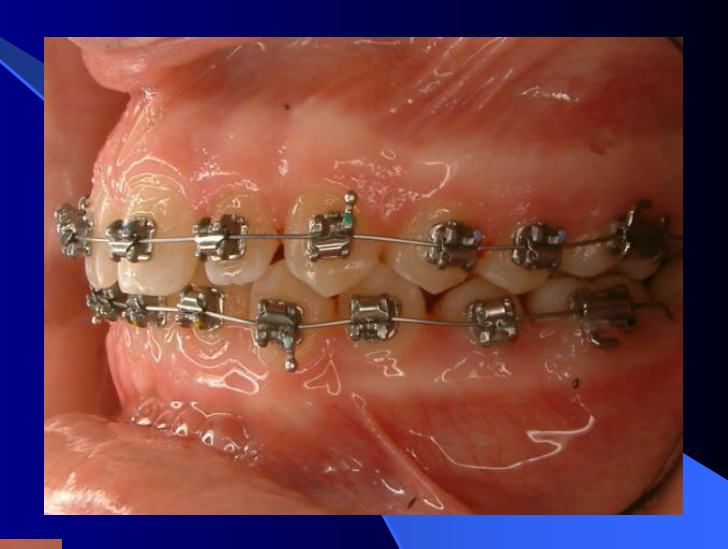 | 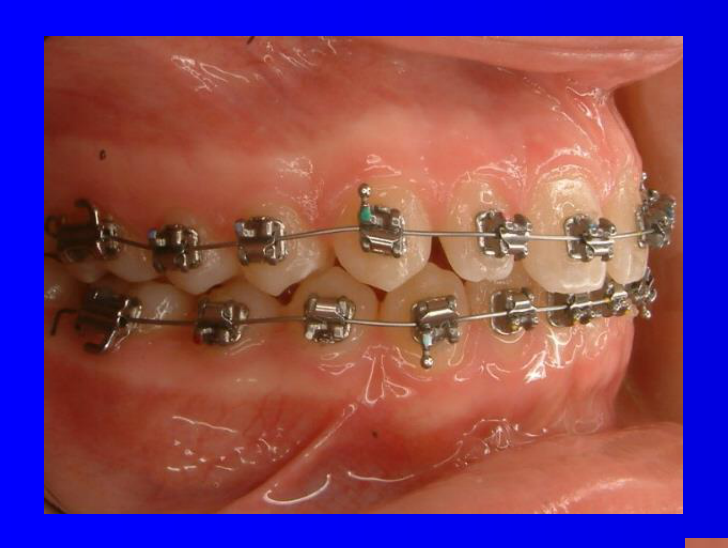 |
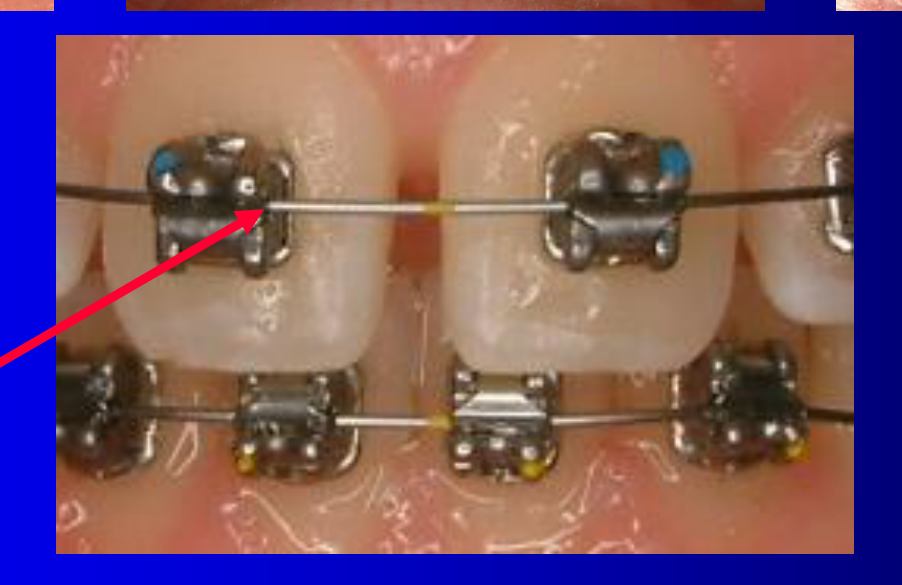 | 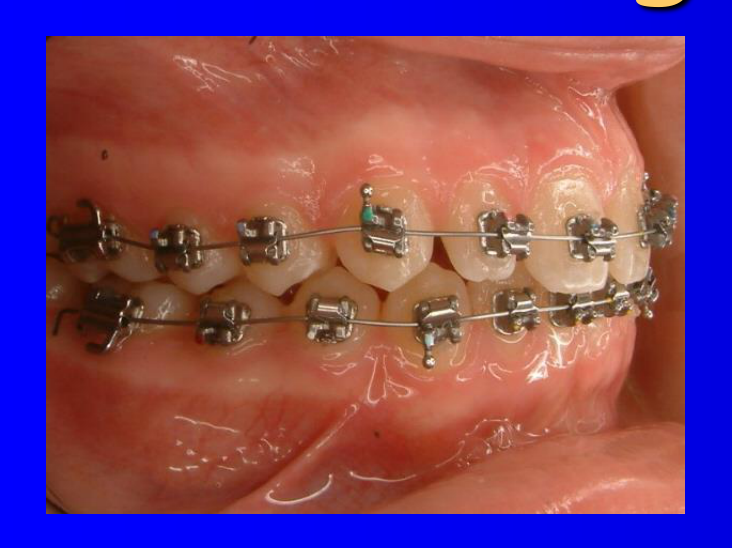 |  |
 |
Bands and Band Fitting Procedures272829
-
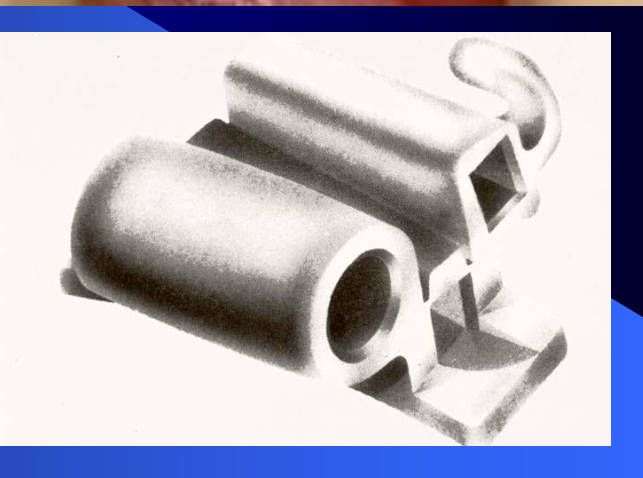
Typically for molars and occasionally premolars
-
Horizontal tube (slot)
-
Heavy stress application
-
Lingual attachments
-
Auxiliary and headgear tubes
-
While bonding is preferred, bands are still used for high-stress applications like maxillary expansion.
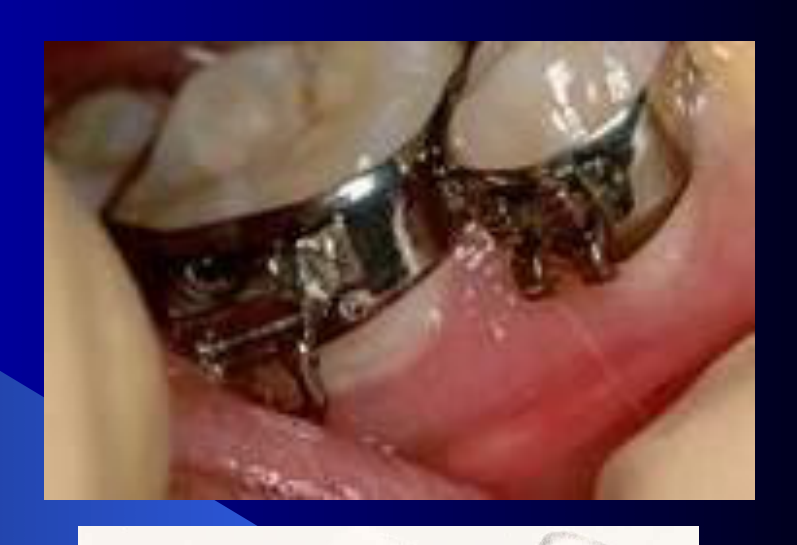
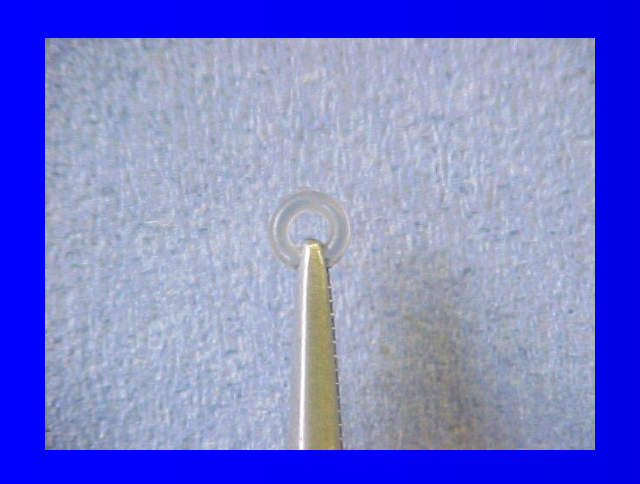
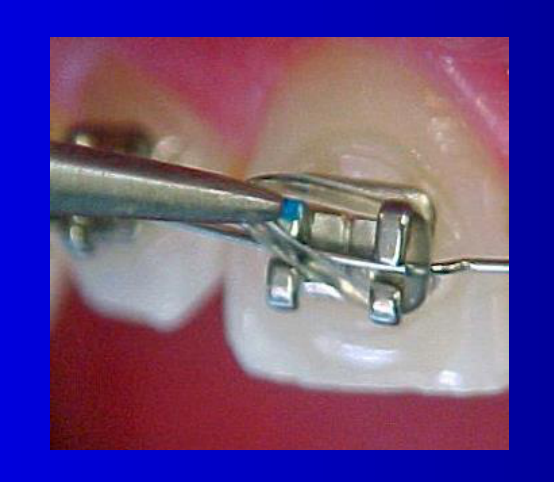
Using the Mathieu or mosquito forceps grip and remove an Alastic module from its “tree”
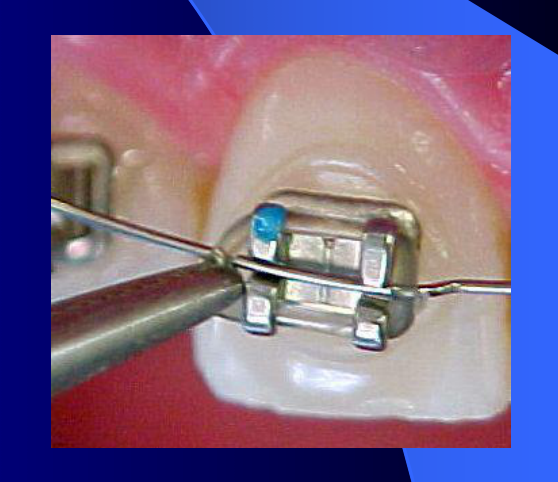
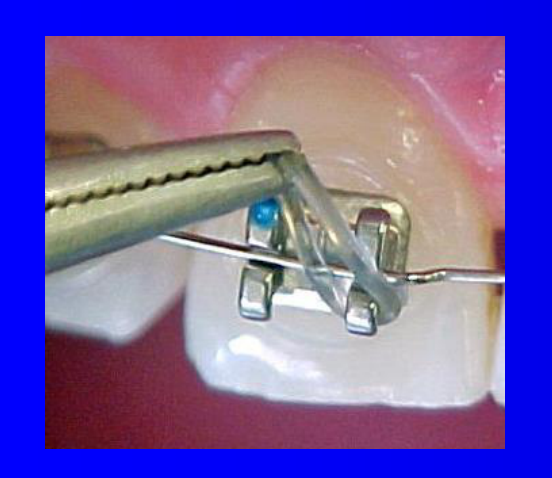
Hook the module onto one wing of the bracket, then over the remaining wings to hold the archwire in place
Proffit, CO Chapter 12
 |  |  |
 |  |  |
Placement of Separators30
Separators are placed 7-10 days before band placement (often on the same visit as bond-up) to separate the molar teeth slightly. This facilitates band placement. Usually elastomeric separators are used, but either brass wire or Kesling separator can be used (see orthodontic staff for more information on these alternatives)
Separator pliers or Dental Floss Separator
Procedure (2 Methods)
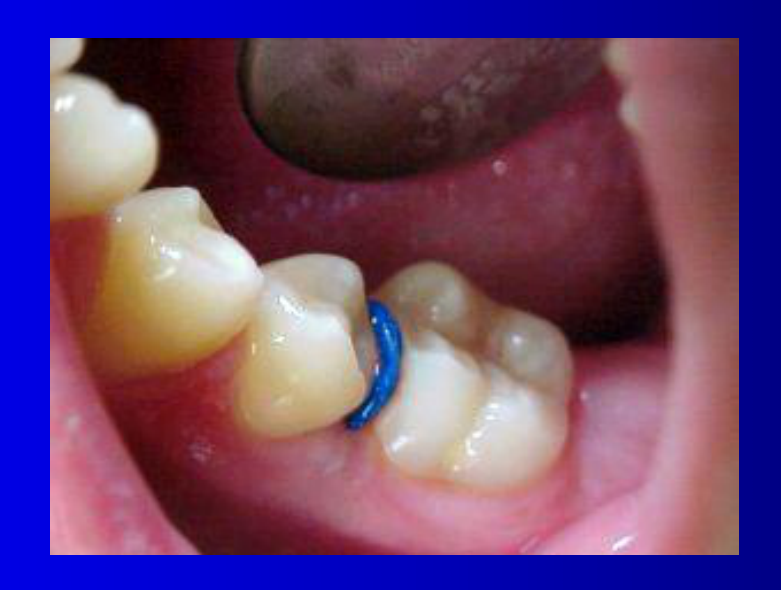
Separator pliers31
Separators are placed over the end of the separator pliers and squeezed between the teeth. EXTREME CARE is needed in order that the pliers do not slip and cause injury
Separator pliers or Dental Floss Separator
Procedure (2 Methods)
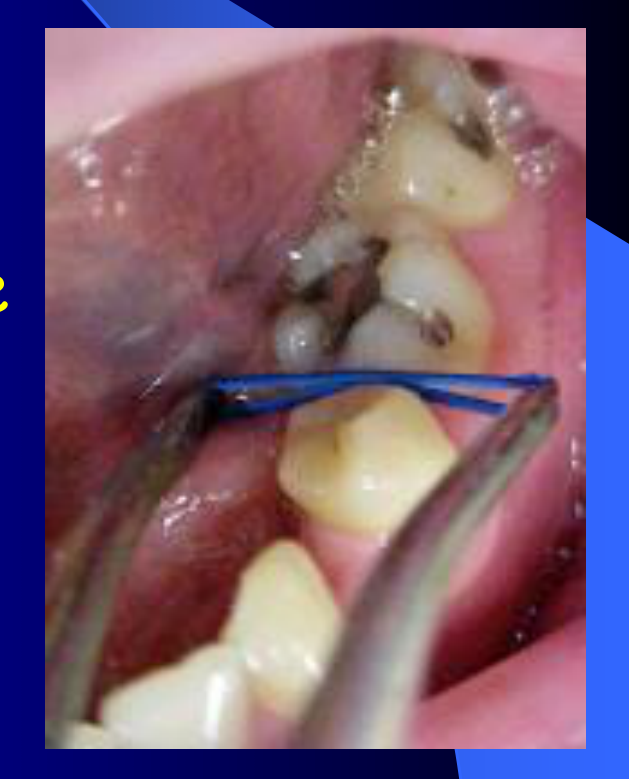
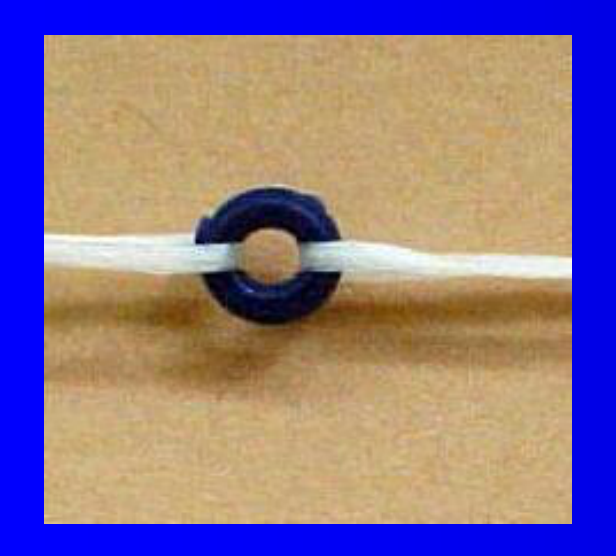
Floss32
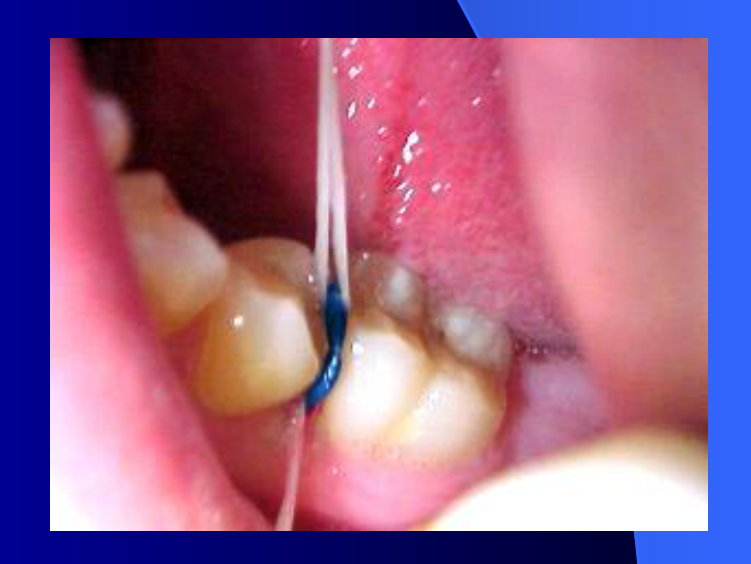
Two lengths of Dental Floss are threaded through the separator.
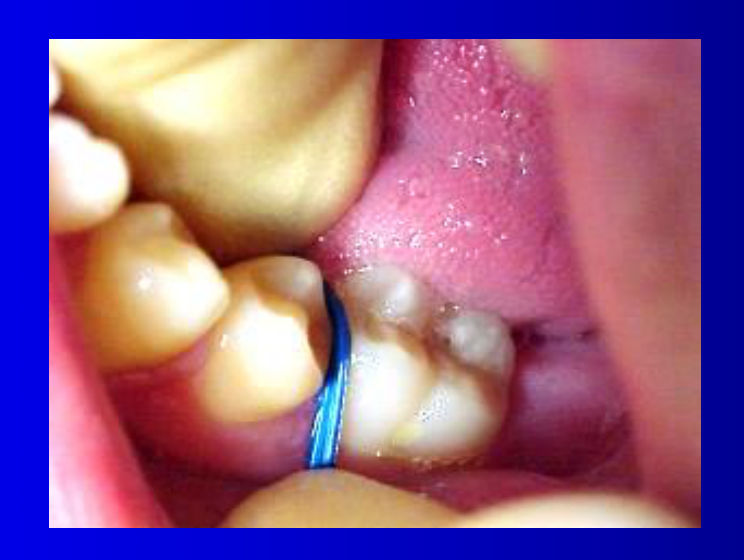
Patient Education
Patients or parents can be taught the floss method to replace lost separators before a fitting appointment.
 |  |
 |
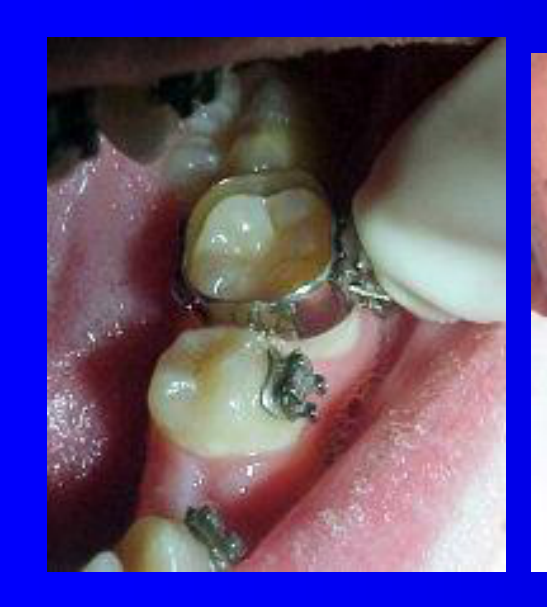
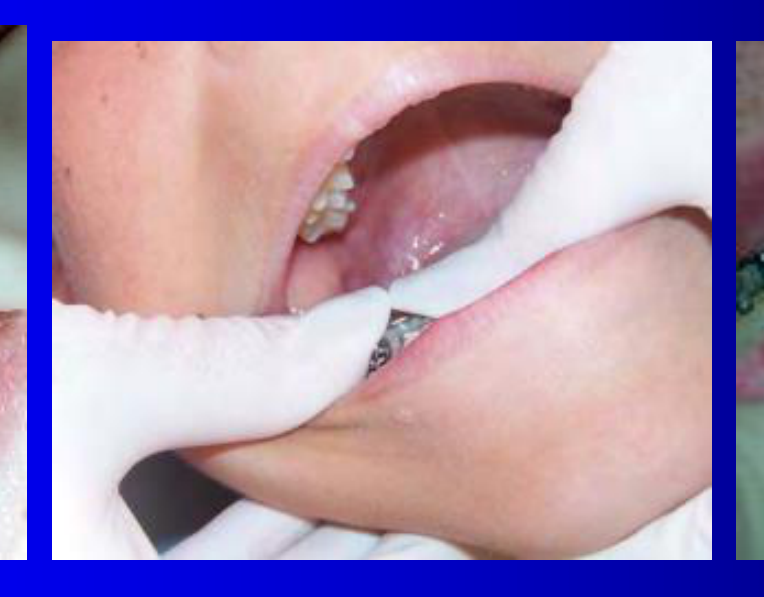
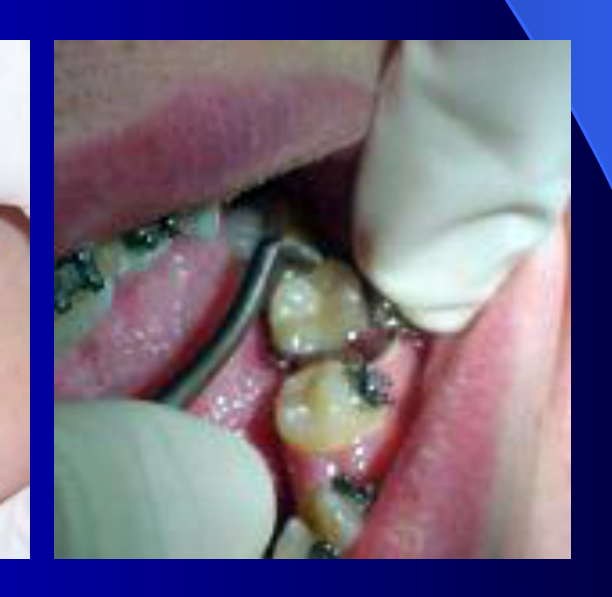
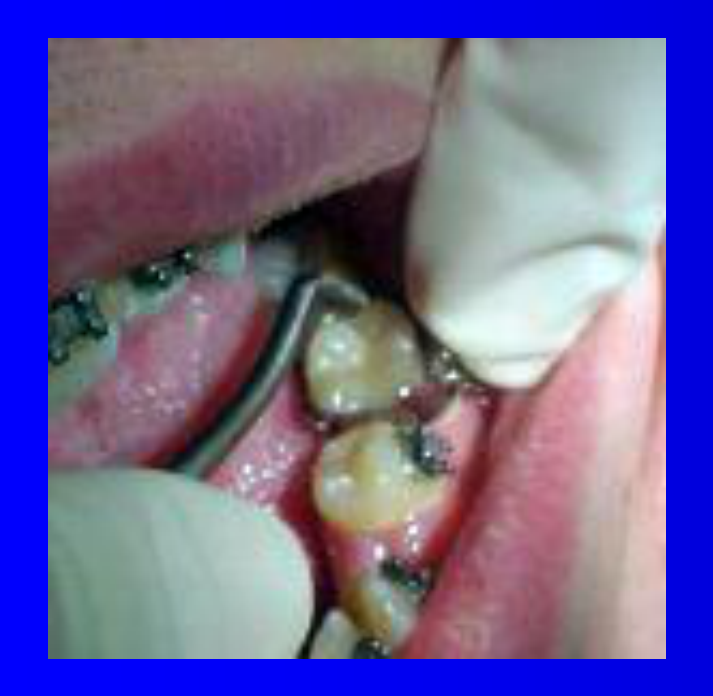
Band Fitting Clinical Procedure33343536373839404142
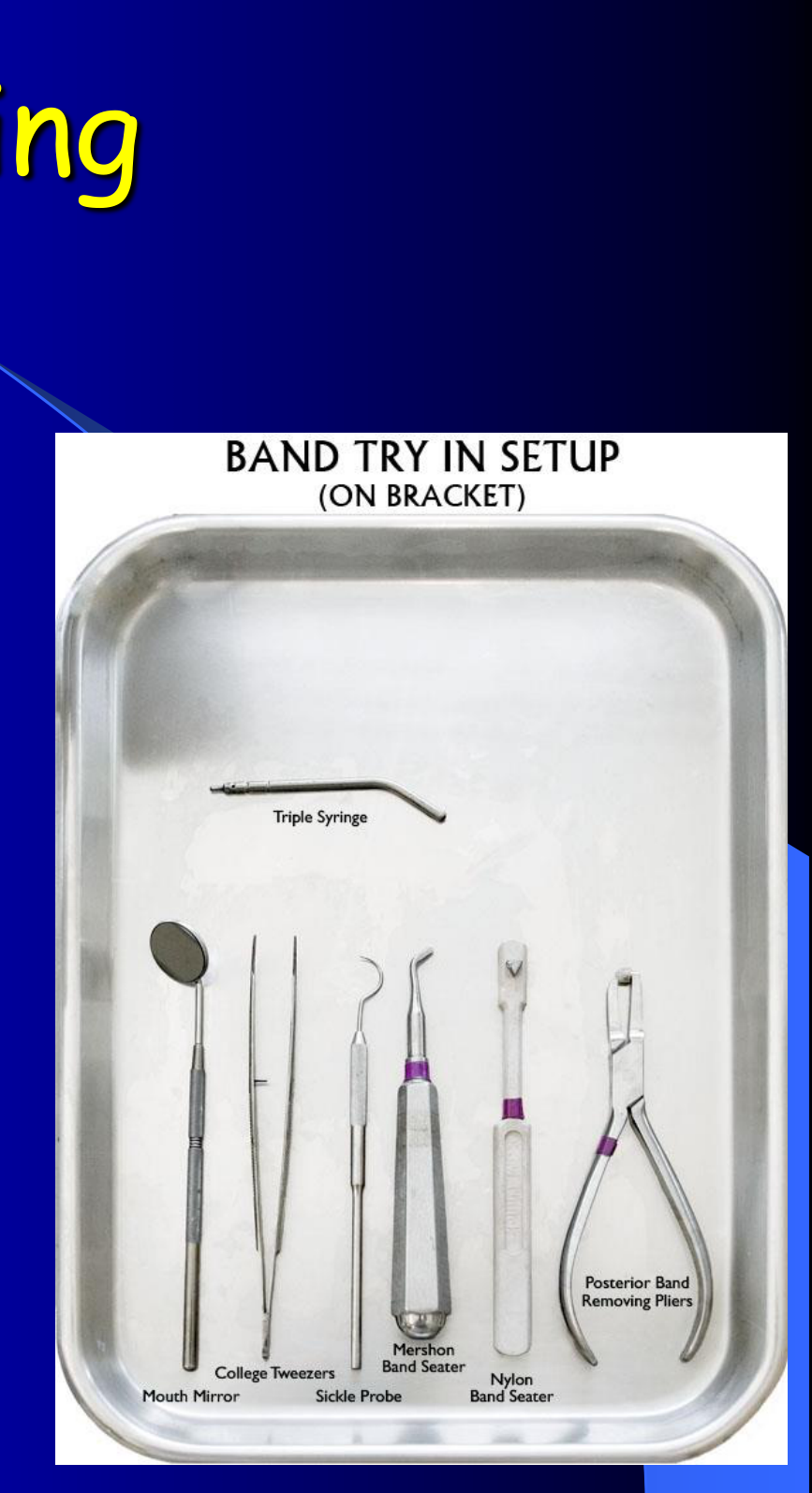
- Handpiece, rubber cup and oil free prophy paste
- Band fit Tray (Band pusher, bite stick, band removing pliers, etc.)
- Cotton wool rolls, Glass ionomer cement, glass mixing slab and spatula
- Triple Syringe
- Mouth Mirror
- College Tweezers
- Sickle Probe
- Mershon Band Seater
- Nylon Band Seater
- Posterior Band Removing Pliers
Band TRY IN SETUP (ON BRACKET)
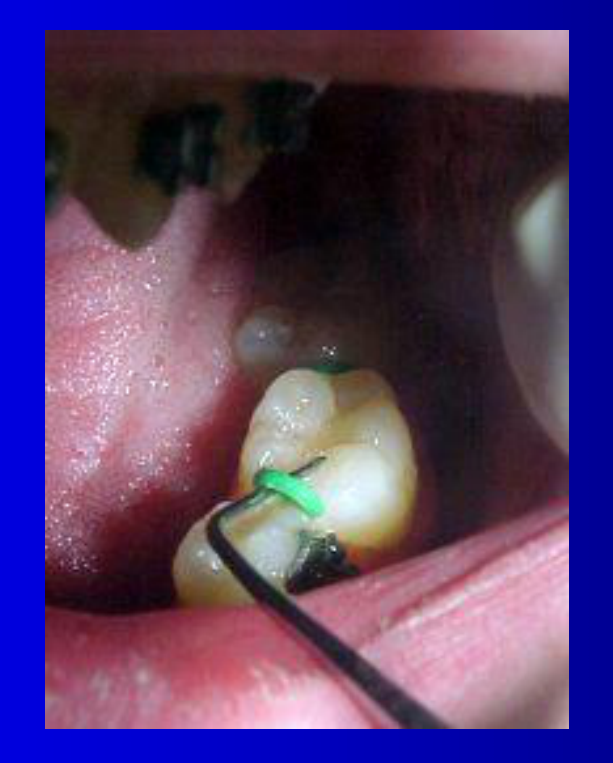
Remove any separators present (use a Probe or Schure to hook them out)
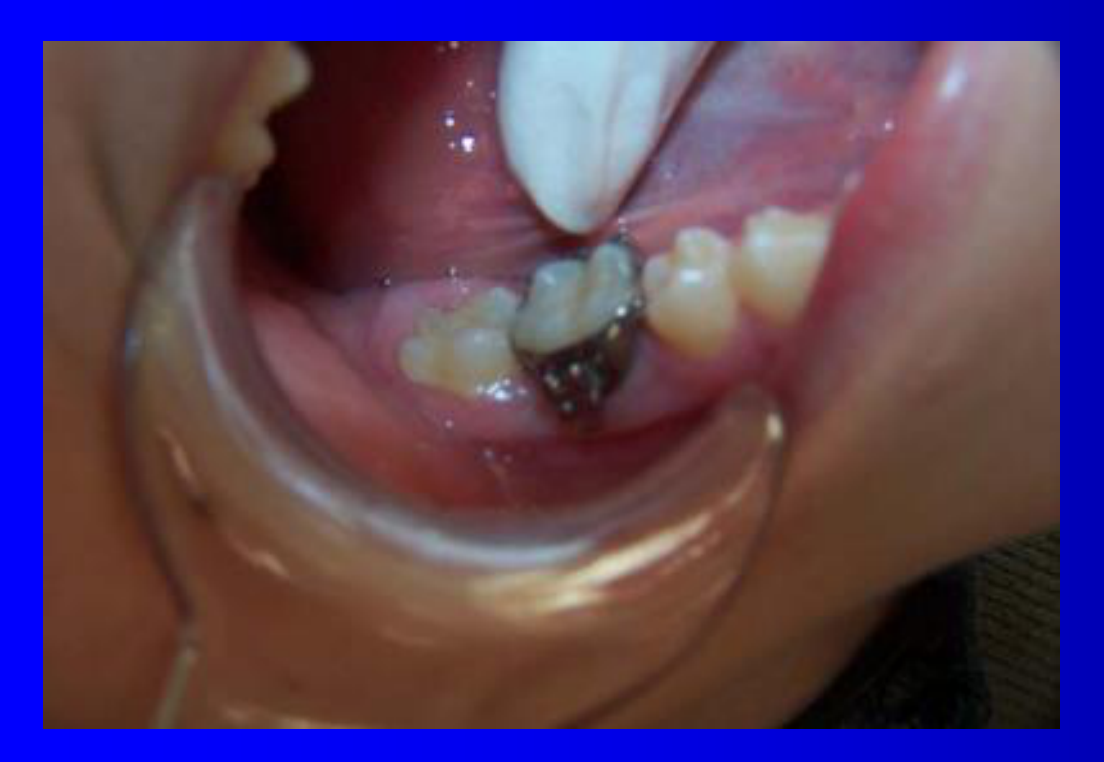
**Select the band size to be fitted and press into place using band seater.
- Selection involves trial and error to find a size that is retentive and not loose.
- Initial placement is done with fingers, followed by the use of a band seater on the proximal faces.**
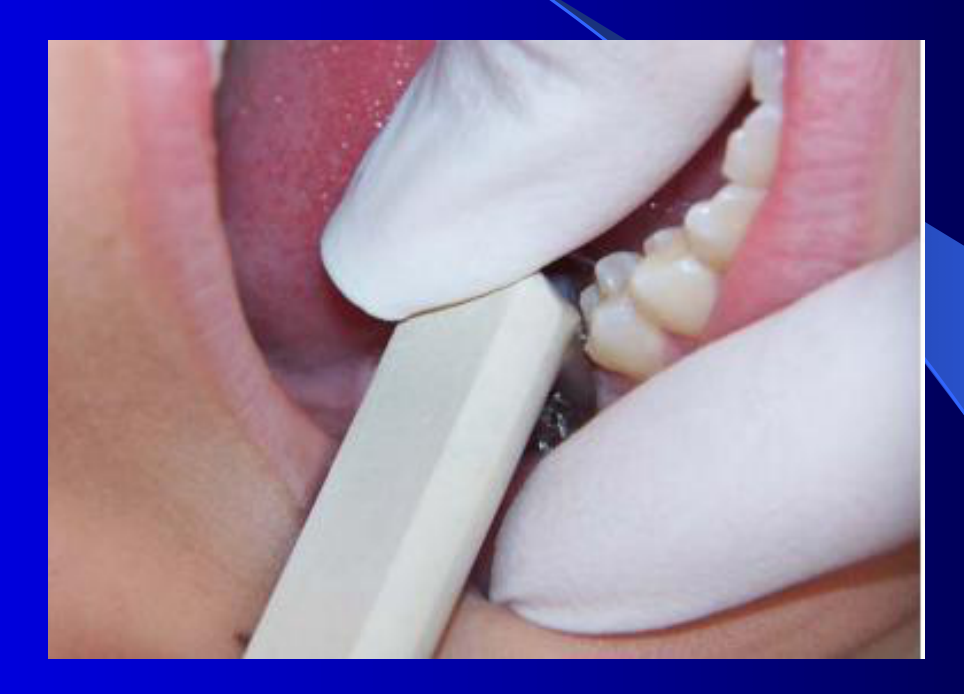
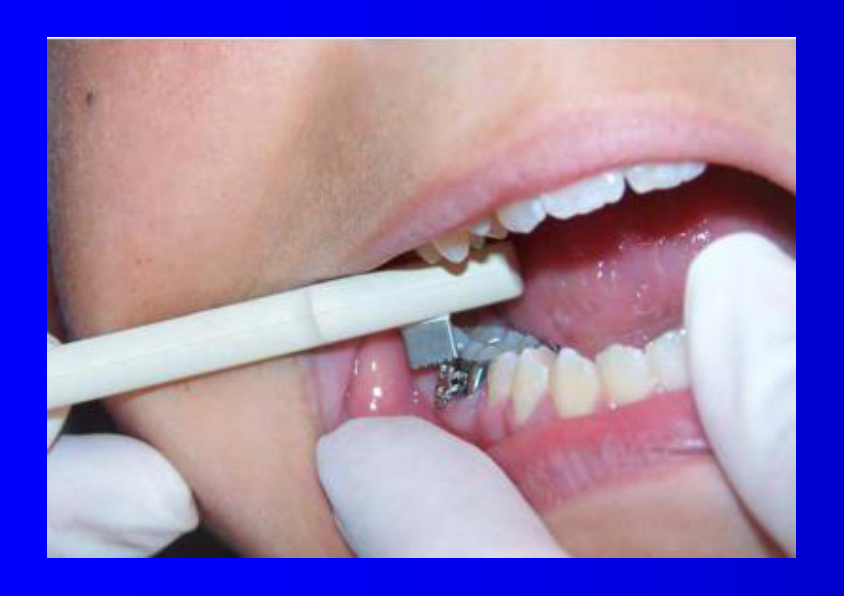
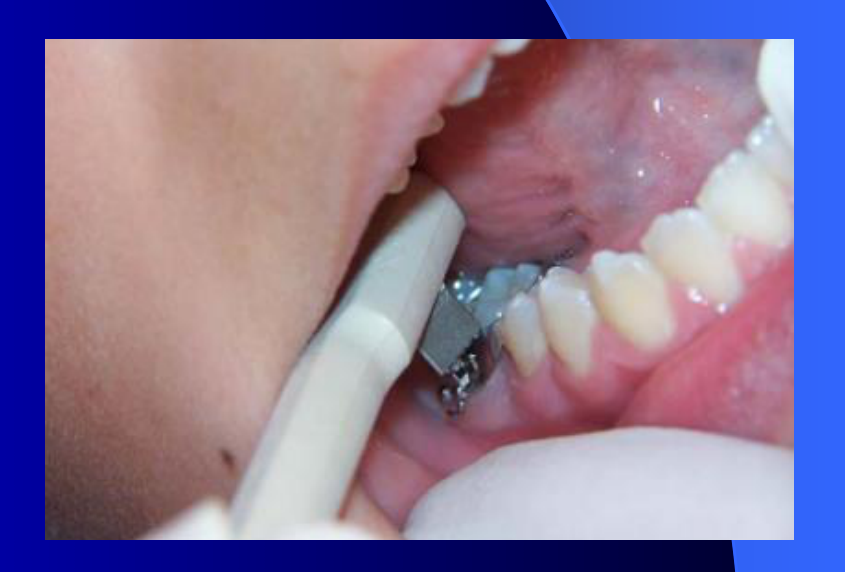
**Use the handle of the bite stick to have the patient bite lightly to start seating the band
- The band is pushed slightly below the contact point.
- A band remover is used if the size is incorrect.**
Use the flat side of the tip on the buccal attachment or on the top of the band
Mesial buccal bite on the edge of the band gently
Use one of the points of the triangle to lightly push the edge of the band
Have the patient bite gently on the lingual and hold the buccal attachment with the thumb to avoid over seating
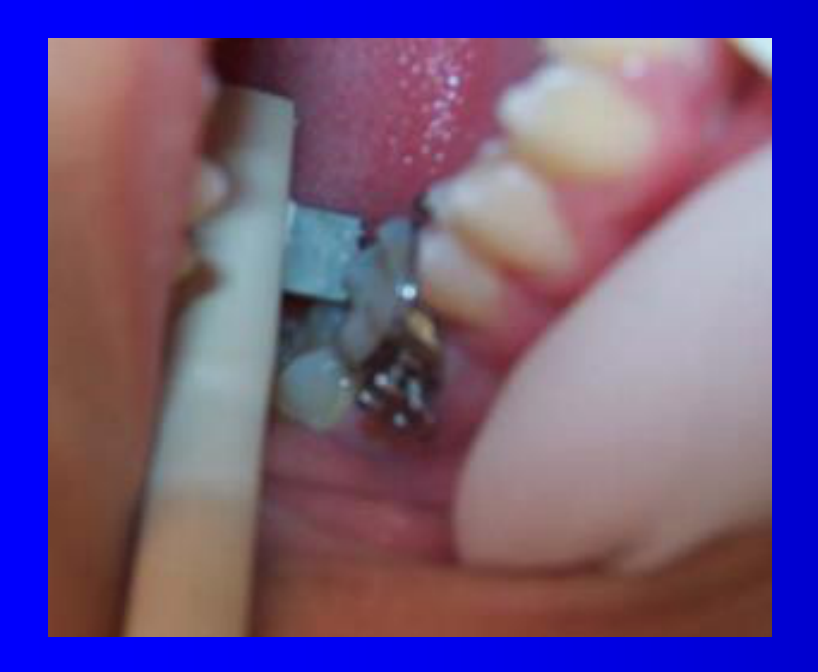
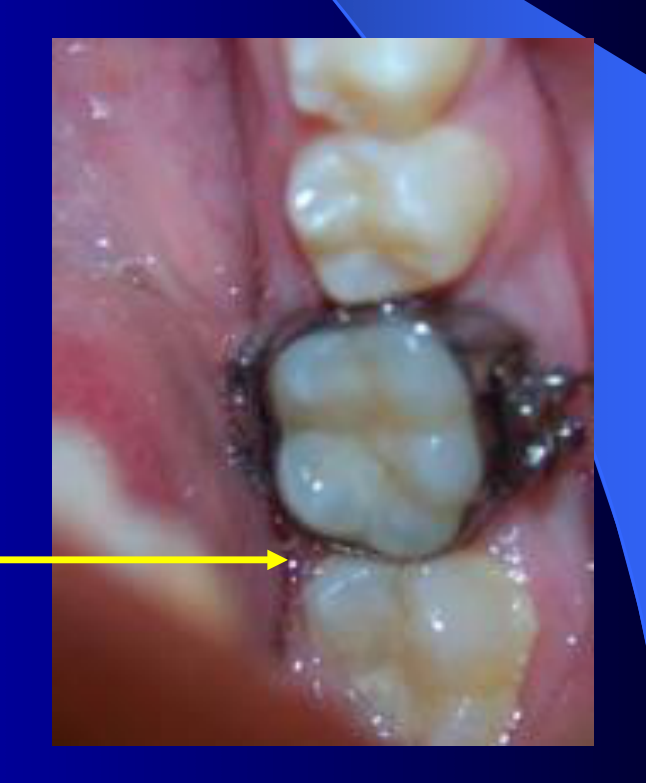
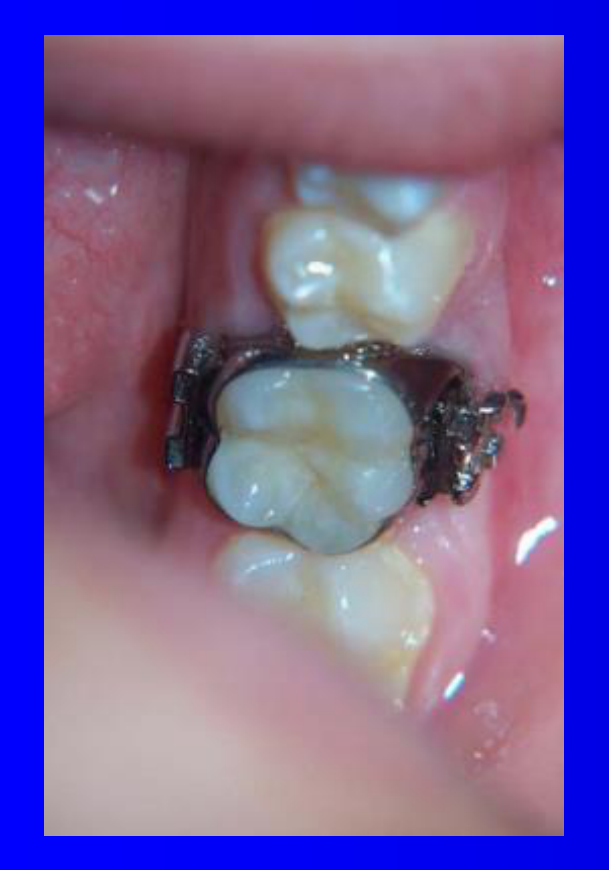
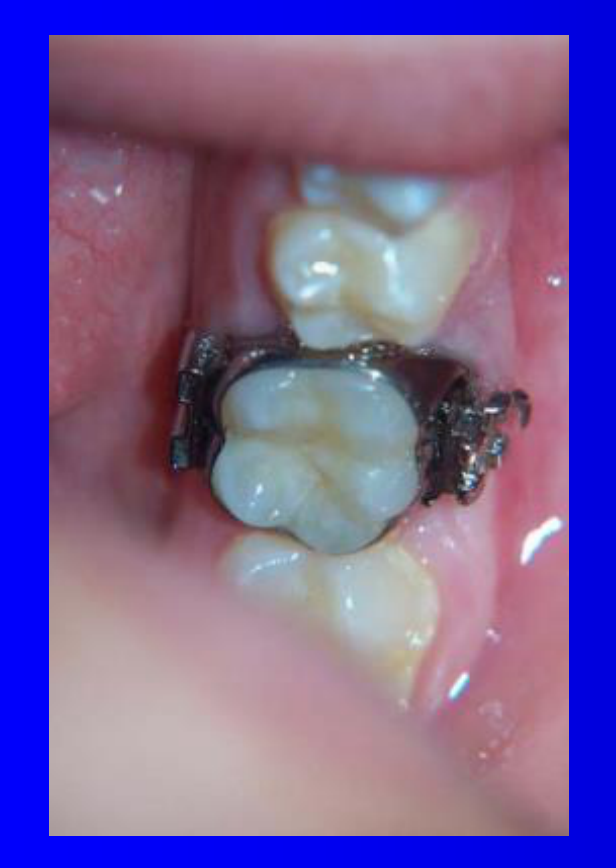
Band seated and now to inspect for band fitting to contours of the tooth
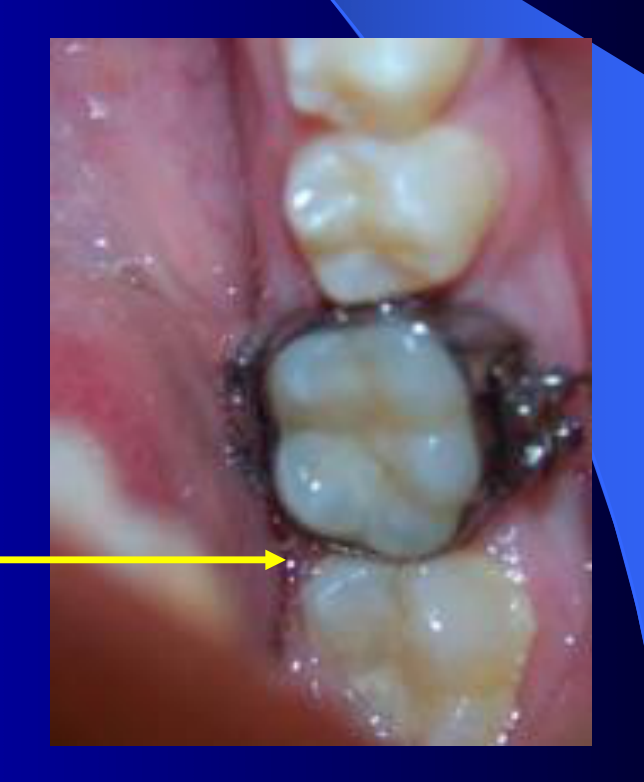
Notice a small gap on the distal lingual cusp
Take the band file or Schure and contour the band into the distal lingual cusp if necessary
Check the tooth for any gaps and use the file to contour areas if gaps are seen
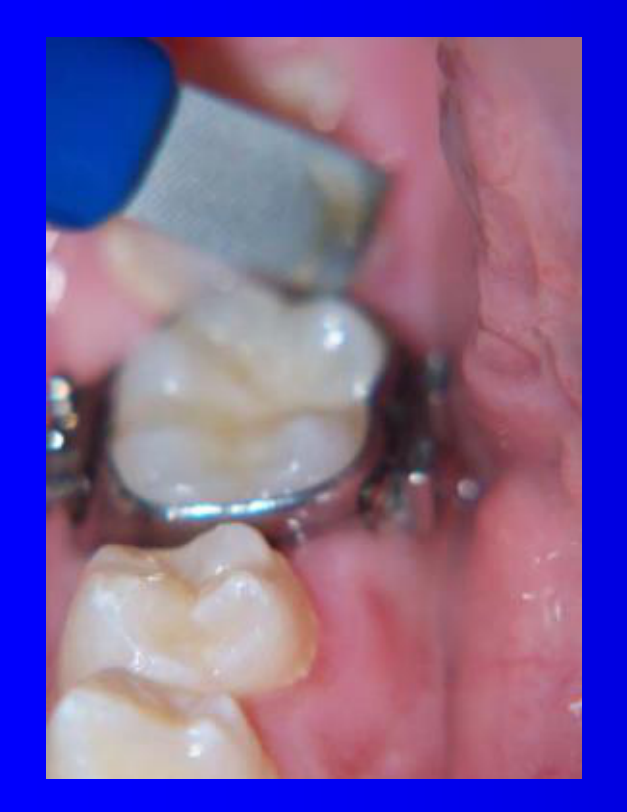
Band seated after contouring; no gaps on the distal cusps
Notice the relative position of the band to the occlusal margins of the tooth
Some but not all of you will get the opportunity to fit bands. Ask if you can… when you see the procedure being completed as you will benefit immensely
 |  |  |
 |  |  |
 |  |  |
 |  |  |
 |  |  |
 |  |
Band Cementation
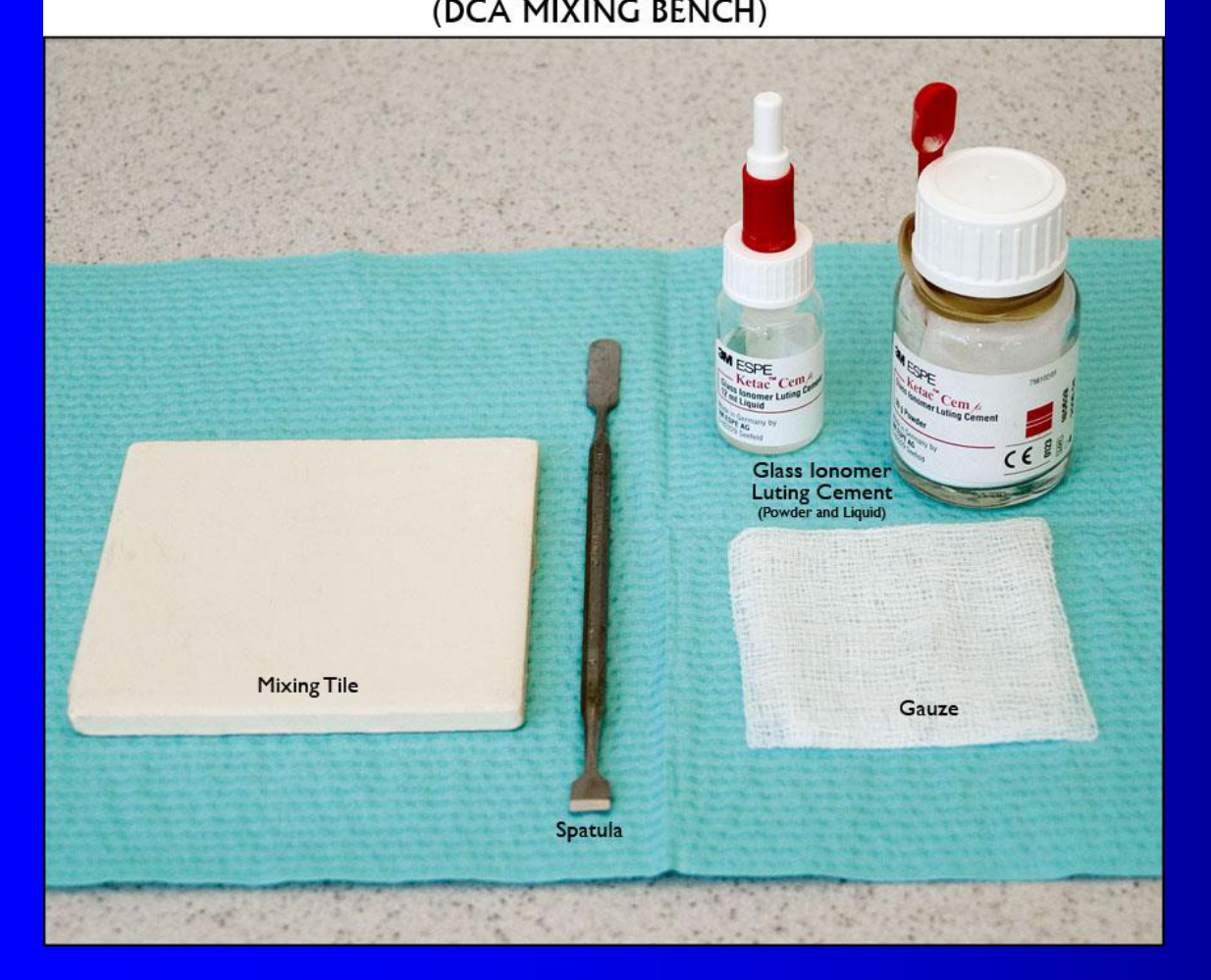
BAND CEMENTATION (DCA MIXING BENCH)43
Band cementation is much like cementing a crown with the cement placed at the gingival margins of the band and just repeat the process of band fitting/seating
Mixing Tile, Spatula, Glass Ionomer Luting Cement (Powder and Liquid), Gauze.
- Historically done with glass ionomer; now often done with light-cured cements for better results.
Archwires and Bends
Modern "Straight Wire" Prescriptions
Modern “Straight Wire” prescriptions have these bends pre-built into the bracket geometry.
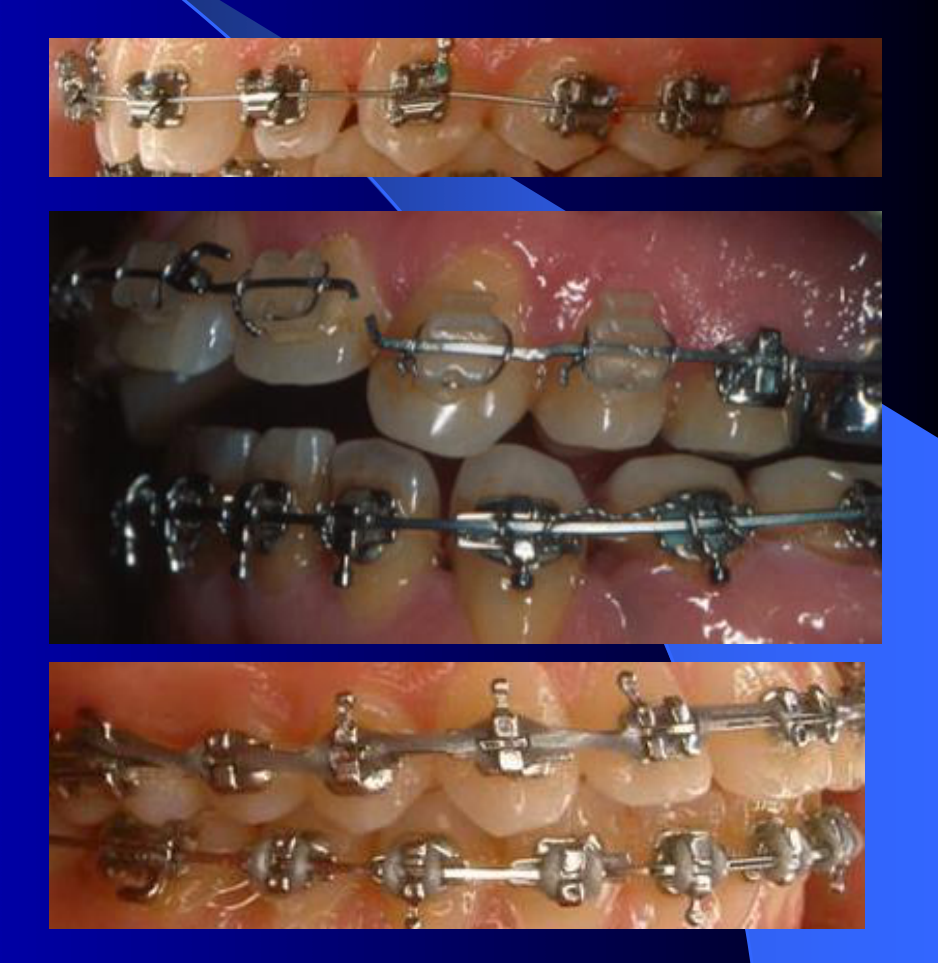
- Continuous or Segmented
- Round, Square or Rectangular
- First, Second and Third Order Bends
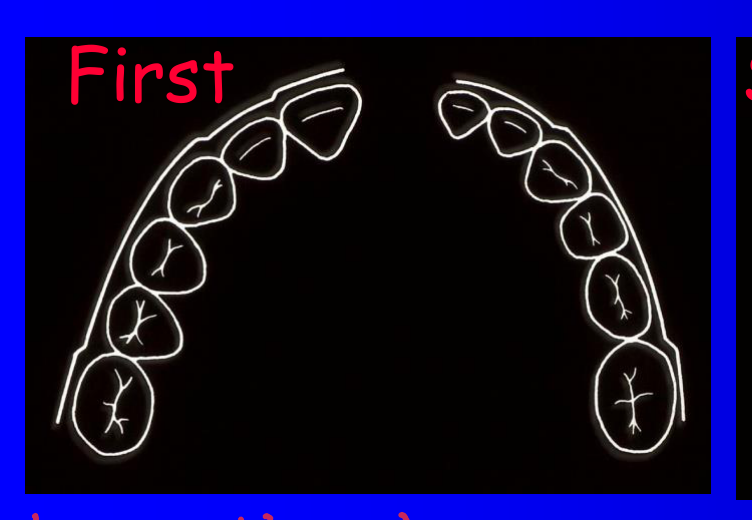
First Order Bends44
Buccolingual.
- Compensations for the thickness of the tooth (buccal-lingual position), built into the bracket base thickness.
 |  |
 |  |
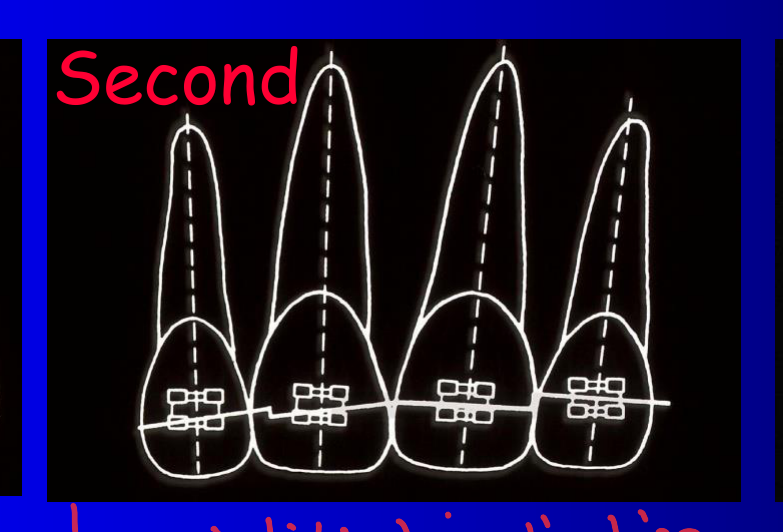
Second Order Bends
Mesiodistal inclination.
- Compensations for “tip” or mesiodistal angulation (e.g., angling a canine forward or back).
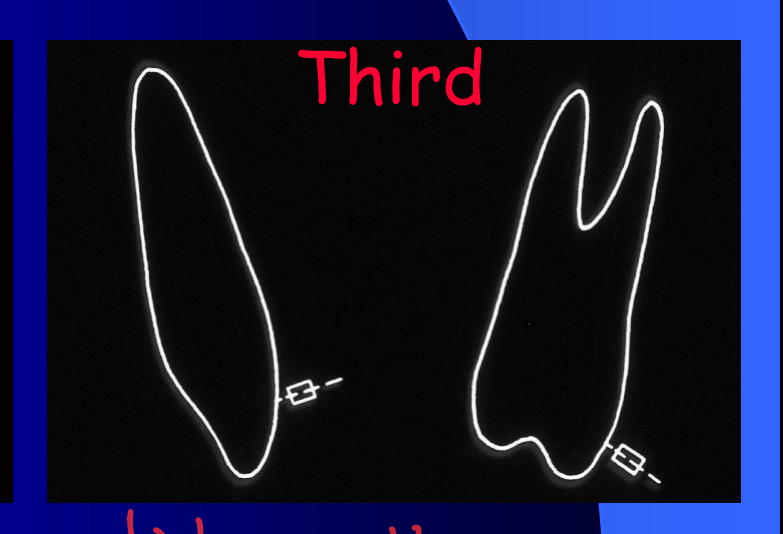
Third Order Bends
Torque / torsion.
- The torsion of a rectangular wire within the slot to control root position and compensate for uncontrolled tipping.
Auxiliary Components and Elements4546
- Tubes on Bands
- Arches
- Arch wires
- Elastics
- Hooks (Anchor elastic band)
- Coils (open space)
Auxiliaries
Power chain: Achieves movement
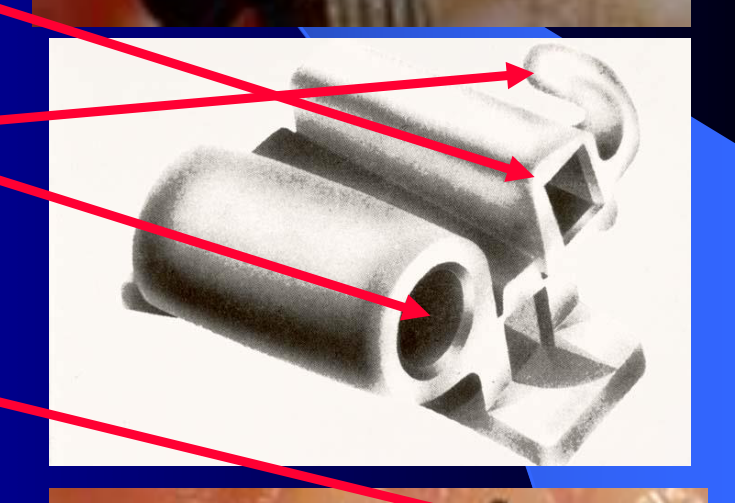
Bracket and Band Auxiliaries474849
Bracket / Band Auxiliaries
- Auxiliary tubes (buccal, palatal or lingual)
- Headgear tubes
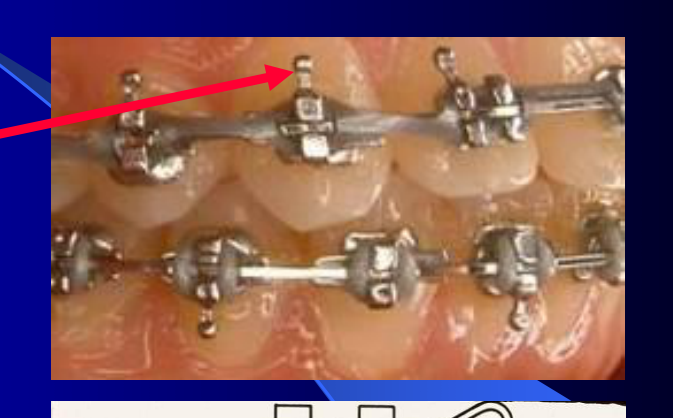
- Hooks
- Points for attaching elastics; can be built-in, tied on with wire, or sliding.
**Standard vs “Straight wire” Bracket
- Tubes: Similar to brackets but covered; usually used on molars.**
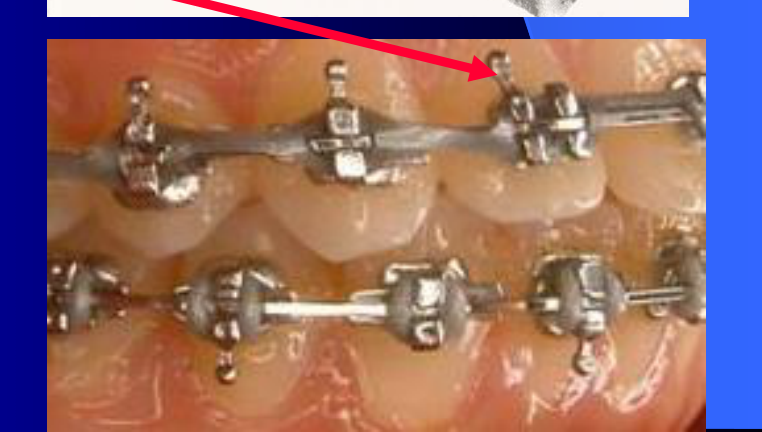
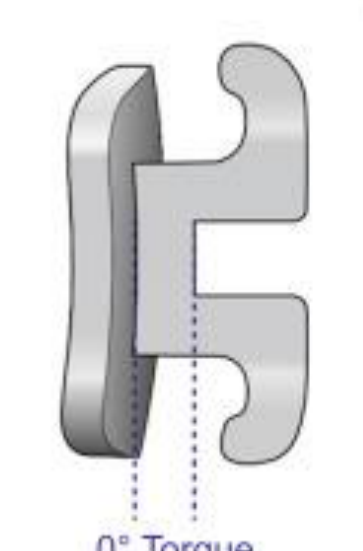
Standard bracket 0° Tip 0° Torque
Straight-wire bracket 8° Tip 7° Torque
Each brand has diff rent prescription.
Common Prescriptions Chart *
| | | TIP | | | | | |---|---|---|---|---|---|---|---| | | 1 | 2 | 3 | 4 | 5 | 6 | 7 | | | Andrews | 5 | 9 | 11 | 2 | 2 | 5 | 5 | | UPPER | Roth | 5 | 9 | 13 | 0 | 0 | 0 | 0 | | | MBT | 4 | 8 | 8 | 0 | 0 | 0 | 0 | | | Andrews | 2 | 2 | 5 | 2 | 2 | 2 | 2 | | LOWER | Roth | 2 | 2 | 7 | -1 | -1 | -1 | -1 | | | MBT | 0 | 0 | 3 | 2 | 2 | 0 | 0 |
| | | TORQUE | | | | | |---|---|---|---|---|---|---|---| | | 1 | 2 | 3 | 4 | 5 | 6 | 7 | | | Andrews | 7 | 3 | -7 | -7 | -7 | -9 | -9 | | UPPER | Roth | 12 | 8 | -2 | -7 | -7 | -14 | -14 | | | MBT | 17 | 10 | +7/0/-7 | -7 | -7 | -14 | -14 | | | Andrews | -1 | -1 | -11 | -17 | -22 | -30 | -30 | | LOWER | Roth | -1 | -1 | -11 | -17 | -22 | -30 | -30 | | | MBT | -6 | -6 | +6/0/-6 | -12 | -17 | -20 | -10 |
| | | ROTATION | | | | | |---|---|---|---|---|---|---|---| | | 1 | 2 | 3 | 4 | 5 | 6 | 7 | | | Andrews | 0 | 0 | 0 | 0 | 0 | 10 | 10 | | UPPER | Roth | 0 | 0 | 4 | 2 | 2 | 14 | 14 | | | MBT | 0 | 0 | 0 | 0 | 0 | 10 | 10 | | | Andrews | 0 | 0 | 0 | 0 | 0 | 0 | 0 | | LOWER | Roth | 0 | 0 | 2 | 4 | 4 | 4 | 4 | | | MBT | 0 | 0 | 0 | 0 | 0 | 0 | 0 |
 |  |
 |
Auxiliary Arches and Arch Wires5051
Auxiliary Arches
Can rotate upper 6’s
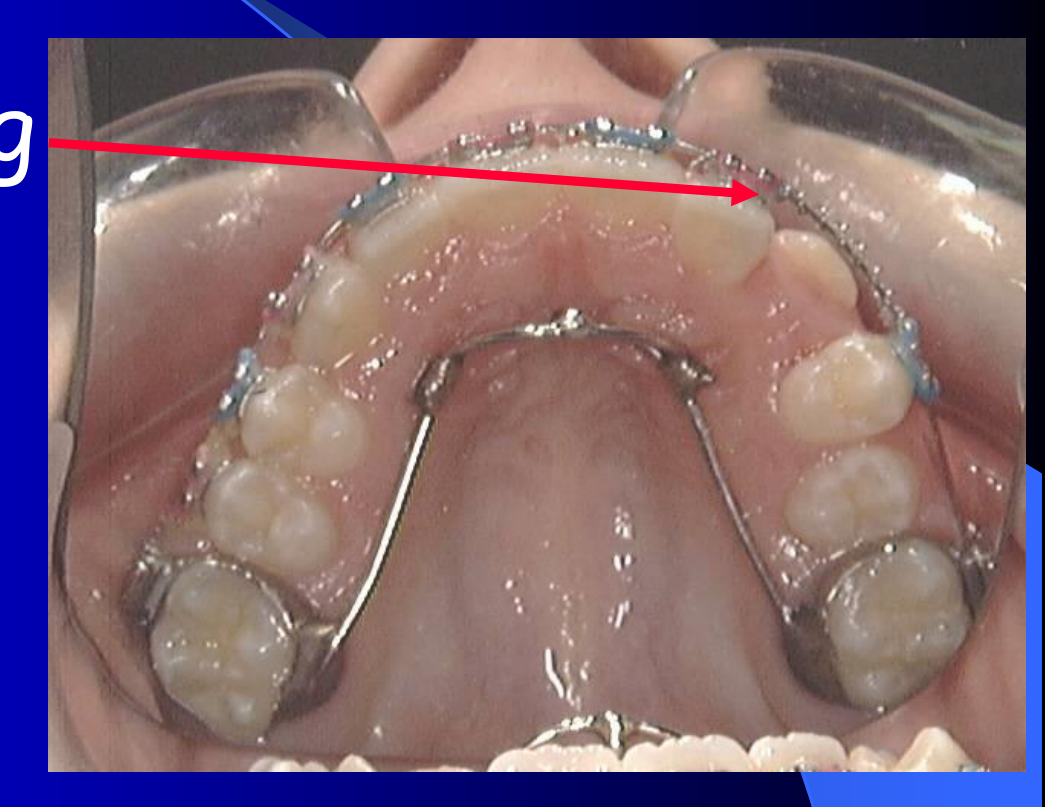
- Trans-palatal
- Palatal
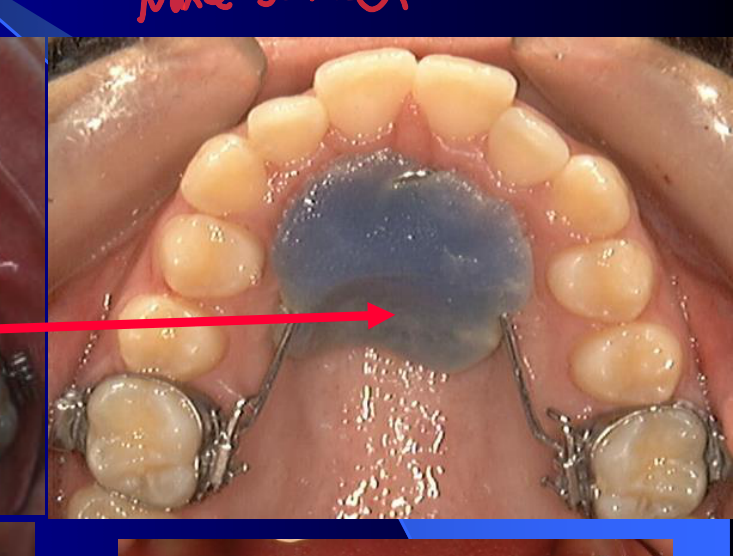
- Nance Button
- Lingual
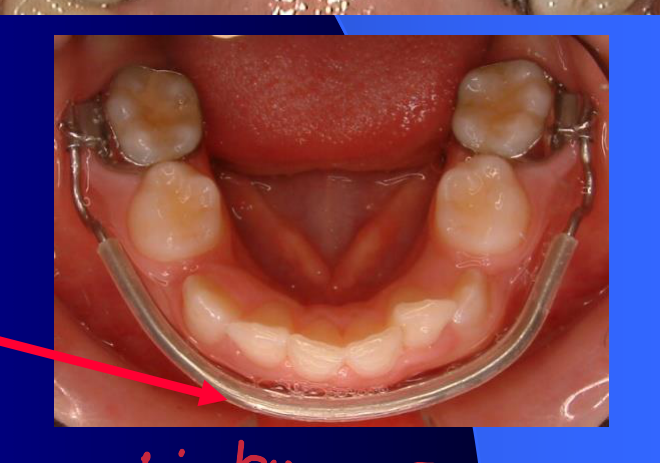
- Lip Bumper
Trans palatal Lingual bar
- Lingual Arch: Connects lower molars to provide extra anchorage control.
- Nance Button: A palatal button that blocks the mesial drift of upper molars.
- Transpalatal Bar (TPA): Used for anchorage or to rotate/derotate upper molars.
- Lip Bumper: Used to upright lower molars.
Auxiliary Arch Wires
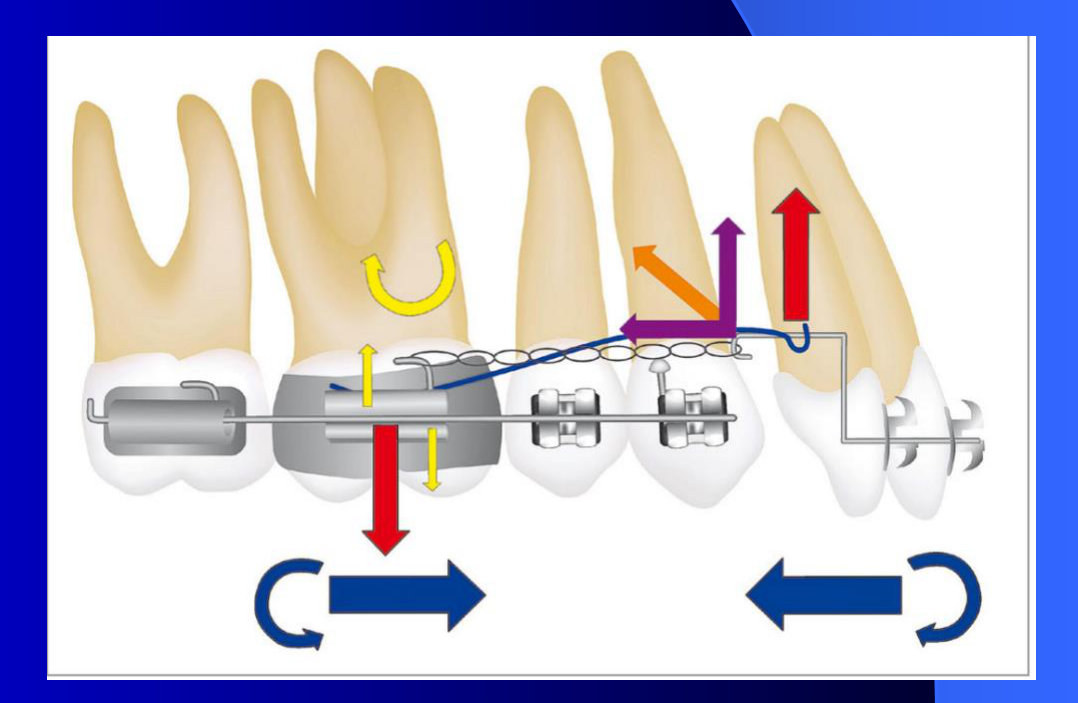
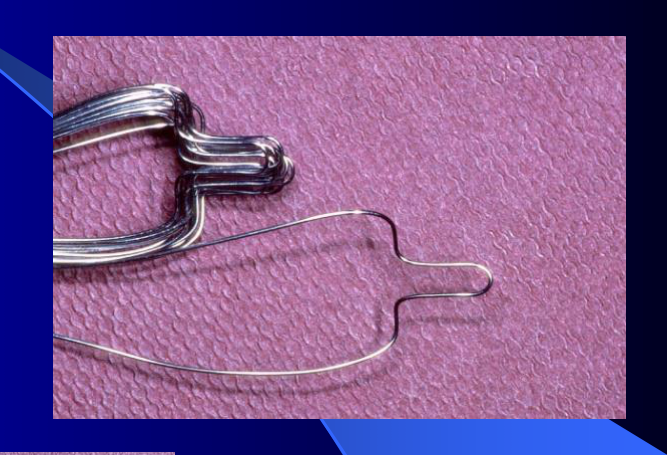
Intrusion Arches (also referred to as auxiliary arch)
Sectional arches
- Intrusion Arches: Use cantilevers to apply specific force moments.
 |  |
 |
Elastomeric and Mechanical Auxiliaries5253545556
Elastomeric Auxiliaries
- Elastic ligature thread
- Elastomeric modules
- Power Chains
- Continuous elastomeric rings used for space closure (e.g., canine retraction).
- Elastics
- Intermaxillary
- Intra-arch
Auxiliaries
Elastic Tie Wire Elastic Power Chain Headgear Tube Long Wire Wire Slots Coil Molar Band Steel Tie Rubber Band Post Steel Tie Pig Tail
Auxiliary Hooks
- Incorporated into the bracket
- Soldered brass
- Kobayashi ligature wires (k-ties)
- Sliding
- Surgery
Auxiliary Coils
- Push (open) coil spring
- Pull coil spring
- Closed coil spring
- Open/Push Coils: Compressed between brackets to open space.
- Closed Coils: Used to pull teeth together (e.g., sliding a canine back).
- Open/Push Coils: Compressed between brackets to open space.
Types of Ligatures
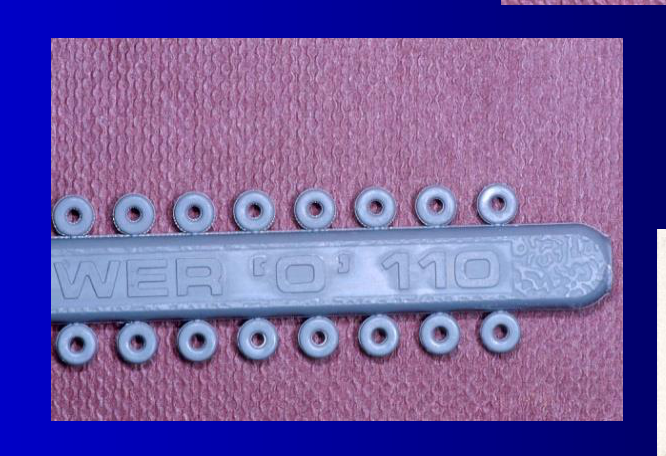
Stainless Steel wire Elastomeric donut-shaped modules Elastic Thread
- O-rings/Ligatures: Hold the wire in the slot; available in colors.
- Steel Ties: Used for a more secure, non-degradable lock, though they can increase friction.
 |  |
 |  |
Arch Wire Materials and Types5758
-
Auxiliary arches
-
Arch wire materials
-
Arch wire types
-
Arch wire forms
-
Auxiliary arch wires
-
Trans-palatal
-
Palatal
-
Lingual
-
Nance Button
-
Lip Bumper
Arch Wire Material Composition596061
- Precious Metal Alloys
- Stainless steel and Cobalt-Chromium Alloys
- Stainless Steel: High stiffness, low friction; the “tough” wire used for finishing.
- Nickel Titanium (NiTi) Alloys A-NiTi and M-NiT (austinitic / martinsitic)
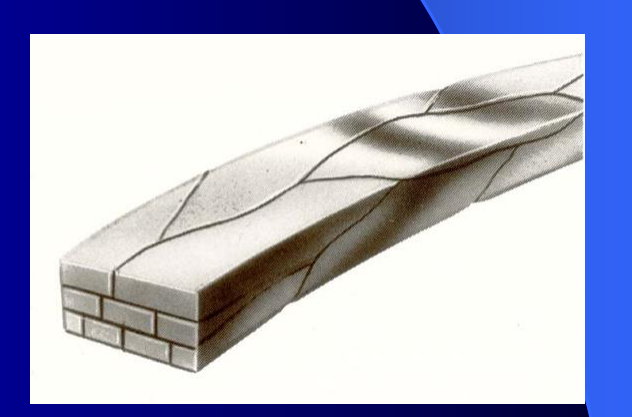
- Nickel-Titanium (NiTi): Shape memory alloy with super-elasticity. It can be bent significantly and still deliver light, continuous forces. It generally cannot be hand-bent.
- Beta-Titanium
- Beta-Titanium (TMA): Has about 40% of the stiffness of steel; good for intermediate stages but has higher friction.
- Composite plastics
Electric current on NiTi can cause it to change Used to correct deep bite
Continuous or segmented
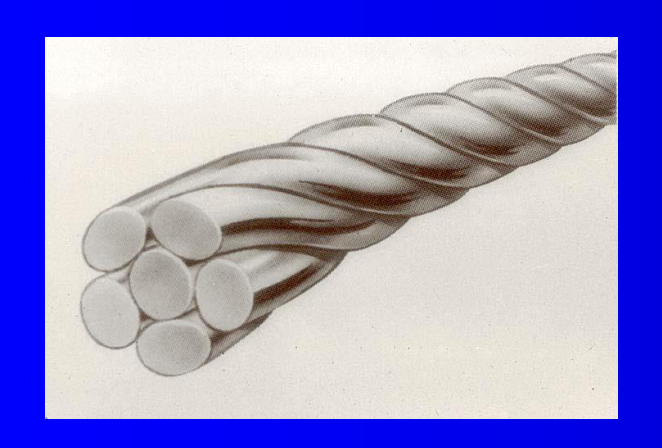
- Solid or multistranded
- Multi-strand: Several small wires twisted together to reduce stiffness compared to a solid wire of the same diameter.
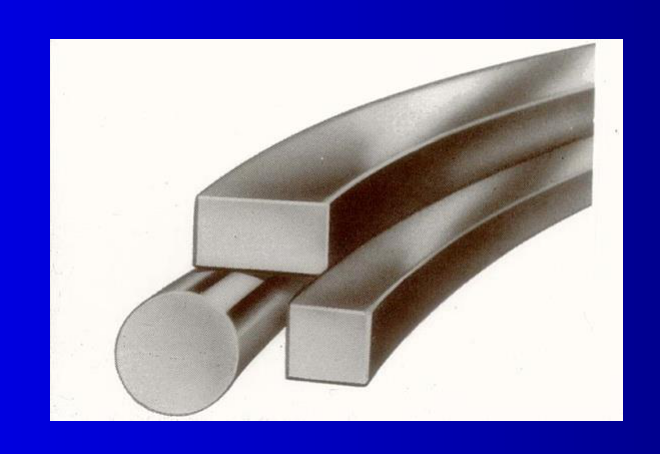
- Round, square or rectangular
- Round (initial leveling), Square, and Rectangular (for torque control).
 |  |
 |  |
Arch Wire Forms62
- Bonwill-Hawley
- Cantenary curve
- Brader arch form
- Lingual appliance arch forms (mushroom Arch)
- Most if not all arch wires require some form of modification to match the patient’s arch form
Arch Form Stability
Maintaining the patient’s original arch form is recommended to reduce the risk of relapse, as the original position is often the most stable for the patient’s musculature.
Treatment Stages and Limitations
Traditional Stages of Orthodontic Treatment63
Stages of Orthodontic Treatment
- Stage 1 - Leveling and Alignment
- Correcting tooth heights and aligning them to the arch form using light, round wires.
- Stage 2 - Space Management
- Closing extraction spaces or regaining space.
- Stage 3 - Finishing
- Individualizing the positions using specific bends (detailing) because pre-programmed prescriptions are not perfect for every patient.
- Stage 4 - Retention
- Maintaining the result.
Fixed Appliance Limitations64656667
Fixed appliances are limited to moving teeth within the confines of the alveolar bone. Therefore, fixed appliances depend upon an adequate and healthy periodontium.
Fixed appliances often require a high degree of patient cooperation. The best treatment results depend upon faithful wearing of elastics, headgear and/or other orthodontic or orthopaedic auxiliaries.
Fixed appliances require an acceptable level of oral hygiene to allow movement of the teeth with minimal loss of crestal bone, as well as to prevent dental caries.
Hygiene and Bone Loss
Treatment cannot proceed in the presence of gingivitis or poor hygiene, as orthodontic forces applied to inflamed tissues lead to rapid bone loss.
Fixed appliances require an acceptable skeletal relationship prior to the completion of treatment. The skeletal relationship may be achieved before or during fixed appliance treatment by the use of extraoral traction, functional appliances or orthognathic surgery.
Orthodontic Complications686970
• Pain – Appliance impinging on soft tissues pain associated with tooth movement - Pain is usually limited and manageable.
• Appliance Breakages – Bracket/bond/wire
• Oral Hygiene – Periodontal/Dental caries issues
- White Spot Lesions: Decalcification due to poor hygiene around appliances.
• Root Resorption – due to patient susceptibility or treatment mechanics - A serious risk that may be genetically related. - Management involves using light forces, avoiding rectangular wires, and taking OPGs every six months. - If resorption is detected, treatment may be paused for three months.
-
Devitalization
-
Muscle and/or TM Joint Pain
- TMJ Pain often improves once a stable occlusion is achieved.
-
Relapse
-
Tooth mobility – due to bone loss or tooth movement into area of inadequate osseous support
-
Loss of crestal bone – due to gingival inflammation
-
Atypical Growth – Growth that distorts the skeletal relationship beyond the orthodontist’s ability to compensate.
-
Compliance
-
Ceramic Brackets – Potential enamel damage
-
Complimentary Aesthetic Dentistry
-
Loose or Debonded Fixed Retainer
Complications of Orthognathic Surgery71
- Altered Sensation / Anesthesia
- Nerve-related changes.
- Surgical Relapse
- The jaw moving back toward its original position.
- Fixation Time
- Tooth Devitalization/Root Resection
- Loss of tooth vitality due to osteotomy cuts.
- Condylar Resorption
- Particularly a risk in lower jaw setbacks.
- Reduced TM Joint Mobility
- TM Joint Pain
Clinical Cases
Case: Early Orthodontic Device (Angle Edgewise)
Question/Prompt:
“From the very beginning we have some rudimentary arch wires. So remember, we did not have anything with bonding in that time… have a look at this. You have like screws which tighten like the six, like a rhyme ball, okay. And you have an arch on the buccal labial face.”
Findings and Reasoning:
- Device Characteristics: This early system used screws to tighten around the molars and a buccal/labial archwire.
- Limitations: Because there was no etching or bonding available, the teeth had to be “laced” to correct rotations. The biomechanics were limited compared to modern systems.
- Manual Adjustment: In the original edgewise device, there were no built-in compensations in the brackets. The clinician had to manually bend the first, second, and third-order (torque) adjustments into every archwire for every patient.
Case: Pin and Tube Appliance
Question/Prompt:
“Then it’s evolved for a pin and tube 10 years later, more or less. So we have a pin attached to the, to the bands and have a look, we have bands across all the teeth, all right? No bonding.”
Findings and Reasoning:
- Attachment Method: Force was delivered through pins attached to bands on every single tooth.
- Biomechanics: The force application had a specific distance from the center of resistance.
- Clinical Challenge: Placing bands on every tooth increased the risk of white spot lesions due to the difficulty of maintaining hygiene around so many metallic bands.
Case: Band with Eyelets/Wings
Question/Prompt:
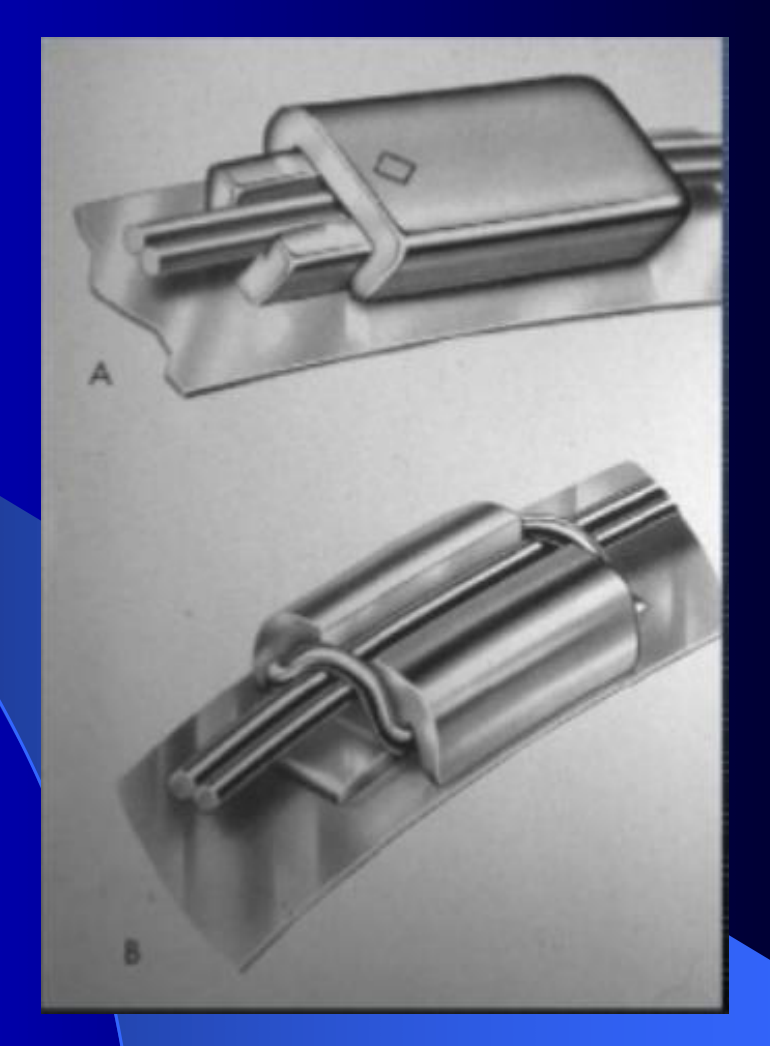
“See, we have a slot attached to the bend… We still could do this. You have this kind of what we call eyelet that is this device solder here that we can use to pin something here on both sides on the measuring on the logistical to control rotation. So we can use these wings, okay. To control the rotation of the tooth.”
Findings and Reasoning:
- Rotation Control: The “wings” or eyelets soldered to the bands allowed for control of tooth rotation.
- Technical Difficulty: These were metallic devices soldered to metallic bands using a hand torch. The clinician had to be careful not to block the inner part of the slot with soldering material.
Case: Begg Appliance
 Question/Prompt:
“Then we got the Begg appliance, as you can see here. So the arch wire was connected like on a vertical pins… within Begg did not use a kind of a rectangular slot.”
Question/Prompt:
“Then we got the Begg appliance, as you can see here. So the arch wire was connected like on a vertical pins… within Begg did not use a kind of a rectangular slot.”
Findings and Reasoning:
- Wire Type: The Begg technique used round wires only, not rectangular ones.
- Tipping Control: Because it lacked a square/rectangular slot, it could not control third-order (torque) movements as effectively as modern systems. It relied on elastics and specific pin connections to manage uncontrolled tipping.
- Components: It utilized molar tubes and vertical pins rather than standard modern brackets.
Case: Self-Ligating Brackets
Question/Prompt:
“But now we have the system, the self ligating system. This is more or less the same bracket, but it has a lid. So you can open and close the lid. The lid is this one like a gate. So you open with your probe, connect the wire and close the lid.”
Findings and Reasoning:
- Mechanism: Instead of elastomeric O-rings, a mechanical “gate” or lid holds the wire in the slot.
- Advantages: It reduces clinical time and avoids the degradation/biofilm buildup associated with polymeric elastomeric rings.
- Risks: If oral hygiene is poor, calculus can build up on the edges of the gate, causing it to get stuck. If the gate cannot be opened after 6-7 weeks, the entire bracket may need to be replaced.
Case: Bonding to Non-Enamel Surfaces (PFM/Metal Crowns)
Question/Prompt:
“I was just wondering like, can you bond graphics to PFM or like any sort of crown or like a metal crown? … For example, last week we had a problem… the six were still crowned. So no, no H bonding. What should we do?”
Findings and Reasoning:
- Surface Preparation: For ceramic or metal crowns, standard etching is insufficient. The surface may need to be sandblasted.
- Adhesion: A different bonding system (similar to what is used to set ceramic crowns) or zinc phosphate cement can be used to attach the appliance to the crown.
- Clinical Scenario: In the mentioned case, a 3D-printed lingual arch (chrome cobalt) was fitted to a patient with steel crowns by sandblasting the crowns and using zinc phosphate.
Case: Twin vs. Single Bracket Systems
Question/Prompt:
“So twin system, like you have like this, these double wings here… We have this kind of just a single system here. So when you have just this kind of not twin system, okay, Your, your bracket, your bracket become narrow.”
Findings and Reasoning:
- Single Brackets: Being narrower, they increase the “inter-bracket distance” (more wire between teeth). This increases resilience and decreases stiffness, delivering lower forces but offering less rotational control.
- Twin Brackets: These have two points of contact with the wire. This reduces the inter-bracket distance (higher force levels) but provides significantly more control over tooth movement.
Case: First, Second, and Third Order Bends
Question/Prompt:
“See how the wires are bent here on this first image? So all of these bands we had to do by our own… Now we can just use a straight wire. Okay. And all of these bands are already compensated inside the bracket system.”
Findings and Reasoning:
- First Order: Relates to the thickness of the bracket (in-out position).
- Second Order: Relates to the “tip” or mesiodistal angulation (e.g., angulating incisors for aesthetics).
- Third Order: Relates to “torque” or the torsion of a rectangular wire within the slot to compensate for uncontrolled tipping and achieve bodily movement.
- Straight Wire System: In modern “Straight Wire” prescriptions (like Roth or MBT), these compensations are built into the bracket slot and base rather than bent into the wire.
Case: Anchorage Auxiliaries (Lingual Arch, Nance, TPA)
Question/Prompt:
“For example, a lingual arch here. When we want, we need extra control of the lower anchorage… we have the nancy button of the top, okay. Which it blocks the major drift of the upper molars… you can use a transpalatal bar.”
Findings and Reasoning:
- Lower Lingual Arch: Connects the lower molars to provide extra anchorage when retracting canines.
- Nance Button: Uses a button on the palate to physically block the upper molars from drifting mesially (forward).
- Transpalatal Bar (TPA): Similar to a lingual arch but for the upper jaw; it can be used for anchorage or to rotate/de-rotate the upper molars.
Case: Space Opening and Closing (Coils)
Question/Prompt:
“We also have this kind of push coils, okay? They are open springs… when you place them on the position, they come like compressed. So usually open space… and they can be also closed.”
Findings and Reasoning:
- Open/Push Coils: Placed between brackets in a compressed state to create space.
- Closed Coils: Used to pull teeth together, such as sliding a canine backwards into an extraction space.
Footnotes
-
Original PDF page 1: 04 - DENT5311 Contemporary Fixed Appliances, p.1 ↩
-
Original PDF page 2: 04 - DENT5311 Contemporary Fixed Appliances, p.2 ↩
-
Original PDF page 3: 04 - DENT5311 Contemporary Fixed Appliances, p.3 ↩
-
Original PDF page 4: 04 - DENT5311 Contemporary Fixed Appliances, p.4 ↩
-
Original PDF page 5: 04 - DENT5311 Contemporary Fixed Appliances, p.5 ↩
-
Original PDF page 6: 04 - DENT5311 Contemporary Fixed Appliances, p.6 ↩
-
Original PDF page 7: 04 - DENT5311 Contemporary Fixed Appliances, p.7 ↩
-
Original PDF page 8: 04 - DENT5311 Contemporary Fixed Appliances, p.8 ↩
-
Original PDF page 9: 04 - DENT5311 Contemporary Fixed Appliances, p.9 ↩
-
Original PDF page 10: 04 - DENT5311 Contemporary Fixed Appliances, p.10 ↩
-
Original PDF page 11: 04 - DENT5311 Contemporary Fixed Appliances, p.11 ↩
-
Original PDF page 12: 04 - DENT5311 Contemporary Fixed Appliances, p.12 ↩
-
Original PDF page 13: 04 - DENT5311 Contemporary Fixed Appliances, p.13 ↩
-
Original PDF page 14: 04 - DENT5311 Contemporary Fixed Appliances, p.14 ↩
-
Original PDF page 15: 04 - DENT5311 Contemporary Fixed Appliances, p.15 ↩
-
Original PDF page 16: 04 - DENT5311 Contemporary Fixed Appliances, p.16 ↩
-
Original PDF page 17: 04 - DENT5311 Contemporary Fixed Appliances, p.17 ↩
-
Original PDF page 18: 04 - DENT5311 Contemporary Fixed Appliances, p.18 ↩
-
Original PDF page 19: 04 - DENT5311 Contemporary Fixed Appliances, p.19 ↩
-
Original PDF page 20: 04 - DENT5311 Contemporary Fixed Appliances, p.20 ↩
-
Original PDF page 21: 04 - DENT5311 Contemporary Fixed Appliances, p.21 ↩
-
Original PDF page 22: 04 - DENT5311 Contemporary Fixed Appliances, p.22 ↩
-
Original PDF page 23: 04 - DENT5311 Contemporary Fixed Appliances, p.23 ↩
-
Original PDF page 24: 04 - DENT5311 Contemporary Fixed Appliances, p.24 ↩
-
Original PDF page 25: 04 - DENT5311 Contemporary Fixed Appliances, p.25 ↩
-
Original PDF page 26: 04 - DENT5311 Contemporary Fixed Appliances, p.26 ↩
-
Original PDF page 27: 04 - DENT5311 Contemporary Fixed Appliances, p.27 ↩
-
Original PDF page 28: 04 - DENT5311 Contemporary Fixed Appliances, p.28 ↩
-
Original PDF page 29: 04 - DENT5311 Contemporary Fixed Appliances, p.29 ↩
-
Original PDF page 30: 04 - DENT5311 Contemporary Fixed Appliances, p.30 ↩
-
Original PDF page 31: 04 - DENT5311 Contemporary Fixed Appliances, p.31 ↩
-
Original PDF page 32: 04 - DENT5311 Contemporary Fixed Appliances, p.32 ↩
-
Original PDF page 33: 04 - DENT5311 Contemporary Fixed Appliances, p.33 ↩
-
Original PDF page 34: 04 - DENT5311 Contemporary Fixed Appliances, p.34 ↩
-
Original PDF page 35: 04 - DENT5311 Contemporary Fixed Appliances, p.35 ↩
-
Original PDF page 36: 04 - DENT5311 Contemporary Fixed Appliances, p.36 ↩
-
Original PDF page 37: 04 - DENT5311 Contemporary Fixed Appliances, p.37 ↩
-
Original PDF page 38: 04 - DENT5311 Contemporary Fixed Appliances, p.38 ↩
-
Original PDF page 39: 04 - DENT5311 Contemporary Fixed Appliances, p.39 ↩
-
Original PDF page 40: 04 - DENT5311 Contemporary Fixed Appliances, p.40 ↩
-
Original PDF page 41: 04 - DENT5311 Contemporary Fixed Appliances, p.41 ↩
-
Original PDF page 42: 04 - DENT5311 Contemporary Fixed Appliances, p.42 ↩
-
Original PDF page 43: 04 - DENT5311 Contemporary Fixed Appliances, p.43 ↩
-
Original PDF page 44: 04 - DENT5311 Contemporary Fixed Appliances, p.44 ↩
-
Original PDF page 45: 04 - DENT5311 Contemporary Fixed Appliances, p.45 ↩
-
Original PDF page 46: 04 - DENT5311 Contemporary Fixed Appliances, p.46 ↩
-
Original PDF page 47: 04 - DENT5311 Contemporary Fixed Appliances, p.47 ↩
-
Original PDF page 48: 04 - DENT5311 Contemporary Fixed Appliances, p.48 ↩
-
Original PDF page 49: 04 - DENT5311 Contemporary Fixed Appliances, p.49 ↩
-
Original PDF page 50: 04 - DENT5311 Contemporary Fixed Appliances, p.50 ↩
-
Original PDF page 51: 04 - DENT5311 Contemporary Fixed Appliances, p.51 ↩
-
Original PDF page 52: 04 - DENT5311 Contemporary Fixed Appliances, p.52 ↩
-
Original PDF page 53: 04 - DENT5311 Contemporary Fixed Appliances, p.53 ↩
-
Original PDF page 54: 04 - DENT5311 Contemporary Fixed Appliances, p.54 ↩
-
Original PDF page 55: 04 - DENT5311 Contemporary Fixed Appliances, p.55 ↩
-
Original PDF page 56: 04 - DENT5311 Contemporary Fixed Appliances, p.56 ↩
-
Original PDF page 57: 04 - DENT5311 Contemporary Fixed Appliances, p.57 ↩
-
Original PDF page 58: 04 - DENT5311 Contemporary Fixed Appliances, p.58 ↩
-
Original PDF page 59: 04 - DENT5311 Contemporary Fixed Appliances, p.59 ↩
-
Original PDF page 60: 04 - DENT5311 Contemporary Fixed Appliances, p.60 ↩
-
Original PDF page 61: 04 - DENT5311 Contemporary Fixed Appliances, p.61 ↩
-
Original PDF page 62: 04 - DENT5311 Contemporary Fixed Appliances, p.62 ↩
-
Original PDF page 63: 04 - DENT5311 Contemporary Fixed Appliances, p.63 ↩
-
Original PDF page 64: 04 - DENT5311 Contemporary Fixed Appliances, p.64 ↩
-
Original PDF page 65: 04 - DENT5311 Contemporary Fixed Appliances, p.65 ↩
-
Original PDF page 66: 04 - DENT5311 Contemporary Fixed Appliances, p.66 ↩
-
Original PDF page 67: 04 - DENT5311 Contemporary Fixed Appliances, p.67 ↩
-
Original PDF page 68: 04 - DENT5311 Contemporary Fixed Appliances, p.68 ↩
-
Original PDF page 69: 04 - DENT5311 Contemporary Fixed Appliances, p.69 ↩
-
Original PDF page 70: 04 - DENT5311 Contemporary Fixed Appliances, p.70 ↩
-
Original PDF page 71: 04 - DENT5311 Contemporary Fixed Appliances, p.71 ↩