Case 21
Worksheet prompts (Suggested Approach, applies to every case)
- Describe the image/radiograph.
- Identify relevant soft tissue findings.
- Identify relevant hard tissue findings.
- Estimate the patient’s dental age.
- Develop a problem list.
- Formulate differential diagnoses.
- Consider additional investigations.
- Develop a management plan.
Clinical Case
Answered from the lecturer’s comments in the recording only. The student presentations are left out.
Partly unintelligible
Much of the W2.2 audio is off-mic. The discussion also refers to a clinical photo (a gum lump, white spot lesions) that isn’t in the worksheet, which only shows this OPG.
1. Image / radiograph
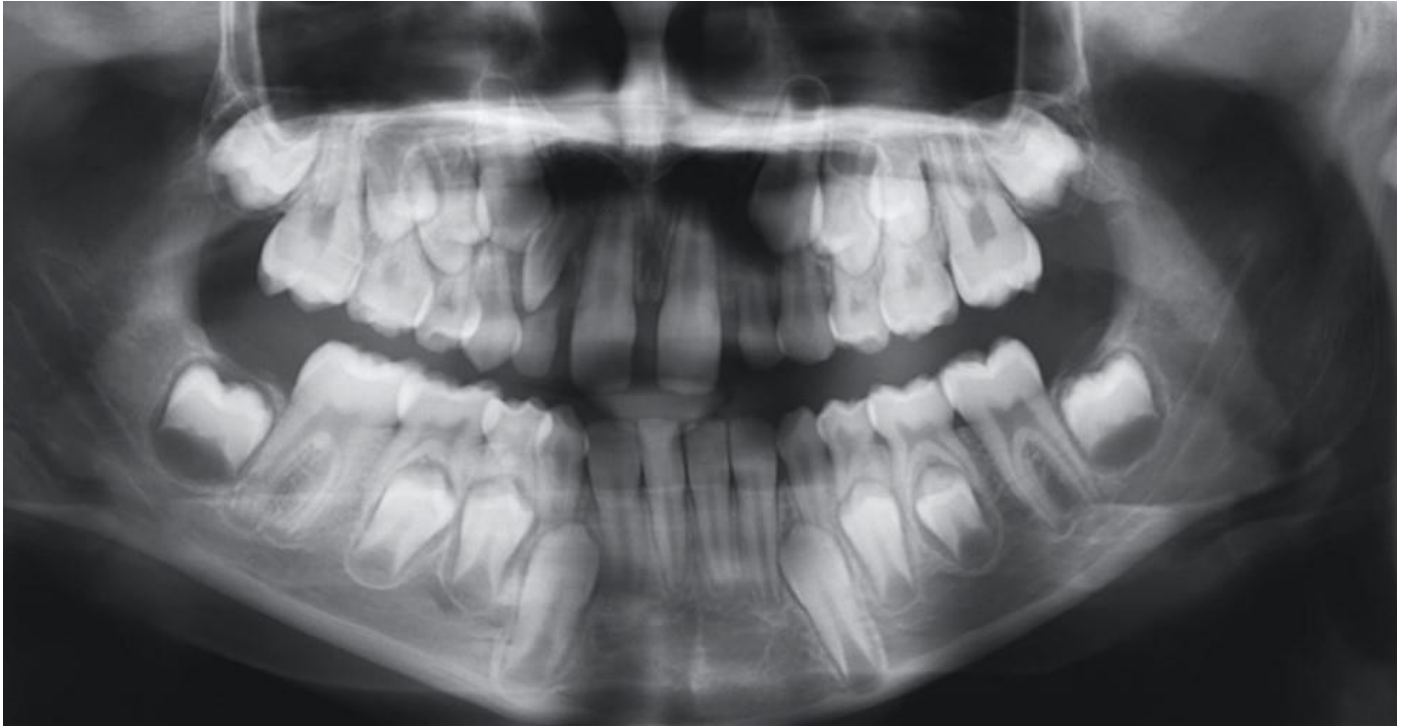
- OPG. The tutorial slides also had a clinical photo, which isn’t in the worksheet.
2. Soft tissue findings
- Lump above the exfoliated 61 (raised by the group).
- There are no surrounding signs of infection and it doesn’t look like a draining sinus, so it is probably a normal variant.
- A very wobbly tooth that has been hanging on for a long time can cause local gingival irritation or infection. This heals once the tooth is lost.
3. Hard tissue findings
- Root development: the lecturer noted that the central incisor roots are expected to complete at about 9–10 years and the laterals at about 11, and that these teeth are “way ahead”. The conclusion is unintelligible.
- Caries: multiple white spot lesions and a brown spot lesion (on the clinical photo, raised by the group). The lecturer agreed that white spot lesions at this age mean a high caries risk patient.
4. Dental age
- The group said 6–7 years, from the erupted 31, 41 and 26. The lecturer’s response is unintelligible.
5. Problem list
- High caries risk (white spot lesions).
- Gingival lump above the exfoliated 61, probably a normal variant.
6. Differential diagnoses
- Gingival lump: normal variant or local irritation from a long-standing mobile tooth, versus a pathological lesion. Normal variant favoured.
7. Additional investigations
- Not discussed in an audible part of the recording.
8. Management plan
- Lump, if a normal variant: send the child home to wiggle the tooth, and review the following week. The exception is if the new tooth has erupted lingually or palatally.
- Caries: not discussed in an audible part of the recording.
Footnotes
-
Original PDF page 1: T2 Case 2, p.1 ↩