Oral Health Care System In Australia
Medicare Card Details1
Image source: https://www.healthdirect.gov.au/what-is-medicare
Lecturer — System Structure
Australia’s oral health system operates within a hybrid health system.
- A public system
- A private system
- Public funding provided through different levels of government
- Private payments made directly by patients
- Private health insurance
Although these components may appear to contribute equally in principle, dental funding is substantially weighted toward private payment.
Lecturer — Medicare Eligibility
Medicare provides access to healthcare for several groups beyond the cardholders shown.
- Australian citizens
- Permanent residents
- Individuals applying for permanent residency
- Temporary residents covered by specific ministerial agreements
- Residents of countries with reciprocal healthcare agreements, including the United Kingdom and New Zealand
Most temporary residents are outside Medicare coverage.
Who Pays For Dental Services In Australia
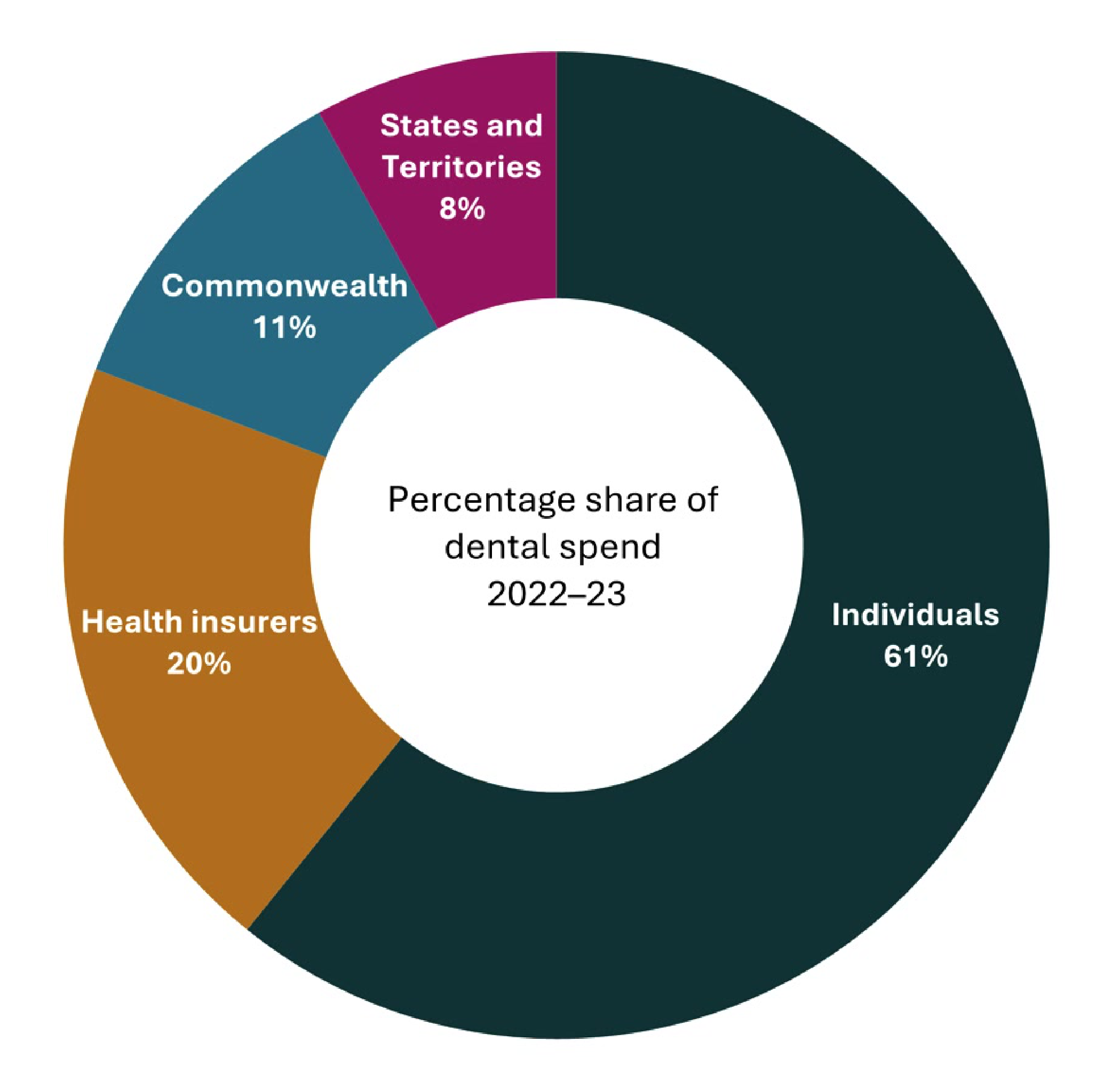
Percentage Share of Dental Spend (2022–23)2
- Individuals: 61%
- Health insurers: 20%
- Commonwealth: 11%
- States and Territories: 8%
Total Expenditure Breakdown
In 2022–23, $12.5 billion was spent on dental services in Australia:
- Individuals spent more than $7.6 billion
- Health insurers spent close to $2.5 billion
- The Commonwealth spent nearly $1.4 billion
- State and territory governments spent nearly $1 billion
Lecturer — Private Payment
Approximately 81% of dental expenditure came directly or indirectly from individuals. The distribution demonstrates that dental care in Australia remains heavily dependent on private payment.
Lecturer — Public Funding
The public sector contributed approximately 19% of total dental spending.
- Commonwealth Government: 11%
- State and territory governments: 8%
The lecturer described the level of public funding as very low, despite the substantial total amount spent on dental services.
Source: Parliament of Australia: https://www.aph.gov.au/About_Parliament/Parliamentary_departments/Parliamentary_Library/Research/Policy_Briefs/2025-26/Commonwealthfundingfordental?utm
A Shared Responsibility: State Delivery, Commonwealth Support
Core Principles3
-
Not in Medicare: Unlike medical care, dental care has never been included in Medicare.
-
State led, Commonwealth supports: States and territories have always delivered public dental services, with funding help from the Commonwealth.
-
Focus on need: Programs have mainly targeted children, vulnerable people, and those with specific health conditions.
-
Still evolving: Australia continues to debate how to make dental care fairer, more accessible, and affordable for all.
-
Oral health has not generally been treated by policymakers as integral to general health.
-
The current system is a hybrid model shaped by historical policy decisions and funding arrangements.
 |  |  |
 |  |  |
 |  |  |
 |  |  |
 |  |  |
 |  |  |
Key Milestones
- 1900s–1970s: States establish public dental services, mainly focusing on school children and people in need.
- 1946: A constitutional change allows the Commonwealth to fund dental services, but states remain responsible for delivery.
- 1973–1981: Commonwealth funds a national scheme to improve children’s oral health through school dental services.
- 1973 & 1981: Dental care is left out of Australia’s universal health insurance and remains mostly a private expense.
- 1994–1996: First major program for adults. Aimed to reduce public dental waiting lists and improve access for those most in need.
- 2000s:
- Veterans’ Dental Program expands.
- Medicare Chronic Disease Dental Scheme (2007) provides Medicare-funded dental care for people with chronic conditions (ended in 2012).
- 2014–present: Medicare-funded scheme for eligible children (0–17 years) for basic and preventive dental care delivered by private dentists.
- 2014–present: Ongoing funding partnerships to support public dental services for adults, especially concession card holders, and reduce waiting lists.
- 2020s and beyond: Growing calls for universal dental care and inclusion in Medicare to achieve better oral health for all Australians.
Lecturer — School Dental Services
School dental services became especially important in the early twentieth century.
- Queensland developed large-scale school dental programs as early as 1911, and South Australia established a program around 1923.
- Australia was influenced by the New Zealand school dental nurse model, with specially trained dental nurses providing preventive and basic restorative care in schools.
- These services responded to high levels of untreated childhood caries, a shortage of dentists, rural and remote access difficulties, and the need for a cost-effective population-based preventive strategy.
Lecturer — Commonwealth Responsibility
From 1946, the Commonwealth began taking greater responsibility for supporting state health services while maintaining Australia’s federal structure.
- Negotiated funding agreements with states and territories developed as part of this shared-responsibility model.
- These agreements continue to support the delivery of health services, including dental services.
Lecturer — Excluding Dentistry
Medibank was introduced before Medicare, which was introduced in 1984, but dentistry was excluded from both universal health insurance arrangements.
- Reasons discussed included concerns about uncontrolled demand, the high level of dental need, the potentially very high cost to the Commonwealth, and opposition from professional organizations.
Lecturer — Commonwealth Dental Program
The Commonwealth Dental Health Program provided approximately $300 million in federal funding to reduce public dental waiting lists, support disadvantaged adults, and strengthen state public dental systems. It was a time-limited injection of funding rather than a structural reform and was discontinued in 1996 following a change in government.
Lecturer — Chronic Disease Scheme
The Chronic Disease Dental Scheme integrated dental care with chronic disease management, including diabetes and cardiovascular disease.
- Patients were referred by a general practitioner and received Medicare rebates, with the government paying up to approximately $4,000 over two calendar years.
- The scheme was used extensively, and government costs increased to almost $2 billion before it was discontinued in 2012.
How Funding Works Today
- Commonwealth Government: Provides targeted funding and payments (e.g., CDBS) and contributes to state programs.
- State and Territory Governments: Plan, fund, and deliver public dental services to eligible people.
- Australians: Most dental care is still provided by private dentists.
The Big Picture
- Australia has never had universal public dental coverage.
- Funding has focused on children, vulnerable people, and those with specific health needs.
- States deliver the services; the Commonwealth provides support.
- Better oral health improves overall health, equality, and quality of life.
The Goal
A fair and accessible dental system where every Australian can get the care they need to keep their mouth healthy and their body healthy.
Adapted from Parliament of Australia: https://www.aph.gov.au/About_Parliament/Parliamentary_departments/Parliamentary_Library/Research/Policy_Briefs/2025-26/Commonwealthfundingfordental?utm_
Commonwealth Government4
-
Medical services through the MBS (both referred and non-referred medical services, as well as some allied health services)
-
Limited dental services
-
Pharmaceuticals through the PBS
-
Community-controlled Aboriginal and Torres Strait Islander primary healthcare
-
Aged care services (including residential aged care and home care) through the AN-ACC residential aged care funding model, as well as capital grants and programs
-
Contributions to support access to private health insurance, such as the private health insurance rebate
-
Health and medical research through the National Health and Medical Research Council
-
45 per cent of public hospital activity service delivery (under the National Health Reform Agreement 2020–2025)
-
The Commonwealth also supports dental care through the Royal Flying Doctor Service, dental research funding, the Northern Territory Remote Aboriginal Investment Oral Health Program for people under 16, and funding for Aboriginal Community Controlled Health Services.
State and Territory Governments
- 55 per cent of public hospital activity service delivery (under the National Health Reform Agreement 2020–2025)
- Ambulance services
- Limited dental services
- Some community and public health services
- Some medical research
Local Governments
- Public health promotion
- Community health services
Non-Government Organisations
Funding Of Health Care In Australia
- Charitable healthcare services, such as medical clinics
- Health promotion initiatives and educational programs
Private Health Insurers
- Private health services delivered in public hospitals
- Services delivered in private hospitals
- Some community services
- Some dental services
- Medicines
- Some referred medical services
- Some allied health services
- Some medical research
Lecturer — Dental Funding Sources
Private health insurers contribute approximately 20% of total dental expenditure and may provide dental cover through extras policies.
- Patients are the largest source of dental funding: direct out-of-pocket payments account for approximately 61% of total dental expenditure.
- When private insurance contributions are included, approximately 81% of total dental spending comes directly or indirectly from individuals.
Patients
- Out-of-pocket expenses (medical, dental, diagnostic investigation, and allied health services)
- Private health insurance premiums, excess payments
- Medicine costs
- Medicare levy and Medicare levy surcharge
Australian Medical Association, https://www.ama.com.au/sites/default/files/2023-12/Discussion%20paper_Rethinking%20funding%20models%20to%20%20align%20with%20%20population%20%20health%20%20goals_0.pdf
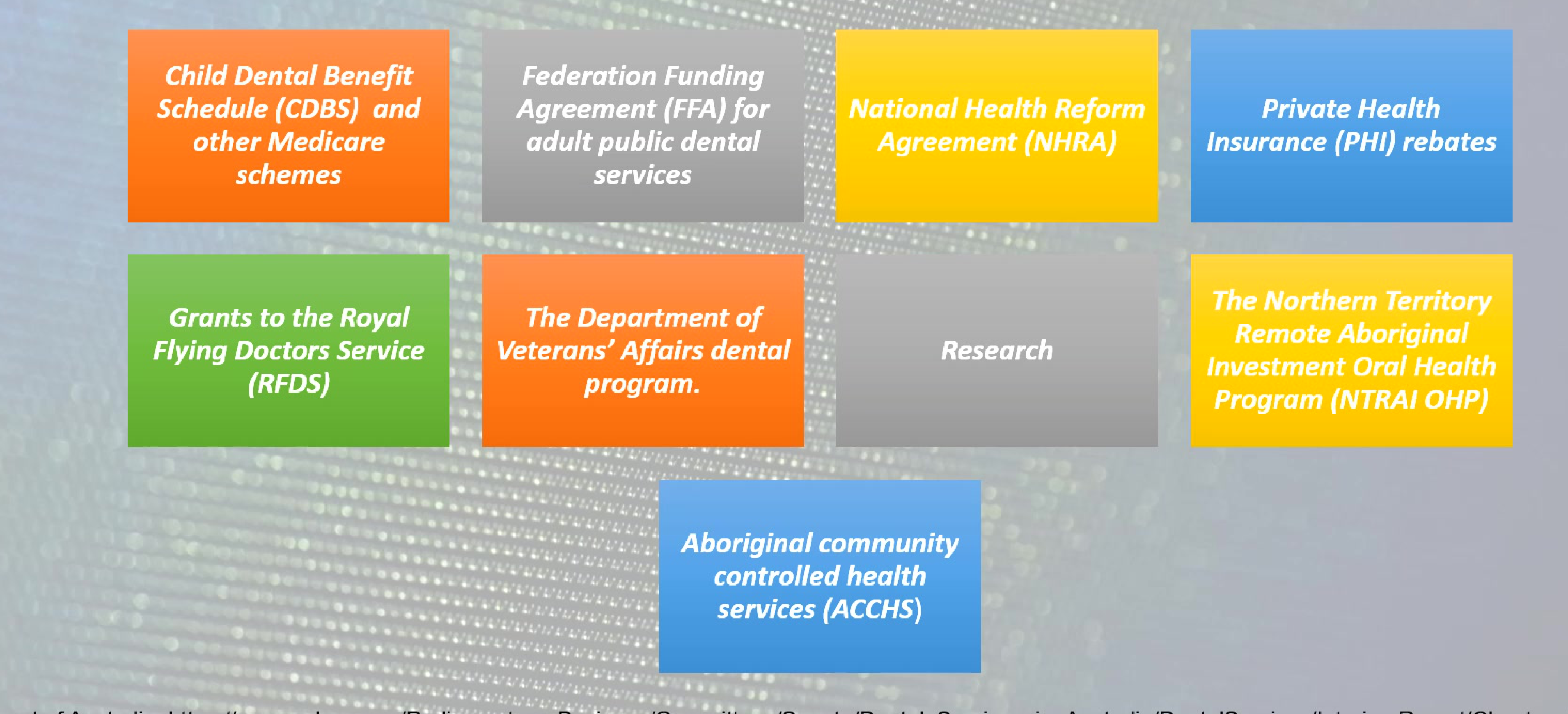
Commonwealth Government Based Dental Services5
| Child Dental Benefit Schedule (CDBS) and other Medicare schemes | Federation Funding Agreement (FFA) for adult public dental services | National Health Reform Agreement (NHRA) | Private Health Insurance (PHI) rebates |
|---|---|---|---|
| Grants to the Royal Flying Doctors Service (RFDS) | The Department of Veterans’ Affairs dental program | Research | The Northern Territory Remote Aboriginal Investment Oral Health Program (NTRAI OHP) |
| Aboriginal community controlled health services (ACCHS) |
- Hospital dentistry funded through the National Health Reform Agreement, the Northern Territory Remote Aboriginal Investment Oral Health Program for people under 16, and Commonwealth support for state and territory public dental services through funding agreements Parliament of Australia: https://www.aph.gov.au/Parliamentary_Business/Committees/Senate/Dental_Services_in_Australia/DentalServices/Interim_Report/Chapter_1_Introduction_and_background
Lecturer — Service Delivery Details
The lecturer noted additional details about how these services are organised and delivered.
- Public dental services in Western Australia are primarily provided through Dental Health Services, including services provided through the Oral Health Centre of Western Australia.
- The school dental service is led in part by dental therapists, who report to an area dental officer.
- There are approximately three general dental services in the Perth metropolitan area, with Salter Point identified as the most important.
- The new special needs clinic is located at Salter Point.
State Government Based Dental Services6
(Western Australian context)
-
Dental Health Services
- School Dental Service
- General Dental Service
- Special Dental Service
- Aged care facility (visiting program)
- Special Needs Clinic
- Prison dental service
- Disability Service Commission clients
- Visiting services to Royal Perth Hospital and Graylands Hospital
- Specialist services at Fiona Stanley Hospital
- Dental Subsidy Schemes
- Country Patients Dental Subsidy Scheme (CPDSS)
- Metropolitan Patients Dental Subsidy Scheme (MPDSS)
- Private Orthodontic Subsidy Scheme (POSS)
-
Aboriginal Medical Services
-
Oral Health Centre of Western Australia: Only tertiary teaching specialist dental hospital in WA.
WA Department of Health, Dental Health Services: https://www.health.wa.gov.au/en/Articles/A_E/Dental-Health-Services
Lecturer — CDBS Access Barriers
The CDBS is considered underutilized despite the number of people who may be eligible. The remuneration available through the scheme may be considerably lower than usual fees, which may discourage clinicians from using it.
Medicare And Dental Care7
How much of dental care is covered by Medicare?
Australian Government | Services Australia | Medicare
Source: https://www.healthdirect.gov.au/partners/medicare
How Does Medicare Work
- Funded by Australian taxpayers (2% of their taxable income).
- Service offered to ANZ citizens, permanent residents, applicants for permanent residency, temporary residents covered by a Ministerial order, permanent residents of Australian overseas territories, and citizens of countries with reciprocal healthcare agreements.
- Concurrently, costs for most medicines under the Pharmaceutical Benefits Schedule (PBS) are covered, and many prescribed medicines are subsidised by the government.
Lecturer — Medicare Funding
Medicare is funded through both the Medicare levy and general taxation revenue. It is a publicly funded universal insurance scheme rather than a contributory insurance model.
Payment Coverage8
- General Practitioners: Full schedule fee
- Specialists: 85% of schedule fee
- In-hospital Services: 75% of schedule fee
Lecturer — Schedule Fees
The Medicare Benefits Schedule specifies schedule fees, which represent an average fee recorded across practitioners.
- Doctors who claim the full schedule fee from the government are described as bulk-billing doctors.
- Treatment in public hospitals is free.
- Patients may receive full coverage or partial reimbursement depending on where and how care is delivered.
- When out-of-pocket expenditure exceeds an annual threshold, higher rebate rates may apply through the Medicare Safety Net.
In addition, a Medicare Safety Net and PBS Safety Net are provided to individuals with extensive healthcare needs.
- Medicare: https://www.healthdirect.gov.au/what-is-medicare
- Pharmaceutical Benefits Scheme: https://www.healthdirect.gov.au/pharmaceutical-benefits-scheme-pbs
Medicare Benefit Schedule And Dental Coverage9
Does Medicare cover costs of general dental care? Mostly, NO!!
However, some dental and maxillofacial services are provided under specific schemes:
-
Child Dental Benefits Schedule (CDBS)
- Covers basic dental services for eligible children aged 0–17 years.
- Benefit cap of up to AU$1,158 over a two-calendar-year period.
- Eligibility requires being eligible for Medicare and receiving a relevant Australian Government payment.
-
Oral and Maxillofacial Services
- Relevant benefit and extended Medicare safety net apply for each scheduled service.
-
Cleft Lip and Cleft Palate Services
- Available to individuals under 28 years enrolled in Medicare and diagnosed with an eligible cleft or craniofacial condition.
- Covers general dental, paediatric, orthodontic, prosthodontic, and oral surgical treatment.
Child Dental Benefits Schedule: https://www.health.gov.au/sites/default/files/2024-01/cdbs-guide-to-the-child-dental-benefits-schedule.pdf
Lecturer — CDBS Benefit Amount
The lecturer referred to the CDBS benefit as approximately 1,158. The amount changes over time in line with inflation and the Consumer Price Index.
Child Dental Benefits Schedule
The Child Dental Benefits Schedule (CDBS) helps eligible Australian children access dental care, providing up to $1,158 over two consecutive calendar years.
Eligibility Criteria10
A child may be eligible if they:
- Are aged 0–17 years for at least one day during the calendar year
- Have a Medicare card
- Receive, or have a parent/carer receiving, an eligible government payment (such as Family Tax Benefit Part A and other eligible Centrelink payments) during the year
Services Australia assesses eligibility each year.
 |  |  |
 |  |  |
 |  |  |
 |  |  |
 |  |  |
 |  |  |
 |  |  |
 |  |  |
 |  |  |
 |  |  |
Covered Services
Basic dental care includes:
- Dental check-ups
- Dental X-rays
- Teeth cleaning
- Fissure sealants
- Fillings
- Root canal treatment
- Partial dentures (when clinically required)
Excluded Services
- Braces and orthodontics
- Cosmetic dental treatment (e.g., teeth whitening)
- Dental treatment provided in hospital operating theatres
- Other services outside the CDBS schedule
Lecturer — Hospital-Based CDBS Care
Hospital-based care is generally not covered under the CDBS. This is significant because children with the greatest dental needs may require treatment under general anesthesia, and the CDBS may not be usable for all aspects of that care.
How It Works
- Services Australia checks eligibility annually.
- Confirm eligibility through Medicare via myGov or consult your dental clinic.
- Book an appointment with a participating dentist.
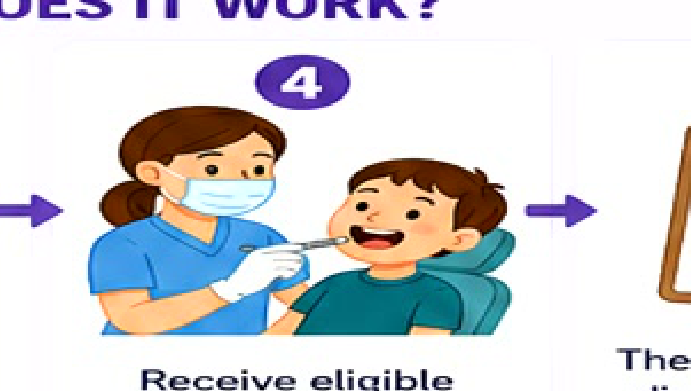
- Receive eligible dental care.
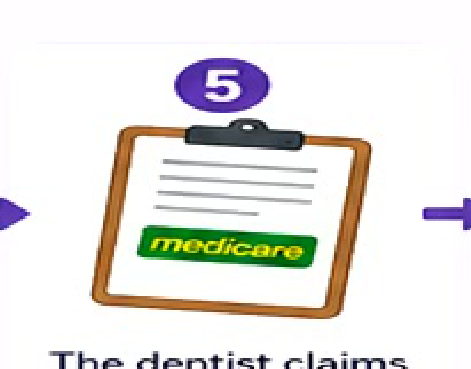
- The dentist claims directly through Medicare (many clinics bulk bill eligible services).
- The available balance decreases as services are claimed until the 2-year cap is reached.
Source: https://www.servicesaustralia.gov.au/whats-covered-child-dental-benefits-schedule?context=22426
Cleft And Craniofacial Scheme
Medicare provides funded dental and surgical treatment for eligible patients with cleft and craniofacial conditions.
Eligibility11
- Patients diagnosed with an eligible cleft lip, cleft palate, or eligible craniofacial condition by an approved healthcare professional.
- Must be enrolled in Medicare.
- No age limit: Since November 2023, eligible patients of any age can access treatment based on clinical need.
 |  |  |
 |  |  |
 |  |  |
 |  |  |
 |  |  |
 |  |  |
 |  |  |
 |  |  |
 |  |  |
 |  |  |
Covered Services
| General Dental Care | Specialist Dental Care |
|---|---|
| - Dental examinations - Preventive care - Fillings and restorations - Tooth extractions | - Orthodontic treatment - Paediatric dentistry - Prosthodontic treatment (including select prostheses) |
| Surgical Care | Care Delivery Model |
|---|---|
| - Oral and maxillofacial surgery - Surgical dental procedures - Simple and surgical tooth extractions | Treatment is tailored to individual needs and may involve a coordinated team of dental and medical specialists. |
Eligible Providers
- Dentists
- Paediatric Dentists
- Orthodontists
- Prosthodontists
- Oral & Maxillofacial Surgeons
Note: Not all providers are registered or familiar with Category 7 claiming; verify before treatment begins.
Pathway to Care
- Diagnosis: Eligible cleft or craniofacial condition identified by an accredited health professional.
- Referral: Referral made to an eligible dental specialist or provider (if required).
- Treatment: Treatment provided using Medicare Category 7 MBS item numbers.
- Medicare Benefit: Medicare contributes toward the cost of eligible treatment.
Important Considerations
- Some services require a specialist referral.
- Patients may incur out-of-pocket costs if provider fees exceed the Medicare rebate.
- Providers must bill under relevant Category 7 MBS item numbers.
- Not all services or items are covered across every clinical circumstance.
Lecturer — Provider Remuneration
The amount returned to providers under the cleft and craniofacial arrangements may be lower than their usual remuneration. This may discourage clinicians from using the scheme.
Conditions Covered
In addition to cleft lip and palate, an array of eligible craniofacial anomalies and specific rare developmental conditions are covered under Medicare Category 7.
Key Benefits
- Improves access to specialised oral healthcare
- Reduces financial barriers to treatment
- Supports individuals with complex congenital conditions
- Integrates dental and medical care across the lifespan
For more information, visit servicesaustralia.gov.au/cleft-and-craniofacial-conditions or call Services Australia on 132 011.
Current as of May 2024.
Dental Workforce And Service Funding
Dental Workforce Statistics
Dentists and Dental Specialists12
- The number of full-time dentists in Australia was 61.1 per 100,000 population.
- The number of full-time equivalent oral health therapists was 9 per 100,000 population.
- 84% of dentists work in the private sector and 4.6% in public clinics. Victoria has the lowest proportion of dentists in public dental service, while NT had the highest.
- Five in 10 dentists work part-time (50%).
- The largest group of specialists in Australia are Orthodontists (34% of all dental specialists), with nearly 68% of them being male.
Lecturer — Workforce Distribution
The central workforce issue is not simply the number of dentists but their distribution.
- Most dentists work in metropolitan areas.
- Far fewer dentists work in rural and remote areas, creating a distribution problem that affects access to care.
Data as of 2023.
Parliament of Australia. Maldistribution and capacity training and workforce matters. https://www.aph.gov.au/Parliamentary_Business/Committees/Senate/Dental_Services_in_Australia/DentalServices/Final_report/Chapter_5 AIHW (Australian Institute of Health and Welfare) (2025). Oral health and dental care in Australia, AIHW, Australian Government, accessed 18 June 2026. Available from: https://www.aihw.gov.au/reports/dental-oral-health/oral-health-and-dental-care-in-australia/contents/dental-workforce
Public Dental Services And Funding Sources13
| Public dental service | Source of funding |
|---|---|
| Child Dental Benefit Scheme | Australian Government (Federal) |
| School Dental Service | State Funded |
| Cleft lip and cleft palate services | Australian Government (Federal) |
| Oral and Maxillofacial Services | Australian Government (Federal) |
| Private Health Insurance Incentive Scheme | Australian Government (Federal) |
| Aboriginal Oral Health | Australian Government (Federal) → Community controlled Aboriginal primary dental care via National Aboriginal Community Controlled Health Organisations. State funded → Aboriginal Medical Services |
| Refugee dental care | Australian Government (Federal) |
| Prisoner dental care | State Funded |
| Aged care dental services | State (very little) – Sadly very little funding |
| Disability dental service | National Disability Insurance Scheme does not cover dental but does in exceptional circumstances. |
| Dental Teaching Hospitals | Mix of State and Federal Funding |
| Armed forces | Australian Government (Federal) via Royal Australian Army Dental Corps |
Lecturer — Public Dental Funding
Public dental services are funded through multiple sources, including state and territory governments, Commonwealth funding agreements, targeted Commonwealth schemes, hospital funding arrangements, and means-tested public dental systems. Specific programs also support children, veterans, Aboriginal communities, and other eligible groups. Public dental services commonly use means testing to determine eligibility.
Budget 2026-27 Dental Care At A Glance
What It Means for You and Your Family14
 |  |  |
 |  |  |
 |  |  |
 |  |  |
 |  |  |
 |  |  |
 |  |  |
 |  |  |
1. Children: Child Dental Benefits Schedule (CDBS)
-
Continues for eligible children aged 0–17 years
-
Up to $1,158 available over 2 years (indexed from 2026)
-
Covers check-ups, cleans, X-rays, fillings, and extractions
-
Does not cover orthodontics or cosmetic dentistry
-
Eligibility is connected to age and Family Tax Benefit Part A
2. Public Dental Funding Investment
Budget 2026–27 strengthens existing dental programs rather than introducing universal dental care.
- $431 million federal investment
- Permanent Commonwealth funding established
- Supports dental care for:
- Concession card holders
- Low-income adults
- Eligible public dental patients
- Services are delivered through state and territory public dental systems
Lecturer — Funding Certainty
The Federal Funding Agreement has become more permanent. Previously, funding was time-limited, for example for two or three years; under the newer arrangement, annual funding is intended to continue and provides greater certainty, but the amount remains insufficient for population size and growth and does not adequately match demand for public dental services.
3. What Did Not Change?
- No universal dental care under Medicare
- No major expansion of dental benefits for adults outside public dental schemes
- No Senior Dental Benefits Schedule announced in the Budget
Shared Responsibility
- Commonwealth Government
- Funds the Child Dental Benefits Schedule (CDBS)
- Provides ongoing funding for adult public dental services
- States & Territories
- Operate public dental clinics
- Manage eligibility and waiting lists
- Deliver treatment services
Key Takeaways
- Ongoing support for children through CDBS
- Permanent funding certainty for public adult dental services
- States remain responsible for delivering most public dental care
Lecturer — Dental Funding Model
Australia spent approximately $12.5 billion on dental services in 2022–23.
- Individuals paid 61% directly out of pocket.
- Private health insurers contributed approximately 20%.
- The Commonwealth contributed approximately 11%.
- States and territories contributed approximately 8%.
- Dental care has never been included comprehensively in Medicare.
- Public dental funding developed through state-led programs, targeted Commonwealth schemes, and negotiated funding agreements.
- School dental services have played an important historical role.
- Cleft and craniofacial dental services receive specific Medicare support.
Australian Dental Association. CDBS benefits cap to increase to $1,158 for 2026–2027. https://ada.org.au/cdbs-benefits-cap-to-increase-to-1-158-for-2026-2027 ABC News (2026). What is in federal budget to help cost of living explainer. https://www.abc.net.au/news/2026-05-12/what-is-in-federal-budget-to-help-cost-of-living-explainer/106671806
Is The Oral Health System Working15

Community Perspectives16
“When we were diagnosed with diabetes, we weren’t even told that our teeth were an issue by the doctor”
“Honestly it is too expensive. I have got three holes in my teeth, cavities, and I cannot afford to go to the dentist. Because my money is going on things that I think are more important like my house, power, everything else, food”
“If we look at access to health care – a lot of them won’t go to the doctor until something is seriously wrong. So, if they are not going to do that in general day to day health, you’ve got Buckley’s of getting anyone going to see the dentist. ‘Oh, I need to go and see a dentist for an appointment just for my regular check-up’ – it’s not going to happen”
Durey, A., McAullay, D., Gibson, B. et al. Aboriginal Health Worker perceptions of oral health: a qualitative study in Perth, Western Australia. Int J Equity Health 15, 4 (2016). https://doi.org/10.1186/s12939-016-0299-7
Lecturer — System Delivery
The lecture questioned whether the Australian oral health system is adequately delivering services.
- Despite structured governance, public and private services, multiple funding mechanisms, shared Commonwealth and state responsibilities, and targeted dental programs, service delivery continues to fall short.
- Challenges include low public funding, high reliance on private payment, long public dental waiting lists, unequal dentist distribution, and limited rural and remote access.
- Routine dental care has limited Medicare coverage, available schemes such as the CDBS are underused, and funding does not match population growth or dental need.
Overall Revision17
- Factors that influence development of health systems
- Components of a health care system
- Health care delivery models – global context
- Structure of Health System in Australia
- Medicare and dental care
- Funding sources of public dental schemes
- The Australian dental system is primarily a shared responsibility between the states, which deliver much of the public dental care, and the Commonwealth, which provides funding through Federal Funding Agreements and targeted programs.
- Public dental services generally use means-tested eligibility, while most dental costs are paid directly or indirectly by individuals.
- The lecture also introduced the burden of oral disease, oral healthcare system challenges, and oral health inequities as subsequent topics.
 |  |
Thank You18
Image source: https://www.hcamag.com/au/specialisation/diversity-inclusion/how-to-get-cultural-diversity-right/162698
Audio Appendix
Additional Audio Content
The following sections from the lecture audio did not correspond to any heading in the main document.
Dental Subsidy Schemes
Patients who experience difficulty accessing treatment through Dental Health Services because of long waiting lists may be given permission to use dental subsidy schemes.
The Metropolitan Patients Dental Subsidy Scheme allows eligible patients to attend selected enrolled private practices. These practices agree to see government patients and accept payment according to the scheme. Participating clinicians cannot charge additional fees beyond the scheme arrangements.
Aboriginal Community Controlled Health Services are largely funded by the Commonwealth, although some aspects also receive state funding.

Footnotes
-
Original PDF page 1: L1.1 Oral health care delivery system in Australia final recording 2 slides, p.1 ↩
-
Original PDF page 2: L1.1 Oral health care delivery system in Australia final recording 2 slides, p.2 ↩
-
Original PDF page 3: L1.1 Oral health care delivery system in Australia final recording 2 slides, p.3 ↩
-
Original PDF page 4: L1.1 Oral health care delivery system in Australia final recording 2 slides, p.4 ↩
-
Original PDF page 5: L1.1 Oral health care delivery system in Australia final recording 2 slides, p.5 ↩
-
Original PDF page 6: L1.1 Oral health care delivery system in Australia final recording 2 slides, p.6 ↩
-
Original PDF page 7: L1.1 Oral health care delivery system in Australia final recording 2 slides, p.7 ↩
-
Original PDF page 8: L1.1 Oral health care delivery system in Australia final recording 2 slides, p.8 ↩
-
Original PDF page 9: L1.1 Oral health care delivery system in Australia final recording 2 slides, p.9 ↩
-
Original PDF page 10: L1.1 Oral health care delivery system in Australia final recording 2 slides, p.10 ↩
-
Original PDF page 11: L1.1 Oral health care delivery system in Australia final recording 2 slides, p.11 ↩
-
Original PDF page 12: L1.1 Oral health care delivery system in Australia final recording 2 slides, p.12 ↩
-
Original PDF page 13: L1.1 Oral health care delivery system in Australia final recording 2 slides, p.13 ↩
-
Original PDF page 14: L1.1 Oral health care delivery system in Australia final recording 2 slides, p.14 ↩
-
Original PDF page 16: L1.1 Oral health care delivery system in Australia final recording 2 slides, p.16 ↩
-
Original PDF page 15: L1.1 Oral health care delivery system in Australia final recording 2 slides, p.15 ↩
-
Original PDF page 17: L1.1 Oral health care delivery system in Australia final recording 2 slides, p.17 ↩
-
Original PDF page 18: L1.1 Oral health care delivery system in Australia final recording 2 slides, p.18 ↩