Problems With Oral Healthcare Delivery Systems1
Dr Mohammed Junaid Senior Lecturer – Dental Public Health
Image source: Australian Broadcasting Corporation. https://www.abc.net.au/news/2023-08-23/dalby-uq-dental-clinic-improves-oral-health-indigenous-patients/102701604 .
Government of Western Australia North Metropolitan Health Service Dental Health Services Dental Health Services, WA: https://www.dental.wa.gov.au/
 |  |
Acknowledgement Of Country2
I would like to acknowledge the traditional custodians of the land, the Whadjuk Noongar people, in whose land, I have recorded this lecture and pay my respects to elder’s past, present and emerging. Including to all those with Indigenous heritage who are listening to this recording.
Image source: Linelelu Arts https://www.linleluarts.com.au/products/noongar-seasons

Learning Outcomes3
-
Describe the common problems with health care delivery.
-
Define the term ‘access to care’/‘barriers to care’.
-
Describe these problems from an Australian context.
-
Identify enablers as a concept commonly used when discussing health systems.
-
Understand what a person experiences before meeting a doctor or dentist.
-
Consider healthcare delivery problems from both a general and an Australian perspective. Adapted from: Daly, Blánaid, and others, ‘Problems with health care delivery’, Essential Dental Public Health (Oxford, 2013; online edn, Oxford Academic, 12 Nov. 2020), https://doi.org/10.1093/oso/9780199679379.003.0030, accessed 3 Aug. 2024.
Lecturer — Earlier Lectures
The lecture followed two earlier lectures that established the health-system and oral-disease context.
- The first lecture covered the components of healthcare systems and how healthcare delivery systems are structured globally and in Australia.
- The second lecture covered the burden of oral disease and the burden of disease among priority population groups identified by the Australian Institute of Health and Welfare.
- Earlier messages were that oral disease is disproportionately distributed, healthcare systems must respond to changing population needs, and multiple factors influence how a health system operates.

Characteristics Of A Good Health Care System4
(adapted from Maxwell 1984)
-
Equitable (fair)
-
Accessible
-
Relevant to health needs
-
Effective (high quality)
-
Efficient & Sustainable
-
Socially acceptable
-
Equity should provide functional services that improve people’s functional health across different social strata and ethnicities.
-
Accessibility means that people can reach the health professional they need, and that the practice or service is designed to meet users’ needs.
-
Affordability requires high-quality services to be available at a cost that is not excessively expensive.
-
Sustainability requires financial consideration; providing services without considering the consequences for the health system can make it unsustainable.
-
Acceptability means that services should be acceptable to all populations being served.
-
Putting these principles into practice is highly complex, although they appear achievable. Adapted from: Daly, Blánaid, and others, ‘Problems with health care delivery’, Essential Dental Public Health (Oxford, 2013; online edn, Oxford Academic, 12 Nov. 2020), https://doi.org/10.1093/oso/9780199679379.003.0030, accessed 3 Aug. 2024.
Common Problems In Health Care Delivery
Macro Level Problems
- Treatment focus
- Unclear goals
- Maldistribution of resources
- Structure and configuration of health care services
- Lack of accountability
Lecturer — Macro-Level Context
Many healthcare systems remain largely biomedical, prioritising disease progression and treatment over prevention and wellbeing.
- Hospitals, tertiary institutions and disease-treatment services consequently receive more attention than health promotion and prevention.
- Healthcare goals may focus on reducing disease burden without also promoting health, creating a mismatch between stated goals and resource distribution.
- Specialised services and institutions receive most resources, while health-promotive and preventive services receive fewer.
- Policymakers and non-dental professionals also influence healthcare delivery; their commitment to oral healthcare can either worsen or alleviate these problems.
Micro Level Problems5
- Communication problems
- Adherence with dental advice
- Access to dental care
Lecturer — Micro-Level Context
Micro-level problems occur at the practice level and involve interactions between practitioners and patients. They include how a practice is structured and organised, how practitioners respond to patient needs, and how practice behaviour can affect a patient’s ability to access care.
(Modified from Plamping 1988)
Adapted from: Daly, Blánaid, and others, ‘Problems with health care delivery’, Essential Dental Public Health (Oxford, 2013; online edn, Oxford Academic, 12 Nov. 2020), https://doi.org/10.1093/oso/9780199679379.003.0030, accessed 3 Aug. 2024.
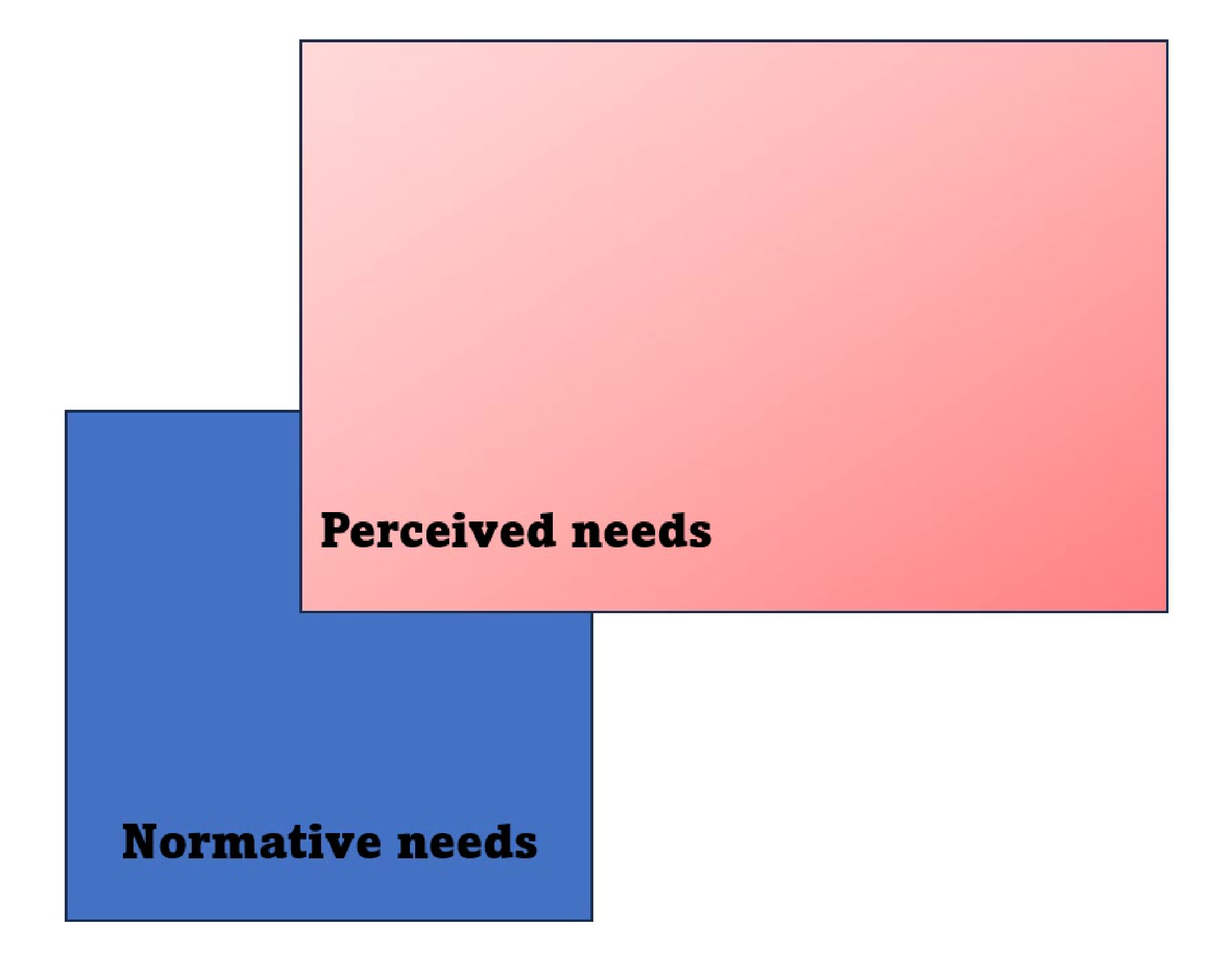
Relationship Between Different Types Of Health Needs6
Aubrey Sheiham, Georgois Tsakos. Oral Health Needs Assessment, Chapter 4, Community Oral Health, Quintessence books, pages:60-1
Normative Needs7
Aubrey Sheiham, Georbios Tsakos. Oral Health Needs Assessment, Chapter 4, Community Oral Health, Quintessence books, pages:60-1
Lecturer — Health Needs
Health needs refer to a person’s need for a health service.
- Normative needs are detected by a professional, even when a person has dental caries or periodontal disease without being aware of it.
- These conditions may progress without the person identifying them, and the person may not recognise the need until seeing a practitioner.
Perceived Needs8
- Normative needs
- Perceived needs
Aubrey Sheiham, Georgois Tsakos. Oral Health Needs Assessment, Chapter 4, Community Oral Health, Quintessence books, pages:60-1
Lecturer — Perceived Needs
Perceived needs occur when a person becomes subjectively aware that they have a health problem.
- Examples include recognising that they have periodontal disease, tooth decay, or bleeding gums.
- Perceived needs represent only the visible part of a larger group of health needs because many normative needs remain hidden.
- Not everyone with a perceived need will demand care; an expressed need occurs when a person communicates or seeks help for the perceived problem.
- Some people know they have dental problems but do not approach a dental professional for assistance.
- A person may perceive a problem without experiencing enough impact to seek care. As symptoms become more severe, the condition may develop into an impact-related need, such as spontaneous bleeding, gum pain, or worsening gum problems.
- Not every impact-related need leads to a demand for care. A propensity-related need occurs when a person has developed the health-seeking behaviour or motivation to seek care.
- Patients seen in clinical practice generally have felt the impact of their condition, become aware of its possible negative consequences, and developed the motivation to seek care.
- Needs are unmet when the health system does not provide a service equivalent to the need, whether the need is normative, perceived, expressed, impact-related, or propensity-related.
Interaction Between Client And Health Service
First Phase9
- Lay referrals and interventions
- Health care organization
- Geographic availability
- Ability to pay
- Self-care, self-help
Single Parent Considering Dental Care
A single parent may think about visiting a dentist but may prioritise the needs of their child or children.
- Even if the parent has a dental problem, other daily responsibilities may prevent them from developing the propensity to seek care.
- This illustrates how the perception of need and readiness to seek care can be influenced by social circumstances.
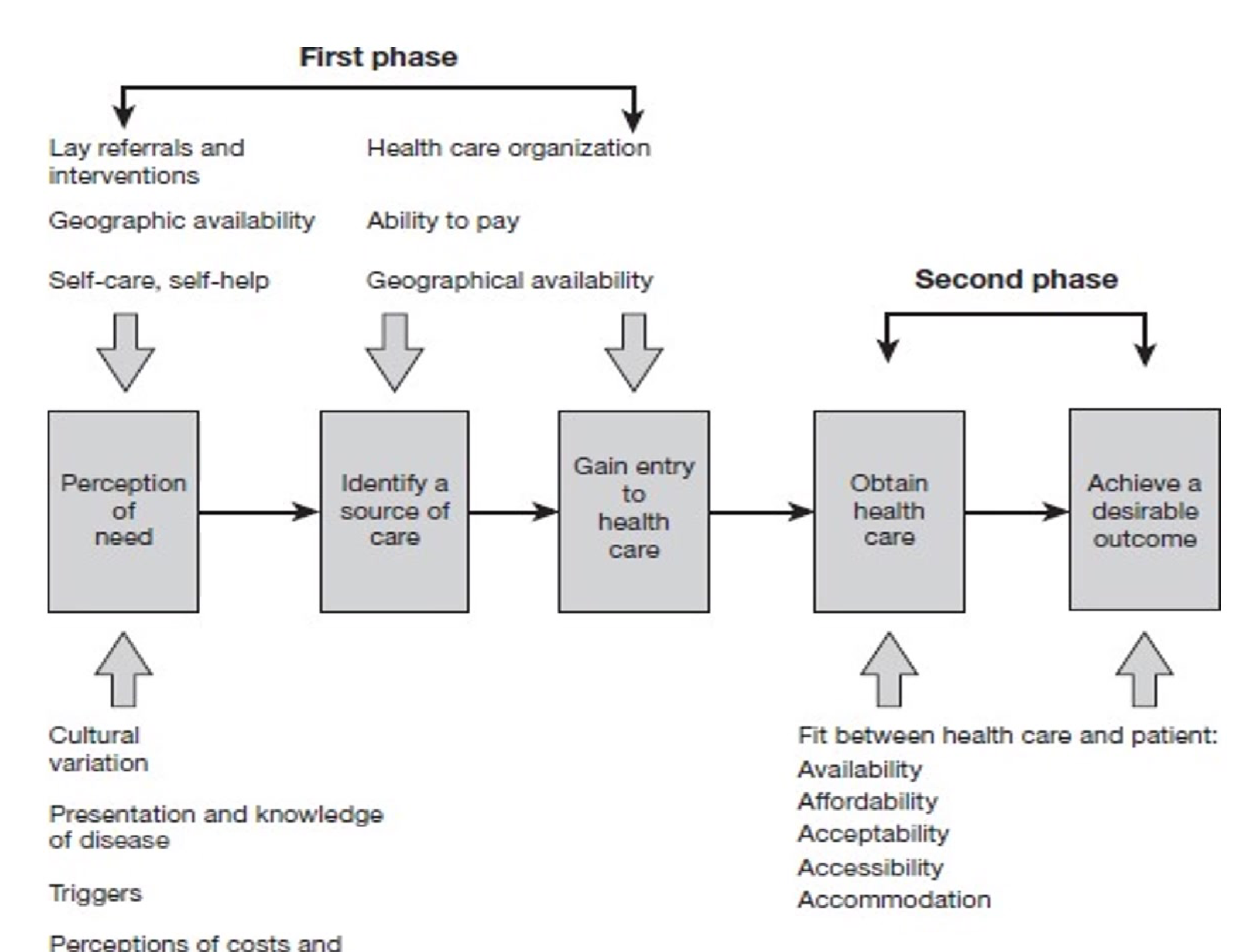
Pathway of Care
- Perception of need
- Identify a source of care
- Gain entry to health care
- Obtain health care
- Achieve a desirable outcome
Lecturer — Care-Seeking Pathway
A patient’s need for care alone is not sufficient to complete the pathway.
- The person must become ready to demand care and successfully move through the healthcare system.
- Influencing factors include social demographic, social psychological, social cultural, economic, geographical, predisposing, enabling, and need-related factors.
Second Phase
- Cultural variation
- Presentation and knowledge of disease
- Triggers
- Perceptions of costs and benefits
Bleeding Gums and Periodontal Therapy
A person may first notice that their gums are bleeding, but mild bleeding may not lead to a request for care.
- If the bleeding becomes spontaneous or is accompanied by pain, the person may recognise a greater impact.
- After developing the motivation to seek care, they may attend a dental service.
- The desired outcome would be receiving suitable periodontal therapy.
Fit Between Health Care and Patient
- Availability
- Affordability
- Acceptability
- Accessibility
- Accommodation
Lecturer — Patient Experience
A considerable amount may have occurred in a patient’s life before they arrive at a practice.
- Patients may cancel appointments or fail to attend because they find it difficult to prepare themselves mentally to obtain care.
- Practitioners should recognise this background and respond empathetically rather than assuming that the appointment is the first significant step in the care process.
Adapted from: Daly, Blánaid, and others, ‘Problems with health care delivery’, Essential Dental Public Health (Oxford, 2013; online edn, Oxford Academic, 12 Nov. 2020), https://doi.org/10.1093/oso/9780199679379.003.0030, accessed 3 Aug. 2024.
Models Of Access To Health Care10
| Andersen and Newman 1972 | McKinlay 1972 | Penchansky and Thomas 1981 |
|---|---|---|
| Predisposing factors (Propensity to use) | Socio-demographic Socio-psychological Socio-cultural | |
| Enabling factors (Aids and barriers to use) | Economic factors Geographic factors Organization | Accessibility, availability, acceptability, accommodation, affordability = fit between services and client |
| Factors related to need |
Gibson, B. et al. 2001.
Adapted from: Daly, Blánaid, and others, ‘Problems with health care delivery’, Essential Dental Public Health (Oxford, 2013; online edn, Oxford Academic, 12 Nov. 2020), https://doi.org/10.1093/oso/9780199679379.003.0030, accessed 3 Aug. 2024.
Five Dimensions Of Access11
- Availability of services
- Accessibility of services
- Affordability of services
- Acceptability of services
- Accommodation of services
Penchansky and Thomas 1981.
Lecturer — Access Dimensions
Models simplify the complexity of how people access health services. The access factors are shaped by social, psychological, cultural, economic and geographical circumstances, and the five dimensions interact rather than operating as completely separate categories.
Adapted from: Daly, Blánaid, and others, ‘Problems with health care delivery’, Essential Dental Public Health (Oxford, 2013; online edn, Oxford Academic, 12 Nov. 2020), https://doi.org/10.1093/oso/9780199679379.003.0030, accessed 3 Aug. 2024.
Remote Access to Orthodontic Services
A person living remotely may require orthodontic care, but even when the service exists elsewhere, they may need to travel thousands of kilometres to obtain it. This demonstrates how the distribution of services can limit availability.
Understanding Aspects Of Health Service Use12
| Aspect of Health Service | Context | Challenge/s |
|---|---|---|
| Availability | How well distributed health services are? Example: dentist to population ratio. | People living in deprived communities with greater health need have fewer doctors and dentists compared to richer areas with fewer health care needs – Inverse care law (Tudor Hart 1971). Lack of specialised dental services. |
| Accessibility | Two dimensions: 1. Location – how far do I need to travel to avail service? 2. Spatial dimension – Can I physically access the premises? | People living in remote and rural areas often must travel far to access basic health care service. Individuals with disability do not have access to many disability friendly practices. |
| Affordability | Direct and indirect costs of dental care. Financial model of health system. | Direct costs of dental care – poorly funded health system → predominantly out of pocket care would lead to increased disease burden. Indirect costs like time of work, travel costs, cost of childcare whist at dentist. |
| Acceptability | Expectations on how a health service should look like. | Lack of a culturally trained workforce. |
| Accommodation | Flexibility of health care service to suit patient needs. | Long waitlist for dental care especially specialist dental services. |
Lecturer — Dental Care Costs
In Australia, most dental care has been kept outside Medicare. People may therefore need private insurance or personal funds to pay for care, and the cost can cause them to avoid or delay treatment, increasing the burden of disease.
Lecturer — Cultural Acceptability
Globalisation has contributed to a less homogeneous society, so cultural differences influence what patients expect from health services. Professionals may prefer patients who pay well, cooperate with treatment and are less demanding, but the responsibility lies with professionals to understand patient needs and provide care with empathy and appropriateness.
Oral Health Centre of Western Australia
Eligible patients seeking specialised services at the Oral Health Centre of Western Australia may have difficulty accessing care without entering a waiting list. Efforts are being made to reduce these waiting lists, but they remain an issue in public dental services; the example also illustrates how accommodation is connected to availability, accessibility, affordability and acceptability.
Lecturer — Patient Interaction
Patient-related barriers largely arise during the first phase of interaction with the health service.
- The person recognises a need, develops a perception that care is required, experiences the condition’s impact, and develops a propensity to seek care.
- The person then identifies a source of care and decides whether they can reach and use the service.
- Relevant influences include social demographic, social psychological, social cultural, economic, and geographical circumstances.
- Family responsibilities, competing problems in daily life, and whether the person has developed health-seeking behaviour also influence access.
Lecturer — Dentist Interaction
Dentist-related barriers concern how professionals influence the patient’s interaction with the service.
- Relevant factors include how the practice is structured and how practitioners communicate with patients.
- Professionals should respond to patient needs empathetically and deliver culturally appropriate care.
- Practitioners need to recognise that patients may have different expectations, while practices should be flexible and accommodating.
Lecturer — System Factors
System-related barriers reflect wider, macro-level problems in the organisation and financing of care.
- Healthcare systems may have a biomedical focus, emphasise treatment rather than prevention and health promotion, or have unclear goals.
- Resources may be distributed towards hospitals and specialised services, leaving limited resources for preventive and health-promotive services.
- Policymakers and non-dental professionals influence these arrangements, which can contribute to unequal distribution of doctors, dentists, and specialised services.
- Other barriers include the financial structure of dental care, long waiting lists in public dental services, and limited disability-friendly or culturally appropriate services.
Barriers To Dental Health Service Use
Patient Related Factors13
- Perceived need
- Fatalistic attitude
- Lack of awareness
- Anxiety/fear
- Past dental experiences
- Disability – mental and/or physical
- Time availability – getting time off work
Dentist Related Factors
- Professional attitude
- Perceived competence of dentist by patients
- Availability of dentists with specialist skills
System Related Factors
- Cost
- Availability of NHS services
- Physical barriers – e.g., surgery accessible only via steps/stairs
- Rural and remote area issues
- Availability of transport
Chestnutt, Ivor G., Dental Public Health at a Glance, John Wiley & Sons, Incorporated, 2016. ProQuest Ebook Central, https://ebookcentral.proquest.com/lib/uwa/detail.action?docID=7103897.
Quick Revision14
- Characteristics of an ideal health system
- Macro and microlevel problems in health care systems
- Interaction between a patient/client and health service
- Factors influencing Phase II of health service use:
- Availability
- Accessibility
- Affordability
- Acceptability
- Accommodation
- Barriers to oral health service use
Lecturer — Lecture Coverage
The lecturer specified the characteristics of an ideal healthcare system as equity, accessibility, relevance, quality, affordability, sustainability, and acceptability.
- Healthcare delivery problems occur at both the macro or organisational level and the micro or practice level.
- Health needs include normative, perceived, expressed, impact-related, propensity-related, and unmet needs.
- Patient–health service interaction has two phases: becoming ready to seek care, then obtaining care and achieving a desirable health outcome.
- Barriers can be grouped into patient-related, dentist-related, and system-related factors.
- The next recording will examine challenges in the Australian oral health system using a recent Senate inquiry as the guiding document.
Revise!
Image sources: https://giphy.com/explore/revision

Footnotes
-
Original PDF page 1: L3 Problems of oral health care delivery system slides, p.1 ↩
-
Original PDF page 2: L3 Problems of oral health care delivery system slides, p.2 ↩
-
Original PDF page 3: L3 Problems of oral health care delivery system slides, p.3 ↩
-
Original PDF page 4: L3 Problems of oral health care delivery system slides, p.4 ↩
-
Original PDF page 5: L3 Problems of oral health care delivery system slides, p.5 ↩
-
Original PDF page 6: L3 Problems of oral health care delivery system slides, p.6 ↩
-
Original PDF page 7: L3 Problems of oral health care delivery system slides, p.7 ↩
-
Original PDF page 8: L3 Problems of oral health care delivery system slides, p.8 ↩
-
Original PDF page 9: L3 Problems of oral health care delivery system slides, p.9 ↩
-
Original PDF page 10: L3 Problems of oral health care delivery system slides, p.10 ↩
-
Original PDF page 11: L3 Problems of oral health care delivery system slides, p.11 ↩
-
Original PDF page 12: L3 Problems of oral health care delivery system slides, p.12 ↩
-
Original PDF page 13: L3 Problems of oral health care delivery system slides, p.13 ↩
-
Original PDF page 14: L3 Problems of oral health care delivery system slides, p.14 ↩