Tackling Oral Health Inequities at the Population Level1
Lecturer — Downstream Inequities
Most clinical dental activity occurs downstream, after oral disease has developed.
- It benefits people who are able to attend dental services, while people with substantial needs who do not attend remain unserved.
- Action is delayed until disease has developed, and access to the benefits of care is not equally distributed.
- Relying primarily on downstream services may therefore worsen inequalities.
Lecturer — Upstream Equity
The further upstream action occurs, the more equitable it can be because policies and conditions apply to everyone in the relevant community or population.
Lecturer — Combining Approaches
The solution to dental problems is not simply to increase the number of dentists.
- An exclusive focus on the biomedical model can result in funding specialised hospitals and disease-focused services, which primarily addresses downstream problems.
- The best approach to tackling inequity combines upstream action through healthy public policy and health promotion with downstream action through accessible dental services.
- Combining both approaches addresses current needs while reducing future disease.
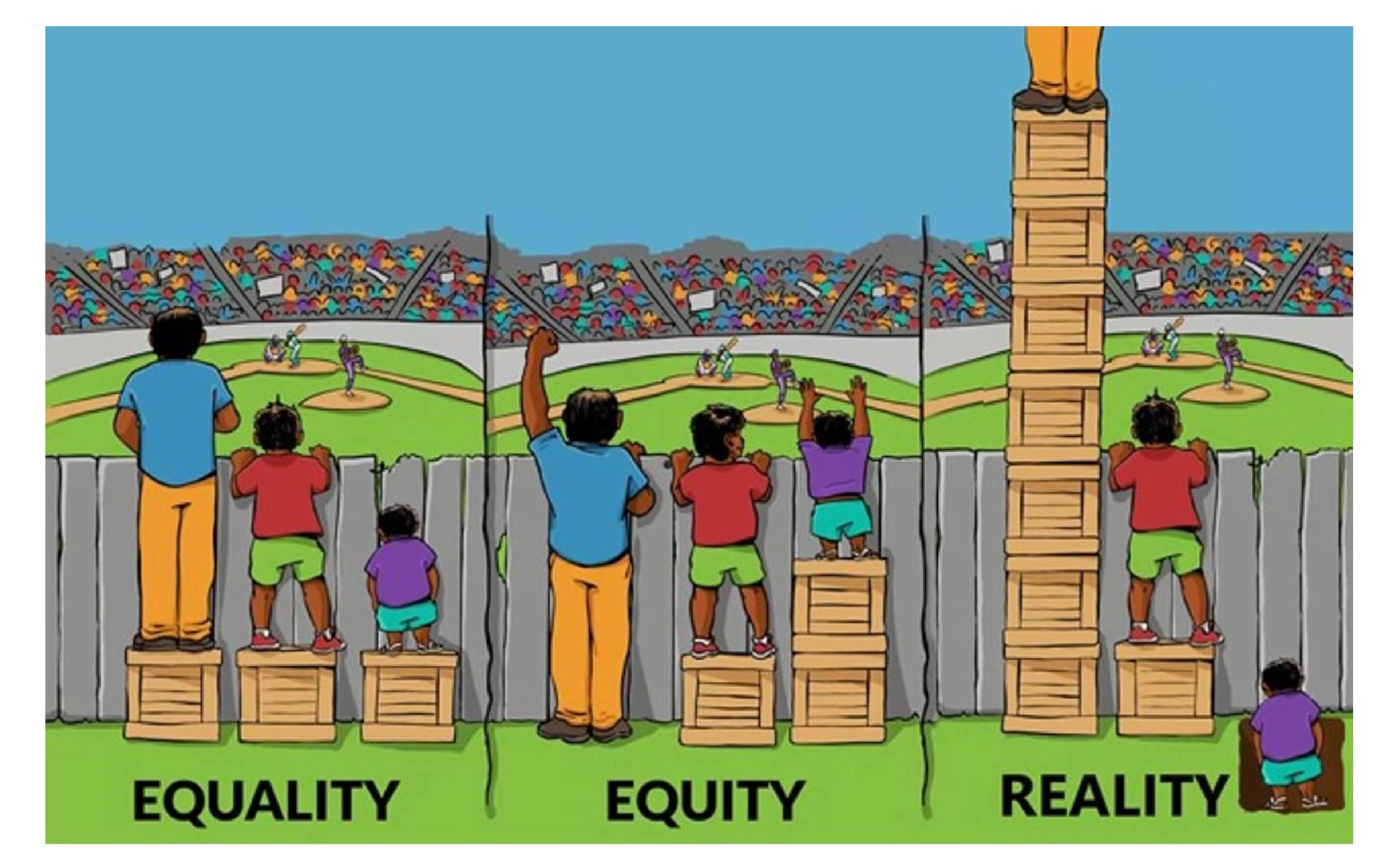
- Equality
- Equity
- Reality
Image source: https://belonging.berkeley.edu/equity-vs-equality-whats-difference
Upstream and Downstream Approaches
The Upstream-Downstream Concept
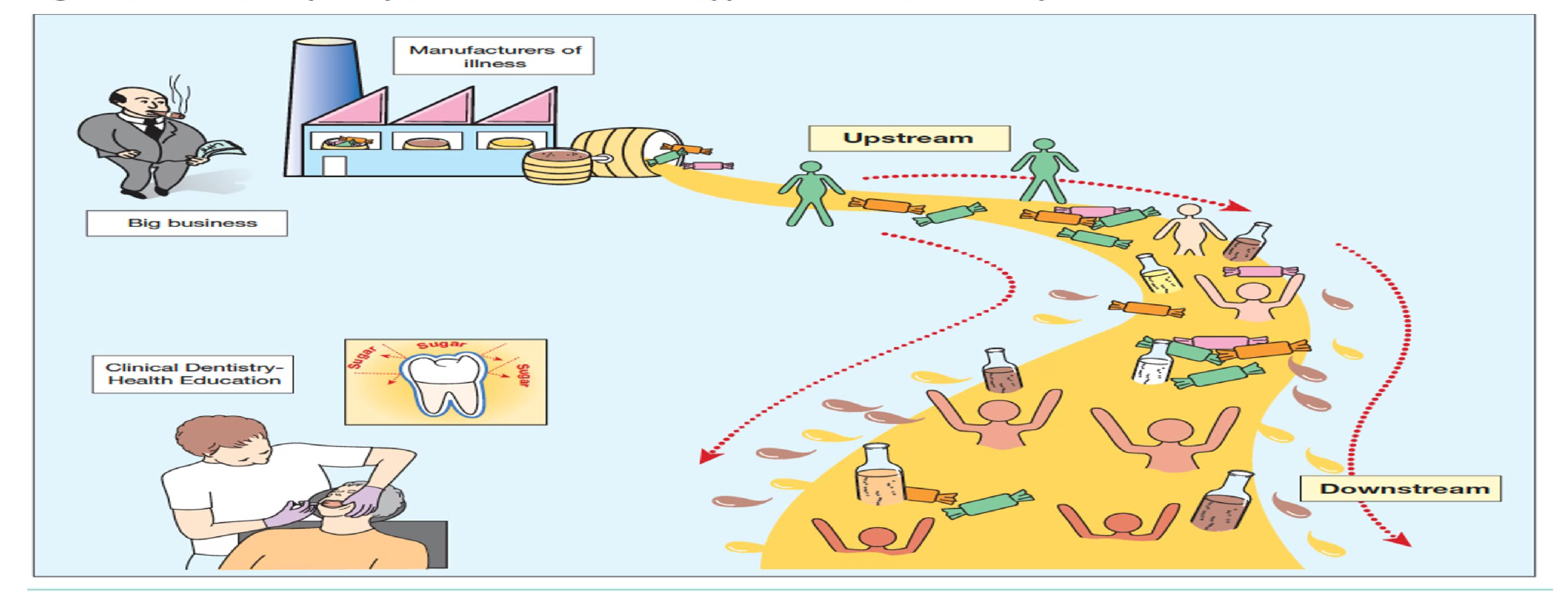
Understanding approaches to tackle oral health inequities at the population level involves the “upstream” and “downstream” framework (McKinlay 1979).
The Upstream–Downstream Continuum2
- Upstream: Focuses on “big business” and the manufacturers of illness.
- Downstream: Focuses on clinical dentistry and health education.
Source: Ivor G Chestnutt, Dental Public Health at a Glance, John Wiley & Sons, Inc., 2016.
Upstream Action Through Healthy Public Policy
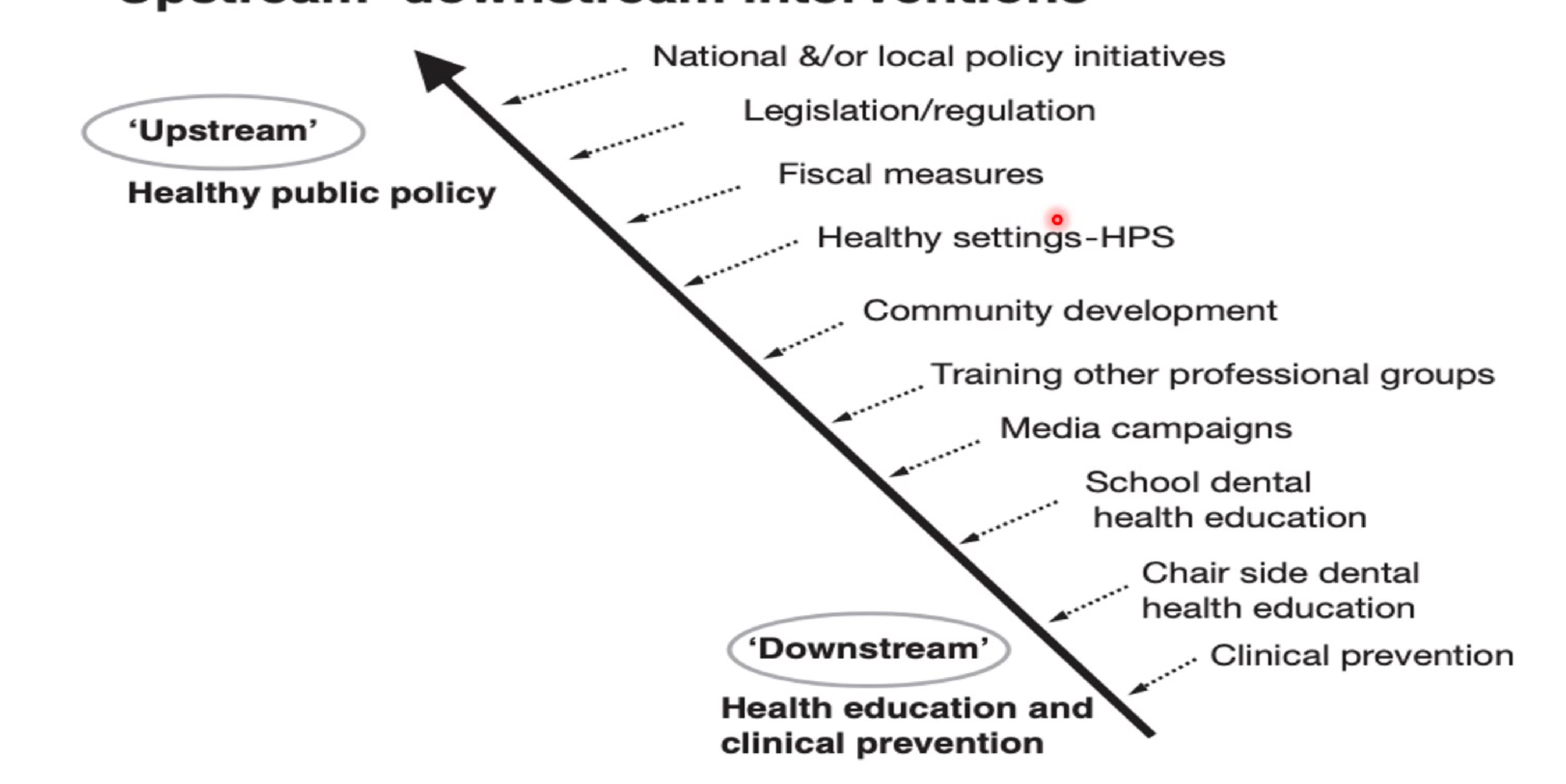
Continuum of Action: From Upstream to Downstream3
- Upstream (Healthy public policy):
- National and/or local policy initiatives
- Legislation/regulation
- Fiscal measures
- Healthy settings (HPS)
- Community development
- Training other professional groups
- Media campaigns
- School dental health education
- Chairside dental health education
- Clinical prevention
- Downstream (Health education and clinical prevention)
Figure 8.4: Upstream action.
Watt, R.G. (2007). From victim blaming to upstream action: tackling the social determinants of oral health inequalities, Community Dentistry and Oral Epidemiology, 35, 1–11.
Ottawa Charter for Oral Health Promotion
The Ottawa Charter Framework
Lecturer — Ottawa Charter Origins
The Ottawa Charter was introduced and adopted at the First International Conference on Health Promotion in Ottawa in 1986. It provides a framework for planning health promotion programs.
- The framework supports systematic, uniform and efficient implementation.
- It directs strategies towards the major areas required to improve population health and can also be applied to oral health promotion.
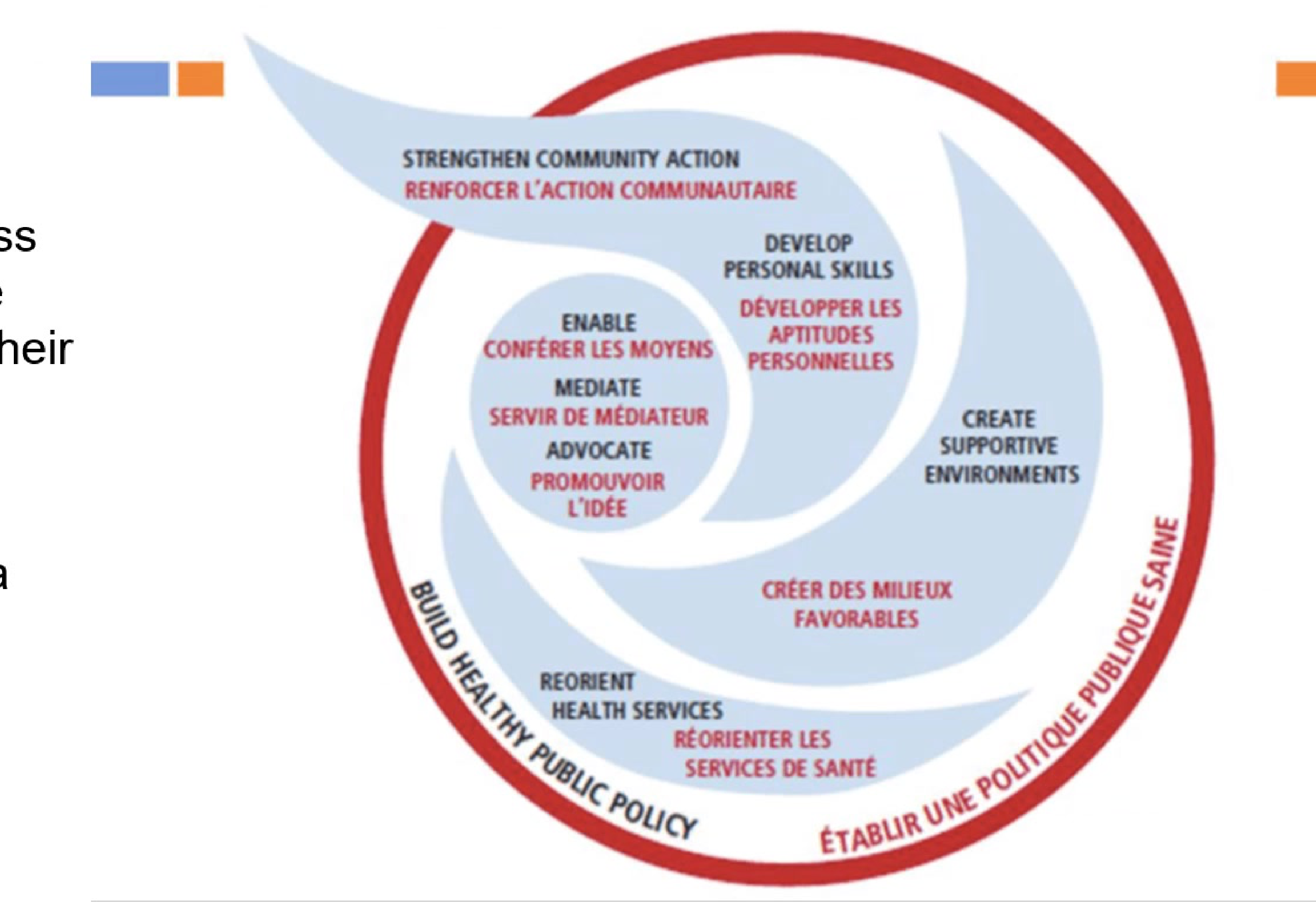
Core Principles and Action Areas of the Ottawa Charter4
The Ottawa Charter Emblem:
- Advocate (Promouvoir l’idée)
- Enable (Conférer les moyens)
- Mediate (Servir de médiateur)
Five Key Action Areas:
- Build Healthy Public Policy (Établir une politique publique saine)
- Create Supportive Environments (Créer des milieux favorables)
- Strengthen Community Action (Renforcer l’action communautaire)
- Develop Personal Skills (Développer les aptitudes personnelles)
- Reorient Health Services (Réorienter les services de santé)
Lecturer — Community Action
Improving oral health requires community engagement rather than implementing policies without approval, consultation or involvement.
- Programs may involve Aboriginal communities, migrant or refugee community leaders, and steering committees led by community representatives.
- Recognising that cultures and communities work differently helps ensure programs are appropriate, accepted and effective.
Lecturer — Personal Skills
Developing personal skills includes providing people with knowledge and skills that support healthy behaviour.
- Examples include teaching toothbrushing, flossing and the use of interdental aids.
- Aged-care workers may be taught how to clean residents’ dentures, and people may need education about oral hygiene practices with which they are unfamiliar.
Lecturer — Supportive Environments
A residential aged-care setting should function as an oral-health-promoting environment.
- This may include pamphlets, oral health resources and support for oral hygiene.
- Such measures can help reduce preventable hospitalisations among frail and elderly residents susceptible to dental conditions.
Lecturer — Reorienting Services
Reorienting health services means moving away from primarily disease-centred care towards more promotive practices.
- This may involve community oral health services, maximising efficiency with limited resources, and using artificial intelligence and computers.
- Services can also train a broader workforce in social medicine concepts while using teledentistry to reach remote areas.
Lecturer — Public Policy
Healthy public policy holds the other action areas together. Community action, personal skills, supportive environments and reoriented services will not function effectively without strong public policy.
- Policy must evolve as communities and populations change; a policy developed in the 1990s may not remain viable in the 2000s.
Definition and Scope of Health Promotion
- Health promotion is the process of enabling people to increase control over, and to improve, their health.
- It moves beyond a focus on individual behaviour towards a wide range of social and environmental interventions (WHO).
The emblem symbolizes the enhancement and empowerment of individuals through health promotion, enabling them to pursue health as a resource for life and well-being. It underscores the vital shift from solely targeting individual lifestyle factors to addressing broader social and environmental determinants.
Lecturer — Health Promotion Scope
Health promotion is broader than health education. Educating a person without changing the surrounding environment may not improve oral health outcomes, because people need conditions that allow them to adopt and maintain healthy behaviours.
David Locker, Evelyn Wexler, Lone Schou. Principles of oral health promotion, Chapter 11, Community Oral Health, Quintessence books, pages:303-4.
Common Risk Factor Approach
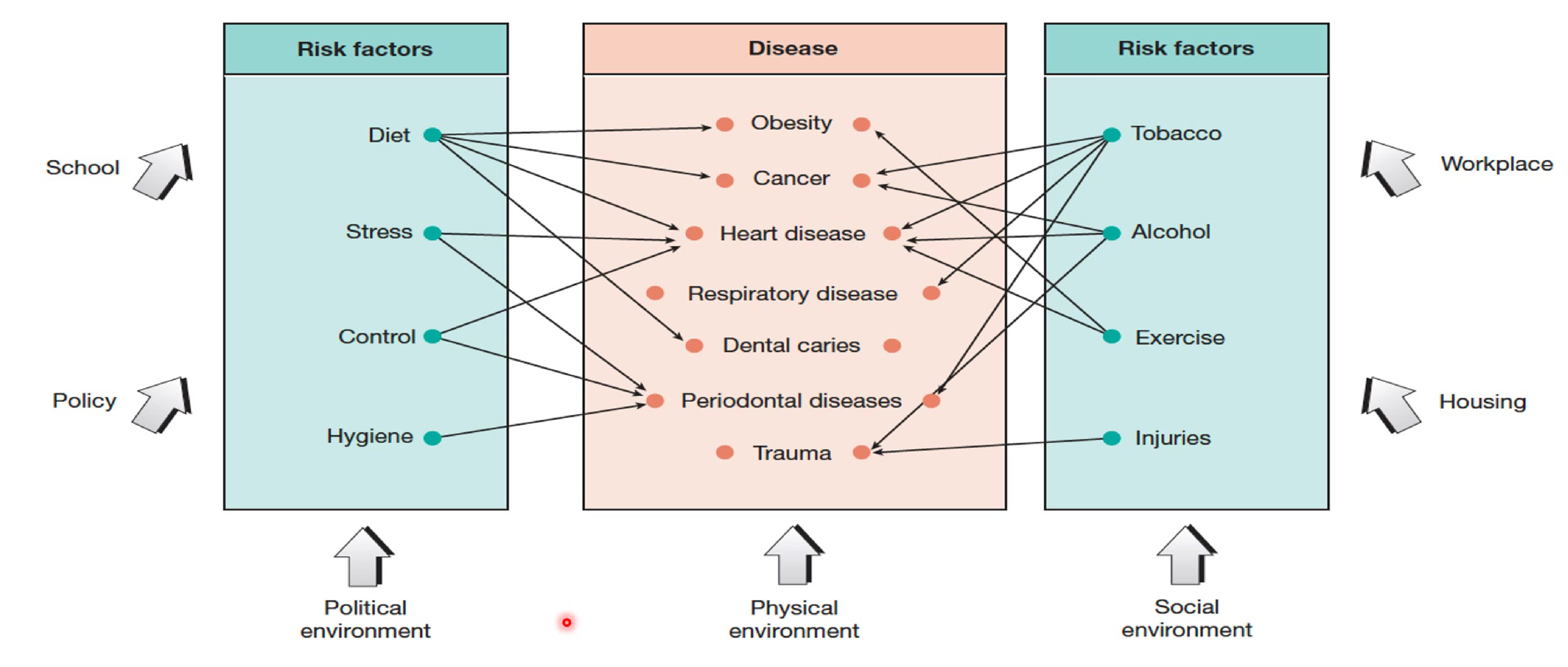
Framework Overview5
Figure 21.1: Common-risk factor approach
graph LR
    subgraph Risk_Factors_Left [Risk factors]
        Diet
        Stress
        Control
        Hygiene
    end

    subgraph Disease [Disease]
        Obesity
        Cancer
        Heart_disease[Heart disease]
        Respiratory_disease[Respiratory disease]
        Dental_caries[Dental caries]
        Periodontal_diseases[Periodontal diseases]
        Trauma
    end

    subgraph Risk_Factors_Right [Risk factors]
        Tobacco
        Alcohol
        Exercise
        Injuries
    end

    Diet --> Obesity
    Diet --> Cancer
    Diet --> Heart_disease
    Diet --> Dental_caries

    Stress --> Heart_disease
    Stress --> Periodontal_diseases

    Control --> Heart_disease
    Control --> Periodontal_diseases

    Hygiene --> Periodontal_diseases

    Tobacco --> Cancer
    Tobacco --> Heart_disease
    Tobacco --> Respiratory_disease
    Tobacco --> Periodontal_diseases

    Alcohol --> Cancer
    Alcohol --> Heart_disease
    Alcohol --> Trauma

    Exercise --> Heart_disease
    Exercise --> Obesity

    Injuries --> Trauma
Environmental Influences and Context:
- Social & Structural: School, Policy, Workplace, Housing
- Broad Environments: Political environment, Physical environment, Social environment
Watt 2005. Reproduced with permission from World Health Organisation. Originally adapted from Sheiham and Watt 2000 with permission from John Wiley & Sons.
Ivor G Chestnutt, Dental Public Health at a Glance, John Wiley & Sons, Inc., 2016.
Processed Food and Health
People with dental caries who consume large amounts of processed food may also experience obesity. Processed food may be cheaper, making it more common among people who are poor; this demonstrates a link between poor oral health and general health.
Applying Ottawa Charter Principles to Reduce Oral Health Inequities6
| Principles of Ottawa Charter | Actions to Reduce Oral Health Inequities |
|---|---|
| Building healthy public policy | - National and local food policies - Water fluoridation, smoking, paan, and alcohol policies |
| Creating supportive environments | - Supporting healthy supermarket practice and promoting sponsorship ethics - Providing access to more fluoridated toothpastes - Oral health promoting schools |
| Developing personal skills | - Oral health education (workplace- or school-based) |
| Strengthening community action | - Community development, engagement, and representation |
| Reorienting health services | - Accessible primary dental care services in remote settings and priority populations - Training the broader workforce - Utilizing teledentistry - Encouraging sugar-free prescriptions - Improving research data |
Lecturer — Public Policy Measures
Additional policy measures include using taxation to make cigarettes more expensive and difficult to purchase, introducing sugar taxes as macroeconomic policies, and increasing the cost of sugar-related products. The Australian Medical Association has recommended applying such policies to soft drinks.
Lecturer — Supportive Environments
Supportive environments can reduce the placement of chocolates and other products near checkout counters, where they may tempt customers to purchase them.
Lecturer — Upstream Health Promotion
Health promotion is an upstream approach. The more action occurs upstream, the greater the opportunity to tackle inequalities.
Watt, R., Sheiham, A. (1999). Inequalities in oral health: a review of the evidence and recommendations for action, British Dental Journal, 187, 6–12.
Australia’s National Oral Health Plan (2015-24)
National Goals and Guiding Principles
National Goals7
- Improve oral health status by reducing the incidence, prevalence and effects of oral disease
- Reduce inequalities in oral health status across the Australian population
Lecturer — Population-Level Approaches
The national plan demonstrates how inequity can be addressed through population-level oral health programs.
- Whole population approaches work across the entire population.
- Targeted population approaches focus on specific populations.
- High-risk approaches focus on people at high risk.
- Proportionate universalism allocates resources according to the proportion of disease burden.
Guiding Principles
- Population health approach
- Proportionate universalism
- Appropriate and accessible services
- Integrated oral and general health
Lecturer — Proportionate Universalism
Proportionate universalism is an evidence-based way to use limited resources according to need.
- More resources should be directed towards populations with greater need.
- Funding should be allocated in proportion to the burden of disease.
- The burden of oral disease is disproportionate, particularly among priority populations.
Government of Australia. Healthy Mouths Healthy Lives – AUSTRALIA’S NATIONAL ORAL HEALTH PLAN 2015 – 2024. Adelaide; 2016.
Universal Approach and Foundation Areas
Foundation Areas8
- Oral health promotion: All Australians have access to oral health promoting environments and appropriate evidence-based information and programs that support them to make informed decisions about their oral health.
- Accessible oral health services: All Australians have access to appropriate oral health care in a clinically acceptable timeframe.
- System alignment and integration: Social, health and education systems work together to support healthy mouths and healthy lives.
- Safety and quality: Oral health services are provided in accordance with the Australian Safety and Quality Goals for Health Care.
- Workforce development: The workforce for oral health is of an appropriate composition and size and is appropriately trained and distributed.
- Research and evaluation: Appropriate and timely data is available at both the population and service level for planning, monitoring and evaluation.
Lecturer — Current Oral Health Data
Existing oral health data are old, so further research is needed to understand current oral disease problems.
- A Senate committee suggested conducting further research, and the government agreed.
- Another national oral health survey would help identify current oral disease problems.
- Understanding the problems is necessary before they can be addressed.
Government of Australia. Healthy Mouths Healthy Lives - AUSTRALIA’S NATIONAL ORAL HEALTH PLAN 2015 - 2024. Adelaide; 2016.
Equitable Approach9
Lecturer — Equitable Resource Allocation
An equitable national approach requires resources to be proportionate to the burden of disease. Priority populations should receive more funding because they experience a greater burden of oral disease.
- The approach combines universal population-level action, targeted action for particular populations and high-risk interventions.
- It also combines proportionate resource allocation, upstream health promotion, downstream access to care, workforce development, and research evidence.
Government of Australia. Healthy Mouths Healthy Lives - Australia’s National Oral Health Plan 2015-2024. Adelaide; 2016.
Summary and Revision10
Key Concepts for Revision11
- Upstream and downstream approach
- Health promotion and Ottawa charter
- Common risk factor approach whilst developing population activities
- National oral health plan in Australia
Lecturer — Equity and Inequality
Equity, rather than equality, is the goal of population-level action.
- Downstream services alone cannot address oral health inequalities because they primarily benefit people who can access dental care.
- Upstream action occurs before disease develops and can benefit everyone in a population.
- The most effective and sustainable programs combine upstream and downstream approaches.
Audio Appendix
Additional Audio Content
The following sections from the lecture audio did not correspond to any heading in the main document.
Case Study: Bunbury Water Fluoridation
The recent fluoridation of Bunbury’s public water supply was described as an example of an upstream and equitable approach.
- People from different socioeconomic backgrounds and ethnicities who drink water from the regular public supply can receive the benefits of fluoride.
- The approach does not depend on whether an individual can attend a dentist.
- It therefore provides a population-level way to reduce dental caries and dental problems.
 |  |
 |
Footnotes
-
Original PDF page 1: L4.1 Tackling Oral health inequalities at the population Level slides, p.1 ↩
-
Original PDF page 2: L4.1 Tackling Oral health inequalities at the population Level slides, p.2 ↩
-
Original PDF page 3: L4.1 Tackling Oral health inequalities at the population Level slides, p.3 ↩
-
Original PDF page 4: L4.1 Tackling Oral health inequalities at the population Level slides, p.4 ↩
-
Original PDF page 5: L4.1 Tackling Oral health inequalities at the population Level slides, p.5 ↩
-
Original PDF page 6: L4.1 Tackling Oral health inequalities at the population Level slides, p.6 ↩
-
Original PDF page 7: L4.1 Tackling Oral health inequalities at the population Level slides, p.7 ↩
-
Original PDF page 8: L4.1 Tackling Oral health inequalities at the population Level slides, p.8 ↩
-
Original PDF page 9: L4.1 Tackling Oral health inequalities at the population Level slides, p.9 ↩
-
Original PDF page 11: L4.1 Tackling Oral health inequalities at the population Level slides, p.11 ↩
-
Original PDF page 10: L4.1 Tackling Oral health inequalities at the population Level slides, p.10 ↩