| Procedure/Topic | Biological Considerations | Mechanical Considerations | Aesthetic Considerations |
|---|---|---|---|
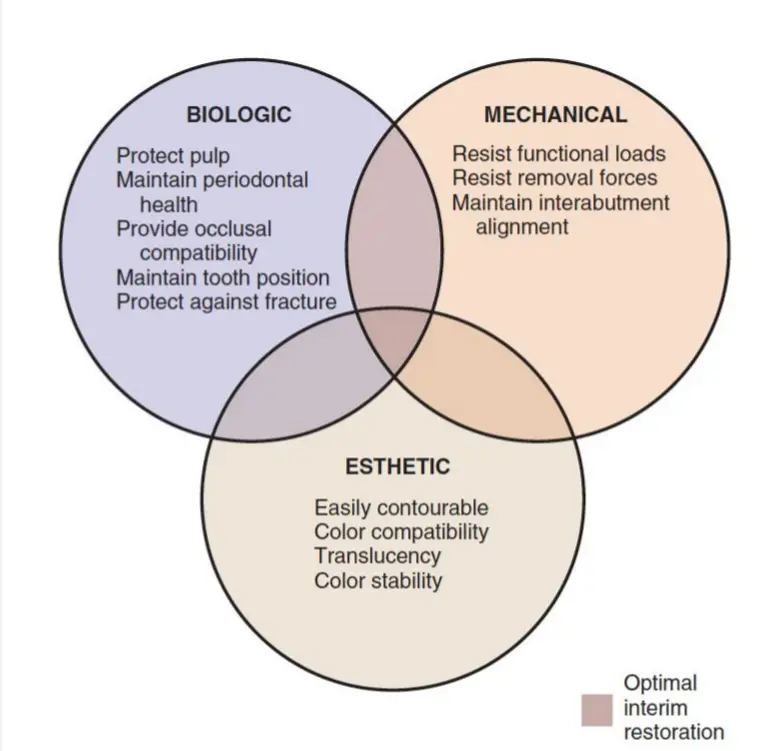
| Temporization | Pulpal protection; periodontal health; positional stability; biocompatibility | Strength & durability; retention; occlusal function; wear resistance | Appearance (shade, shape, contour); patient comfort (smoothness); phonetics |
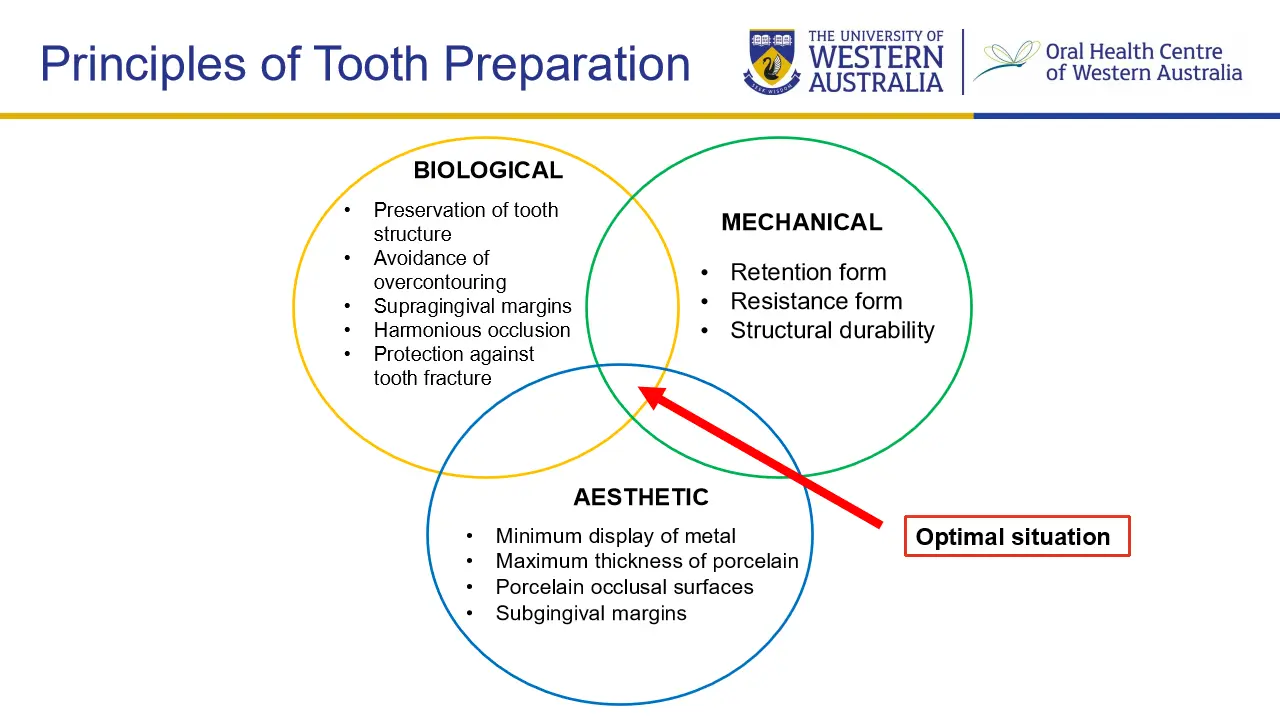
| Tooth Preparation | Conservation of tooth structure; avoidance of overcontouring; supragingival margins; harmonious occlusion; protection against fracture | Retention form; resistance form; structural durability | Minimum display of metal; maximum thickness of porcelain; porcelain occlusal surfaces; subgingival margins |
| PFM Preparation | Preservation of tooth structure; avoidance of overcontouring; supragingival margins; harmonious occlusion; protection against tooth fracture | Retention form; resistance form; structural durability | Minimum display of metal; maximum thickness of porcelain; porcelain occlusal surfaces; subgingival margins |
| Inlay/Onlay Preparation | Immediate dentin sealing; deep margin elevation | No sharp internal line angles; accessible margins; adequate interocclusal space; no undercuts; smooth surfaces | Aesthetic placement of margins (incisal/cervical thirds) |
| Crown Try-in | - | Proximal & occlusal contacts; internal fit; marginal fit; stability | Contour; occlusion; aesthetics |
Reformatated to be easier:
🦷 Comparison of Objectives: Preparation vs. Temporization
This table aligns the goals of the definitive restoration (achieved by preparation) with the goals of the interim restoration (achieved by temporization).
Biological Objectives
| Objective Focus | Tooth Preparation (Goal for Definitive Restoration) | Temporization (Goal for Interim Period) |
|---|---|---|
| Pulp Protection & Sealing | Conservation of tooth structure (minimum reduction) to protect the pulp. Provides a definitive, long-term seal to prevent microleakage and secondary caries. | Protect pulp vitality by sealing and insulating the prepared dentin tubules from thermal, chemical, and bacterial irritants. |
| Periodontal Health & Contour | Maintain periodontal health by favoring supragingival margins and avoiding violation of the biological width. Avoid overcontouring by providing adequate space (reduction) so the final crown does not create plaque traps. | Maintain periodontal health by ensuring provisional margins are sealed, smooth, and well-contoured to be cleansable and prevent soft tissue injury. |
| Tooth Fracture Prevention | Protection against tooth fracture through preparation design, such as covering weakened cusps (cuspal coverage). | Protect against fracture by covering unsupported tooth structure. (Can also be used diagnostically to splint a cracked tooth). |
Mechanical Objectives
| Objective Focus | Tooth Preparation (Goal for Definitive Restoration) | Temporization (Goal for Interim Period) |
|---|---|---|
| Resisting Chewing Forces (Resistance) | Resistance Form: Features (e.g., preparation height, small taper) that resist dislodgement by apical or oblique forces. Resistance to Deformation: Ensuring sufficient space (depth) for the material to prevent it from flexing or fracturing. | Resist functional loads (chewing stresses) during the interim period without breaking or dislodging. |
| Resisting Pulling Forces (Retention) | Retention Form: Features (e.g., parallel axial walls) that resist displacement of the restoration along the path of insertion. | Resist removal forces applied by sticky foods, relying on the preparation’s retention and the temporary cement. |
| Maintaining Tooth Position | (Not a primary prep goal, but the prep creates the need for this) | Maintain tooth position by establishing proper inter-arch (opposing) and intra-arch (adjacent) contacts to prevent supra-eruption or drifting. |
Aesthetic & Functional Objectives
| Objective Focus | Tooth Preparation (Goal for Definitive Restoration) | Temporization (Goal for Interim Period) |
|---|---|---|
| Natural Shape & Contour | Adequate facial reduction (e.g., two-plane reduction) to follow the natural tooth contour and provide space for aesthetic materials, avoiding a bulky look. | Provides aesthetic acceptability by establishing the correct shape and morphology for the interim period. |
| Material Appearance & Shade | Allows for minimum display of metal and maximum thickness of porcelain for natural aesthetics. Provides the option for subgingival margins in the aesthetic zone to hide the restoration transition. | Provides aesthetic acceptability by having an appropriate shade matching and translucency, especially for anterior teeth. |
| Diagnostic “Try-In” | (Enables the final form) | Allows the patient to “try-in” proposed changes (e.g., new shape or length) before the definitive restoration is fabricated. |
| Phonetics (Speech) | (Enables the final form) | Maintain phonetics by ensuring the shape of the provisional (especially palatal contours) does not affect the patient’s speech. |
I hope this re-formatted table is much easier for you to memorize and review.
Would you like me to convert these paired concepts into Anki-style cloze deletion flashcards for you?