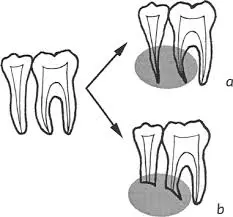
Spiking root resorption is a classic radiographic finding in gnathic (jaw) osteosarcomas, though not universally present. It refers to a tapered, “spiked” narrowing of the root apex, rather than the more uniform, blunted resorption seen with benign lesions.
Radiographic Appearance
- Spiking root resorption appears as pointed, narrow apices of affected tooth roots on radiographs. The normal broad root gradually narrows to a spike or pencil-point at the tip, sometimes described as “tapered” or “spiked.”
- This contrasts with the smooth, even shortening typical in benign tumors or cysts. In osteosarcoma, resorption is irregular and more aggressive in appearance.12345
- Other common findings with spiking root resorption include widening of the periodontal ligament (PDL) space (“Garrington’s sign”), loss of lamina dura, a mix of radiopaque and radiolucent bone patterns, and sometimes a “sunburst” periosteal reaction adjacent to the lesion.246
- Annotated radiograph examples commonly label: narrowed, tapered root apices (“spiking”), PDL space widening, and ill-defined lesion borders.
Example Description
One source notes: “When root resorption is associated with malignant disease, the resorption often occurs in smaller quantities, causing thinning of the root into a ‘spiked’ shape… Note the ‘spiking’ resorption of the mesial root of the first molar”.2
Another describes: “Root resorption often leads to tapered narrowing of the root and is described as ‘spiking’ resorption. Tumor infiltration along the periodontal ligament space leads to a symmetric widening of the space around affected teeth…”.5
Clinical Utility
Spiking root resorption, especially when seen alongside other signs of malignancy (PDL widening, irregular lesion margin, sunburst periosteal reaction), helps radiologists and oral pathologists distinguish osteosarcoma from benign jaw lesions.4615
In summary, radiographically, spiking root resorption in osteosarcoma presents as sharply tapered, pointed root tips, often along with other aggressive features that together strongly suggest malignancy of the jaw.361452 789101112
Footnotes
-
https://www.northstateperio.com/wp-content/uploads/Nifty-Shades-of-Grey-Handout.pdf ↩ ↩2 ↩3
-
http://oralpathol.dlearn.kmu.edu.tw/case/Journal reading-intern-19-02/20 class signs-OR-2019.pdf ↩ ↩2 ↩3 ↩4
-
https://www.sciencedirect.com/science/article/pii/S0929664621004009 ↩ ↩2
-
https://pmc.ncbi.nlm.nih.gov/articles/PMC10098420/ ↩ ↩2 ↩3 ↩4
-
https://www.ouhsc.edu/pathologyJTY/OUMC/OUMC-COM/Com04/Com408-1-Diss.htm ↩ ↩2 ↩3 ↩4
-
https://www.sciencedirect.com/science/article/pii/S2212440321003813 ↩ ↩2 ↩3
-
https://scienceforecastoa.com/Articles/JOMDH-V1-E1-1003.pdf ↩
-
https://pdfs.semanticscholar.org/5347/4f9bcd05368a8930d31f7f625faa64cd9b1d.pdf ↩
-
https://www.oatext.com/low-grade-central-osteosarcoma-of-the-mandible-clinically-mimicking-a-benign-fibro-osseous-lesion-a-rare-case-report.php ↩