The 5x5x5 All-Ceramic Crown Preparation Technique
Presented by: Dr. Richard Stephenson, Director of Education at Stevenson Dental Solutions
 and Emeritus Professor of Clinical Dentistry at UCLA.
Introduction
The 5x5x5 technique is a streamlined approach designed to produce high-quality all-ceramic crown preparations for both anterior and posterior teeth. By utilizing five specific burs and five logical steps
 , clinicians can achieve a predictable, high-standard preparation in approximately five minutes.
Preparation Requirements and Material Guidelines
Before beginning the preparation, it is essential to understand the geometric and material-specific requirements for a successful restoration.
Geometric Goals
- Occlusal Planes: The occlusal surface must be reduced following three distinct planes (A, B, and C)
 .
.
- Taper: Aim for a total occlusal convergence (taper) of 6 to 10 degrees
 .
.
- Axial Planes: Incorporate primary and secondary planes, particularly in aesthetic zones.
- Finish Line: A rounded shoulder or “fillet” design is preferred for all-ceramic materials.
Material Reduction Standards
| Material | Occlusal Reduction | Axial/Margin Reduction |
|---|---|---|
| Zirconia | 1.5 mm | 0.8 mm |
| Lithium Disilicate | 1.5 mm - 2.0 mm | 0.8 mm - 1.0 mm |

The Five-Step Technique
Step 1: Occlusal Punch Cuts
The process begins with the 1.5 mm 330 Carbide bur.
- Method: Create punch cuts in the deep pit areas
to establish a depth reference.
- Extension: Run small “stripes” of reduction from the pits toward the buccal and lingual surfaces. This ensures a consistent 1.5 mm depth across the occlusal table
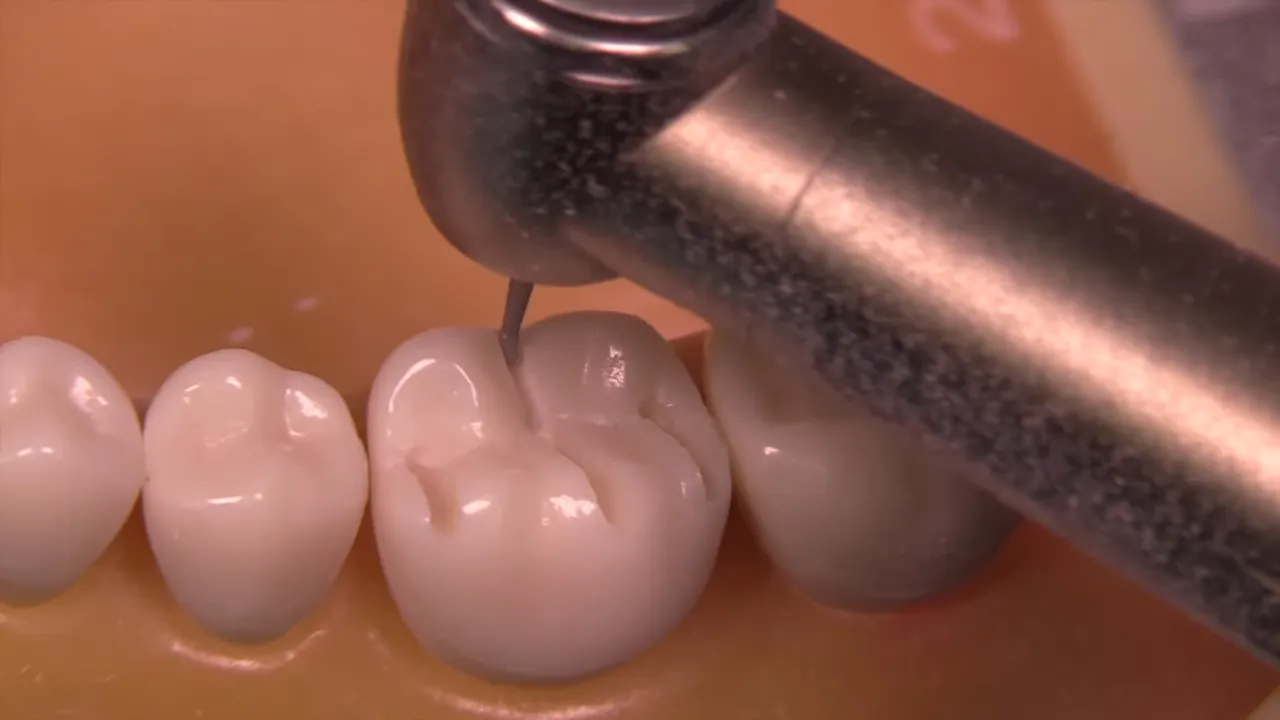 before bulk reduction.
Step 2: Axial Reduction (Buccal and Lingual)
Using a Green Stripe Diamond (6856-016), perform the axial reduction.
- Design: This aggressive diamond creates the necessary 6 to 10-degree taper and the required fillet margin.
- Execution: Reduce the facial and lingual surfaces while keeping the bur parallel to the long axis of the clinical crown to ensure a proper line of draw
.
Step 3: Interproximal Reduction
To avoid damaging adjacent teeth, switch to a smaller diameter bur: the 6856-012
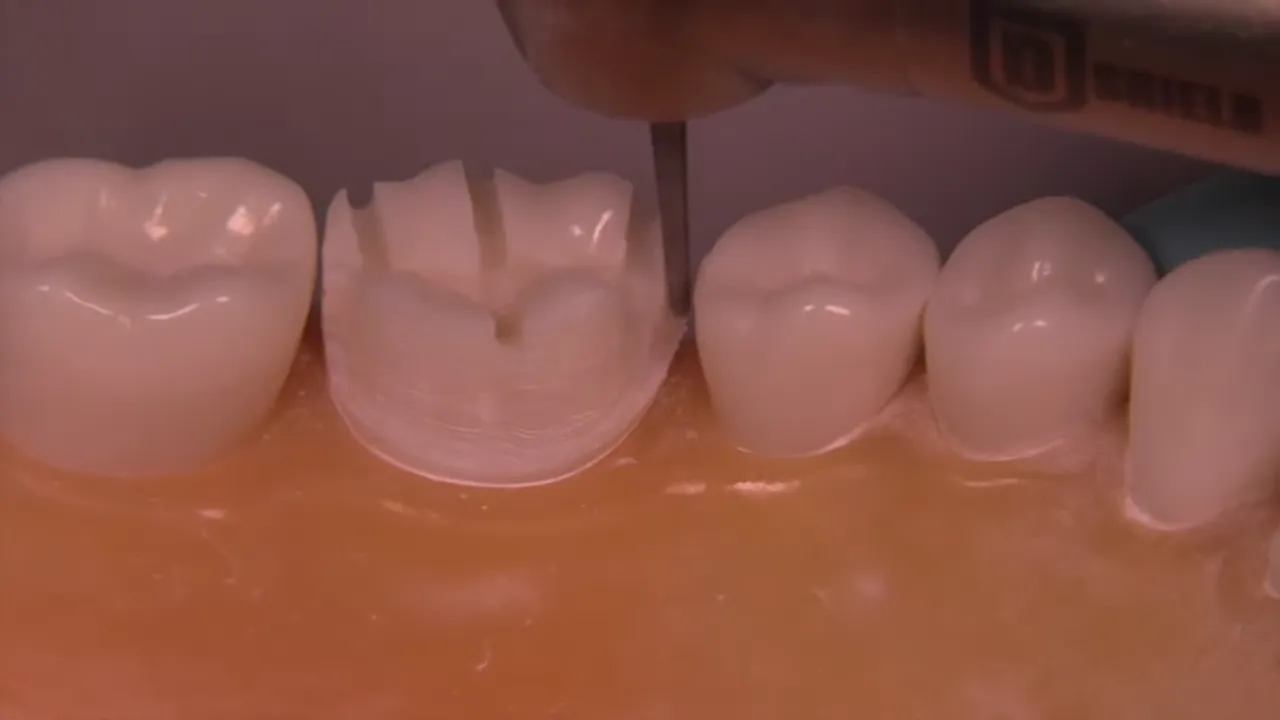 .
.
- Method: Pass this thinner bur through the interproximal contacts to create initial clearance.
- Refinement: Once clearance is established, return to the larger 6856-016 bur to blend the interproximal finish line with the buccal and lingual
 fillet margins for uniformity.
Step 4: Occlusal Reduction
After the axial walls are established, perform the bulk occlusal reduction.
- Tool: Utilize a unique keg-shaped bur
.
- Goal: Follow the established depth cuts from Step 1 to complete the reduction while maintaining the anatomical planes of the tooth.
Step 5: Refinement and Polishing
The final step ensures the preparation is smooth, which is critical for the fit and longevity of ceramic restorations.
- Refinement: Use the 8856-016 (Fine Grit Diamond). This bur shares the same geometry as the axial bur used in Step 2 but features a finer grit for smoothing the finish line
 and axial walls.
- Polishing: Finish the preparation using a Jiffy Cup (specifically for posterior teeth). This creates a highly smooth surface, reducing stress concentrations in the final ceramic crown
.
Conclusion
The 5x5x5 technique offers a highly predictable workflow. By using a pre-defined bur block and following these five steps, clinicians can move from initial depth cuts to a polished, final preparation efficiently. While initial attempts may take longer, mastery of the technique allows for a complete, high-quality preparation in roughly five minutes. To verify accuracy, clinicians are encouraged to use a putty matrix to confirm that the reduction meets the specific requirements
 of the chosen ceramic material.