Abbott and Sunthoramoorthy 2021 - Invasive Resorption Cohort
Citation and evidence type
The lecture attributes the dataset to “An Analysis of 219 patients with External Invasive Resorption in 293 Teeth” — 2021, Abbott & Sunthoramoorthy (unpublished data). It is an unpublished clinical cohort with case-series treatment outcomes; no journal publication or full bibliographic citation is supplied.
The source spells the second surname “Sunthoramoorthy” in most headings and outcome captions, but “Sunthoramorthy” beside the class and tooth-distribution data. Both spellings are retained as a source discrepancy.
The lecture does not report the recruitment period, selection method, diagnostic criteria, follow-up schedule, or definitions for outcome labels. Potential predisposing factors are reported as associations, not established causes.
Contextual takeaway
This unpublished series of 219 patients and 293 teeth describes class-specific outcomes across varied treatments and follow-up, without a controlled comparison of efficacy.
Source-linked evidence
The cohort material appears across L9’s Epidemiology and Prevalence, Classification Systems, and Case Series Outcomes sections. The original lecture and PDF pages are linked in the metadata and page references below.
Cohort characteristics
The series includes 219 patients and 293 teeth. The lecture reports patient-level and tooth-level percentages separately.
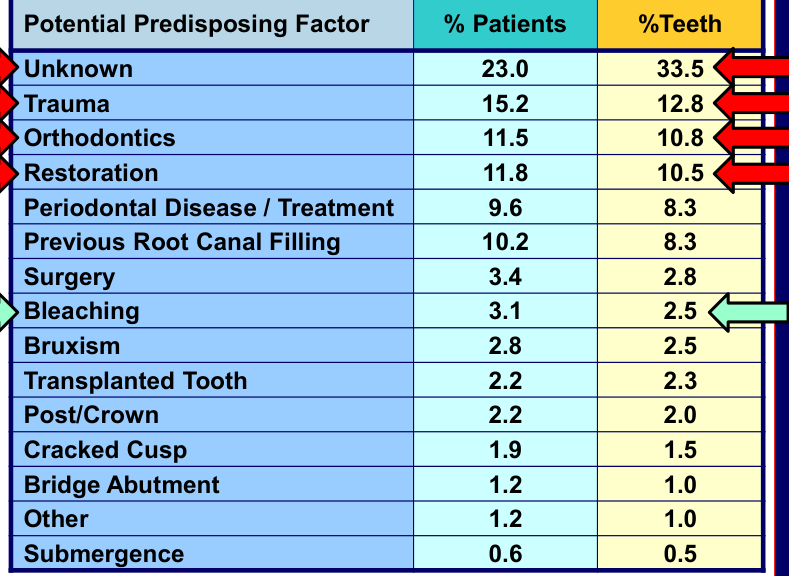
Potential predisposing factors 1
| Potential Predisposing Factor | % Patients | % Teeth |
|---|---|---|
| Unknown | 23.0 | 33.5 |
| Trauma | 15.2 | 12.8 |
| Orthodontics | 11.5 | 10.8 |
| Restoration | 11.8 | 10.5 |
| Periodontal Disease / Treatment | 9.6 | 8.3 |
| Previous Root Canal Filling | 10.2 | 8.3 |
| Surgery | 3.4 | 2.8 |
| Bleaching | 3.1 | 2.5 |
| Bruxism | 2.8 | 2.5 |
| Transplanted Tooth | 2.2 | 2.3 |
| Post/Crown | 2.2 | 2.0 |
| Cracked Cusp | 1.9 | 1.5 |
| Bridge Abutment | 1.2 | 1.0 |
| Other | 1.2 | 1.0 |
| Submergence | 0.6 | 0.5 |
The image immediately after Abbott’s 1994 Table 5 is captioned as that table in L9, but its contents match this 2021 predisposing-factor table. The caption mismatch is retained here.
Gender and age 1
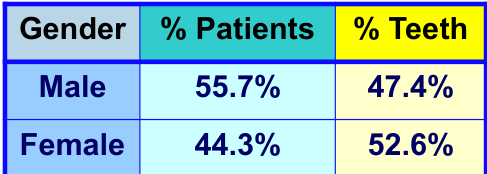
| Gender | % Patients | % Teeth |
|---|---|---|
| Male | 55.7% | 47.4% |
| Female | 44.3% | 52.6% |
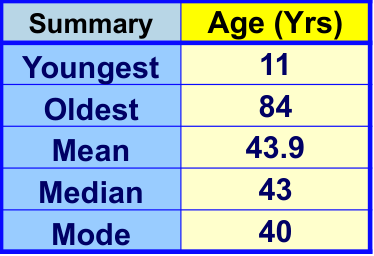
| Age summary | Age (years) |
|---|---|
| Youngest | 11 |
| Oldest | 84 |
| Mean | 43.9 |
| Median | 43 |
| Mode | 40 |
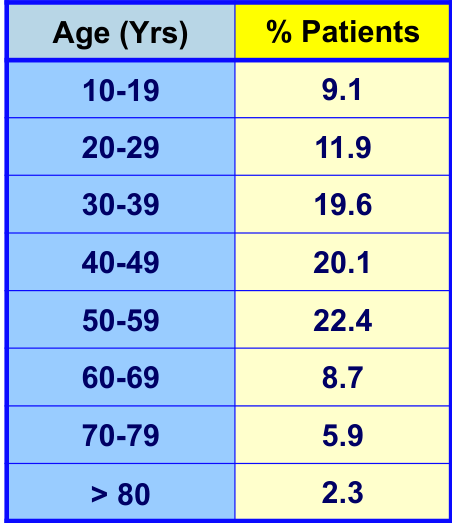
| Age (years) | % Patients |
|---|---|
| 10–19 | 9.1 |
| 20–29 | 11.9 |
| 30–39 | 19.6 |
| 40–49 | 20.1 |
| 50–59 | 22.4 |
| 60–69 | 8.7 |
| 70–79 | 5.9 |
| > 80 | 2.3 |
L9 places the following uncaptioned images after the cohort demographics and multiple-site lecturer note, before its Clinical Features section. Their individual relationship to the dataset is not stated 2.
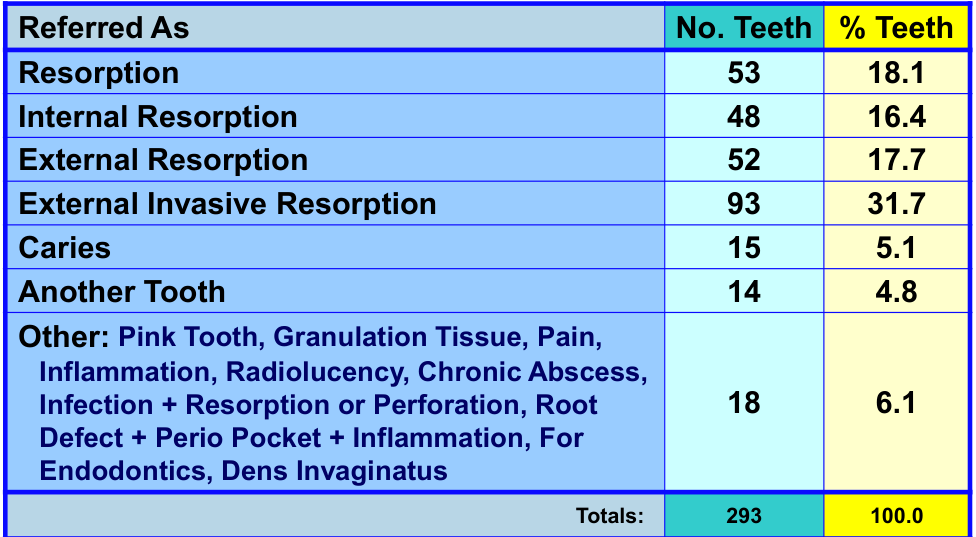
Referral categories by tooth 3
| Referred As | No. Teeth | % Teeth |
|---|---|---|
| Resorption | 53 | 18.1 |
| Internal Resorption | 48 | 16.4 |
| External Resorption | 52 | 17.7 |
| External Invasive Resorption | 93 | 31.7 |
| Caries | 15 | 5.1 |
| Another Tooth | 14 | 4.8 |
| Other: Pink Tooth, Granulation Tissue, Pain, Inflammation, Radiolucency, Chronic Abscess, Infection + Resorption or Perforation, Root Defect + Perio Pocket + Inflammation, For Endodontics, Dens Invaginatus | 18 | 6.1 |
| Totals | 293 | 100.0 |
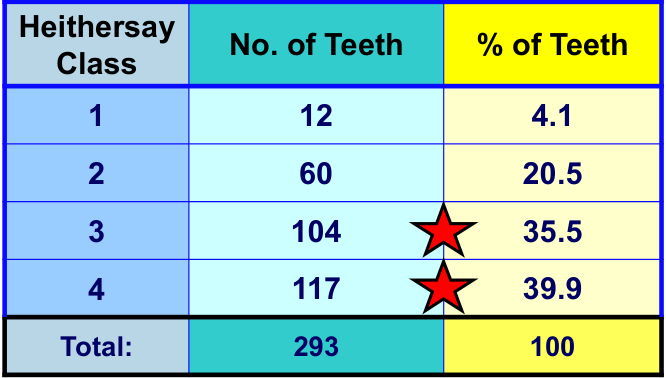
Class and tooth distributions 4
| Heithersay Class | No. Teeth | % Teeth |
|---|---|---|
| 1 | 12 | 4.1 |
| 2 | 60 | 20.5 |
| 3 | 104 | 35.5 |
| 4 | 117 | 39.9 |
| Total | 293 | 100 |
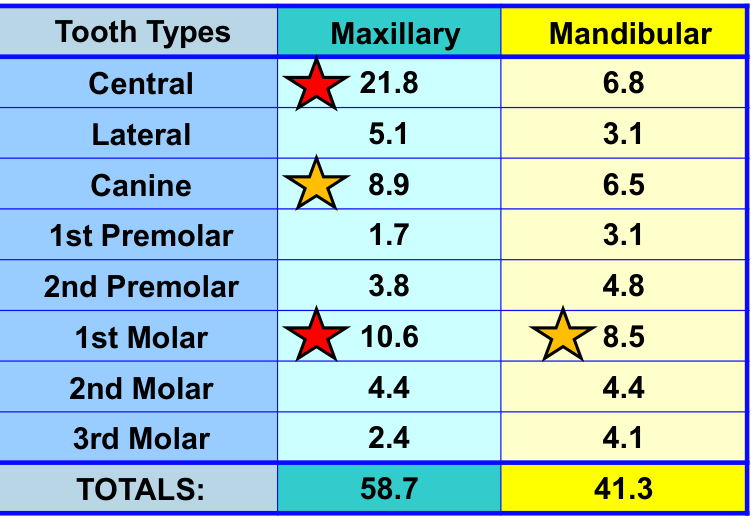
| Tooth type | Maxillary | Mandibular |
|---|---|---|
| Central | 21.8 | 6.8 |
| Lateral | 5.1 | 3.1 |
| Canine | 8.9 | 6.5 |
| 1st Premolar | 1.7 | 3.1 |
| 2nd Premolar | 3.8 | 4.8 |
| 1st Molar | 10.6 | 8.5 |
| 2nd Molar | 4.4 | 4.4 |
| 3rd Molar | 2.4 | 4.1 |
| TOTALS | 58.7 | 41.3 |
L9 labels the class distribution as “2021 — Abbott & Sunthoramorthy (unpublished data)” and the tooth-type data as “2021 — Abbott & Sunthoramoorthy (unpublished data).”
The tooth-type row in L9 also contains a Patel classification figure; only the separate image captioned with this cohort is reproduced here.
Class-specific treatments and follow-up
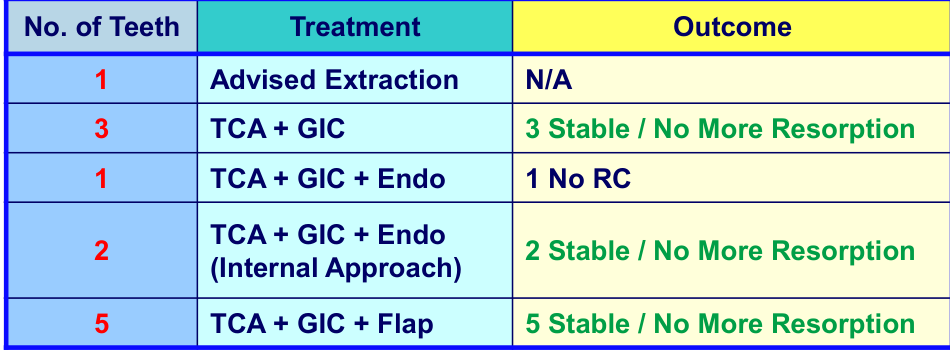
Class 1 cases — 12 teeth (follow-up: 6 mths–6 yrs) 5
| No. Teeth | Treatment | Outcome |
|---|---|---|
| 1 | Advised Extraction | N/A |
| 3 | TCA + GIC | 3 Stable / No More Resorption |
| 1 | TCA + GIC + Endo | 1 No RC |
| 2 | TCA + GIC + Endo (Internal Approach) | 2 Stable / No More Resorption |
| 5 | TCA + GIC + Flap | 5 Stable / No More Resorption |
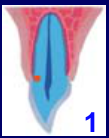
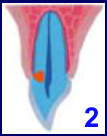
L9 shows numbered images 1 and 2 after this table, with uncaptioned companion images:
Class 2 cases — 60 teeth (follow-up: 6 mths–10 yrs) 6
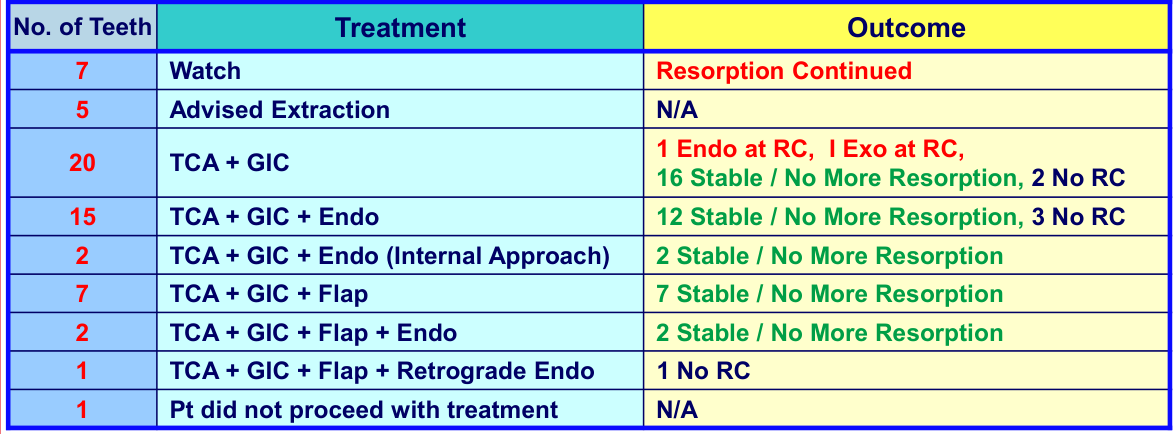
| No. Teeth | Treatment | Outcome |
|---|---|---|
| 7 | Watch | Resorption Continued |
| 5 | Advised Extraction | N/A |
| 20 | TCA + GIC | 1 Endo at RC, 1 Exo at RC, 16 Stable / No More Resorption, 2 No RC |
| 15 | TCA + GIC + Endo | 12 Stable / No More Resorption, 3 No RC |
| 2 | TCA + GIC + Endo (Internal Approach) | 2 Stable / No More Resorption |
| 7 | TCA + GIC + Flap | 7 Stable / No More Resorption |
| 2 | TCA + GIC + Flap + Endo | 2 Stable / No More Resorption |
| 1 | TCA + GIC + Flap + Retrograde Endo | 1 No RC |
| 1 | Pt did not proceed with treatment | N/A |
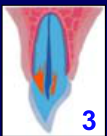
L9 shows numbered images 3 and 4 and three uncaptioned companion images after this table:
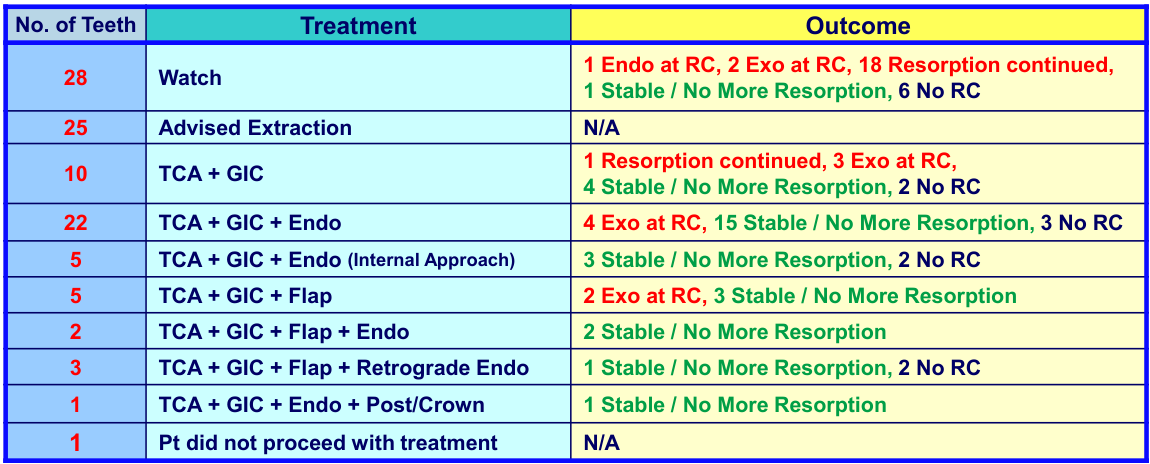

Class 3 cases — 104 teeth (follow-up: 6 mths–6 yrs) 6
| No. Teeth | Treatment | Outcome |
|---|---|---|
| 28 | Watch | 1 Endo at RC, 2 Exo at RC, 18 Resorption continued, 1 Stable / No More Resorption, 6 No RC |
| 25 | Advised Extraction | N/A |
| 10 | TCA + GIC | 1 Resorption continued, 3 Exo at RC, 4 Stable / No More Resorption, 2 No RC |
| 22 | TCA + GIC + Endo | 4 Exo at RC, 15 Stable / No More Resorption, 3 No RC |
| 5 | TCA + GIC + Endo (Internal Approach) | 3 Stable / No More Resorption, 2 No RC |
| 5 | TCA + GIC + Flap | 2 Exo at RC, 3 Stable / No More Resorption |
| 2 | TCA + GIC + Flap + Endo | 2 Stable / No More Resorption |
| 3 | TCA + GIC + Flap + Retrograde Endo | 1 Stable / No More Resorption, 2 No RC |
| 1 | TCA + GIC + Endo + Post/Crown | 1 Stable / No More Resorption |
| 1 | Pt did not proceed with treatment | N/A |
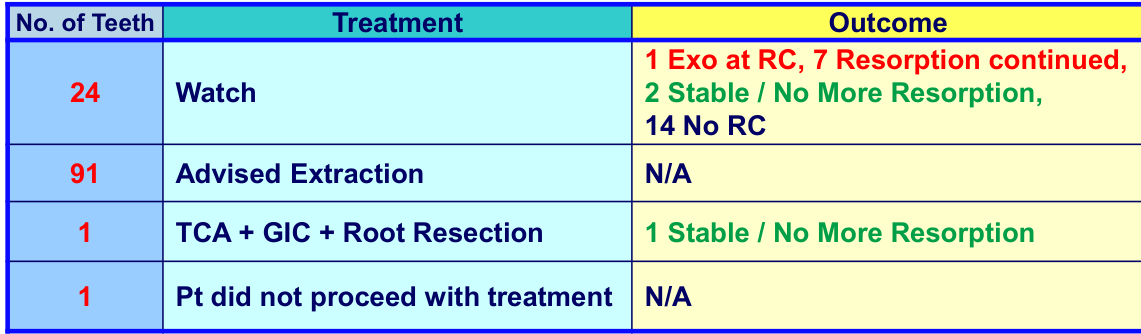
Class 4 cases — 117 teeth (follow-up: 3 mths–21 yrs) 6
| No. Teeth | Treatment | Outcome |
|---|---|---|
| 24 | Watch | 1 Exo at RC, 7 Resorption continued, 2 Stable / No More Resorption, 14 No RC |
| 91 | Advised Extraction | N/A |
| 1 | TCA + GIC + Root Resection | 1 Stable / No More Resorption |
| 1 | Pt did not proceed with treatment | N/A |
The source abbreviates outcomes as “No RC,” “Endo at RC,” and “Exo at RC” in these treatment tables without defining RC. The later summary expands one outcome column as “No Recall / Unknown Result”; abbreviations are retained rather than silently normalized.
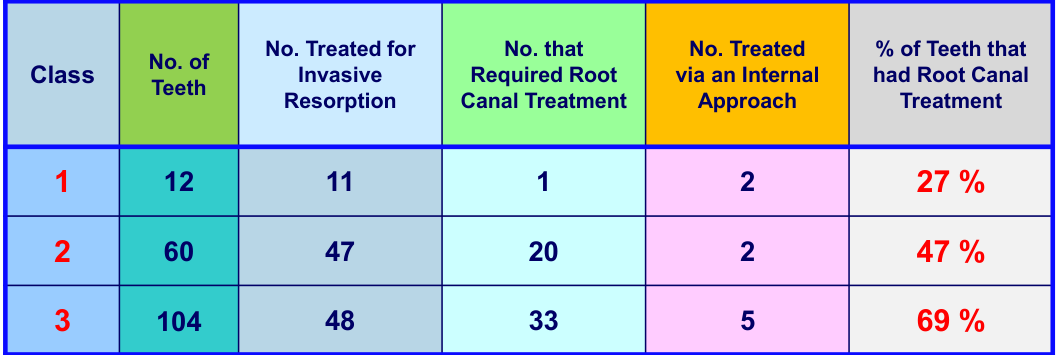
Root canal treatment 7
| Class | No. Teeth | No. Treated for Invasive Resorption | No. that Required Root Canal Treatment | No. Treated via an Internal Approach | % of Teeth that had Root Canal Treatment |
|---|---|---|---|---|---|
| 1 | 12 | 11 | 1 | 2 | 27% |
| 2 | 60 | 47 | 20 | 2 | 47% |
| 3 | 104 | 48 | 33 | 5 | 69% |
L9 has no Class 4 row in this summary. The images immediately after the table carry the 2021 cohort caption:
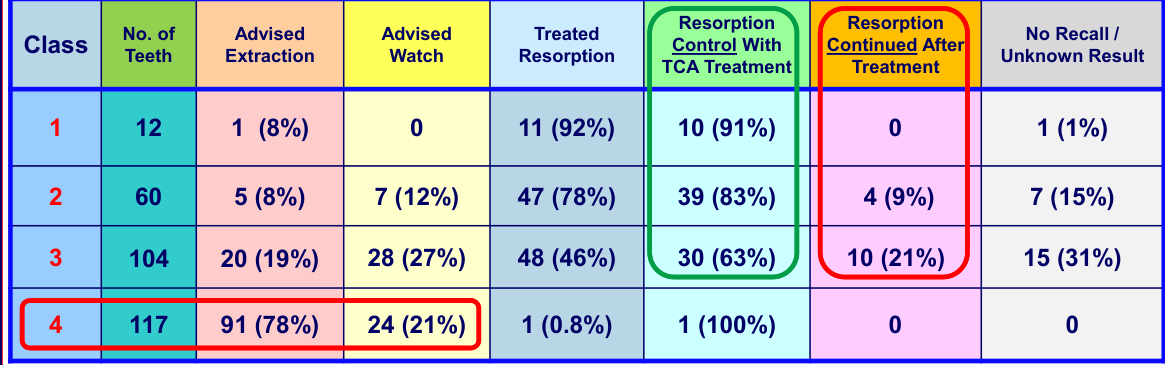
All cases — 293 teeth; follow-up 3 mths–21 yrs 7
| Class | No. Teeth | Advised Extraction | Advised Watch | Treated Resorption | Resorption Control With TCA Treatment | Resorption Continued After Treatment | No Recall / Unknown Result |
|---|---|---|---|---|---|---|---|
| 1 | 12 | 1 (8%) | 0 | 11 (92%) | 10 (91%) | 0 | 1 (1%) |
| 2 | 60 | 5 (8%) | 7 (12%) | 47 (78%) | 39 (83%) | 4 (9%) | 7 (15%) |
| 3 | 104 | 20 (19%) | 28 (27%) | 48 (46%) | 30 (63%) | 10 (21%) | 15 (31%) |
| 4 | 117 | 91 (78%) | 24 (21%) | 1 (0.8%) | 1 (100%) | 0 | 0 |
Source limitations and table checks
The lecture presents no comparator, recruitment or selection method, diagnostic protocol, or outcome definitions. The detailed Class 3 treatment entries sum to 102 teeth against the 104-tooth heading. In the all-cases summary, extraction/watch/treatment counts sum to 59/60 for Class 2, 96/104 for Class 3, and 116/117 for Class 4. The control/continued/unknown-result counts also exceed the treated totals for Classes 2 and 3; Class 1 prints “1 (1%)” for one unknown result. These values are preserved as printed and are not pooled or recalculated.
Original PDF pages
Footnotes
-
Original L9 PDF page 10: L9 PDF p. 10. ↩ ↩2
-
Original L9 PDF page 11: L9 PDF p. 11. ↩
-
Original L9 PDF page 15: L9 PDF p. 15. ↩
-
Original L9 PDF page 21: L9 PDF p. 21. ↩
-
Original L9 PDF page 37: L9 PDF p. 37. ↩
-
Original L9 PDF page 38: L9 PDF p. 38. ↩ ↩2 ↩3
-
Original L9 PDF page 39: L9 PDF p. 39. ↩ ↩2