Caliskan and Turkun 1997 - Internal Resorption Case Series
Their selected 28-case series describes causes, perforation status and treatment outcomes, but its categories and small sample do not establish causal effects or general prognosis.
Citation and study context
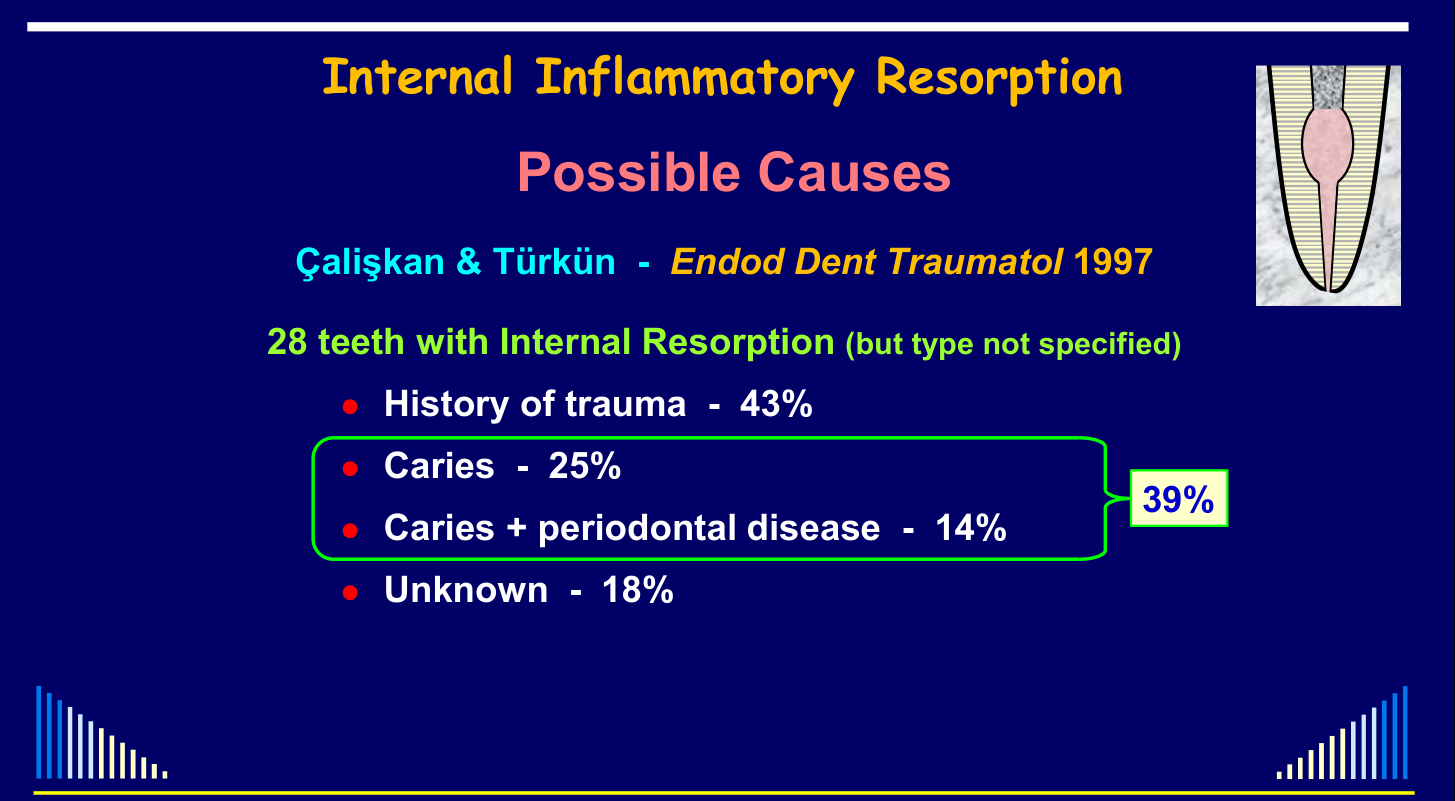
Citation as given in L2: Çalışkan & Türkün — Endod Dent Traumatol, 1997.12 The lecture does not provide the article title, volume, issue, or page range, so those details remain unresolved.
Evidence type: A selected clinical case series as summarized in the lecture. The summary does not state recruitment or selection criteria, methods beyond the reported case counts, or the patient denominator.
Sample: 28 teeth with internal resorption. The type of internal resorption was not specified.
Causes reported
Among the 28 teeth, the lecture reports the following history/categories:
- History of trauma: 43% of 28 teeth.
- Caries: 25% of 28 teeth.
- Caries plus periodontal disease: 14% of 28 teeth.
- Unknown: 18% of 28 teeth.
The slide groups the two caries-associated categories as 39% combined. Raw category counts are not supplied. These recorded histories describe associations in this series; they do not establish that the listed factors caused resorption.
Treatment and outcomes reported
The lecture reports root canal treatment for 20 of the 28 teeth. Outcomes for the other 8 of 28 are not described in this extract.
- Among the 20 root-canal-treated teeth, 16 had no perforation; all 16 of 16 had favourable outcomes.
- The other 4 of the 20 treated teeth had perforation and received long-term calcium hydroxide; the duration is not stated.
- 1 of 4 had a favourable outcome.
- 3 of 4 had an unfavourable outcome and then underwent surgery.
- After surgery, 2 of 3 healed.
- 1 of 3 was lost because of extensive loss of marginal bone and increased tooth mobility.
The lecture gives no follow-up interval for these outcomes. The results are descriptive and do not support a general prognosis for all internal resorption.
Limits of the extract
The lecture does not specify the resorption subtype, number of patients, case-selection process, full study methods, or outcome follow-up. The treatment outcome extract covers only 20 of the 28 teeth. With a small series and no comparison group described in the lecture summary, the cause categories cannot establish causal effects and the outcomes cannot establish general prognosis or treatment effectiveness.
Source links
L2 presents the cause data in Features and Possible Causes and the outcome data in Treatment Outcomes. The original slide-page references are retained below.
Footnotes
-
Original PDF page 16: L2 PDF, p. 16 ↩
-
Original PDF page 34: L2 PDF, p. 34 ↩