Chen et al 2005 - Intracanal Medicaments After Dry Storage
Citation as presented in L7: The effect of intracanal anti-inflammatory medicaments on external root resorption of replanted dogs’ teeth after extended extra-oral dry time — Chen, Teixira, Ritter, Levin, Trope, AAE 2005.12
Evidence type: Dog replantation experiment.
Contextual takeaway: After 60 minutes of extra-oral dry time, replanted dog teeth showed different periodontal outcomes across intracanal medicament groups at four weeks; these findings apply to the tested protocol.
Protocol and outcomes
Teeth were kept dry for 60 minutes, replanted, and assessed after four weeks. The treatment arms received immediate endodontic treatment and an intracanal medicament; the control had no endodontic treatment. L7 lists replacement resorption, inflammatory resorption, surface resorption, and normal periodontal ligament (PDL), plotted on a 0–100% scale.
| Group | Outcome reported in L7 |
|---|---|
| Control — no endo | Reference arm in the source graph. |
| Tetracycline | Less inflammatory resorption than the no-treatment control. |
| Triamcinolone | More normal PDL and less inflammatory resorption than the control. |
| Ledermix | Most favorable profile: more normal PDL, less inflammatory resorption, and slightly less replacement resorption. |
The comparative summary reports p = 0.001 for the four-arm Chen et al. 2005 comparison. L7 does not transcribe exact percentages from the chart, so the source figure is preserved here:
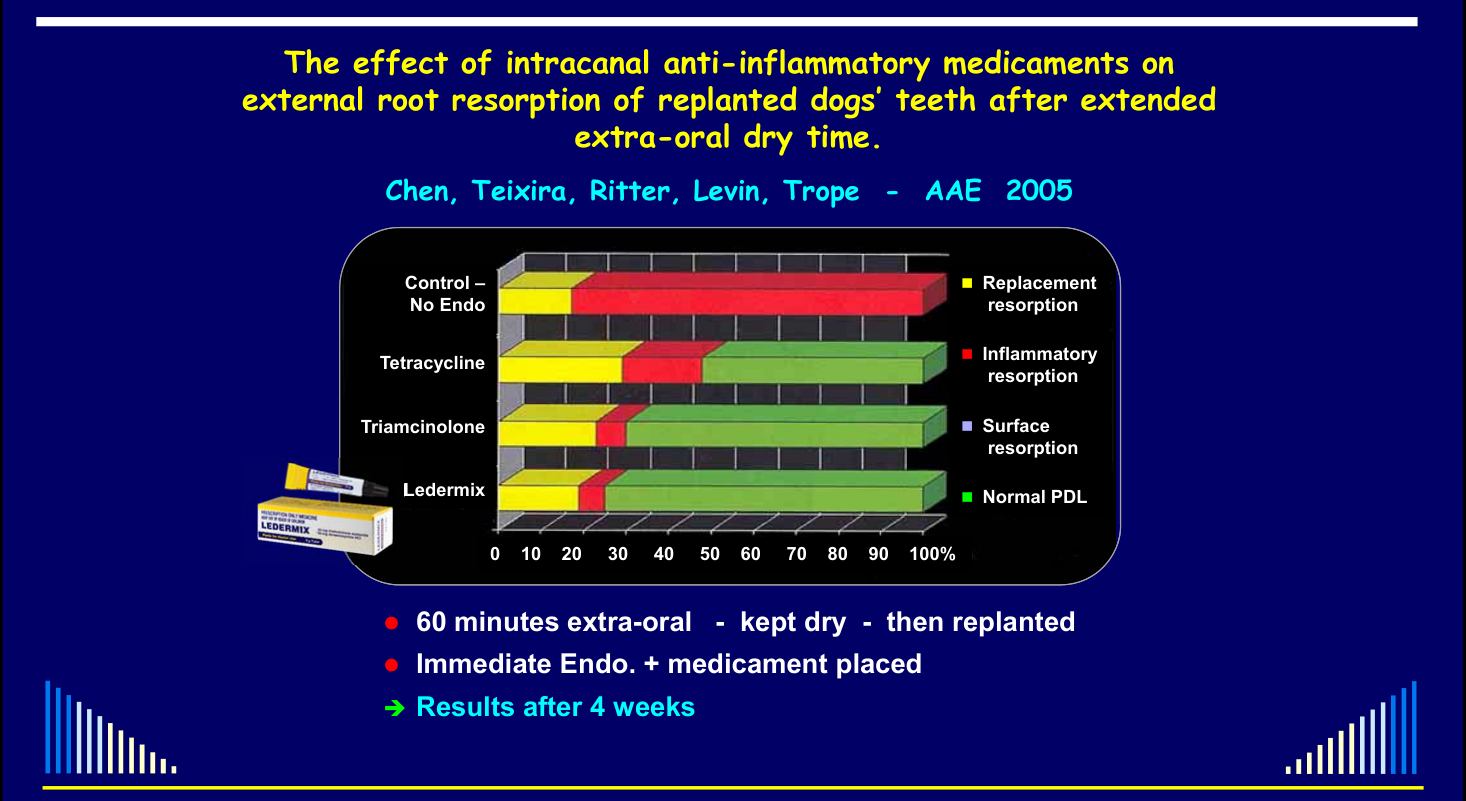
Chen et al. 2005 outcome chart reproduced in L7; the graph shows all four groups and all four outcome categories.
Limits and study distinction
L7 gives no sample size or group denominators in this extract. This is an animal-model result, separate from the Pierce and Lindskog 1987 in-vivo paste comparison and the Pierce, Heithersay and Lindskog 1988 laboratory dentinoclast-inhibition assay.
Original lecture pages
Footnotes
-
Original PDF page 31: L7 Resorption 4 - External Inflammatory, p. 31 ↩
-
Original PDF page 32: L7 Resorption 4 - External Inflammatory, p. 32 ↩