Heithersay 1999 - Predisposing Factors Pages 83-95
Source extract from L9, Histopathogenesis and Predisposing Factors.
Citation and publication boundary
Heithersay, G. S. Quintessence International. 1999;30:83–95, as listed in L9. The lecture labels this page range “Potential predisposing factors”; it does not establish the full article title.
L9 lists three separate papers in Quintessence International 1999;30: pages 27–37 (clinical, radiologic and histopathologic features), 83–95 (potential predisposing factors), and 96–110 (TCA treatment, curettage and restoration). This note covers only pages 83–95. A nearby L9 lecturer note says the three papers appeared in 1990, conflicting with the bibliography’s 1999 citation; this note follows the bibliography entry and preserves the page-range distinction.
L9’s separate table and figure describing 219 patients and 293 teeth are labelled unpublished Abbott and Sunthoramoorthy 2021 data. They are not attributed to this Heithersay paper. The adjacent L9 tissue and pulp section and its 219/293 figure caption do not provide evidence for the predisposing-factor analysis.
Evidence recorded in L9
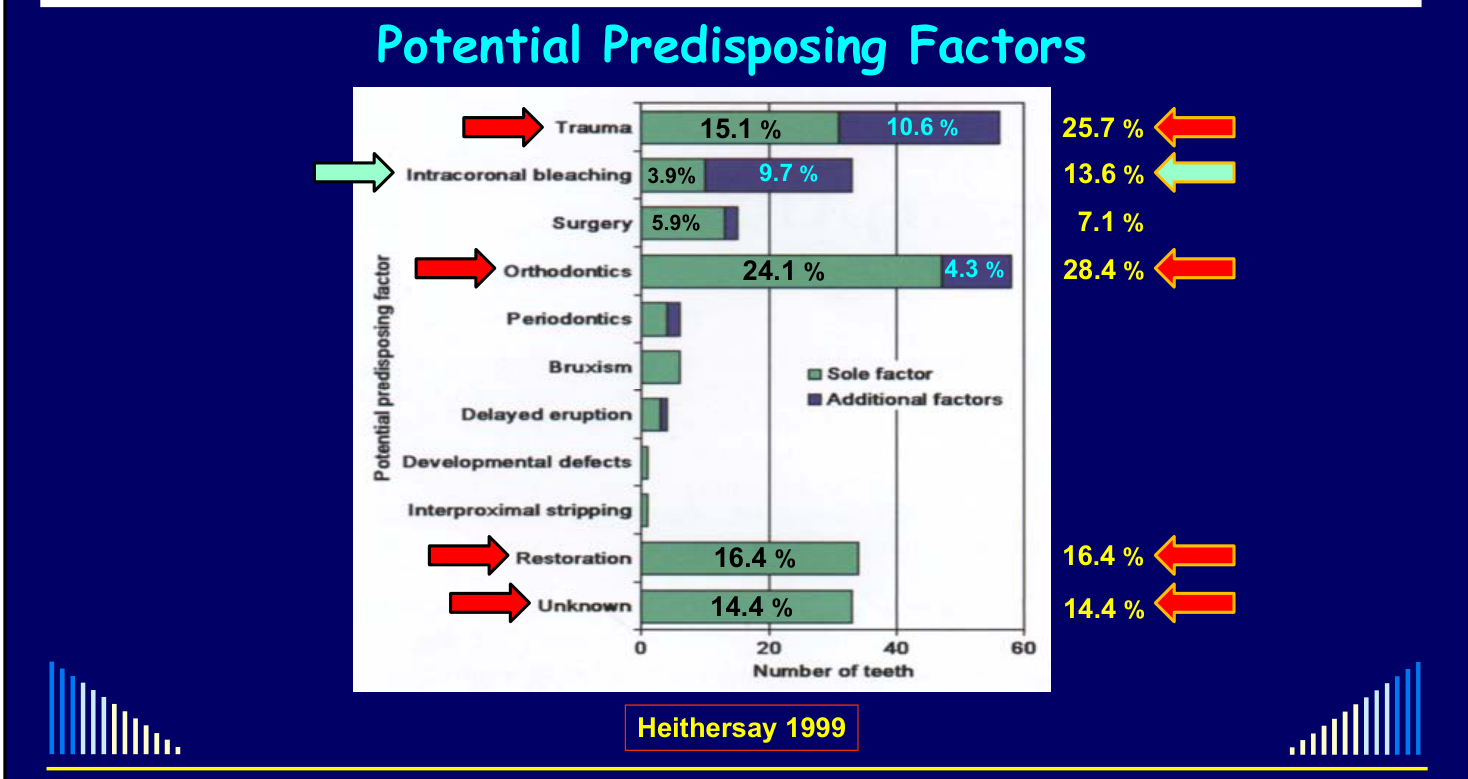
The lecture treats these as potential factors, not proven causes. Its prose describes a review of approximately 250 teeth, but the transcription does not give the exact denominator, selection criteria, or analysis method. The accompanying chart plots number of teeth and separates a “sole factor” from “additional factors”; the chart does not state its total sample size.
| Potential factor | Sole-factor share shown | Additional-factor share shown | Total shown |
|---|---|---|---|
| Orthodontics | 24.1% | 4.3% | 28.4% |
| Trauma | 15.1% | 10.6% | 25.7% |
| Intracoronal bleaching | 3.9% | 9.7% | 13.6% |
| Surgery | 5.9% | Not numerically labelled | 7.1% |
| Restoration | 16.4% | Not shown | 16.4% |
| Unknown | 14.4% | Not shown | 14.4% |
The chart also shows periodontics, bruxism, delayed eruption, developmental defects, and interproximal stripping without legible printed percentages; the original figure is retained below. Nearby lecture text summarizes orthodontics as the most frequently identified factor, trauma at approximately 25%, and bleaching at 13.6%. It separately reports no identified factor in about 15% in one review and an “unknown” category of about 30–32% in another. These are separate summaries and are not combined with the chart’s 14.4% unknown value.
L9 also describes a possible susceptibility at the cemento-enamel junction: enamel and cementum meet directly in about 30% of teeth; in about 5–10%, they do not meet and dentine remains exposed. Exposed dentine has been reported in up to 30% of upper incisors, and the lecture says a defect need not extend around the full root circumference. It presents a developmental defect as a possible underlying susceptibility, with another event potentially stimulating clastic cells; trauma, bleaching, endodontic treatment, and orthodontic movement are discussed as possible contributors, not sufficient causes.
Figure shown with the extract
The L9 figure is labelled “Potential Predisposing Factors” and identifies Heithersay 1999. L9 does not identify its original article page.
Contextual takeaway
In the tooth-based analysis summarized in L9, orthodontics, trauma, intracoronal bleaching, and other histories are reported as potential associations; the lecture does not establish any as a cause, and its transcription does not provide an exact denominator or full methods.
Source lecture pages 12
Footnotes
-
Original PDF page 8 of L9: L9 Resorption 5 - External Invasive, p.8. ↩
-
Original PDF page 9 of L9: L9 Resorption 5 - External Invasive, p.9. ↩