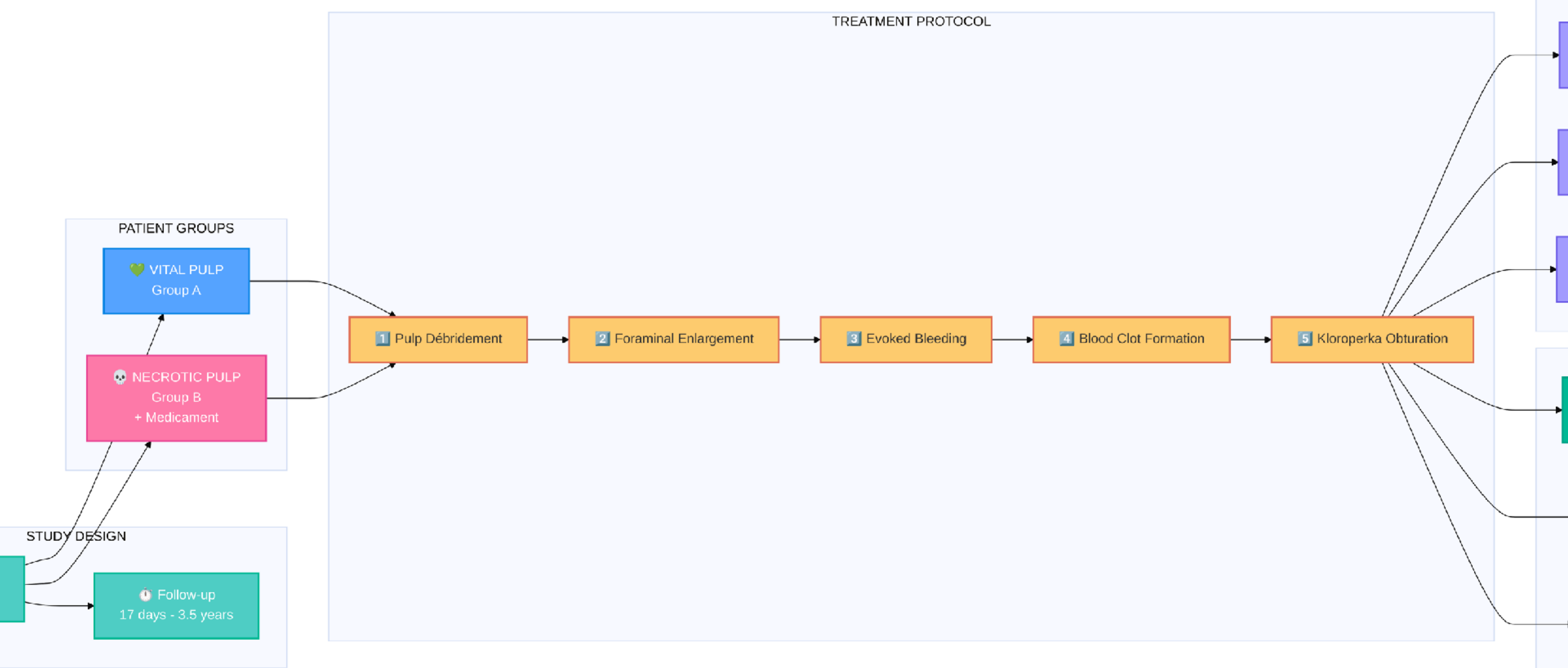
Nygaard-Östby 1961 - Blood Clot Experiment
Contextual takeaway: L16 presents Nygaard-Östby’s 1961 mature-tooth experiment as historical evidence that induced bleeding and canal clot formation were followed by reported histologic tissue formation and clinical/radiographic resolution; this experiment is separate from the lecture’s current regenerative endodontic teaching for immature teeth.
Evidence below comes from the L16 Ostby blood-clot section.
Citation and attribution
The slide title credits B. Nygaard-Östby. The citation is printed as:
Ostby BN. The role of the blood clot in endodontic therapy. An experimental histologic study, Acta Odontol Scand 1961;19: 324.1
The lecture gives page 324 but no full article page range; the citation spelling “Ostby BN” is retained as printed.
Hypothesis and proposed mechanism
He hypothesized that a blood clot could be the first step in the healing of a damaged dental pulp, similar to the role of the blood clot in the healing process observed in other areas. The lecturer described the proposed mechanisms as regeneration or repair of pulp connective tissue, odontoblast-like cells, possible reinnervation, and mineralization or remineralization.2
Method and study groups
L16 describes an experimental histologic study involving 17 patients with mature teeth and follow-up from 17 days to 3.5 years. It lists vital pulp as Group A and necrotic pulp with medicament as Group B. The lecture does not report group sizes or outcome denominators.
The listed protocol was pulp debridement, foraminal enlargement, evoked bleeding, blood-clot formation, and Kloroperka obturation. The lecturer’s note adds that the canal was cleaned and over-instrumented to induce bleeding, left until the blood clotted, then sealed with restorative material over the clot.3
Histology and reported outcomes
- Histology: connective-tissue ingrowth; mineralized tissue on canal walls; mineralized islands in new tissue.
- Lecturer’s histology note: possible reinnervation and some remineralization; the work was presented as an early foundation for later revascularization and regenerative endodontic procedures.
- Reported outcomes: symptom resolution at 17 days, pathosis resolution, and radiographic apical closure. L16 does not give the timing for the latter two outcomes or report results separately by group.3
The study used mature teeth. L16’s separate clinical blood-clot scaffold teaching concerns current regenerative endodontic procedures and should not be read as the protocol tested in this historical experiment.
Source figure