Wedenberg and Lindskog 1985 - Internal Resorption Model
Study identification
Evidence type: experimental animal model with monkey incisor pulps and histological examination.
Citation as printed in L2: Wedenberg & Lindskog - Endod Dent Traumatol 1985; 1: 221-227. L2 does not provide author initials or a separate article title; the lecture heading is not treated as the article title.
The main account and the later repeated result summary are linked below. The original PDF page mappings are retained in footnotes.12
Model and methods
- Monkey incisor pulps were accessed through a labial cavity.
- Predentine and some superficial dentine were removed.
- In one group, Freund’s complete adjuvant solution was injected into the pulp. L2 describes it as a non-specific stimulator of the immune response; these teeth were then sealed with ZO-E.
- The other group was left open to the oral cavity. L2 later describes the sealed group as without bacteria and the unsealed group as infected.
- Teeth were extracted and histologically examined after 1, 2, 6, and 10 weeks.
- The lecture does not report the number of monkeys or teeth, group sizes, allocation details, or counts at each time point.
Histological findings
- Macrophage-like cells were found in both groups.
- In the sealed, non-infected group, this response was transient: cell numbers declined after 6-10 weeks, followed by an increase in fibroblast-like cells and hard tissue formation. L2 labels this internal surface resorption.
- In the open, infected group, resorbing cells had more extensive and prolonged colonisation. Their spread occurred only where dentine was denuded. L2 labels this internal inflammatory resorption.
- The lecturer’s comparison states that the experiment produced internal surface resorption in the non-infected sealed group and internal inflammatory resorption in the infected unsealed group, supporting an association between infection and more extensive, prolonged resorption.
Lecture illustrations
The lecture places these two illustrations beside the repeated evidence summary. L2 does not identify them as original figures from the 1985 paper.
| Lecture label | Illustration |
|---|---|
| Internal SURFACE Resorption | 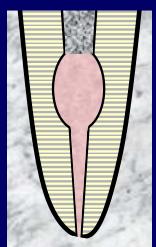 |
| Internal INFLAMMATORY Resorption | 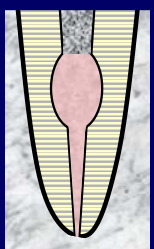 |
Source locations and original PDF pages
- L2 main methods and findings, lines 285-308 maps to original PDF page 12.1
- L2 repeated comparison, lines 423-434 maps to original PDF page 17.2
Limitations
This is an induced monkey model. L2 supplies no sample denominator, histology protocol, statistical analysis, or full bibliographic title. The comparison supports a model-specific association; it does not establish that infection is required in every human case.
Contextual takeaway
In an induced monkey model, non-infected sealed teeth showed transient resorption, while infected unsealed teeth had more extensive and prolonged resorption; this does not establish that infection is required in every human case.
Footnotes
-
Original PDF page 12 in L2’s page map: L2 PDF p.12. ↩ ↩2
-
Original PDF page 17 in L2’s page map: L2 PDF p.17. ↩ ↩2