Wedenberg and Zetterqvist 1987 - Human Internal Resorption Histology
Contextual takeaway
In 13 selected extracted human teeth examined histologically, bacterial presence was reported; selection of extracted cases limits generalization.
Study evidence
This note records the human-tooth study evidence from L2 Resorption 1 - Introduction, General Internal Resorption (pre-edit lines 396–403 and 436–464). General internal-resorption teaching remains in that lecture.
Citation and evidence type
Evidence type: Human extracted-tooth histology, scanning electron microscopy, and enzyme histochemistry.
Citation as given in the lecture: A histological, scanning electron microscopic, and enzyme histochemical study — Wedenberg C, Zetterqvist L. J Endod 1987; 13: 255–259.1
Sample and clinical context
The lecture reports 13 teeth with internal inflammatory resorption:
- History of trauma — 3 teeth
- Caries — 10 teeth
- Trauma + caries — 1 tooth
Location of the resorption defect:
- Middle third — 6 teeth
- Apical third — 7 teeth
All cases had infected root canal systems. Time from diagnosis to extraction was 4 months to 10 years.
The lecture lists the cause counts separately and does not state whether categories overlap; they are transcribed without summing them.
Histological findings
The lecture reports:
- Bacteria were detected in the dentine tubules and in the pulp space coronal to the resorptive defect where the pulp was necrotic.
- The clastic cells had strong tartrate-resistant acid phosphatase (TRAP) activity, similar to other mineralized-tissue-resorbing cells.
- Normal pulp tissue was not present: there were no odontoblasts and no predentine.
- The pulp had been replaced by periodontal-like connective tissue. The study could not determine whether this occurred before or after resorption commenced.2
Figure
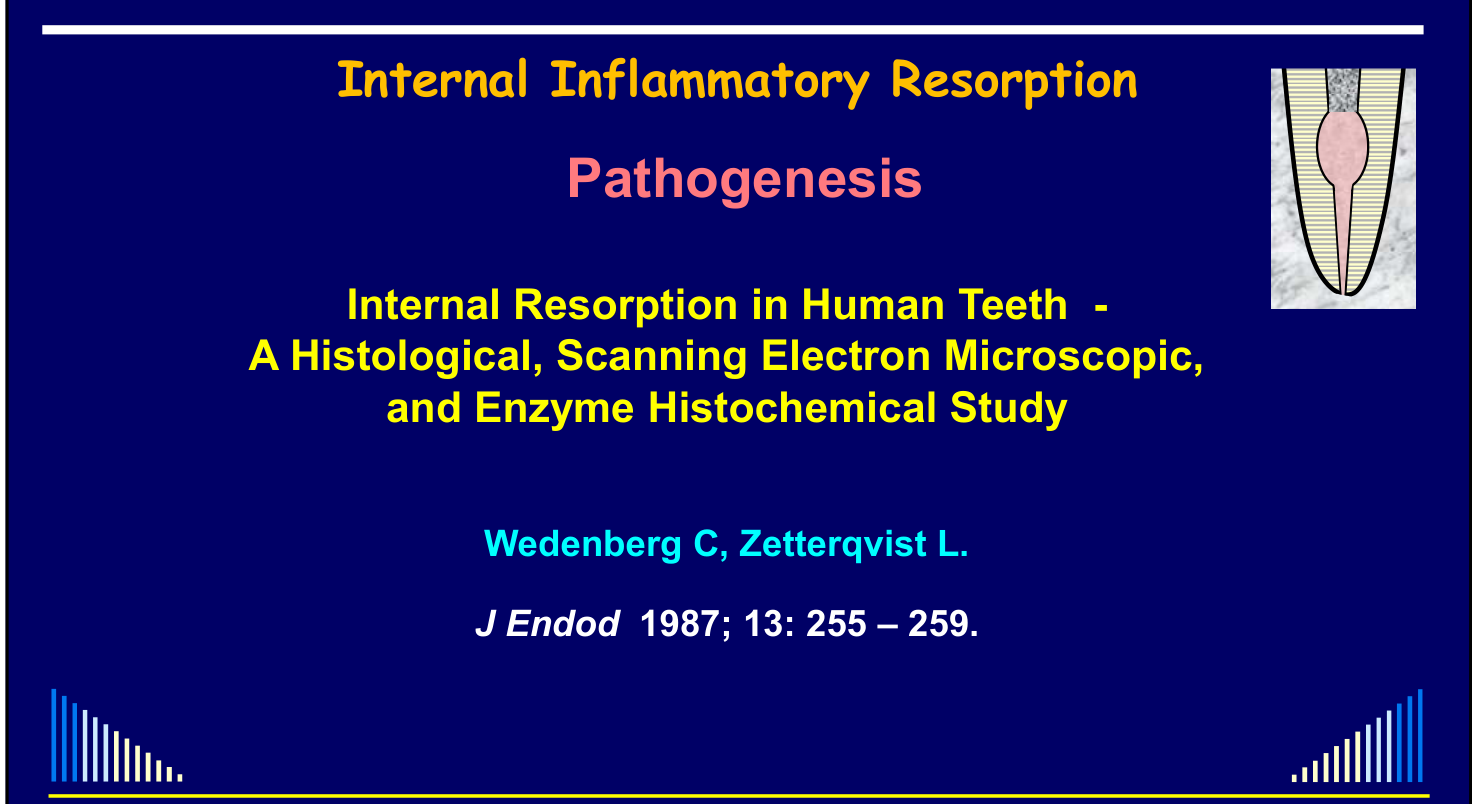
The lecture gives a title variant in its later histology heading (“Scanning Microscopic” at pre-edit line 454), while the citation at line 438 says “scanning electron microscopic”; the citation wording above is retained as printed there.
Limitation
These are selected extracted cases, so the findings do not establish the prevalence or representativeness of internal resorption in the general population.
Footnotes
-
Original PDF page 18: L2 Resorption 1 - Introduction, General Internal Resorption, p.18 ↩
-
Original PDF page 19: L2 Resorption 1 - Introduction, General Internal Resorption, p.19 ↩