Case 21
Worksheet prompts (Suggested Approach, applies to every case)
- Describe the image/radiograph.
- Identify relevant soft tissue findings.
- Identify relevant hard tissue findings.
- Estimate the patient’s dental age.
- Develop a problem list.
- Formulate differential diagnoses.
- Consider additional investigations.
- Develop a management plan.
Clinical Case
Answered from the lecturer’s comments in the recording only. The student presentations are left out.
1. Image / radiograph
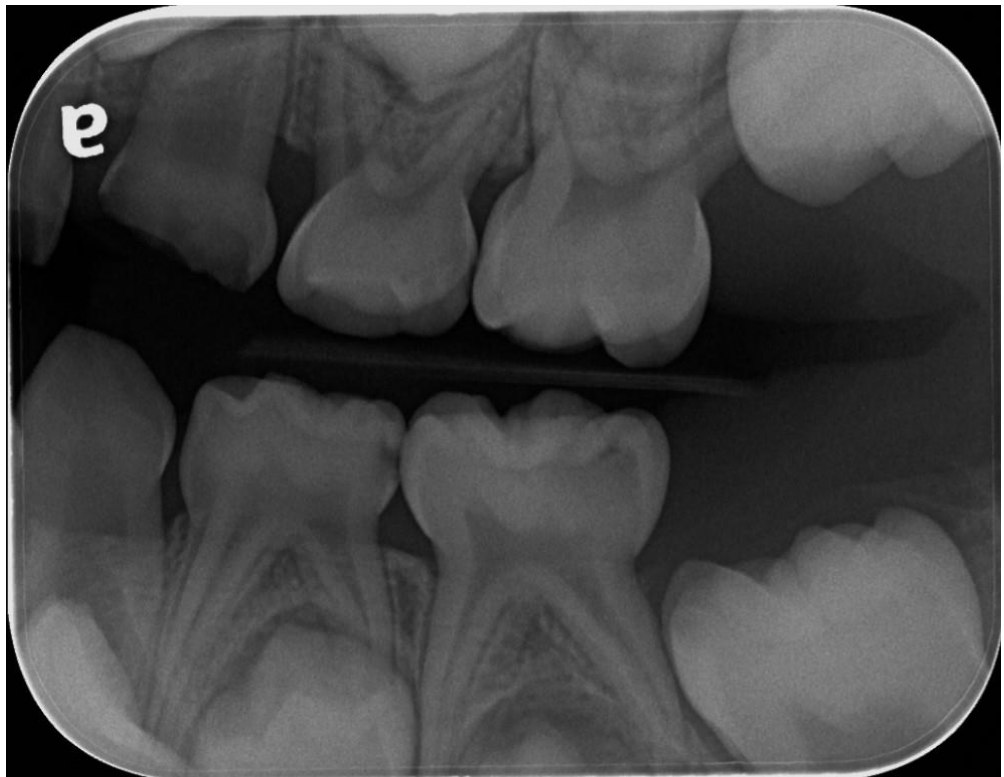
- Left-side bitewing.
2. Soft tissue findings
- Not discussed (radiograph only).
3. Hard tissue findings
- First permanent molars: through the bony crypt, so approaching eruption. As a rough estimate, about 1 year to eruption once through the crypt.
- Caries in two patterns: interproximal, and occlusal on the second primary molars.
- 63: non-carious tooth surface loss.
- Most likely a fracture (trauma) rather than attrition, because there is no wear facet on the opposing tooth.
- 65: the decay comes from the occlusal surface. With that pattern there is less pulp inflammation than from the same depth of proximal decay.
4. Dental age
- 4–5 years (“a good estimate”).
- The primary dentition alone suggests about 3–5 years.
- The first permanent molars being through the crypt puts the child at the latter stage.
5. Problem list
- High caries risk: both interproximal and occlusal caries.
- 63: fractured.
- Carious primary molars: 64, 65, 74, 75.
- Right side: likely interproximal caries there too.
6. Differential diagnoses
- 63: fracture (trauma) versus significant attrition. Fracture is favoured.
7. Additional investigations
- Right-side bitewing immediately: interproximal decay on one side means a high chance of it on the other side.
- Maxillary occlusal: to look at the periapical region of 63. Given the fracture, the pulp status probably needs to be assessed directly as well.
8. Management plan
- 63:
- If retained, a composite (strip) crown is probably necessary.
- If extracted, discuss a balancing extraction. Losing one canine in a young child risks a midline shift once the permanent incisors erupt.
- Primary molars, option 1: Hall crowns.
- Suitable teeth: Hall crowns are reasonable on 65 and on 74/75. 74 could instead have a DO intracoronal restoration if the parents don’t want so many crowns.
- Two appointments per tooth: separators first, then the crown a few days to a week later.
- Not two in the same quadrant at one appointment, unless the child has excessive spacing; the second crown won’t seat.
- Not on opposing teeth: one Hall crown opening the bite is fine, as the bite re-establishes (research supports this), but opposing crowns double the opening. An upper D with a lower E (non-opposing) is usually OK.
- Sequence: start with the worst tooth (75, for its depth), allow about a month to settle, then the next. Four teeth comes to about a year of treatment, and that assumes prompt attendance. The parents must be on board, and the child may burn out.
- Primary molars, option 2: conventional stainless steel crowns under local anaesthetic.
- Prep and fit both teeth in a quadrant together: two 1-hour appointments.
- Nitrous makes it easier where available.
- Not every child is fearful of local anaesthetic if behaviour management is appropriate.
- Mixing the two is possible, for example SSCs under local anaesthetic in one quadrant and Hall crowns for the rest.
- If 36 looks mesially angulated, prefer a prepped SSC on 75, to avoid an oversized crown with a distal overhang affecting 36.
- GA: only if the child is very uncooperative or travels from a remote area. Tolerating bitewings suggests they are cooperative. Referral to a private paediatric dentist is not an option in this case.
- Separators: these are the hardest part of Hall crowns for cooperation (“like steak stuck between your teeth for days”). Topical anaesthetic first can help.
- Fear of needles: often comes from the parents. A rule of thumb: if they can do bitewings, they will usually cooperate for one or two appointments.
- There is no single right answer. Discuss the family’s wants and needs.
Footnotes
-
Original PDF page 1: T1 Case 2, p.1 ↩