DENT5311: Population Informed Clinical Case Summary
Dr Mohammed Junaid BDS, MDS (Public Health Dentistry), MFDS RCPS (Glasg), DDPH RCS (Eng), SFHEA, MDPH (U Syd), PhD (UWA) Senior Lecturer, Dental Public Health UWA Dental School and OHCWA
Front Matter and Acknowledgement of Country12
The University of Western Australia
Our university is located alongside the Derbal Yerrigan (Swan River) on Whadjuk Noongar Boodja.
The University of Western Australia acknowledges that we are situated on Noongar land and that Noongar people remain the spiritual and cultural custodians of their land and continue to practise their values, languages, beliefs and knowledge.
Artist: Dr Richard Barry Walley OAM
© The University of Western Australia | 2026

Opening Interactive Polls345
From your perspective, what factors make a dental visit a positive experience or, conversely, a negative one?
From your perspective, what is the most important outcome to measure the success of dental treatment?
What kind of care or support do you hope to provide your patients who receive care at your dental care service?


Community Conversation Summary Report
Dent Voices6
Prepared By
- Dr. Mohamed Junaid
- Professor Robert Anthonappa
- Dr. David Lim
- Dr. Anita Sakia
August 2023
Western Australia Local Healthcare Network
Learning Outcomes7
By the end of this tutorial, students will be able to:
- Recognise the limitations of biomedical care and explain patient-centred care.
- Analyse how social determinants, barriers and intersectionality influence oral health and care.
- Apply the population informed clinical case summary (PICCS) framework to real clinical cases.
- Develop equitable, realistic and patient-centred management strategies.
- Reflect on their assumptions and clinical practice.
Polls on Social History and Social Dental Practice89

Discussion Question10
What do you ask your patients when you record their social history?
How many among you have heard of the term “Social Dental Practice”?
What comes in mind when you think of social dental practice?

Challenges in Practising Social Dentistry
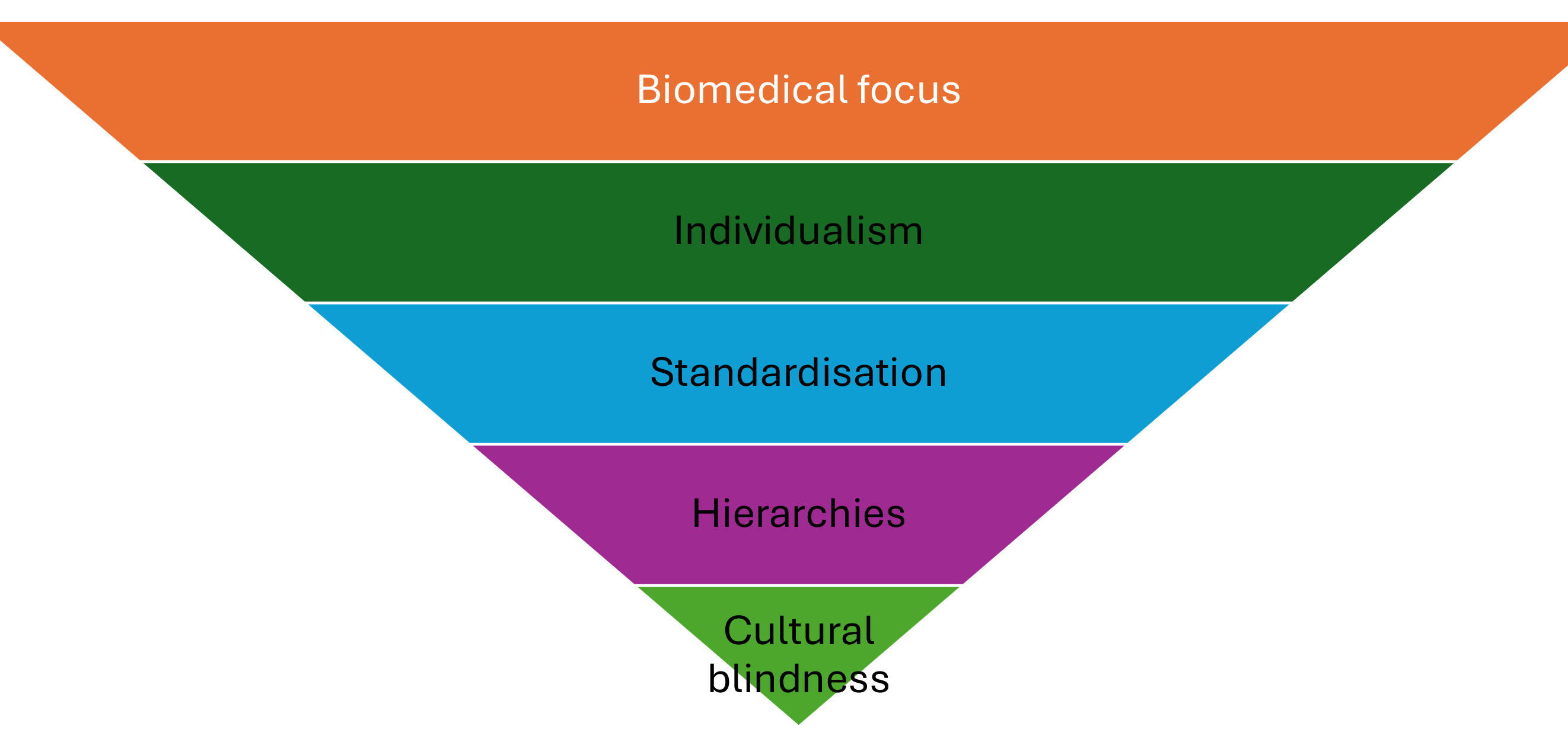
Barriers to Practising Social Dentistry11
- Biomedical approach to training serves as a core obstacle
- Biomedical focus
- Individualism
- Standardisation
- Hierarchies
- Cultural blindness
McGough S, Wynaden D, Gower S, Duggan R, Wilson R. There is no health without Cultural Safety: why Cultural Safety matters. Contemp Nurse. 2022 Feb;58(1):33-42.
Stages of the Seeking Process12
Perception of need → Identify a source of care → Gain entry to health care → Obtain health care → Achieve a desirable outcome
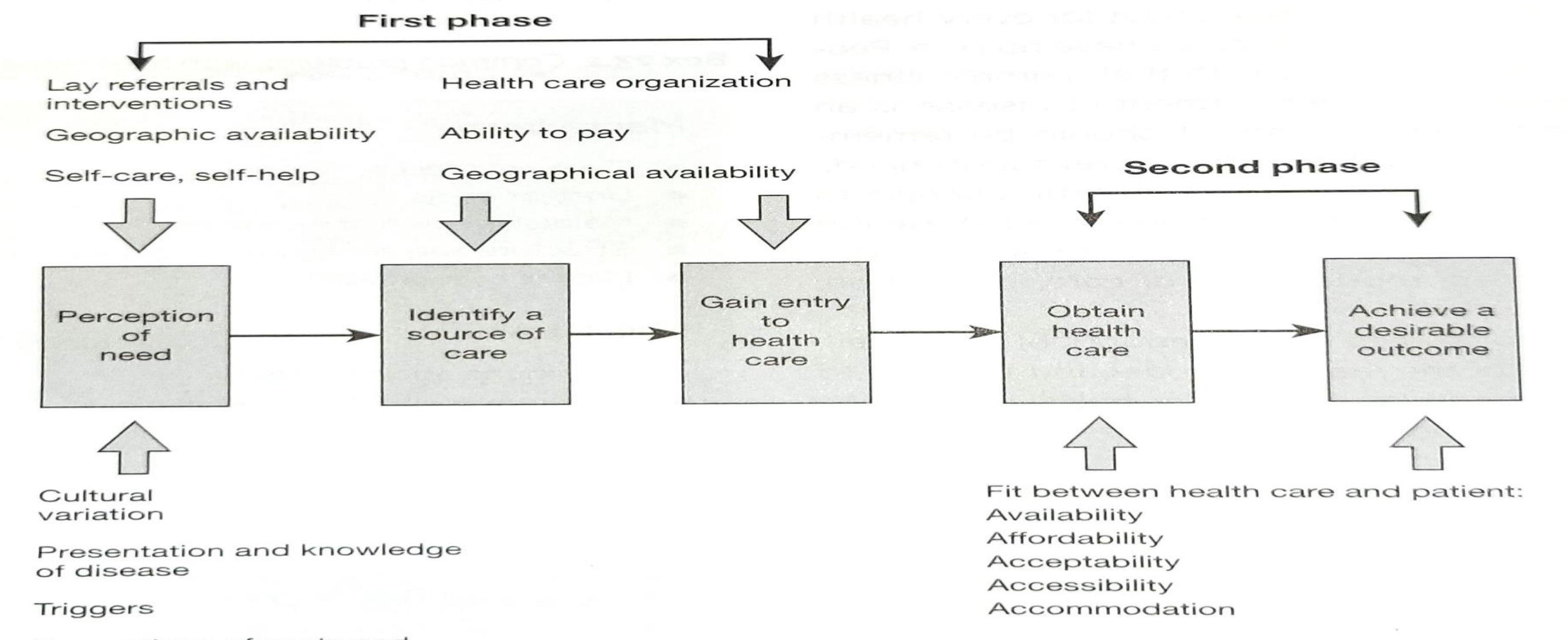
Influencing Factors Across Phases
First Phase
- Lay referrals and interventions
- Geographic availability
- Self-care, self-help
- Cultural variation
- Presentation and knowledge of disease
- Triggers
- Perceptions of costs and benefits
Patients’ Journey in Seeking Oral Health Services
Second Phase
- Health care organization
- Ability to pay
- Geographical availability
Fit Between Health Care and Patient
- Availability
- Affordability
- Acceptability
- Accessibility
- Accommodation
Daly B, Batchelor P, Treasure ET, Watt RG, Essentials in Dental Public Health, Second Edition, Oxford university press.
Wise Mind: Patient Level Perspective13
flowchart LR
    subgraph Emotion_Mind["Emotion Mind"]
        direction TB
        E1["reacting quickly"]
        E2["wanting to hurt who hurt you"]
        E3["behaving impulsively"]
        E4["acting on urges"]
    end

    subgraph Wise_Mind["Wise Mind"]
        direction TB
        W1["taking emotions and logic into account"]
        W2["seeing the situation from multiple perspectives"]
    end

    subgraph Reasonable_Mind["Reasonable Mind"]
        direction TB
        R1["feeling cut off or numb to your emotions"]
        R2["rationalizing behavior (even when it's unacceptable)"]
        R3["avoiding or being in denial about something that's happening"]
        R4["minimizing or shrugging off your feelings"]
    end

    Emotion_Mind --- Wise_Mind --- Reasonable_Mind
Image source: https://thewellnesssociety.org/wise-mind-dbt/
Understanding Social Dentistry
Social Medicine14
The practice of medicine that integrates:
- Understanding and applying the social determinants of health, social epidemiology, and social science approaches to patient care
- An advocacy and equity agenda that treats health as a human right
- An approach that is both interdisciplinary and multi-sectoral across the health system
- Deep understanding of local and global contexts
- Voice and vote of patient, families, and communities
Social Prescribing
A way of linking patients in primary care with sources of support within the community to help improve their health and well-being. A social prescribing scheme may include:
- A referral from a healthcare professional
- A consultation with a link worker
- An agreed referral to a local voluntary, community, and social enterprise organisation
Bedos, C., Apelian, N. & Vergnes, JN. Social dentistry: an old heritage for a new professional approach. Br Dent J 225, 357–362 (2018).
Levels of Influence15
- Structural Determinants (socioeconomic, political, and environmental context):
- Macro-economic policies
- Social and welfare policies
- Trade policies
- Overseas development policies
- Globalisation
- Urbanisation
- Intermediate Determinants (social position and circumstances):
- Social class
- Income
- Education
- Gender
- Ethnicity
- Material circumstances
- Social relationships
- Psychosocial factors
- Health service availability or use
- Environmental setting
- Proximal Determinants (behaviours and biological factors):
- Diet
- Alcohol consumption
- Tobacco use
- Physical activity
- Hygiene
- Inflammation
- Infection
- Immune response
- Outcomes:
- Oral disease and NCD burden
Commercial Determinants: Corporate Strategies
Determinants of Oral Health
- Political and economic power and influence
- Lobbying to influence policy
- Corporate citizenship
- Targeted and tailored marketing and promotion strategies
- Influence on research agenda
- Influences on social norms and local policies
- Media influence to distract attention and cause confusion
- Influence on consumers’ choices and behaviours
Marco A Peres, Lorna M D Macpherson, Robert J Weyant, Blánaid Daly, Renato Venturelli, Manu R Mathur, Stefan Listl, Roger Keller Celeste, Carol C Guarnizo-Herreño, Cristin Kearns, Habib Benzian, Paul Allison, Richard G Watt, Oral diseases: a global public health challenge, The Lancet, Volume 394, Issue 10194, 2019, Pages 249-260.
Multi-Level Influences on Oral Health16
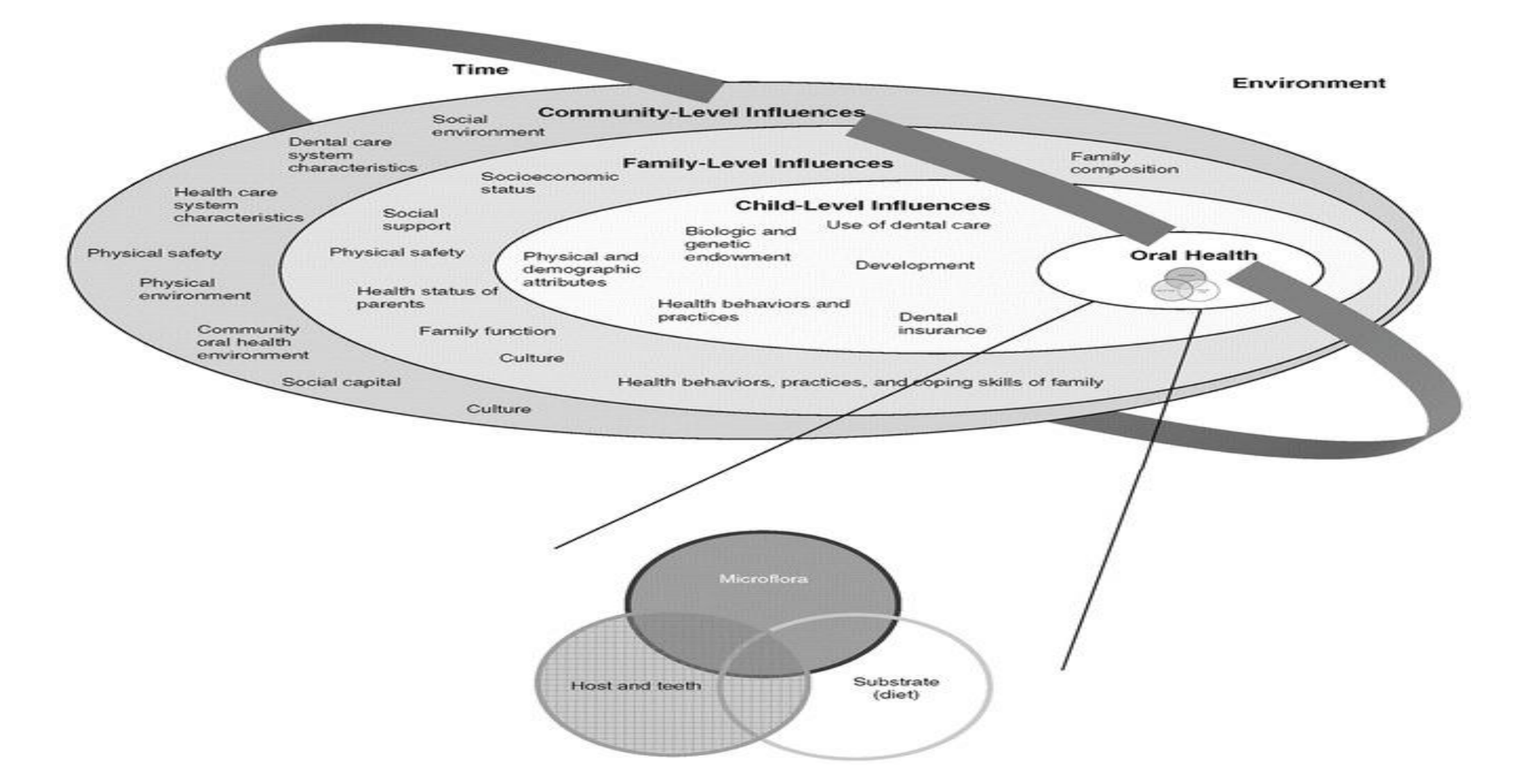
Environmental & Temporal Context
- Time
- Environment
Community-Level Influences
- Dental care system characteristics
- Health care system characteristics
- Social environment
- Physical safety
- Physical environment
- Socioeconomic status
Family-Level Influences
- Social support
- Family composition
- Family function
- Social capital
- Health behaviors, practices, and coping skills of family
- Culture
- Health status of parents
- Dental insurance
Child-Level Influences
- Physical and demographic attributes
- Development
- Use of dental care
- Biologic and genetic endowment
- Health behaviors and practices
- Microflora
- Host and teeth
- Substrate (diet)
Sanders AE 2007. Social Determinants of Oral Health: conditions linked to socioeconomic inequalities in oral health and in the Australian population. AIHW cat. no. POH 7. Canberra: Australian Institute of Health and Welfare (Population Oral Health Series No. 7).
Enabling and Disabling Processes17
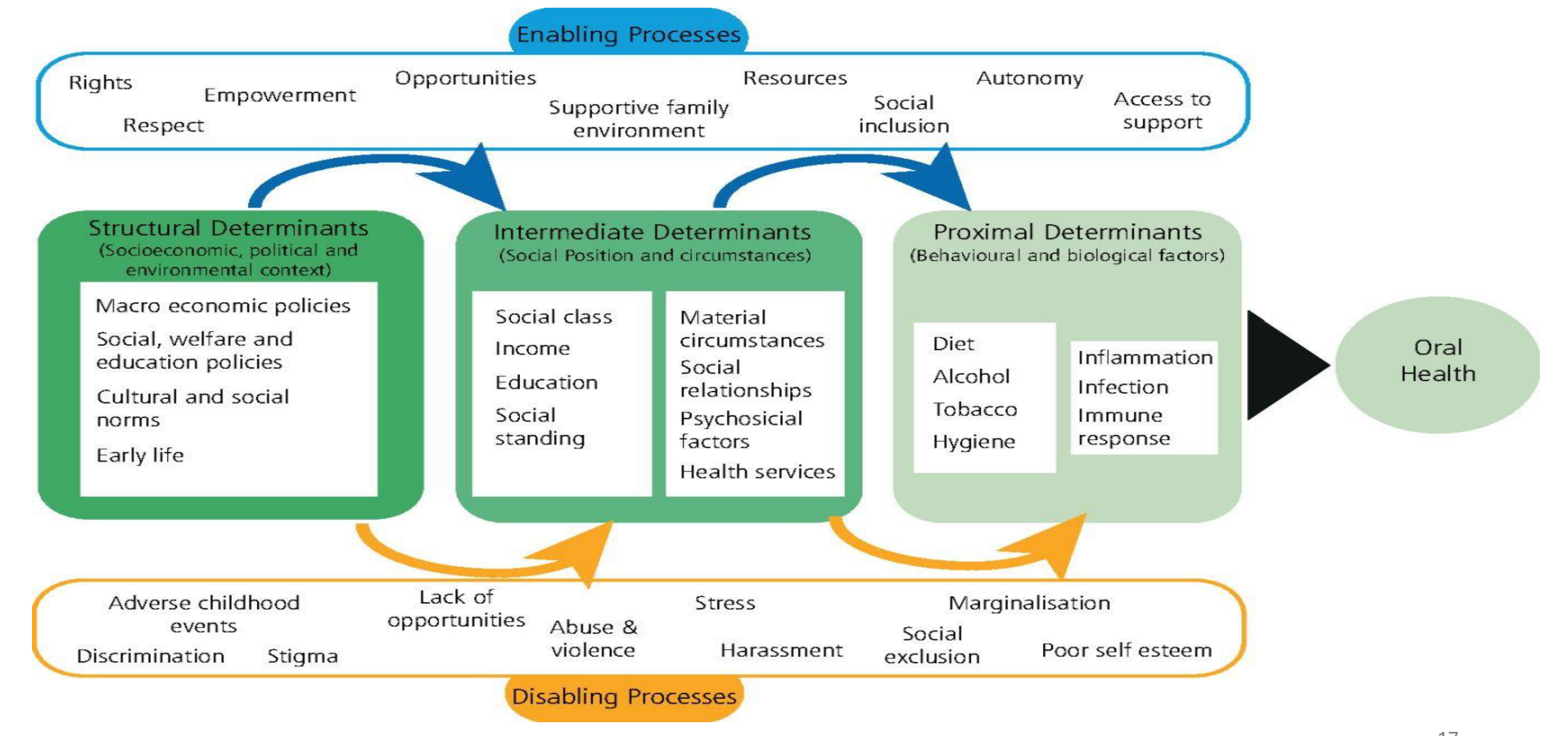
Enabling Processes
- Rights
- Empowerment
- Opportunities
- Resources
- Autonomy
- Respect
- Supportive family environment
- Social inclusion
- Access to support
Structural Determinants (Socioeconomic, Political, and Environmental Context)
- Macro economic policies
- Social, welfare, and education policies
- Cultural and social norms
- Early life
Intermediate Determinants (Social Position and Circumstances)
- Social class
- Income
- Education
- Social standing
- Material circumstances
- Social relationships
- Psychosocial factors
- Health services
Proximal Determinants (Behavioural and Biological Factors)
- Diet
- Alcohol
- Tobacco
- Hygiene
- Inflammation
- Infection
- Immune response
- Outcome: Oral Health
Disabling Processes
- Adverse childhood events
- Discrimination
- Stigma
- Lack of opportunities
- Abuse & violence
- Stress
- Harassment
- Marginalisation
- Social exclusion
- Poor self esteem
Watt, R., Venturelli, R. & Daly, B. Understanding and tackling oral health inequalities in vulnerable adult populations: from the margins to the mainstream. Br Dent J 227, 49–54 (2019).
Role of Intersectionality in Oral Health18
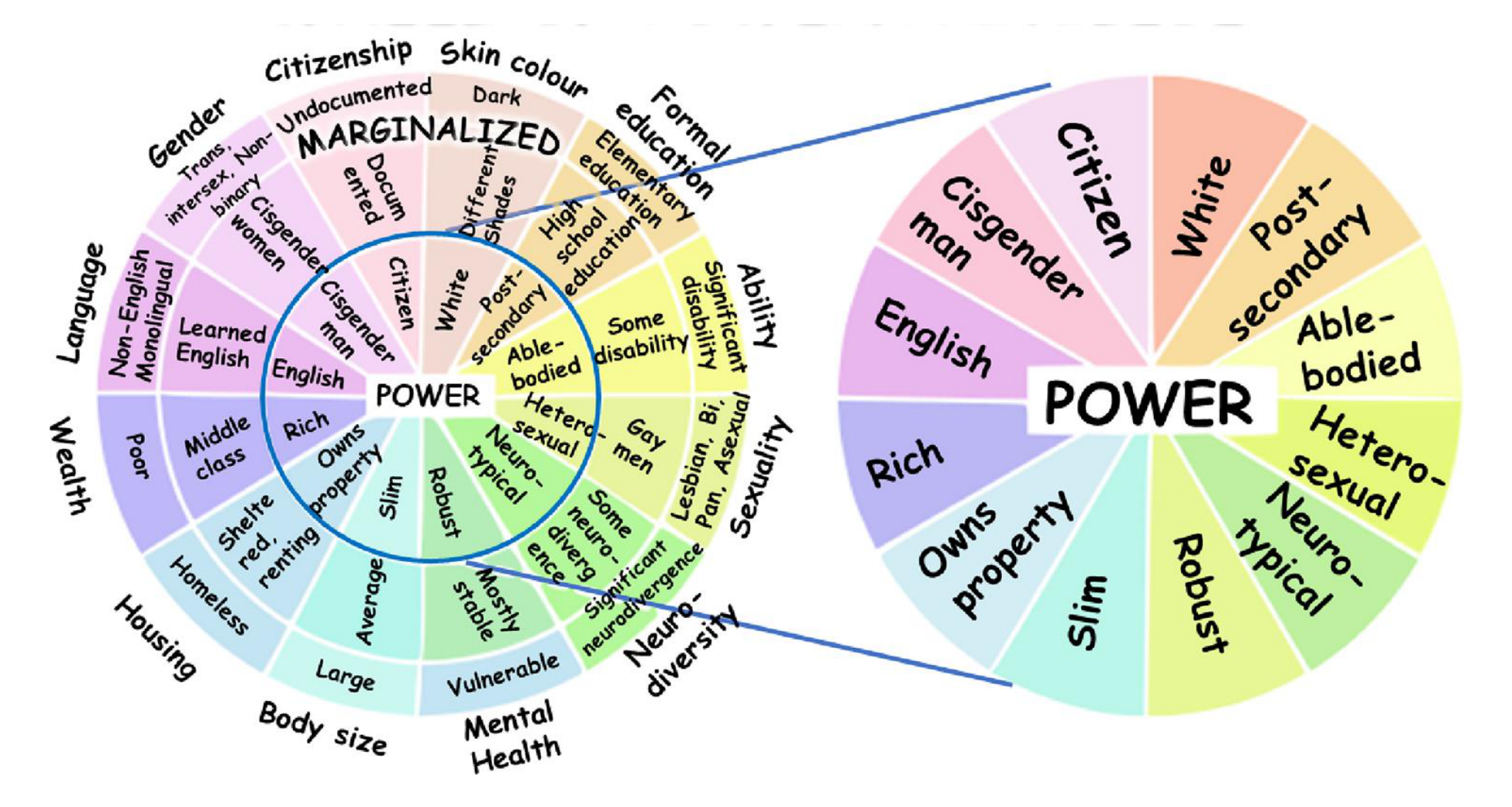
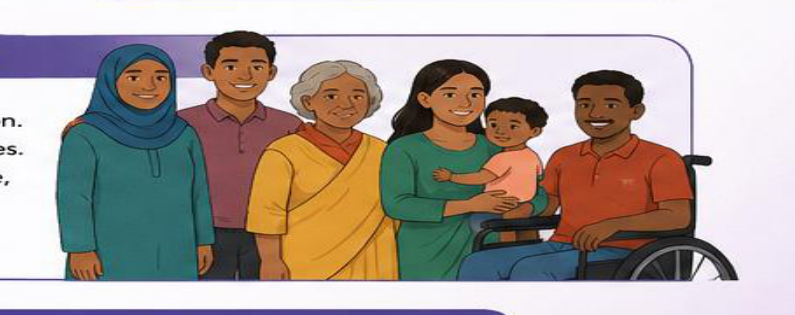
Oral health is shaped by how different parts of our identity and life experience come together.
Intersecting Dimensions19
- Socioeconomic Position: Income, education, employment, financial security
- Culture & Ethnicity: Language, norms, beliefs, traditions, experiences of racism
- Geography & Environment: Where we live, housing, pollution, climate, rurality
- Disability & Health: Physical, mental, intellectual impairments, chronic conditions
- Age: Different needs and vulnerabilities across the life course
 |  |  |
 |  |  |
Examples of Intersection
- A low-income woman from an ethnic minority may face gender discrimination AND racism AND financial barriers.
- A person with a disability from a rural area may face inaccessible services AND stigma AND transport challenges.
- An older adult with low education and limited income may experience ageism AND financial strain AND poor living conditions.
Oral Health Impacts
- Higher risk of cavities, gum disease, and tooth loss
- Less likely to access preventive care
- Delayed treatment and higher pain levels
- More out-of-pocket costs and financial stress
- Impact on self-esteem, wellbeing, and quality of life
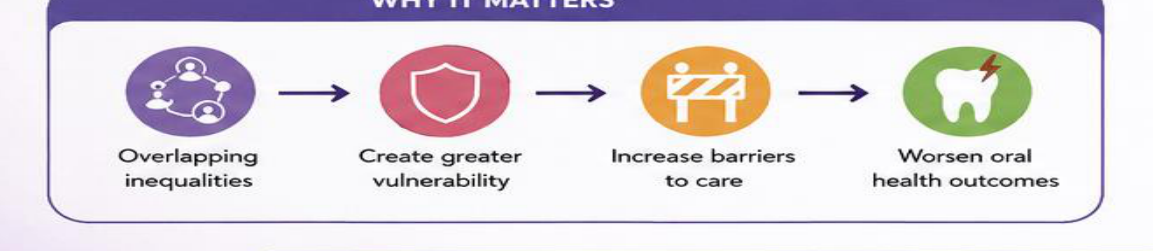
Why It Matters
Overlapping inequalities → Create greater vulnerability → Increase barriers to care → Worsen oral health outcomes
The Way Forward
- Recognize the whole person
- Address structural inequities
- Design inclusive, accessible, and respectful oral health services for all
Oral health equity happens when every part of who we are is seen, respected, and supported.
Slack-Smith L, Ng T, Macdonald ME, Durey A. Rethinking Oral Health in Aging: Ecosocial Theory and Intersectionality. J Dent Res. 2023 Jul;102(8):844-848. doi: 10.1177/00220345231175061. Epub 2023 Jun 14.
Intersectionality: Wheel of power/privilege
Jamieson L, Ju X, Haag D, Ribeiro P, Soares G, Hedges J (2023) An intersectionality approach to Indigenous oral health inequities; the super-additive impacts of racism and negative life events. PLoS ONE 18(1): e0279614. https://doi.org/10.1371/journal.pone.0279614.
Patient Perspectives and Care Frameworks
Patient Voices and Experiences20
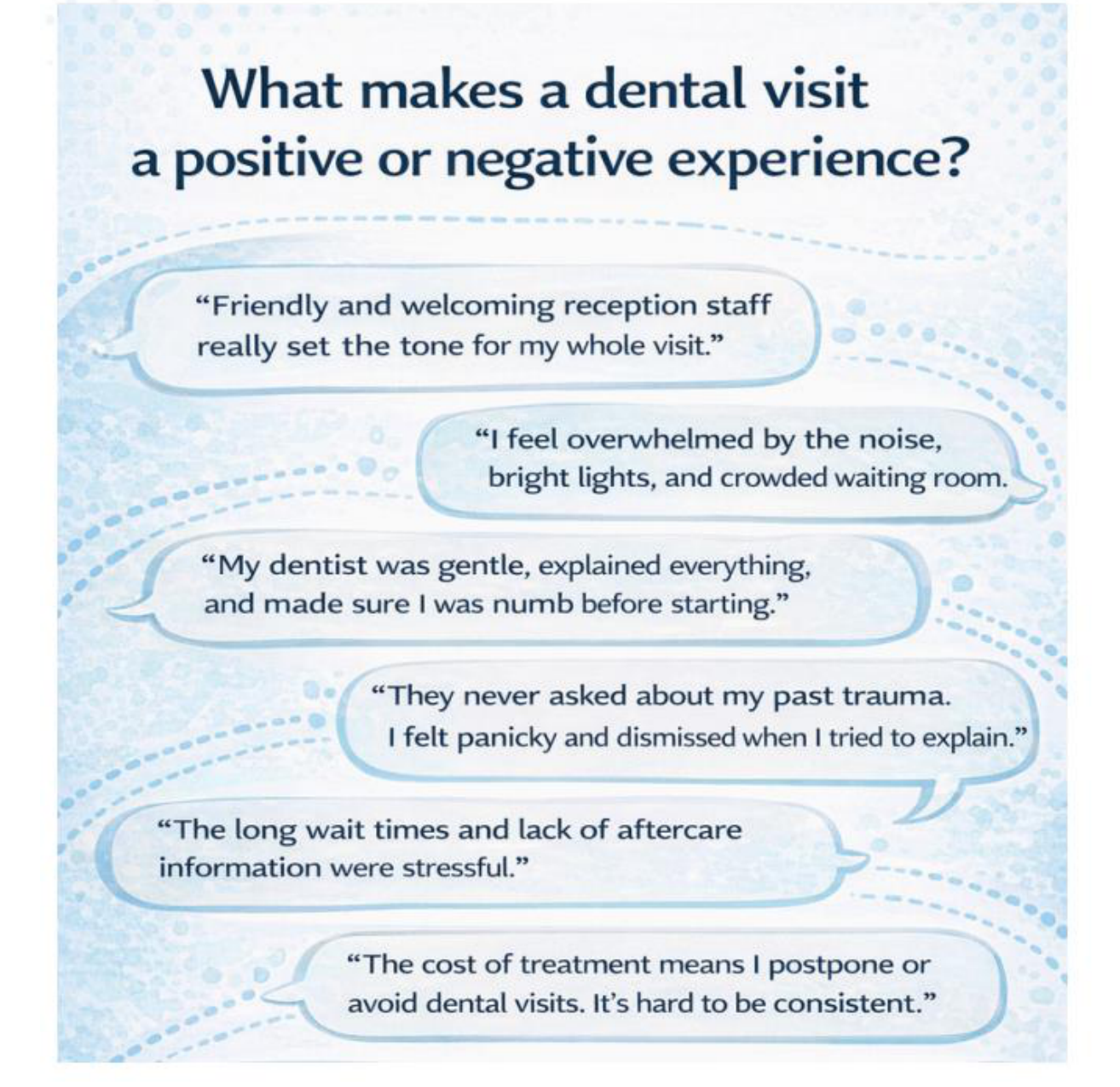
- “Friendly and welcoming reception stuff really set the tone for my whole visit.”
- “I feel overhelmed by the noise, bright lights, and crowded waiting room.”
- “My dentist was gentle, explained everything, and made sure I was numb before starting.”
- “They never asked about my past trauma. I felt panicky and dismissed when I tried to explain.”
- “The long wait times and lack of aftercare information were stressful.”
- “The cost of treatment means I postpone or avoid dental visits. It’s hard to be consistent.”
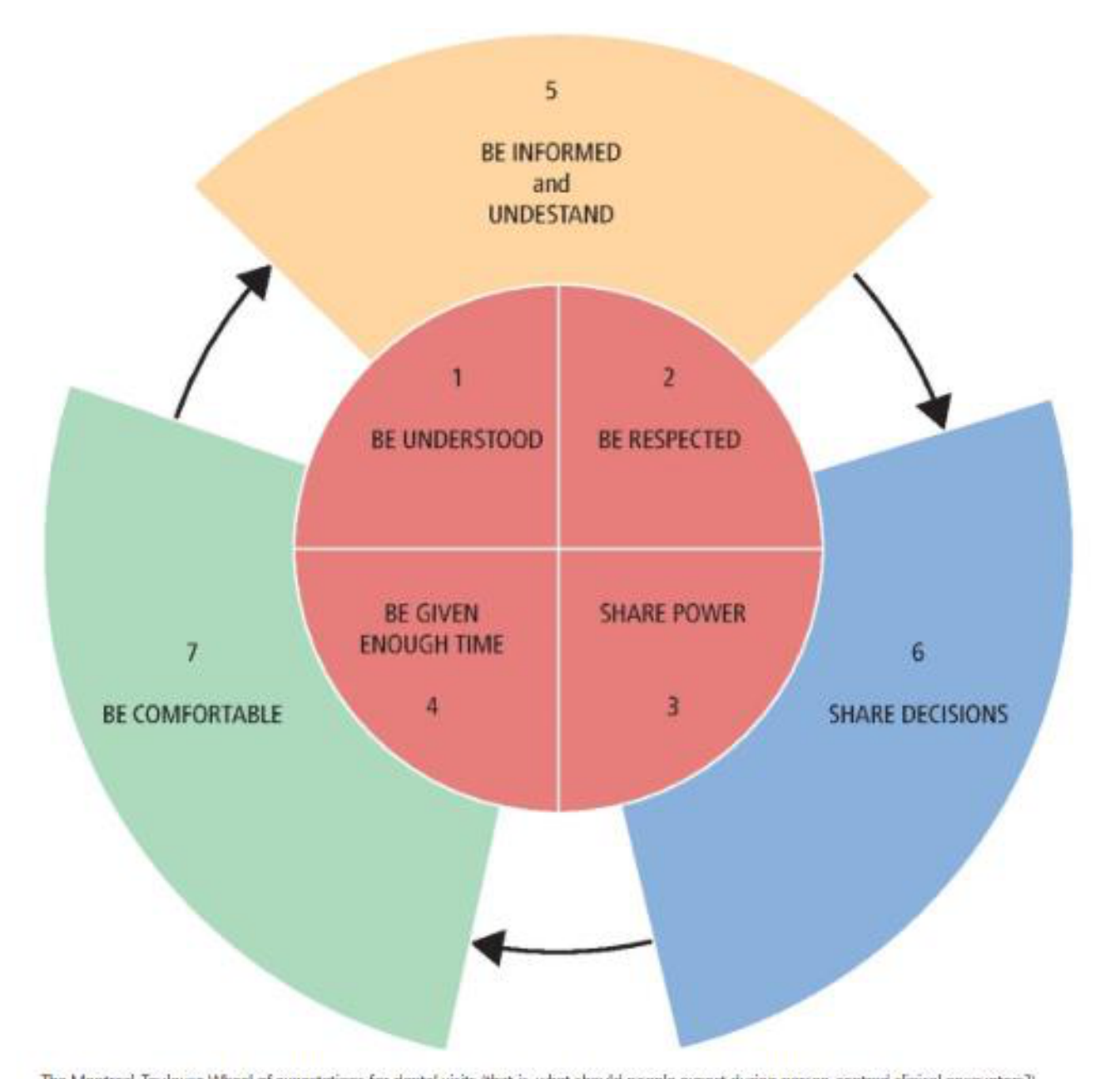 |  |
What Do Our Patients Want?
Bedos, C., Apelian, N. & Vergnes, JN. What should people expect from person-centred dental visits? The Montreal-Toulouse Wheel of expectations. Br Dent J 231, 249–253 (2021).
Junaid, M., Anthonappa, R., Lim, D., & Saikia, A. (2026). Dental Voices Community Conversations Summary Report. https://cciprogram.org/wp-content/uploads/sites/2/2026/02/Dental-Community-Conversation-Summary-Report.pdf
Patient-Centred Care Framework
Core Dimensions of Care21
- Exploring Disease and Its Context
- Involves the clinician considering both the presenting disease and the way the patient experiences it.
- The Patient as a Whole Person
- Clinician seeks to understand illness within the person’s bio-psychosocial circumstances.
- Doctor-Patient Relationship Ethos
- HCPs showing compassion and empathy and developing a long-term relationship conducive to decision-making.
- Doctor-Patient Relationship: Common Ground and Sharing Responsibility
- Patients and HCPs sharing responsibility in conceptualizing the patient’s illness experience.
 |  |  |
 |  |  |
 |  |  |
 |  |  |
 |  |  |
 |  |  |
 |  |  |
Hierarchy of Information and Choice
A patient-centered framework for informed decision-making:
- Level I: Information
- A range of generally disease information relevant to the patient’s health is provided.
- Level II: Information and Choice
- Level I plus the potential of choice between different treatment alternatives and/or non-treatment.
- Level III: Information, Choice, and Tools for Informed Choice
- Patients are supported in fully informed choice with all treatment alternatives considered from a medical and psychosocial perspective.
- Level IV: Patient in Full Control
- Information, choice, and tools are provided to patients, who make the final treatment decision appropriate to their psychosocial and contextual circumstances.
Empowering patients. Enhancing care. Sharing decisions. A collaborative approach to better health outcomes.
Scambler S, Gupta A, Asimakopoulou K. Patient-centred care—what is it and how is it practised in the dental surgery? Health Expect. 2015 Dec;18(6):2549-58.
Trauma-Informed Dental Practice
Core Principles for Oral Health Practitioners22
Safety + Trustworthiness + Choice + Collaboration + Empowerment
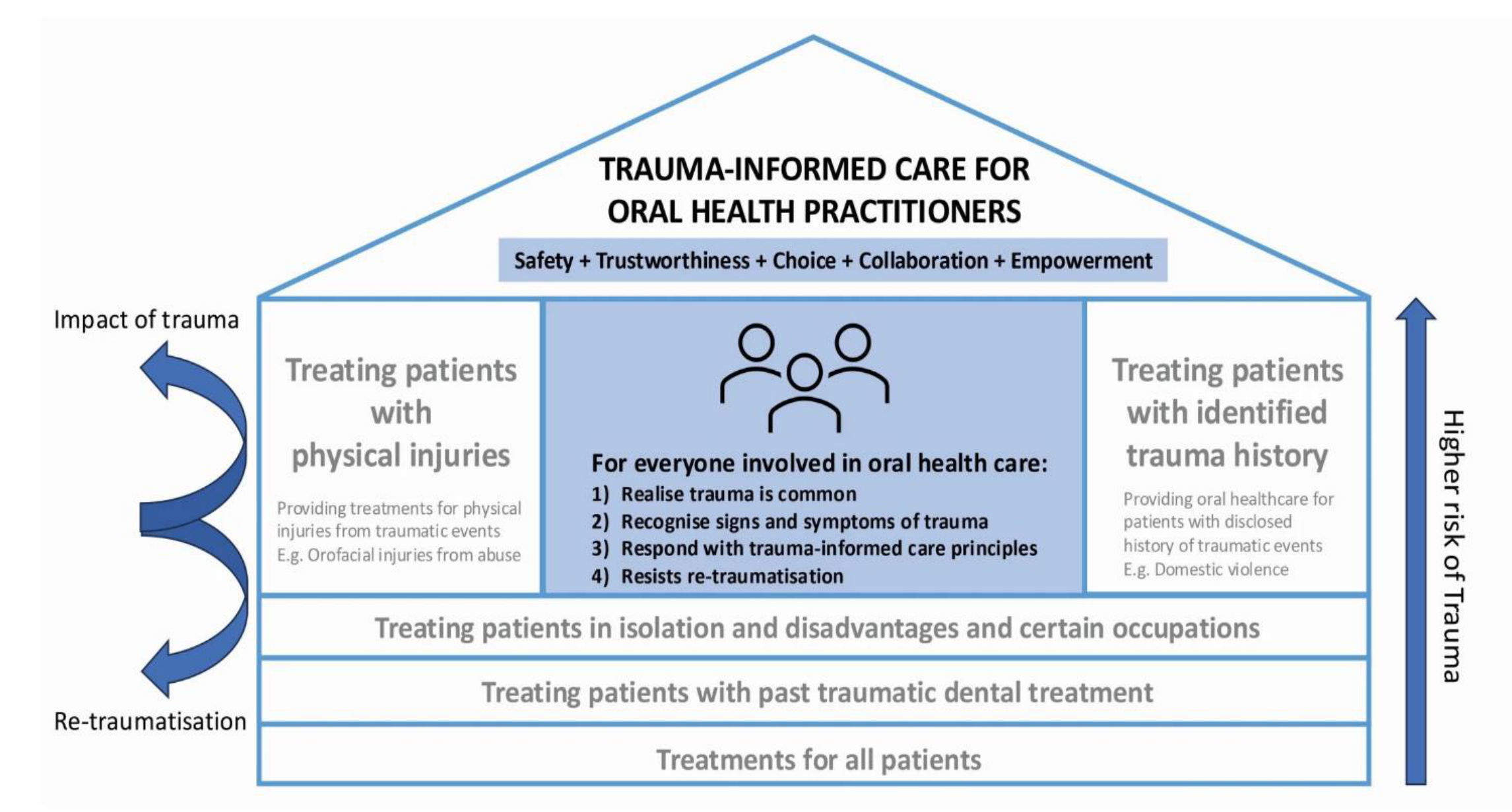
The Four Rs Framework
For everyone involved in oral health care:
- Realise trauma is common
- Recognise signs and symptoms of trauma
- Respond with trauma-informed care principles
- Resist re-traumatisation
Trauma-Informed Practice Scenarios
- Treating patients with physical injuries:
- Providing treatments for physical injuries from traumatic events (e.g., orofacial injuries from abuse)
- Treating patients with identified trauma history:
- Providing oral healthcare for patients with disclosed history of traumatic events (e.g., domestic violence)
- Treating patients in isolation and disadvantages and certain occupations
- Treating patients with past traumatic dental treatment
- Treatments for all patients (higher risk of trauma and re-traumatisation)
Choi KS, Sohn W, Leadbeatter D. Safe haven - a trauma-informed care model for oral health practitioners: a commentary. Br Dent J. 2025 Nov;239(10):717-721.
Steps in Trauma-Informed Practice
The 4 Rs in Dental Practice
1. Realise
Trauma is common. Many people carry invisible experiences.
Examples of trauma:
- Past abuse or violence
- Painful dental experiences
- Loss, grief, or neglect
- Discrimination or racism
- Refugee or war experiences
“Not all trauma is visible.”
2. Recognise
Behaviour may be a sign of trauma, not non-compliance (e.g., “What if it hurts?”, “I don’t like needles”, “I want to leave”).
Examples of behaviours:
- Cancelling or not attending appointments
- Appearing anxious, angry, or withdrawn
- Refusing treatment
- Becoming emotional
- Difficulty trusting
Think: “What might this person have been through?“
3. Respond
Create safety, trust, and choice.
Clinical responses:
- Ask what can make them comfortable
- Explain each step (e.g., “First, I will check your teeth with a small mirror.”)
- Use show-tell-do
- Ask permission to touch or examine
- Offer choices
- Involve in decisions
- Allow more time
4. Resist (Re-traumatisation)
Avoid causing further distress.
Ways to prevent re-traumatisation:
- Do not force treatment
- Be patient and non-judgmental
- Respect boundaries and culture
- Check consent throughout
- Pause if the person is distressed (e.g., “How are you feeling? Do you want to take a break?”)
Guiding Principles
- Patient feels safe, heard, respected, and in control.
- The trauma-informed question is: “What happened to you?” Not: “What’s wrong with you?”
We do no harm. We support healing. Kindness • Respect • Safety • Choice • Collaboration • Empowerment Better experience. Better outcomes. Better together.
Choi KS, Sohn W, Leadbeatter D. Safe haven - a trauma-informed care model for oral health practitioners: a commentary. Br Dent J. 2025 Nov;239(10):717-721.
Closing Poll and Break
Poll23
Do you feel confident in providing adequate person centred and trauma informed care to your patients?
Break24
Let’s have a break!
Audio Appendix
Additional Audio Content
The following sections from the lecture audio did not correspond to any heading in the main document.
Resilience
- Resilience is the capacity of the wire to store elastic energy and release it over time.
- Resilience can be increased by:
- Reducing wire thickness.
- Increasing wire length.
- Incorporating loops and helices.
- The Z spring demonstrates this approach:
- A 0.5 millimetre stainless steel wire is used.
- The design incorporates additional wire through loops and helices.
- This produces a larger range of activation and lower force for a greater deflection.
Posterior Bite Plate
- A posterior bite plate has an effect opposite to that of an anterior bite plate.
- It may be used to open the bite when correcting an anterior crossbite.
- It can also help control posterior tooth eruption in a hyperdivergent patient.
- Posterior encapsulation is used to prevent posterior eruption.
Elastics
- Elastics may be attached to a clasp and used intraorally for incisor retraction.
- The patient must be monitored closely and instructed carefully.
- If the elastic slips, it may injure the soft tissues.
- Incorrect placement by the patient may also compromise treatment.
People Involved in Fabrication
- The dentist or specialist is responsible for:
- Clinical findings.
- Cast analysis or assessment of the digital model.
- Treatment objectives.
- Treatment planning.
- Appliance design.
- Instructions to the technician.
- Appliance fitting, insertion, activation, and follow-up.
- The dental technician is responsible for constructing the appliance according to the clinician’s design and instructions.
- A good relationship and clear communication between clinician and technician are important because inadequate communication may result in an appliance that does not fit or function as expected.
Limitations of Removable Appliances
- Only a limited number of movements can usually be achieved at one time.
- The appliance is generally most suitable for activating one or two teeth at once.
- It is difficult to move teeth that are significantly inclined.
- More complex movements, including controlled tipping, torque, and rotation, may be difficult or impossible.
- Rotation is difficult because it generally requires forces applied at two points, whereas a spring may act primarily in one direction.
- Closing residual spaces is limited:
- Some spaces can be closed with clasps or springs.
- Very small remaining spaces may be difficult to close.
- Lower appliances may be poorly tolerated because of discomfort.
- The appliance may be left out by the patient.
- Speech may be affected during the first weeks, although the patient may gradually adapt.
- Removable appliances are inefficient for multiple individual tooth movements.
- Good laboratory technicians are needed for complex or specialised designs.
- The appliance can lose retention if the acrylic or clasp does not adapt correctly.
- Excessive acrylic thickness may interfere with speech or make insertion and removal difficult.
- Anchorage and retention limit the amount of activation possible.
Double Cantilever or Double-Loop Lever Spring
- A double-loop lever spring follows a similar principle to the Z spring.
- It may be used when movement is required across several incisors.
- Because it affects more teeth, a thicker wire may be necessary to deliver the required force.
- The spring provides a broader movement than a spring designed for a single tooth.
Anchorage in Removable Appliances
- Anchorage is the resistance to unwanted movement caused by activation of the appliance.
- When a spring is activated, the anchorage unit must resist the reciprocal force.
- Reinforced anchorage is achieved by incorporating more teeth into the anchorage block.
- Anchorage can be improved by:
- Extending the acrylic plate.
- Including additional teeth.
- Selecting more retentive clasps.
- Using additional stabilising components.
- Increasing palatal coverage when possible.
- The appliance must remain in position while allowing the planned tooth movement.
- In the lower arch, the acrylic cannot be extended excessively because of the tongue.
- The clinician must therefore compensate with appropriate clasp design and retention.
- Acrylic cannot simply be made thicker because this may interfere with speech or prevent the patient from removing the appliance.
Screws
- Screws may be positioned in different areas of the anterior acrylic.
- Their position determines the movement produced.
- For retroclined incisors, activation of the screw separates parts of the acrylic plate and moves the incisors labially.
- Screw position therefore allows the appliance to be adapted to the required tooth movement.
Reasons for Using a Removable Appliance
- A removable appliance is relatively simple apart from its construction.
- It generally requires less chair time.
- Follow-up and activation are relatively straightforward.
- The appliance is relatively inexpensive.
- Its design can be individualised.
- Oral hygiene is easier because the patient can remove the appliance for cleaning and toothbrushing.
- If the appliance is damaged, the patient can usually remove it and contact the clinician or laboratory rather than requiring an emergency appointment.
- A removable appliance may be used as:
- An active orthodontic appliance.
- A passive retainer.
- A space retainer.
- A space-regaining appliance.
- A habit-breaking appliance.
- An appliance incorporating an anterior or posterior bite plate.
Base Plate
- The base plate is the acrylic component of the appliance.
- Its design includes:
- The limits of acrylic coverage.
- The position and extension of clasps.
- The location of springs, screws, or other active components.
- The amount of coverage required for anchorage.
- Palatal coverage may provide a larger area for support and help prevent unwanted tooth movement.
Required Properties
The wire should have:
- Adequate strength to resist permanent deformation.
- A wide range of deflection.
- A relatively constant force over the working range.
- High resilience.
- Compatibility with the patient.
- Ability to be soldered or joined when required.
Stabilising Components
- A proximal spur may increase retention between teeth.
- An occlusal rest may be used, particularly in a lower removable appliance.
- These components help stabilise the appliance and resist unwanted movement.
Soldering and Heat
- Silver soldering requires the silver to melt at approximately 700°C.
- Heating must be rapid and controlled.
- Excessive heating can remove the hardening produced during wire manufacture.
- This softens the wire and reduces its mechanical properties.
- A wire damaged by overheating should be discarded and replaced.
- Failure to do so may result in additional clinical and laboratory procedures.
Springs and Active Components
Other Clasp Variations
- A clasp may be adjusted beneath a bonded appliance or other dental device to improve retention.
- A Townsend clasp was mentioned as an example of another design.
- The names of clasp designs may vary, so drawings and clear instructions are preferable to relying only on terminology.
Clinical and Laboratory Workflow
Z Spring
- The Z spring is bent during wire-bending exercises and embedded in the acrylic plate.
- It can be used to correct an anterior crossbite.
- Activation of the spring moves an anterior tooth forward.
- The appliance design must provide adequate space for the tooth to move.
- If a clasp is too close to the tooth, the tooth will not have enough room to move.
- The force must be applied from the labial side while the design provides space in the direction of movement.
- A 0.5 or 0.6 wire may be used to provide resilience and an adequate range of activation.
- Both helices can be activated to alter the position of an incisor.
Safety
- Safety glasses should always be used when cutting wire.
- Wire ends must be bent or finished so that they are not sharp inside the patient’s mouth.
- The same principle applies to clasp terminals and appliance-removal components.
Habit-Breaking Cribs
- A tongue habit may result in the tongue positioning between the incisors and contribute to an open bite.
- A crib can block the tongue.
- The crib may be:
- Fixed, or
- Connected to the acrylic of a removable appliance.
- Patient cooperation is particularly important when treating a habit because the patient may find it difficult to understand and maintain the required appliance use.
Ball Clasp
- Ball clasps are placed proximally between teeth.
- They may have a straight or curved design.
- The end can act as a lever to help the patient remove the appliance.
- The terminal end must not be exposed as a sharp wire.
Removable Orthodontic Appliances: Design, Construction, Communication, and Wire Bending
Nickel Sensitivity
- Stainless steel contains nickel.
- Patient allergy history should be considered.
- Earrings may be used as an example when asking about possible nickel sensitivity.
- A patient who can only tolerate gold-based earrings may have a problem with nickel-containing stainless steel.
- A titanium-based wire may be considered in such cases, although it was described as substantially more expensive.
Principles of Removable Appliance Design
Looping Pliers
- Looping pliers are used for forming loops.
- They are available with different tip sizes.
- A round tip should be used when forming loops and helices.
Lecture Purpose and Scope
- Wire bending is taught so students can:
- Prepare their own removable appliance, or
- Have the minimum knowledge required to understand and monitor all stages of appliance construction.
- The lecture brought together previously taught knowledge and applied it to removable appliances.
- Main topics included:
- Reasons for using a removable appliance.
- People involved in fabrication.
- Communication with the dental laboratory.
- Ideal properties, advantages, and limitations.
- Principles of appliance design.
- Active components, retention, and anchorage.
- Different springs, clasps, screws, bite plates, and habit-breaking components.
- Wire properties and basic wire-bending principles.
Communication with the Dental Laboratory
Work Hardening
- Repeated bending and unbending introduces deformation into the wire’s microstructure.
- This process produces work hardening.
- Excessive work hardening can make the wire brittle.
- A wire that is repeatedly bent, unbent, and corrected may fail when activated.
- If a spring fails after the appliance has been constructed, new impressions or scans and additional laboratory procedures may be required.
- Corrections should therefore be minimised before the appliance is placed into service.
Wire Thickness and Force
- Thicker wires provide greater strength but may have lower resilience.
- Thinner wires provide greater flexibility and range but are more vulnerable to distortion.
- A 0.5 millimetre wire may provide increased resilience and range compared with thicker wire.
- A thicker wire may be required when a spring must move several teeth or deliver more force.
Labial Bow
- A labial bow may:
- Increase retention.
- Retract incisors when activated.
- Close residual spaces.
- Function as a passive retainer when inactive.
- The wire may extend from approximately the middle of the canine to the distal region and contact the incisors.
- The design must provide enough acrylic clearance for the bow to be activated.
- Wire sizes mentioned included 0.7 and 0.8 stainless steel wire.
- If the wire is too flexible, the patient must be carefully instructed when inserting and removing the appliance to avoid over-bending it.
Anterior Bite Plate
- An anterior bite plate may be used for a patient with a deep overbite.
- The lower incisors contact the acrylic plate.
- This prevents or limits further eruption of the incisors.
- The posterior teeth may then erupt.
- Posterior eruption can rotate the mandible clockwise and reduce the anterior overbite.
- The acrylic must be oriented approximately perpendicular to the lower incisors.
- If the plate is inclined, it acts as an inclined plane.
- Instead of preventing incisor eruption, it may procline or protrude the incisors.
- Variations may include:
- A groove or indentation for the incisors.
- Additional acrylic coverage over an upper incisor.
Selecting the Correct Pliers
T Spring
- The T spring is named for its shape.
- Depending on its activation, it can move a molar in a buccal or lingual direction.
- Different spring designs and activation directions are selected according to the intended tooth movement.
Z Spring for Molar Distal Movement and Space Regaining
- A variation of the Z spring can be used to move a molar distally.
- This may be required when:
- An early tooth loss has occurred.
- A first permanent molar has drifted mesially.
- The eruption path of a premolar has been compromised.
- Activating the spring moves the molar backwards and opens space for the premolar.
- This movement is difficult because molars are large teeth requiring substantial anchorage.
- The appliance should therefore include as much acrylic coverage as possible.
- In the upper arch, acrylic can cover much of the palate.
- In the lower arch, acrylic cannot be extended as extensively because of the tongue, so additional clasps may be necessary.
- Approximately 0.5 wire may be used.
- The interproximal section of the wire moves the molar distally.
- The movement is limited to approximately two millimetres.
- If the molar has drifted more than half the premolar space, space reopening becomes difficult.
- The second molar may also have moved forward and block distal movement of the first molar.
Movements That May Be Achieved
Depending on appliance design, removable appliances may be used for:
- Labial movement of incisors.
- Palatal movement or retraction of incisors.
- Mesial or distal movement of incisors.
- Buccal or palatal movement of other teeth.
- Space regaining.
- Retraction of canines or incisors.
- Habit breaking.
- Bite opening.
- Overbite reduction.
- Posterior tooth control.
- Expansion.
Ideal Properties of a Removable Appliance
A removable appliance should:
- Be simple in design.
- Provide adequate retention.
- Have wires that are sufficiently strong to resist breakage during repeated insertion and removal.
- Provide an adequate range of action.
- Allow springs to remain active until the next follow-up appointment, often for approximately two or three weeks.
- Be sufficiently flexible to permit adjustment.
- Be comfortable and acceptable to the patient.
- Permit adequate oral hygiene.
- Maintain its position while the active component is functioning.
Buccal Canine Retractor
- A buccal canine retractor can move a canine in the labial or buccal direction toward the palatal orientation.
- Activation of the spring produces the planned movement.
- The movement depends on the position of the spring and the direction in which it is activated.
Expansion
- Removable expansion appliances mainly produce slow dental expansion.
- Activation must be incremental because excessive activation may reduce retention and cause the appliance to dislodge.
- Patients may be instructed to activate the screw once or twice per week.
- Two activations produce approximately 0.5 millimetres of screw opening, or approximately 0.25 millimetres on each side.
- The slow activation is necessary because removable appliances have limited retention and anchorage.
- This differs from a fixed rapid expansion appliance, where bands are cemented and retention is greater.
- In the lower arch, expansion generally produces dental rather than skeletal effects because there is no mid-palatal suture.
- The screw must be positioned correctly in all three planes of space.
- Incorrect positioning may result in:
- Asymmetrical screw activation.
- Asymmetrical expansion.
- Unwanted tooth movement.
- Appliance displacement.
Types of Clasps
Wire Properties
Retention
- Retention is the force that holds the appliance in position in the mouth.
- Retention is provided mainly by:
- Clasps.
- Acrylic adaptation and coverage.
- The appliance does not rely on suction.
- Retention can be increased by:
- Adding more clasps.
- Using labial or other retaining components.
- Including more teeth.
- Extending the acrylic plate.
- Improving adaptation to the teeth.
Clinical Planning
The general sequence includes:
- Record clinical findings.
- Analyse the cast or digital model.
- Develop treatment objectives and a treatment plan.
- Obtain an impression or perform dental scanning.
- Communicate the appliance design and intended movements to the dental technician.
- Construct and bend the required wire components.
- Attach the wire components to the cast.
- Process the acrylic component.
- Trim and polish the appliance.
- Try in, fit, and insert the appliance.
- Adjust clasps and springs.
- Activate springs where necessary.
- Provide instructions and motivate the patient.
- Monitor treatment and complete follow-up appointments.
Practical Session
- The lecture concluded with a transition to the clinical simulation skills laboratory.
- Students were to practise the discussed removable appliance construction, wire bending, and related procedures.
Active Components
Active components produce the planned tooth movement. They may include:
- Springs.
- Bolts.
- Screws.
- Elastics.
Acrylic Processing
- A separating medium is applied to the cast.
- Acrylic can be formed using the salt-and-pepper technique, placing small increments of monomer and polymer.
- Polymerisation may be completed in a pressure pot or another closed environment.
- This helps prevent monomer release and produces a smoother surface with less roughness.
- The completed appliance is trimmed and polished before fitting.
Jack Screws and Expansion Appliances
- A jack screw is activated using a small lever.
- Each turn produces approximately 0.25 millimetres of activation.
- Four activations therefore correspond to approximately one millimetre.
- The screw can be positioned according to the required movement.
- It may be used to:
- Move upper molars forward.
- Regain space on both sides.
- Produce expansion when positioned centrally.
Stainless Steel
- Stainless steel is commonly used because it is relatively inexpensive.
- It has good weldability and can be soldered to another stainless steel component using silver solder.
- An example is connecting a stainless steel lingual arch to a stainless steel band.
- Austenitic stainless steel was described as an 18/8 alloy, with approximately:
- 18% chromium.
- 8% nickel.
- Chromium contributes to corrosion resistance by forming a passive oxide layer.
- Nickel stabilises the austenitic phase.
- Martensitic stainless steel was described as too hard for wire bending.
- Stainless steel has a high modulus of elasticity and is therefore relatively stiff.
- The stiffness is compensated for by using thinner wire and incorporating more wire length through loops and helices.
Basic Wire-Bending Rules
Clasps, Retention, and Stabilisation
Adams Clasp
- The Adams clasp provides a high level of retention.
- It is one of the most retentive clasp designs discussed.
- It may be used to reinforce anchorage during activation.
Retaining Components
Retention is commonly provided by:
- Clasps.
- Ball clasps.
- Acrylic coverage.
- Special stabilising components.
Adams Pliers
- Adams pliers have two square tips.
- They are suitable for sharp-edged or square bending.
- They should not be used to form loops or adjust the helices of a Z spring.
- Using them for loops can require repeated adjustments at the same point and introduce excessive work hardening.
Patient Cooperation
- Patient motivation is essential.
- The appliance will not work effectively if the patient does not cooperate with wearing, removing, cleaning, and caring for it.
- Patients must be instructed carefully on:
- How to insert and remove the appliance.
- How to clean it.
- How to avoid bending or damaging wires.
- How to activate components when required.
- When to contact the clinician or return the appliance for repair.
Bite Plates and Habit-Breaking Appliances
Anchorage
- Anchorage is the resistance to unwanted tooth movement.
- The appliance must be designed so that activation of the active component does not displace the appliance.
- Anchorage can be increased by:
- Including more teeth in the appliance.
- Modifying the clasp design.
- Extending the acrylic plate.
- Increasing palatal acrylic coverage.
- Using additional stabilising components.
- The acrylic plate should be extended sufficiently to maximise anchorage but should not be excessively thick or extensive because this may affect speech and appliance removal.
Piston-Type Screw
- A piston-type screw works through a component positioned beneath the acrylic.
- When the screw is activated, the piston contacts the tooth and moves it labially.
- This can be used for an incisor in anterior crossbite.
Common Design and Construction Problems
- Acrylic may fail to adapt to the model.
- A clasp may be distorted or incorrectly bent.
- Poor clasp adaptation reduces retention.
- Reduced retention decreases anchorage.
- Activation may cause the appliance to dislodge.
- An appliance intended to be a retainer may fail to remain in position.
- A clasp may obstruct eruption of a canine.
- The clasp design may need to be extended toward the premolars or otherwise modified.
- An Adams clasp may not adapt closely to the buccal surface.
- If one side adapts and the other does not, retention may be unequal and the appliance may not remain stable.
- Components may interfere with the planned movement:
- For example, a labial bow intended only for retention may obstruct a spring intended to move a canine distally.
- The clasp or bow must therefore be modified so that it does not contact the distal surface of the tooth being moved.
Indications and Advantages of Removable Appliances
Roberts Retractor
- The Roberts retractor follows a similar principle to other labial retraction components.
- A 0.5 stainless steel wire increases resilience and range of movement.
- However, thinner wire is easier for the patient to over-bend during removal and insertion.
- Patient instruction is therefore important to prevent permanent distortion and loss of activation.
C Clasp
- The C clasp is relatively easy to bend.
- It follows the cervical part of the molar.
- It can be comfortable for the patient.
- The end should be bent so that it is not sharp.
- The distal end may also be used by the patient as a point for removing the appliance.
Heavy Cutters
- The wire should be held securely on both sides before cutting.
- This prevents the cut section from injuring people nearby.
Digital and Conventional Communication
- Historically, the clinician provided an impression and a drawing.
- Current workflows commonly use intraoral scanning.
- Notes can be added to the digital scan.
- Some systems allow a drawing or image to be uploaded with the scan.
- The laboratory may:
- Receive the scan.
- Print a working model.
- Bend the wires.
- Prepare the acrylic and bite plate.
- Although the workflow is now digital, the communication requirements remain essentially the same.
Clinician’s Responsibilities
The clinician must communicate:
- The intended tooth movement.
- Treatment objectives.
- The type and location of active components.
- The clasp design and location.
- The limits of the acrylic plate.
- Any required modifications.
- The desired bite plate or habit-breaking component.
- Any special requirements for retention or anchorage.
Components of the Appliance
Importance of Drawings
- A general instruction such as “make a removable appliance to regain space” is insufficient.
- There are many possible designs for springs, clasps, and active components.
- Clasp names may not be used consistently or may not be understood by every technician.
- A drawing can show:
- The clasp location.
- The acrylic limits.
- The position of springs and screws.
- The desired movement.
- Areas that must remain clear for tooth movement.
- The clinician does not need to tell an experienced technician how to perform the technician’s work, but must clearly state what is required.
Arrowhead Clasp
- The arrowhead clasp is named for the shape of its retaining component.
- Involving more teeth can increase retention and anchorage.
Clinical Cases
Case: Space Regaining for a Drifted Molar
Question
Scenario: A patient presents with a missing first molar where the adjacent first permanent molar has drifted mesially, preventing the eruption of the second premolar.
What’s shown: A clinical scenario of space loss due to the mesial drift of the first molar into the extraction space, blocking the eruption path of the second premolar.
Consider: How can this be managed with a removable appliance, and what are the limitations of this approach?
Answer
Observations:
- The first molar has drifted mesially into the space of the missing tooth.
- The second premolar cannot erupt due to the lack of space.
Reasoning: A spring can be activated on a removable appliance to move the first molar distally and open space for the second premolar. However, there are limitations: a removable appliance can typically only regain up to 2 mm of space. If the molar has drifted more than half the space, the second molar may also have moved mesially, blocking further movement. Additionally, moving a large tooth like a first molar requires significant anchorage, which is challenging in the lower arch where the acrylic base cannot be as extensive.
Takeaway: While removable appliances can be used to regain space for a drifted molar, they are limited in the amount of space they can recover and require careful consideration of anchorage, especially if adjacent teeth have also drifted.
Case: Clasp Interfering with Canine Eruption
Question
Scenario: A removable appliance design is being evaluated for a patient who has a canine that needs to erupt.
What’s shown: An exhibit of a removable appliance where the clasp is positioned in a way that it blocks the eruption path of the canine.
Consider: What is the problem with this design and how should it be modified to accommodate the erupting tooth?
Answer
Observations:
- The clasp is positioned in a way that prevents the canine from erupting.
Reasoning: If a clasp is placed over or near an erupting tooth, it will physically block its vertical movement. To resolve this, the design must be changed, such as by extending the clasp to the premolar area, to clear the canine’s eruption path.
Takeaway: Removable appliance designs must account for the eruption paths of teeth to avoid blocking them with clasps or acrylic components.
Case: Poorly Adapted Adams Clasp
Question
Scenario: An upper removable appliance is being evaluated for fit and retention.
What’s shown: An exhibit showing the bridge or buccal arm of an Adams clasp that is not properly adapted and is sitting far away from the tooth surface.
Consider: What is the consequence of this poor adaptation on the appliance’s function and stability?
Answer
Observations:
- The bridge or buccal arm of the Adams clasp is far from the tooth surface.
- There is a complete lack of retention on the affected side.
Reasoning: Because the clasp is not engaging the tooth properly, it fails to provide retention. Even if the other side of the appliance has adequate retention, the lack of retention on this side means the plate will not stay in position, especially when the active components are activated.
Takeaway: Proper adaptation of clasps is critical for retention; a poorly adapted clasp compromises the anchorage and stability of the removable appliance.
Case: Labial Bow Interfering with a Retraction Spring
Question
Scenario: A removable appliance is designed to retract a canine distally using a spring, while also utilizing a regular labial bow for retention.
What’s shown: An exhibit showing a regular labial bow resting on the distal aspect of the canine, in the exact area where a spring is meant to be activated to move the tooth.
Consider: What is the issue with this design and how can it be resolved to allow the canine to move distally?
Answer
Observations:
- The regular labial bow is in contact with the distal face of the canine.
- This physical presence prevents the activation of the spring intended to move the canine distally.
Reasoning: The labial bow physically blocks the spring from engaging and moving the tooth. To fix this, the design of the labial bow or clasp must be modified so it does not contact the distal surface of the canine, allowing the spring to function properly and move the tooth backwards.
Takeaway: When designing removable appliances, ensure that passive retention components like labial bows do not interfere with the activation path of active components like springs.
Footnotes
-
Original PDF page 1: W1 Project PDH population informed clinical case, p.1 ↩
-
Original PDF page 2: W1 Project PDH population informed clinical case, p.2 ↩
-
Original PDF page 3: W1 Project PDH population informed clinical case, p.3 ↩
-
Original PDF page 4: W1 Project PDH population informed clinical case, p.4 ↩
-
Original PDF page 5: W1 Project PDH population informed clinical case, p.5 ↩
-
Original PDF page 6: W1 Project PDH population informed clinical case, p.6 ↩
-
Original PDF page 7: W1 Project PDH population informed clinical case, p.7 ↩
-
Original PDF page 9: W1 Project PDH population informed clinical case, p.9 ↩
-
Original PDF page 10: W1 Project PDH population informed clinical case, p.10 ↩
-
Original PDF page 8: W1 Project PDH population informed clinical case, p.8 ↩
-
Original PDF page 11: W1 Project PDH population informed clinical case, p.11 ↩
-
Original PDF page 12: W1 Project PDH population informed clinical case, p.12 ↩
-
Original PDF page 13: W1 Project PDH population informed clinical case, p.13 ↩
-
Original PDF page 14: W1 Project PDH population informed clinical case, p.14 ↩
-
Original PDF page 15: W1 Project PDH population informed clinical case, p.15 ↩
-
Original PDF page 16: W1 Project PDH population informed clinical case, p.16 ↩
-
Original PDF page 17: W1 Project PDH population informed clinical case, p.17 ↩
-
Original PDF page 19: W1 Project PDH population informed clinical case, p.19 ↩
-
Original PDF page 18: W1 Project PDH population informed clinical case, p.18 ↩
-
Original PDF page 20: W1 Project PDH population informed clinical case, p.20 ↩
-
Original PDF page 21: W1 Project PDH population informed clinical case, p.21 ↩
-
Original PDF page 22: W1 Project PDH population informed clinical case, p.22 ↩
-
Original PDF page 24: W1 Project PDH population informed clinical case, p.24 ↩
-
Original PDF page 25: W1 Project PDH population informed clinical case, p.25 ↩