Rest and Rest Seat12
This section introduces the fundamental concepts of rests and rest seats within the context of Removable Partial Denture (RPD) design and application.
Learning Outcomes3
Upon completion of this section, the reader should be able to:
- Discuss the clinical importance and functional roles of the rest and rest seat.
- Differentiate between a rest (a component of the RPD framework) and a rest seat (a preparation on the tooth)
- Describe the ideal structural and anatomical features of various rest seats, including:
- Occlusal rest seats
- Lingual rest seats
- Incisal rest seats
- Determine the appropriate clinical positioning for both primary and secondary rests.
- Apply guidelines for rest distribution to ensure biomechanical stability and prevent damage to abutment teeth


Definition4
REST:
- Component of a Removable Partial Denture (RPD) in contact with the tooth surface.
- Provides vertical support and transmits occlusal load to abutments.
- Rigid structure, part of the metallic framework.
- Rigidity is critical—thin or flexible rests risk fracture and fail to provide adequate support.
- The rest is often part of the clasp assembly, connected to the minor connector, retention arm, and reciprocal arm.
REST SEAT:
- A prepared surface on the abutment designed to receive the rest.
Importance of Rest Seat Preparation
Preparation is necessary to create space for the metal framework to sit within the natural tooth contour. Without it, the laboratory must create an oval metal contour sitting on the occlusal surface, causing the patient to bite "high" on that spot. Attempting to grind the metal to correct the high bite results in a dangerously thin rest that cannot function properly. Even when no opposing tooth exists, the occlusal surface must be adjusted to allow the rest to distribute forces properly along the tooth’s long axis.
Topography:
- The topography of the rest should restore the original topography of the tooth as it existed before the rest seat preparation.


Function of Rest56
Primary Functions
- To provide vertical support (occluso-gingival direction).
- Prevents the denture from moving toward the gingiva during function, protecting soft tissue from trauma
- To direct and distribute occlusal load to abutment teeth.
Secondary Functions
- To maintain components in their positions, assisting in stabilization and retention by neutralizing rotational movements.
- To maintain established occlusal relationships.
- To prevent impingement of soft tissues.
- To maintain the correct relationship between the clasp and the abutment.
- Seating Verification: The rest must sit fully inside the rest seat to confirm the denture is fully seated; if lifted, the clasp tips will not engage the correct undercuts
- To restore occlusal plane discrepancies.
- Metal rests serve as a reversible alternative to onlays or crowns for correcting tilted or extruded teeth
Load Distribution
-
Directs and distributes occlusal load to abutment teeth.
-
Axial direction: The most effective resistance is provided if the tooth is stressed along its long axis, which prevents damage to the abutment.
-
Distributes forces evenly along the periodontal ligament (PDL)
-
Prevents tipping forces which concentrate stress and increase the risk of bone resorption, oblique bone loss, and traumatic overload
Anterior Tooth Loading
While anterior teeth (especially canines) handle oblique forces during lateral excursions, strong anterior contacts in maximum intercuspation (MIP) lead to fremitus and PDL destruction.
Types of Rest and Rest Seat789
Classification by Location
- Occlusal
- Lingual (cingulum)
- Incisal
Classification by Function
- Direct
- Indirect
Morphology
- Rounded triangular shape.
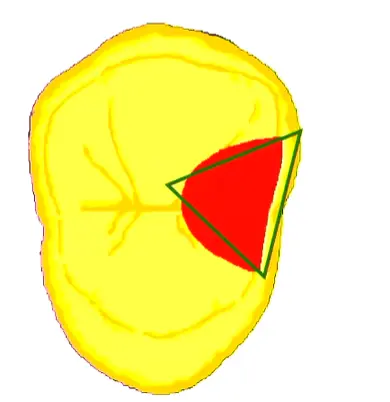


Occlusal Rest and Rest Seat101112131415161718
Dimensions
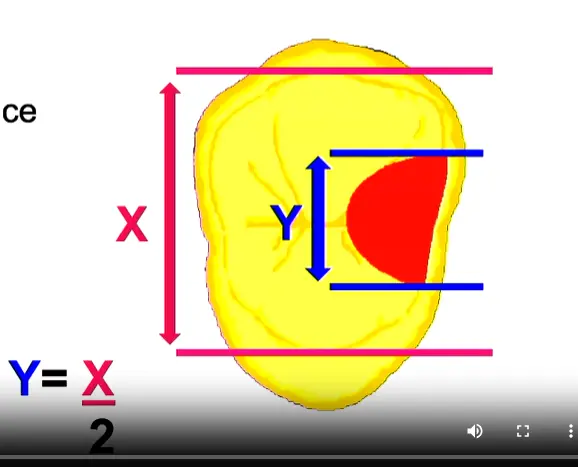
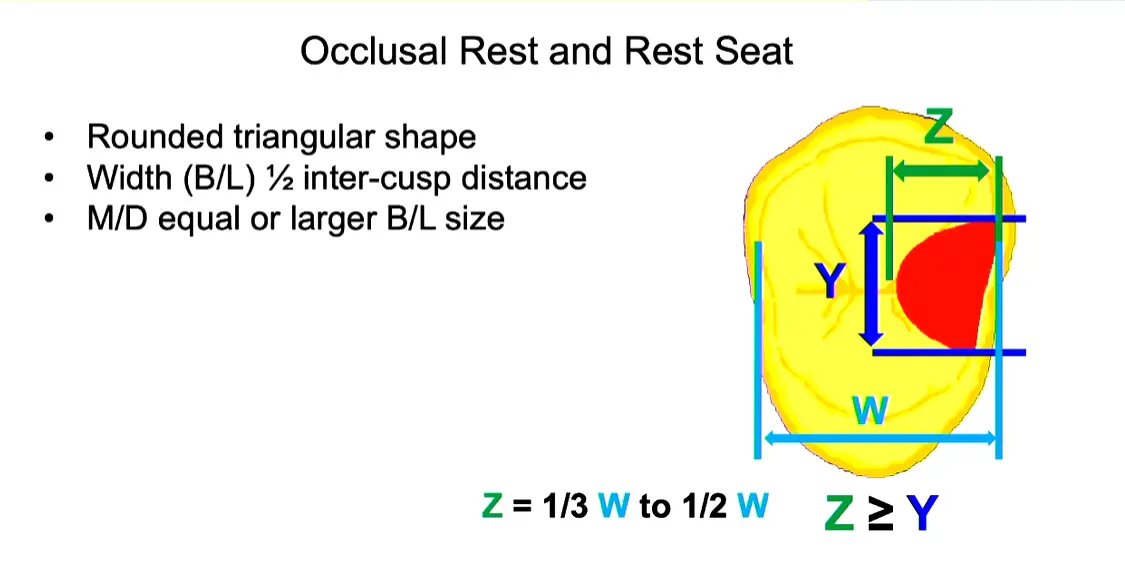
- Width (Bucco-Lingual): 1/2 the inter-cusp distance.
- Formula: Y = X / 2
Proportions
- Mesio-Distal (M/D) size should be equal to or larger than the Bucco-Lingual (B/L) size.
Floor Characteristics
- The floor of the rest seat should be concave and rounded.
- Sharp angles (box-shaped) prevent horizontal movement of the rest, increasing load on the tooth and promoting plaque accumulation.
Angulation
- The floor is slightly inclined apically (less than 90°).
- Sloping from the center toward the proximal contact creates tipping forces that can lead to tooth mobility if the proximal contact is lost.
Summary of Features
- Rounded triangular shape.
- Width (B/L) is 1/2 inter-cusp distance.
- M/D size is equal to or larger than B/L size.
- Floor is concave and rounded.
- Slightly inclined apically (less than 90°).
- if its more than 90 degrees then the load will tip the tooth, overload the ligament and make it mobile
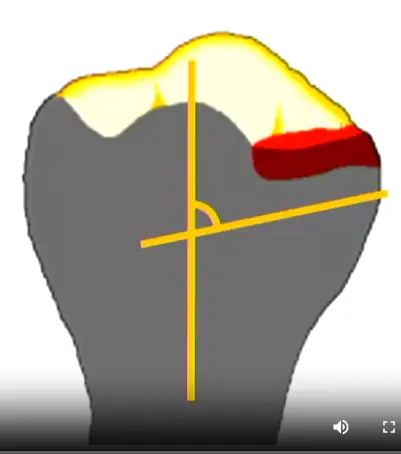
- if its more than 90 degrees then the load will tip the tooth, overload the ligament and make it mobile
Thickness Requirements
- 0.5 mm thick at its point.
- 1.0 – 1.5 mm thickness at the marginal ridge.
Average Measurements (mm)
Enamel Thickness1920
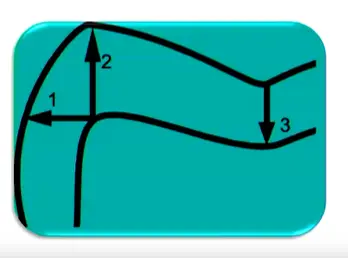
| Jaw | Molar (axial, occlusoaxial line angle, occlusal) | Premolar (axial, occlusoaxial line angle, occlusal) |
|---|---|---|
| Superior (Maxillary) | 1.25, 1.40, 1.25 | 1.00, 1.25, 1.00 |
| Inferior (Mandibular) | 1.25, 1.50, 1.28 | 1.10, 1.25, 0.80 |
Clinical Considerations for Enamel
- In patients with grinding habits or chemical erosion, enamel may be thinner. If dentin is exposed, apply a flowable composite liner to protect it.
- In elderly patients with calcified pulp chambers, minor dentin exposure may not cause sensitivity, though this should be assessed case-by-case.
Axis Alignment
- The deepest part of the rest seat should be located close to the long axis of the tooth.
Occlusal Integration
- Must maintain normal occlusal contact.
(This page contains no text content)
Location
- Placed on the cingulum of anterior teeth.
- The canine is the ideal tooth for lingual rests due to its bulky cingulum.
- Lingual rests are often easier to place on lower teeth as there is typically no opposing tooth contact in Class I or II cases.
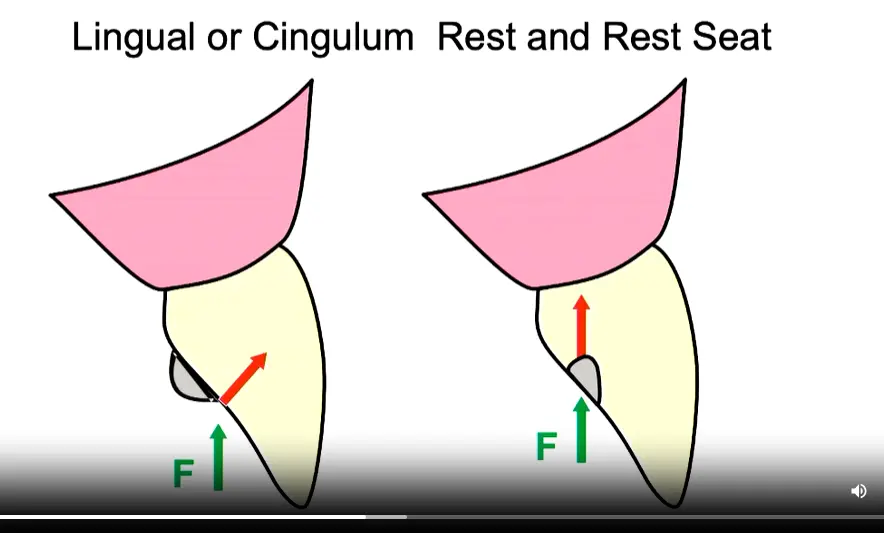
Lingual or Cingulum Rest and Rest Seat212223242526272829
Mesio-Distal Form
- Convex in the Mesio-Distal (M/D) direction.
- This "inverted smile" contour allows rotation of the framework (critical for free-end saddles) without applying excessive torque to the tooth.
Bucco-Lingual Form
- Concave in the Bucco-Lingual (B/L) direction, forming a V-shape.
Floor Angulation
- The floor should be prepared at an angle of less than 90°.
Design Specifications
-
Rounded shape with no sharp line angles.
-
Minimum reduction required: 0.8 mm.
-
Must maintain normal occlusal contact.
-
Rests can be used to establish occlusal contacts for tilted teeth, providing a reversible method to restore the occlusal plane compared to permanent onlays.
Preparation Guidelines30
Risks of Absent Rest Seats
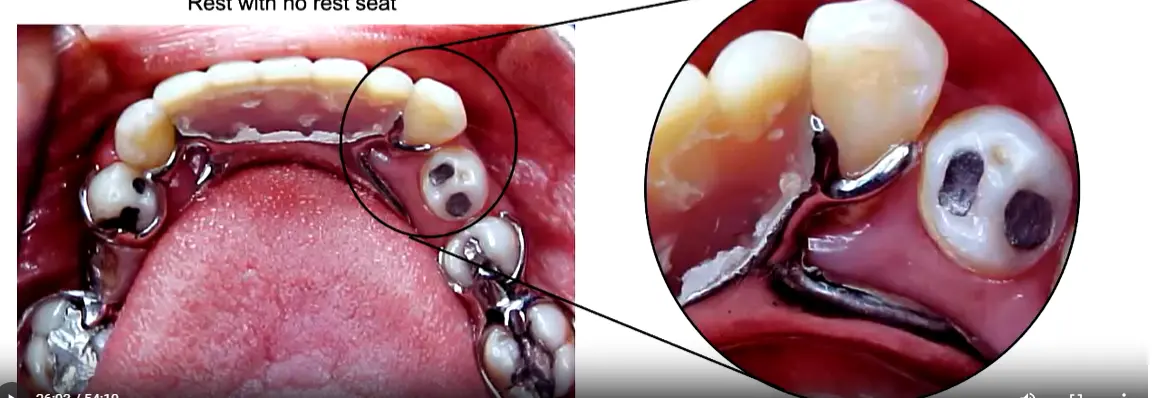
Without a prepared rest seat, the rest slides over the lingual surface, leading to buccal tipping of the tooth, framework impingement on gingival tissue, and increased tooth mobility.
Rest Without Rest Seat31
Case Study: Canine Tipping Due to Absent Rest Seat
A clinical case demonstrated a lower canine that had tipped buccally and appeared misaligned because no rest seat preparation was made. The tooth exhibited mobility and gingival impingement. In contrast, the contralateral canine showed less severe tipping because the adjacent premolar rest provided additional support, demonstrating how rest placement affects load distribution.
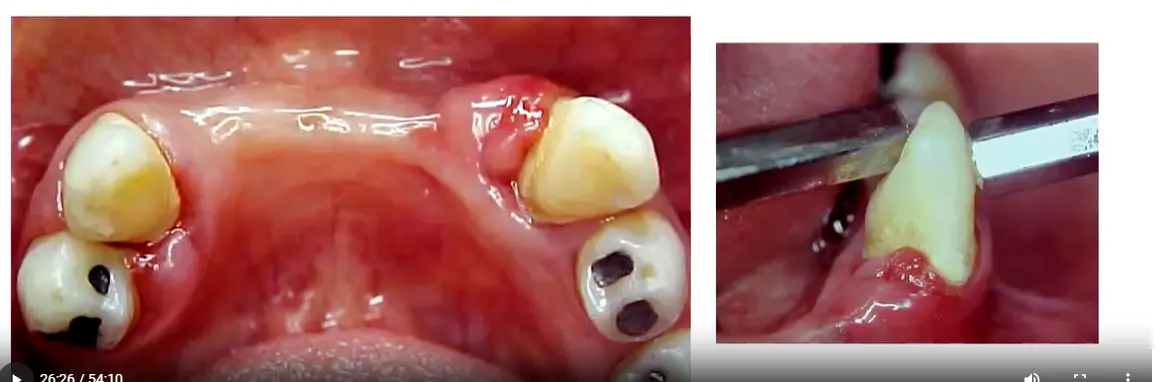
Lingual Rest Seat in Composite323334
Technique
- Applied in one single increment.
- Sculpted to the desired morphology.
- Place composite below the occlusal contact point (verify with articulating paper).
- Use rubber dam and retraction cords for moisture control to ensure reliable bonding.
- If bonding is compromised or the buildup is extensive, consider a survey crown or an onlay instead.
Stress Distribution
- Multiple incisors should receive lingual rests to distribute stress over a number of teeth.
Incisal Rest and Rest Seat3536373839
Morphology
- Concave in the Mesio-Distal (M/D) direction.
- Convex in the Bucco-Lingual (B/L) direction.
Design and Indications40
Floor Angulation
- The floor should be prepared at an angle of less than 90°.
Extension
- Prepared from the Lingual (L) to the Buccal (B) surface.
Design Summary of incisal rest and rest seat
- Concave M/D.
- Convex B/L.
- Floor less than 90°.
- Extends from L to B.
- Rounded with no sharp angles.
Preparation Dimensions and Tools
- Width: 2.5 mm.
- Depth: 1.5 mm.
- Instrument: Diamond tapered bur.
Indications
- Used when there is occlusal interference preventing the use of a lingual rest.
- Note: Lingual rests are generally preferred over incisal rests.
Clinical Considerations414243
Summary of Drawbacks
- Aesthetic concerns.
- Biomechanically not favorable.
- Incisal rests place more load near the gingival margin and bone level compared to cingulum rests, creating unfavorable leverage.
- Potential for occlusal interference.
Function: Direct and Indirect Retention444546474849505152
Direct or Primary Rest53
Characteristics of direct rest
- Located adjacent to or near the edentulous area.
- Functions as part of the retentive clasp assembly.
Direct (Primary/Principal) Rest
- Located adjacent to or near the edentulous area.
- Part of the retentive clasp.
- Prevents the denture from moving toward the gum (gingival displacement) when the patient bites down on the saddle.
- Provides direct retention for that specific edentulous area by resisting vertical displacement.
Indirect (Secondary/Auxiliary) Rest
- Can be part of a clasp or exist as a standalone rest.
Indirect or Secondary Rest54
Functions and Placement
- Prevents the rotation of the denture.
- Positioned distant from the fulcrum line.
Class II Framework Design
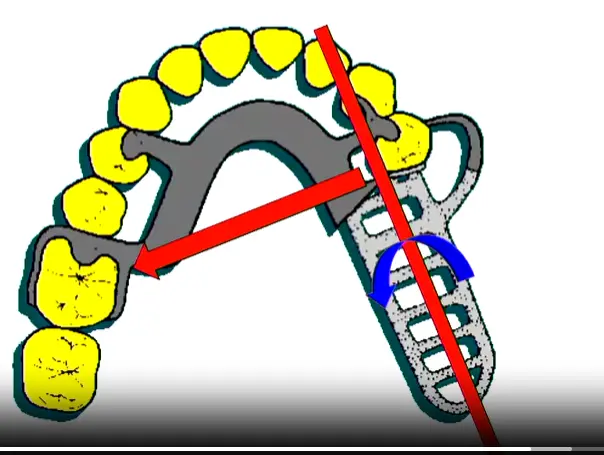
In a Class II case (unilateral posterior extension), the framework presents different fulcrum lines depending on the point of force application:
- Biting on buccal cusp: Framework rotates away from the teeth on the edentulous side; prevented by the clasp on the opposite side.
- Biting on palatal cusp: Framework rotates toward the gum on the edentulous side; prevented by the direct rest adjacent to the space.
- Biting sticky food on saddle: The denture lifts and rotates around the abutment (fulcrum line). The indirect rest (placed on the opposite side of the arch) prevents this rotation.
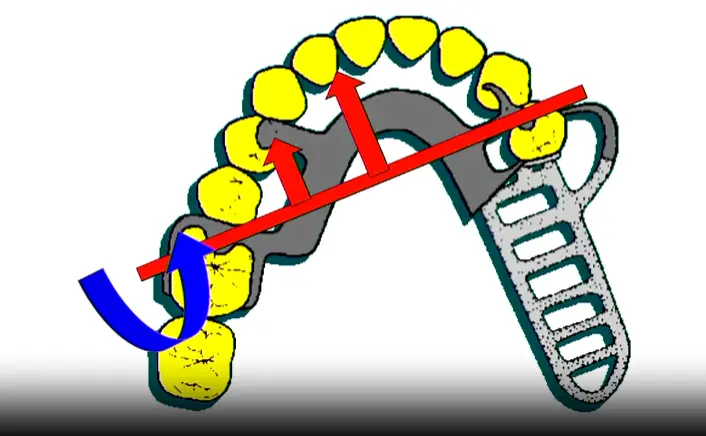
- ==Acts as an indirect retainer to prevent rotation of the denture around the fulcrum line when sticky foods lift the free-end saddle.==
- ==Rule of Placement: Position as far from the fulcrum line as possible.==
- ==Ideally placed on incisors, but retention is often split between the canine and premolar to avoid placing oblique loads on incisors.==
Class I Framework with Multiple Fulcrum Lines EXAM
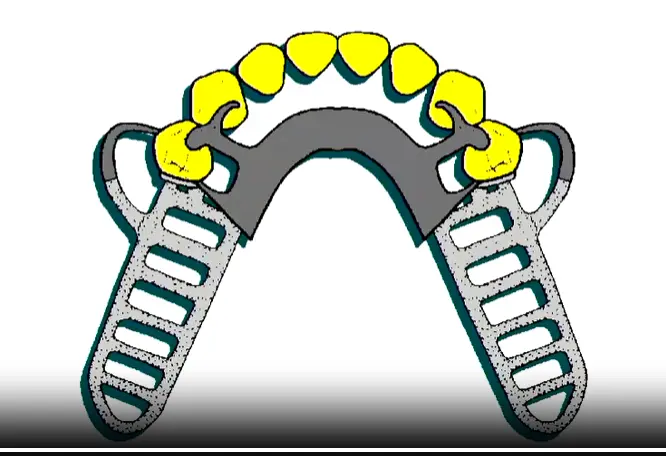
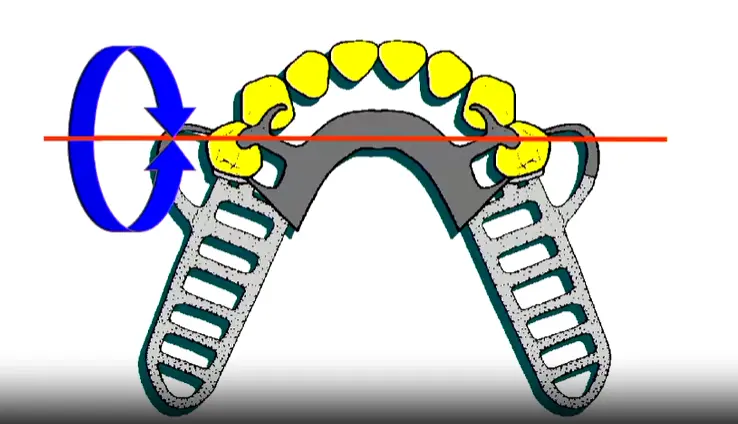
In a Class I case (bilateral posterior extensions), three potential fulcrum lines exist:
- Rotation axis through one posterior abutment when biting on the contralateral side.
- Rotation axis through the opposite posterior abutment.
- Rotation axis through both posterior abutments when biting sticky food with anterior teeth.
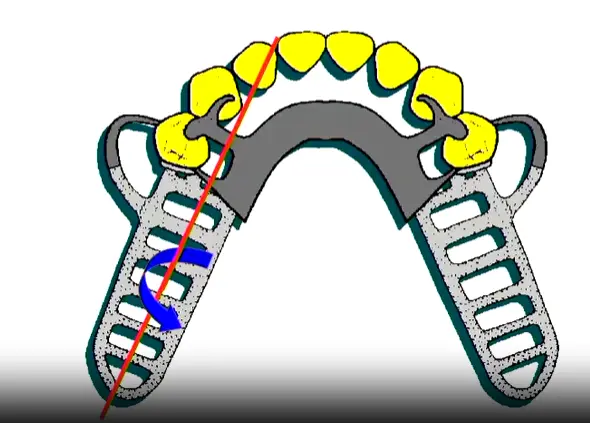
Design Strategy:
- Place direct rests on the premolars adjacent to the edentulous areas.
- Place indirect rests as far anteriorly as possible from the fulcrum lines (ideally canines or extended across multiple anterior teeth to distribute load).
- Avoid concentrating loads on single incisors; instead distribute across the anterior segment or use canines and premolars to share the indirect retention load.

Rest Distribution55565758
Intercalated Edentulous Area59
Placement of rests in an intercalated edentulous area
- Rests are placed adjacent to the edentulous area.
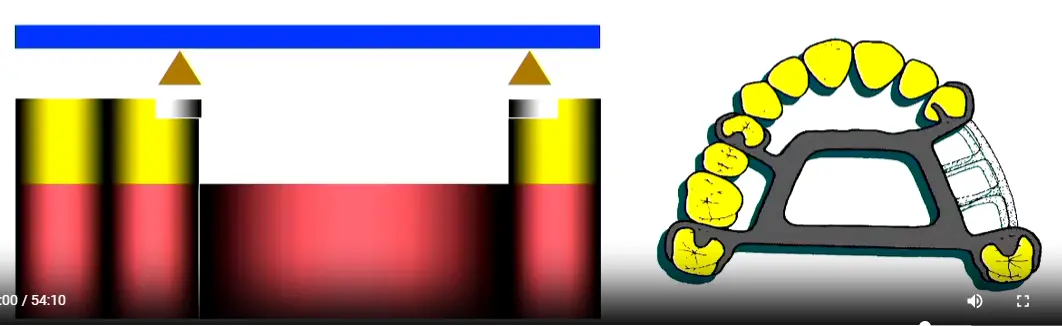
Free-End Edentulous Area60
Placement Strategy
-
Rests are not immediately adjacent to the saddle (distal extension).
-
For Class III cases (tooth-bounded saddles), always place rests adjacent to the edentulous space (e.g., mesial of the distal tooth or distal of the mesial tooth)
-
The bounded nature of the saddle provides stability, making this placement sufficient for support
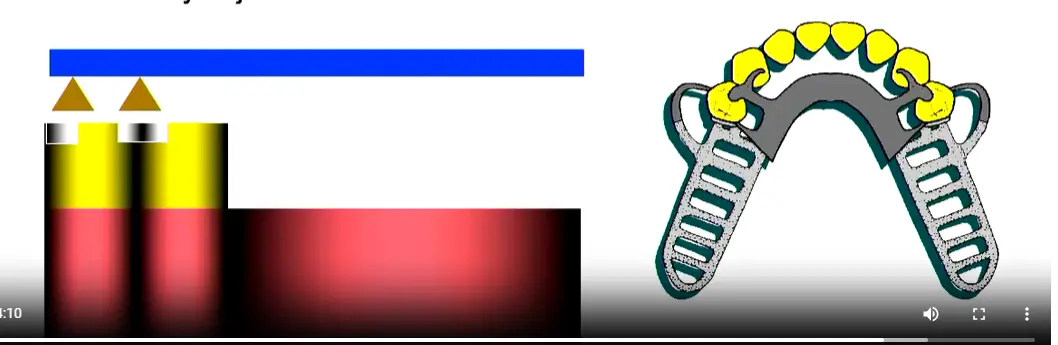
Case Study: Missing Four Teeth (Class I Scenario)
If a patient is missing four posterior teeth and the remaining teeth are periodontally compromised, an acrylic partial denture is preferred over a chrome framework. Acrylic dentures are tissue-supported and require no rest seat preparations, which minimizes the biomechanical load and prevents overloading weak abutments, even though they are bulkier than metal frameworks.
- For Class I and II cases, move the rest away from the edentulous space (e.g., place on the mesial instead of the distal of the most posterior tooth)
- Biomechanical Rationale: A mesial rest uses the proximal contact of the adjacent tooth to resist tipping forces; a distal rest would cause the tooth to tip distally and become mobile
- Class IV Considerations: Extensive anterior edentulous areas act as free-end saddles toward the mesial; therefore, place the rest on the distal of the adjacent tooth
-
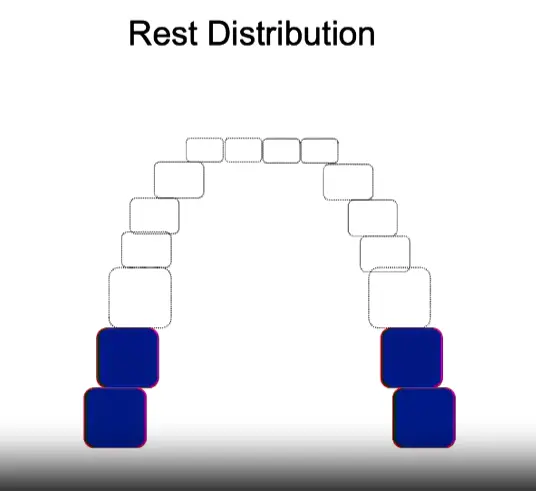
(This page contains no text content)
(This page contains visual diagrams of rest distribution patterns)
Oral Health Centre of Western Australia
Thank you
Audio Appendix
Additional Audio Content
The following sections from the lecture audio did not correspond to any heading in the main document.
Alternative Restorations and Material Considerations
Survey Crowns and Onlays
When tooth structure is severely worn or compromised:
- Survey Crowns: Full coverage crowns (metal or zirconia) with integrated rest seat preparations. Required when insufficient sound tooth structure exists for bonding composite or when the tooth needs full coverage for other reasons
- Onlays: Partial coverage restorations preserving buccal and lingual tooth structure. The rest contacts ceramic while the clasp engages natural tooth structure, offering a conservative option for worn occlusal surfaces
Acrylic vs. Chrome Dentures
- Chrome (Cobalt-Chromium): Requires strict adherence to biomechanical rules, rest seat preparations, and precise design. Provides thin, comfortable major connectors and tooth-supported function. Ideal when abutments are healthy enough to bear loads
- Acrylic: Tissue-supported (no rest seats needed), bulkier, cheaper, easier to modify (adding teeth). Indicated when abutments are periodontally compromised and cannot support a chrome framework without risk of further tooth loss
Clinical Assessment of Abutments
Before designing rests, assess all potential abutments:
- Periodontal Probing: Check for pockets and bone levels
- Mobility Assessment: Use the handles of two metal instruments (not fingers) to move the tooth mesio-distally and vertically. Mobile teeth or those with compromised PDLs require alternative designs (e.g., acrylic dentures) or splinting
- Occlusal Analysis: Verify contact points and potential interferences
- Plaque Control: Rounded, polished rest seat preparations are essential. Sharp, box-shaped preparations create plaque traps and iatrogenic periodontal disease. Always polish the prepared enamel surface
Footnotes
-
Original PDF page 1: L3 Rest and Rest Seat, p.1 ↩
-
Original PDF page 60: L3 Rest and Rest Seat, p.60 ↩
-
Original PDF page 2: L3 Rest and Rest Seat, p.2 ↩
-
Original PDF page 3: L3 Rest and Rest Seat, p.3 ↩
-
Original PDF page 4: L3 Rest and Rest Seat, p.4 ↩
-
Original PDF page 5: L3 Rest and Rest Seat, p.5 ↩
-
Original PDF page 6: L3 Rest and Rest Seat, p.6 ↩
-
Original PDF page 18: L3 Rest and Rest Seat, p.18 ↩
-
Original PDF page 19: L3 Rest and Rest Seat, p.19 ↩
-
Original PDF page 7: L3 Rest and Rest Seat, p.7 ↩
-
Original PDF page 8: L3 Rest and Rest Seat, p.8 ↩
-
Original PDF page 9: L3 Rest and Rest Seat, p.9 ↩
-
Original PDF page 10: L3 Rest and Rest Seat, p.10 ↩
-
Original PDF page 11: L3 Rest and Rest Seat, p.11 ↩
-
Original PDF page 12: L3 Rest and Rest Seat, p.12 ↩
-
Original PDF page 13: L3 Rest and Rest Seat, p.13 ↩
-
Original PDF page 16: L3 Rest and Rest Seat, p.16 ↩
-
Original PDF page 17: L3 Rest and Rest Seat, p.17 ↩
-
Original PDF page 14: L3 Rest and Rest Seat, p.14 ↩
-
Original PDF page 15: L3 Rest and Rest Seat, p.15 ↩
-
Original PDF page 20: L3 Rest and Rest Seat, p.20 ↩
-
Original PDF page 21: L3 Rest and Rest Seat, p.21 ↩
-
Original PDF page 22: L3 Rest and Rest Seat, p.22 ↩
-
Original PDF page 23: L3 Rest and Rest Seat, p.23 ↩
-
Original PDF page 25: L3 Rest and Rest Seat, p.25 ↩
-
Original PDF page 26: L3 Rest and Rest Seat, p.26 ↩
-
Original PDF page 28: L3 Rest and Rest Seat, p.28 ↩
-
Original PDF page 29: L3 Rest and Rest Seat, p.29 ↩
-
Original PDF page 33: L3 Rest and Rest Seat, p.33 ↩
-
Original PDF page 24: L3 Rest and Rest Seat, p.24 ↩
-
Original PDF page 27: L3 Rest and Rest Seat, p.27 ↩
-
Original PDF page 30: L3 Rest and Rest Seat, p.30 ↩
-
Original PDF page 31: L3 Rest and Rest Seat, p.31 ↩
-
Original PDF page 32: L3 Rest and Rest Seat, p.32 ↩
-
Original PDF page 34: L3 Rest and Rest Seat, p.34 ↩
-
Original PDF page 36: L3 Rest and Rest Seat, p.36 ↩
-
Original PDF page 37: L3 Rest and Rest Seat, p.37 ↩
-
Original PDF page 38: L3 Rest and Rest Seat, p.38 ↩
-
Original PDF page 39: L3 Rest and Rest Seat, p.39 ↩
-
Original PDF page 35: L3 Rest and Rest Seat, p.35 ↩
-
Original PDF page 40: L3 Rest and Rest Seat, p.40 ↩
-
Original PDF page 41: L3 Rest and Rest Seat, p.41 ↩
-
Original PDF page 42: L3 Rest and Rest Seat, p.42 ↩
-
Original PDF page 44: L3 Rest and Rest Seat, p.44 ↩
-
Original PDF page 46: L3 Rest and Rest Seat, p.46 ↩
-
Original PDF page 47: L3 Rest and Rest Seat, p.47 ↩
-
Original PDF page 48: L3 Rest and Rest Seat, p.48 ↩
-
Original PDF page 49: L3 Rest and Rest Seat, p.49 ↩
-
Original PDF page 50: L3 Rest and Rest Seat, p.50 ↩
-
Original PDF page 51: L3 Rest and Rest Seat, p.51 ↩
-
Original PDF page 52: L3 Rest and Rest Seat, p.52 ↩
-
Original PDF page 53: L3 Rest and Rest Seat, p.53 ↩
-
Original PDF page 43: L3 Rest and Rest Seat, p.43 ↩
-
Original PDF page 45: L3 Rest and Rest Seat, p.45 ↩
-
Original PDF page 56: L3 Rest and Rest Seat, p.56 ↩
-
Original PDF page 57: L3 Rest and Rest Seat, p.57 ↩
-
Original PDF page 58: L3 Rest and Rest Seat, p.58 ↩
-
Original PDF page 59: L3 Rest and Rest Seat, p.59 ↩
-
Original PDF page 54: L3 Rest and Rest Seat, p.54 ↩
-
Original PDF page 55: L3 Rest and Rest Seat, p.55 ↩