Sources
Info is a mix of
- Contemporary fixed prosthodontics
- Management of TMJ
- M5 from DENT4216 Prosth!
Dentition
Ideally, in the fully bilateral seated position of the condyle–articular disc assemblies, the maxillary and mandibular teeth exhibit maximum intercuspation. This means that the maxillary lingual and mandibular buccal cusps of the posterior teeth are evenly distributed and in stable contact with the opposing occlusal fossae. These functional cusps can then act as stops for vertical closure without excessively loading any one tooth, while left and right TMJs concurrently are in an unstrained position. However, in many patients, maximal intercuspal contact occurs with the condyles in a slightly translated position.” (Rosenstiel et al., 2022, p. 110)
Ideal scenario

Actual Scenario:
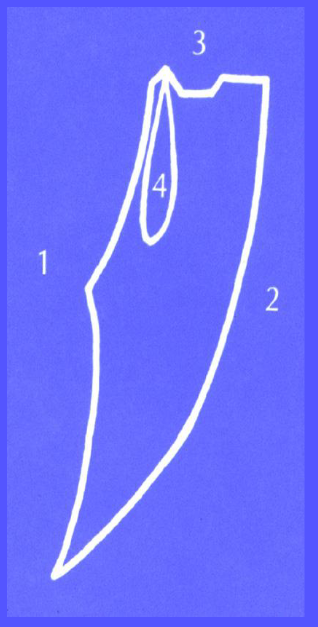
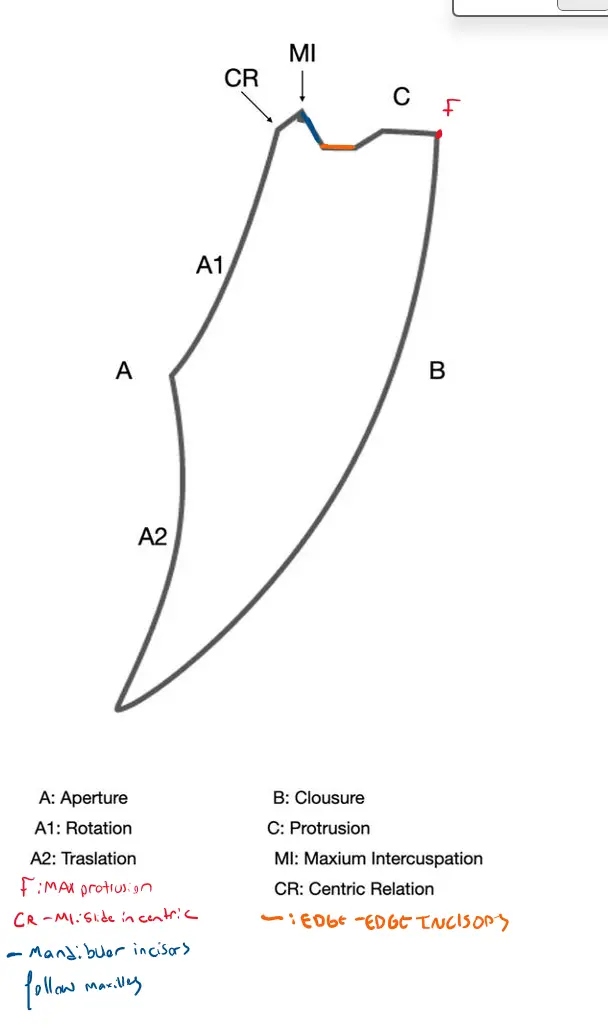
Centric Relation
Centric relation: a maxillomandibular relationship independent of tooth contact, the condyles articulate in the anterior-superior position against the posterior slopes of the articular eminences.
Centric relation is considered a reliable and reproducible reference (and treatment) position. If maximum intercuspation coincides with the centric relation position, restorative treatment is often straightforward. When maximum intercuspation does not coincide with centric relation, it is necessary to determine whether corrective occlusal therapy is needed before restorative treatment is initiated.
Mandibular Movements
- Mandibular movements are discusses in three planes
- Frontal
- Sagittal
- Horizontal
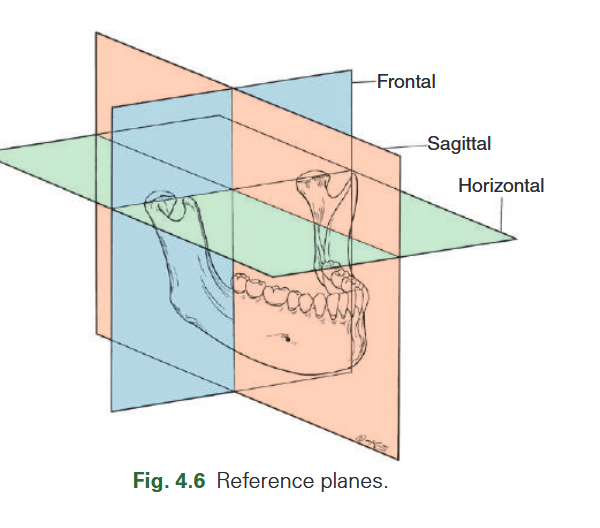
Overview of movements by plane
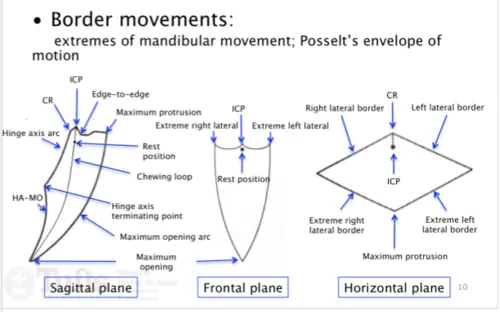
Border Movements & Posselts Envelope
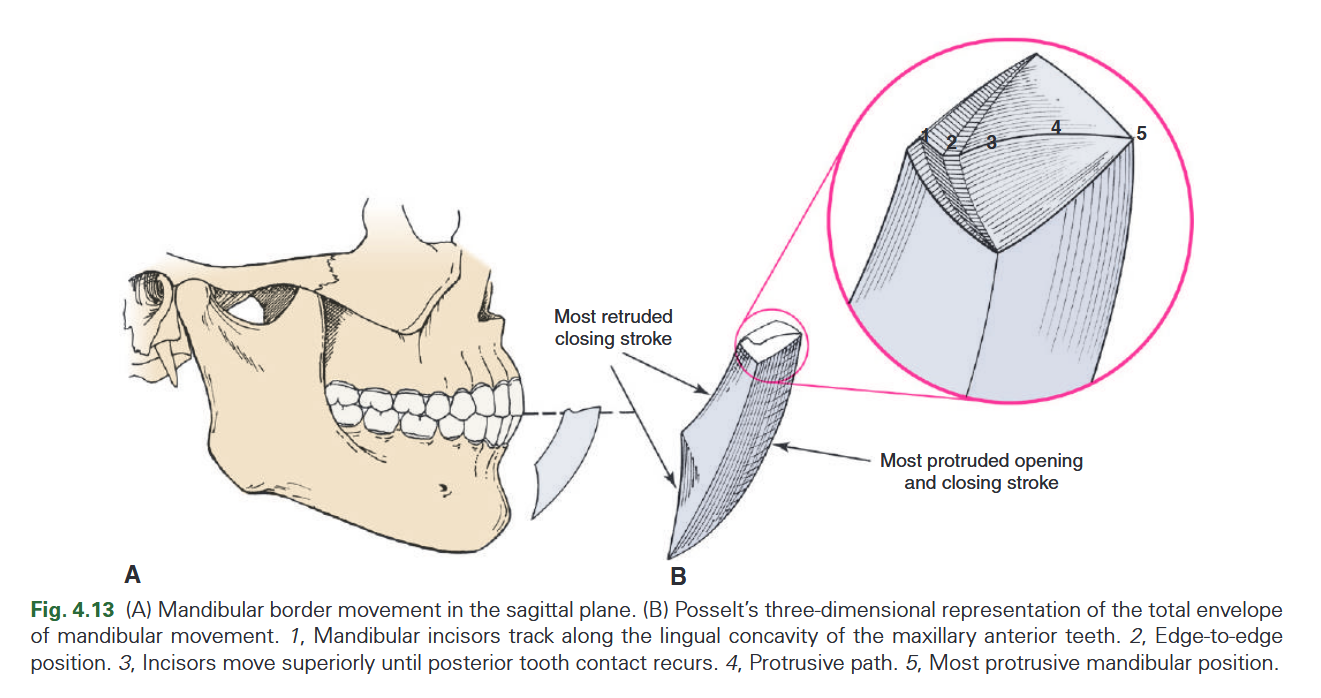
- Border (i.e. the lines in the envelope) movements are split by plane
Single Plane Border Movements
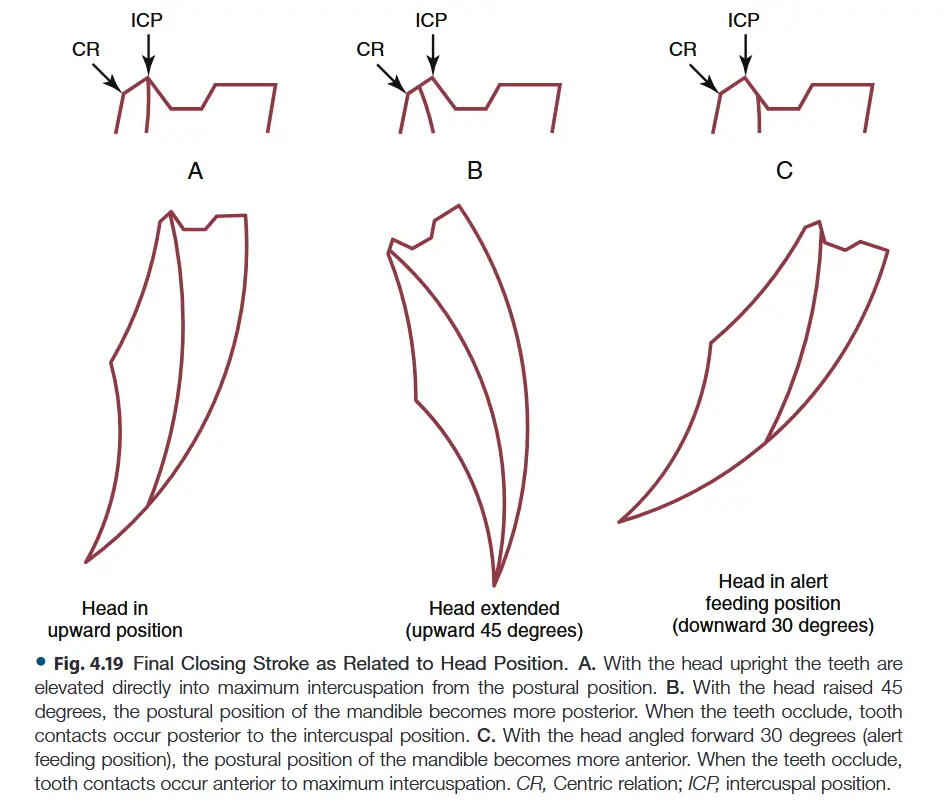
Sagittal Border Movements
Horizontal Border Movements
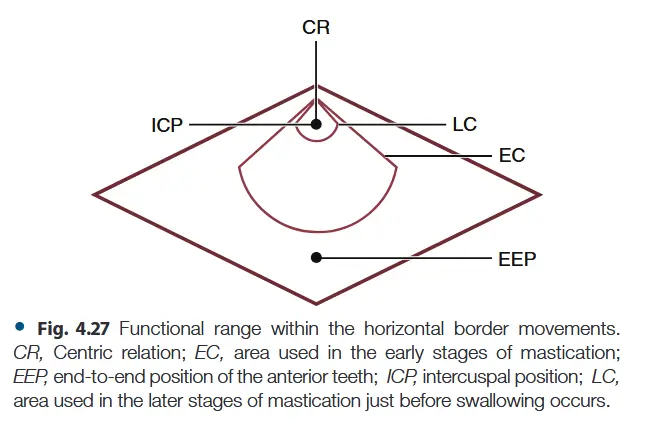
Gothic Tracers
“Gothic arch tracer is used to record the mandibular border movements in the horizontal plane. As the mandible moves, the stylus attached to the mandibular teeth generates a pathway on the recording table attached to the maxillary teeth.” (Okeson, 2020, p. 68)
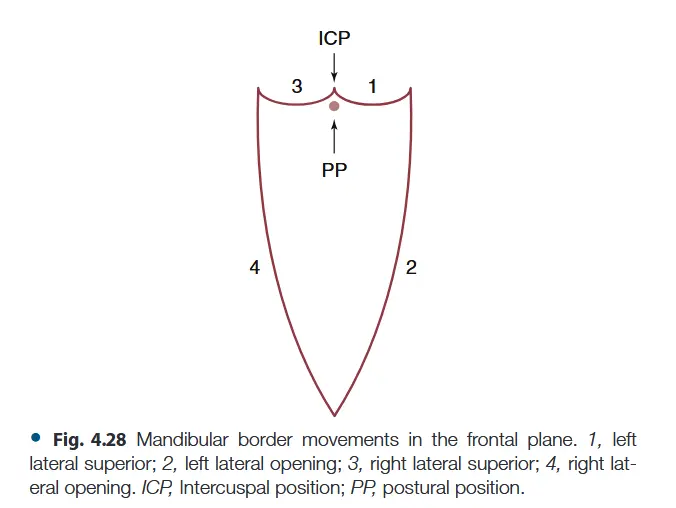
Frontal Border movements
Mandible As a Lever
Rationale
At first glance, it might seem illogical to load the single-rooted anterior teeth, as opposed to the multirooted posterior teeth, during chewing. However, the canines and incisors have a distinct mechanical advantage over the posterior teeth40: The effectiveness of the force exerted by the muscles of mastication is notably less when the loading contact occurs farther anteriorly. The mandible is a class III lever (Fig. 4.22), which is the least efficient of lever systems. An example of another class III lever is a fishing pole. The longer the pole, the more effort it takes to pull a fish out of the water. The same holds true for the muscles of mastication and the teeth: The farther anteriorly initial tooth-to-tooth contact occurs (i.e., the longer the lever arm), the less effective the forces exerted by the musculature are, and the smaller the resulting load to which the teeth are subjected. (Rosenstiel et al., 2022, p. 119)
mandibularmovements #occlusion
In 3D!
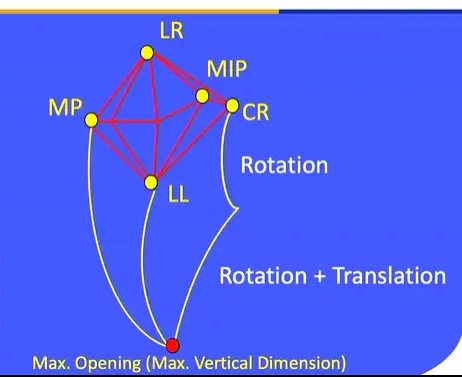
LL = Left lateral LR = Right lateral
Essentially you’re just combinging the saggital plane and adding lateral movements
- from MIP you can go to lateral movements
- From CR you can do lateral movements
- From any point (along the line from CR to MP) you can do lateral movements (these are the extra lines in the central diamond that extend from the middle to the yellow dots )
- From any lateral movement you can also open (the Line from LL to MO )
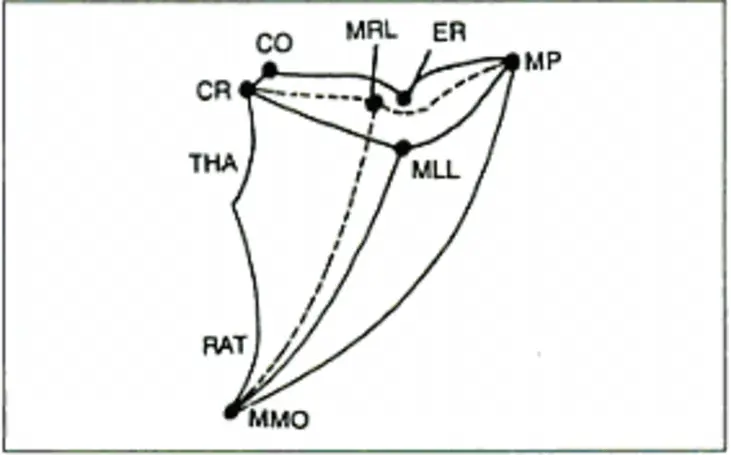
🦷 Mandibular Movements & Posselt’s Envelope of Motion
- CR: Centric Relation
- CO: Centric Occlusion
- MRL: Maximum Right Lateral Position
- MLL: Maximum Left Lateral Position
- MP: Maximum Protrusion
- ER: Edge-Edge Relationship
- MMO: Maximum Mouth Opening
- THA: True Hinge Axis
- RAT: Rotation After Translation