Kennedy Class I Design Review: Mandibular and Maxillary Applications
This document outlines the fundamental principles and academic baselines for designing Kennedy Class I Removable Partial Dentures (RPDs). It follows a systematic four-step design process to ensure stability, support, and retention.
The Four-Step Design Process
To maintain consistency and academic rigor, every design should follow these four sequential steps:
- Outline Edentulous Areas: Identify and mark the areas requiring tooth replacement
 and define the type of retention (e.g., mesh, posts, or metal denture bases).
2. Identify Direct Retainers: Select the primary abutment teeth adjacent to the edentulous spaces
and define the type of retention (e.g., mesh, posts, or metal denture bases).
2. Identify Direct Retainers: Select the primary abutment teeth adjacent to the edentulous spaces
 and determine the appropriate clasping systems.
3. Establish Indirect Retention and Auxiliary Rests: Locate the fulcrum line and place rests to counteract rotational forces.
and determine the appropriate clasping systems.
3. Establish Indirect Retention and Auxiliary Rests: Locate the fulcrum line and place rests to counteract rotational forces.

- Design the Major Connector: Connect the components into a unified framework.

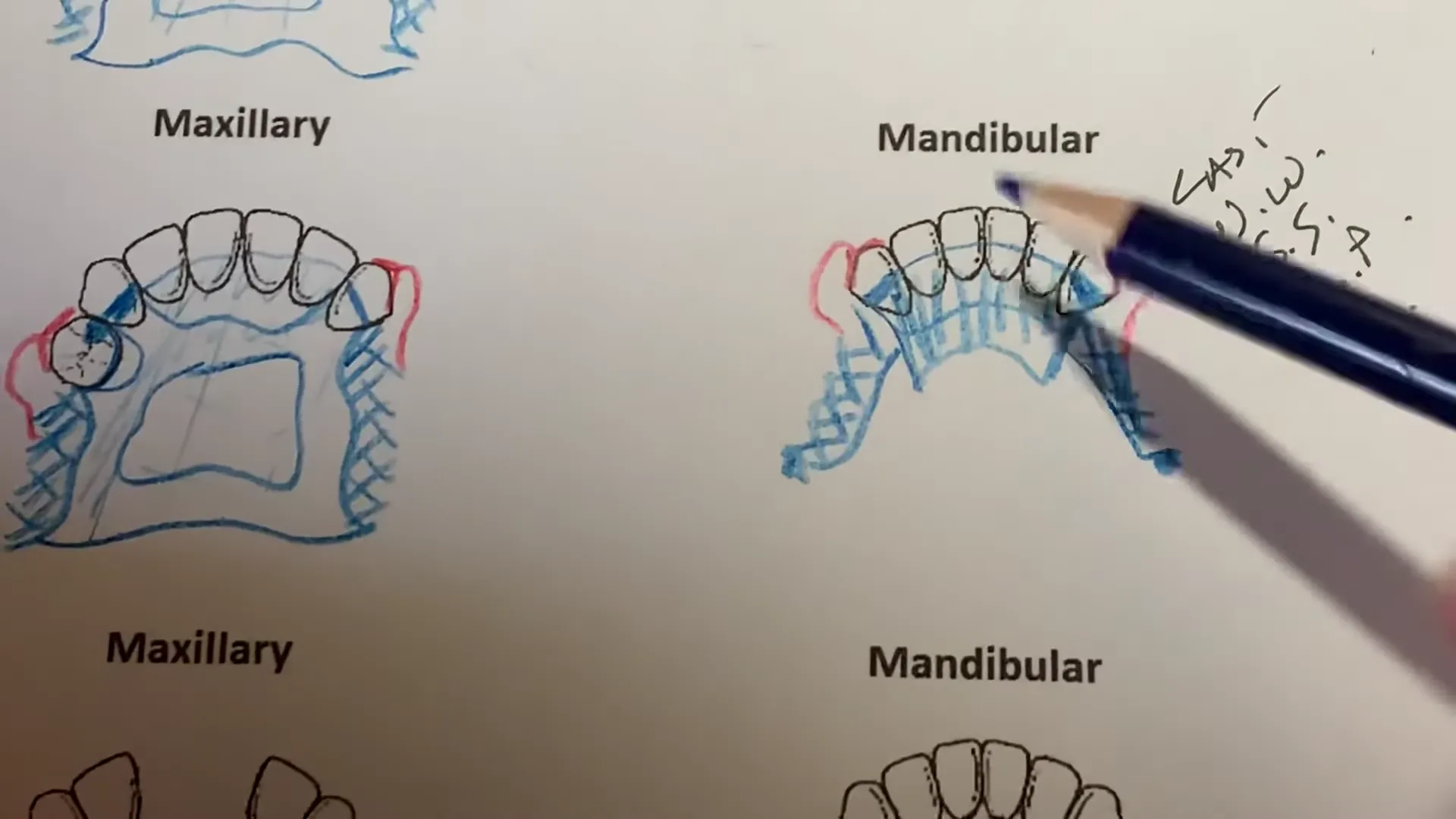
Kennedy Class I: Mandibular (Lower) Design
1. Retention and Support
- Mesh Retention: Extend the mesh distally to the first molar area. While the acrylic will cover the retromolar pads, the framework mesh provides the necessary mechanical retention for the denture base.
- Tissue Stops: Essential for supporting the free-end carriage; these should be placed on the midline of the ridge.
2. Direct Retainers (Stress-Breaking Principles)
For Class I cases, stress-breaking clasps are mandatory to prevent the terminal abutments from drifting or being subjected to excessive torque.
- Clasp Options: RPI, RPA (Y or G), or Roach/I-bars.
- Rest Placement: Use mesio-occlusal rests on terminal abutments
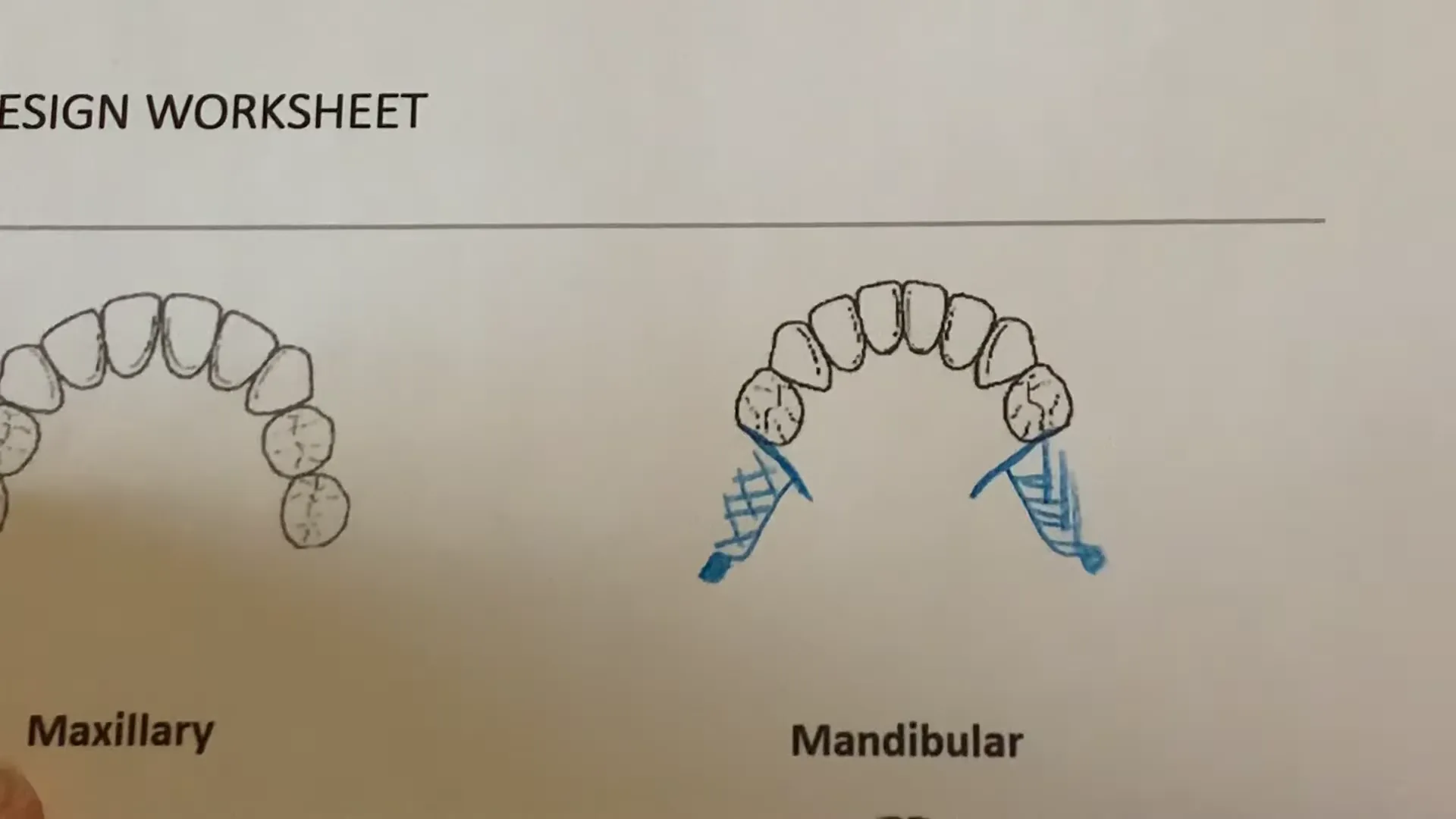 (e.g., teeth 34 and 44) to direct forces vertically and minimize distal tipping.
- Material Options: Cast clasps are the primary choice, but wrought wire (stainless steel, gold, or platinum-gold-palladium) may be used for increased flexibility.
3. Indirect Retention
- Fulcrum Line: Drawn through the two most distal rests.

- Placement: Indirect retainers should be placed perpendicular to the midpoint of the fulcrum line.
- Preferred Sites: Canines (33 and 43) are ideal for cingulum rests.
 While incisors (31, 41) are closer to the perpendicular midpoint, they often have insufficient crown-to-root ratios to support the load.
4. Major Connector
- Lingual Bar: The standard academic baseline.

- Kennedy Bar / Lingual Plate: Used when additional indirect retention or stabilization of periodontally involved teeth is required.
Kennedy Class I: Maxillary (Upper) Design
1. Direct and Indirect Retention
- Direct Retainers: Typically placed on teeth 15 and 25
 using G-clasps or Roach clasps.
- Indirect Retention: Usually placed on the canines (13 and 23).

2. Major Connector Options
Maxillary designs require broader coverage for support:
- Anterior-Posterior (A-P) Palatal Strap: A “closed oval” skeletal design that provides excellent rigidity.

- Full Palate: Indicated when maximum mucosal support is needed or when remaining teeth have a poor prognosis.
Special Considerations and Modifications
The “Pier Abutment” Rule
When a lone-standing bicuspid (freestanding tooth) exists in a free-end edentulous space:
- Academic Rule: Omit the lone tooth from the clasping design. Treat the next tooth in the arch (e.g., the canine) as the primary terminal abutment.
- Rationale: This reduces rotation and preserves the lone bicuspid
 by preventing it from acting as a fulcrum under heavy loads.
Modification Spaces (Class I, Mod 1)
When an anterior modification space is present:
- Rest Placement: Rests must be placed on both sides of the modification space
 to close off the guide planes.
- Retention Type: Depending on the vertical dimension (occlusal clearance), use either mesh and posts for acrylic teeth or metal lingual backings for heavy bites.

Summary of Clasping and Materials
| Component Type | Options |
|---|---|
| Stress-Breaking Clasps | RPI, RPA, Roach, I-Bar, G-Clasp |
| Wrought Wire Materials | Stainless Steel, Gold, Platinum-Gold-Palladium, Ticonium |
| Prosthetic Retention | Mesh (standard), Metal Base (low vertical clearance), Posts (single tooth) |
Clinical Factors Influencing Final Design
While the academic baseline provides the foundation, the following clinical factors will dictate deviations in the workforce:
- Centric Occlusion & Vertical Dimension: Determines if metal backings are required.
- Aesthetics: Patient expectations regarding visible metal clasps.
- Abutment Prognosis: If teeth are failing, a design that allows for easy additions (like a lingual plate) is preferred.
- Opposing Dentition: Whether the RPD is biting against natural teeth, another partial, or a full denture.
- Economics: The patient’s financial constraints often dictate the material and complexity of the design.