Abbott 1994 - Referral Practice Table 5
Citation and evidence type
Abbott PV. Analysis of a Referral-based Endodontic Practice. Part 1. Demographic Data and Reasons for Referral. Journal of Endodontics. 1994;20:93–96.
Evidence type: Referral-based endodontic-practice analysis. The lecture identifies this as Part 1, covering demographic data and reasons for referral.
Population, methods, and limits
The lecture describes Table 5 as covering 2,000 patients referred for treatment. It reports the number and percentage of patients assigned to six root-resorption categories. The lecture extracts do not state the referral period, eligibility criteria, diagnostic methods, or follow-up timing.
The table’s parenthetical percentages are reported in the context of the 2,000 referred patients. The separate 36% misreferral statement has a different denominator: patients with external invasive resorption. The lecture does not provide the numerator for that 36% figure.
Findings
Table 5. Types and incidence of root resorption among the 2,000 patients referred for treatment
| Type of Resorption | No. of Patients |
|---|---|
| Internal inflammatory | 10 (0.5)* |
| Internal replacement | 1 (0.05) |
| External inflammatory | 86 (4.3) |
| External replacement | 13 (0.6) |
| External cervical invasive | 57 (2.8) |
| External idiopathic | 7 (0.4) |
| Totals | 174 (8.65) |
Numbers in parentheses, percentage.
The table lists 57 patients (2.8% of the referral sample) with external cervical invasive resorption.
Misreferral finding
L2 states: “Of the patients with external invasive resorption, 36% had originally been referred because their general dentist thought the condition was internal resorption.” The 36% applies within the external invasive resorption group; it is not 36% of all 2,000 referred patients. The lecture extract does not give the count behind that subgroup percentage.
L9 repeats the table and reduces the accompanying statement to “36% referred as ‘internal resorption’.” That repeated block adds no separate sample or outcome.
Source-linked evidence and figures
The Table 5 transcription and explicit subgroup interpretation are preserved from L2 Resorption 1 - Introduction, General Internal Resorption.md (pre-edit lines 178–194; original PDF page 81). L9 carries the article citation and the same table/percentage footnote at pre-edit lines 207–226, then repeats the table at lines 371–385 (original PDF page 102).
L2 also includes two lecture illustrations beside the 36% statement. They are clinical teaching images, not figures identified as originating in Abbott’s article; both are retained here with the lecture’s caption claim:
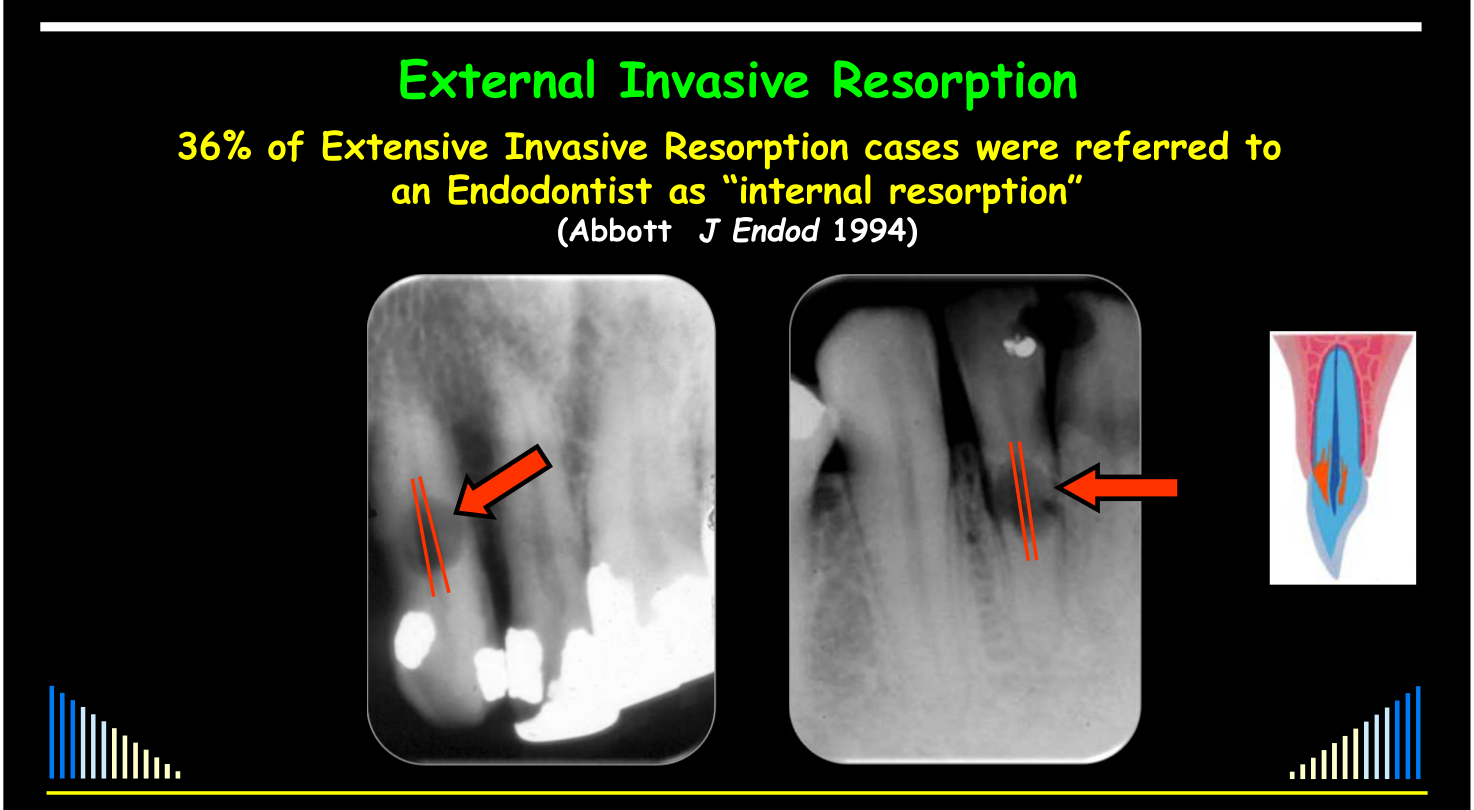
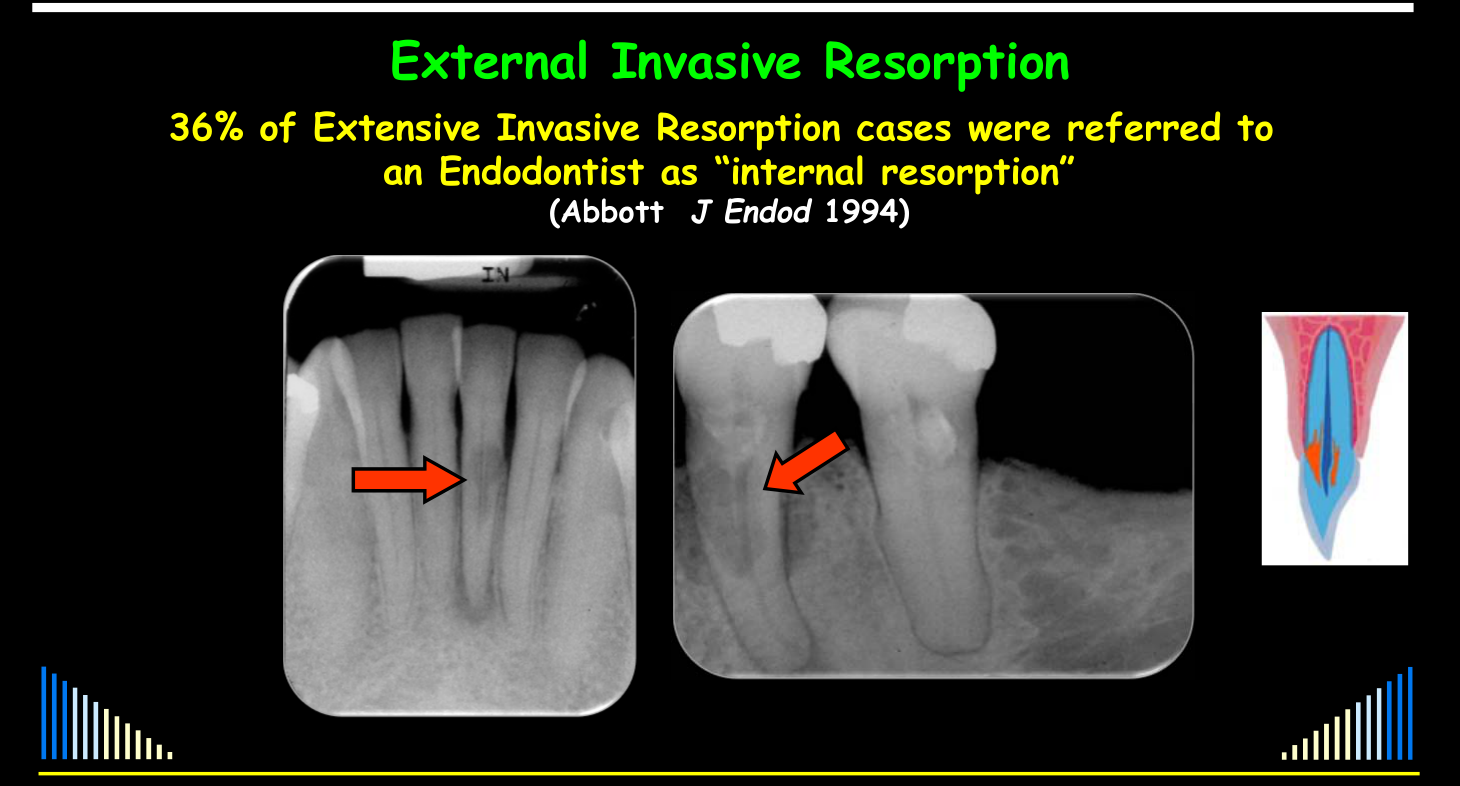
The image embedded immediately after Table 5 in L9 is captioned as the table, but the image itself shows a potential-predisposing-factor chart associated with the separate 2021 dataset. It is not treated as an Abbott 1994 figure here; the complete text table and its footnote are transcribed above.
Takeaway
In this referral-based cohort, 36% of patients with external invasive resorption were referred as internal resorption; this is not 36% of all 2,000 patients.
Footnotes
-
Original PDF page 8: L2 Resorption 1, PDF p. 8. ↩
-
Original PDF page 10: L9 Resorption 5, PDF p. 10. ↩