Stockwell 1988 - Western Australian School Dental Trauma
Contextual takeaway
The WA school-service sample chiefly recorded single-tooth incidents and uncomplicated crown fractures, while its school-hours service selection likely missed some severe injuries treated after hours or in hospital.
Study frame and limits
The L3 lecture cites an incidence study in the Western Australian School Dental Service and identifies the population as children aged 6–12. The excerpt reports rates per 100 children and per 100 erupted teeth, but it does not state the total sample, observation period, or case-identification method. It also does not restate the denominator for every injury-type percentage, so the figures below are retained as reported without assigning an unstated denominator.
The service mainly operated during school and ordinary working hours. The lecturer notes that serious injuries occurring outside those hours might instead be treated by an after-hours service or a children’s hospital; parents might wait for the school dentist for an uncomplicated crown fracture but seek immediate care for a luxation or avulsion. Very few motor-vehicle accidents were recorded; the lecturer suggests more serious cases were likely treated at a children’s hospital or an after-hours provider. The approximately equal place-of-occurrence distribution is also described as limited by the service’s lack of general after-hours availability.
Exact L3 source extract
Source: L3 - Dental Trauma (pre-edit lines 212-280).
Sports-Related Injuries
Stockwell AJ. Incidence of trauma in the Western Australian School Dental Service. Comm Dent Oral Epidemiol 1988; 16: 294-8.
Incidence in Western Australia
Incidence of Trauma in 6-12 Year Old Children in WA1
- 1.66 children and 2.05 teeth per 100 children
- 11.7 teeth per 100 erupted teeth
- 80.5% of children had 1 tooth per incident
- 88% of the traumatised teeth were upper central incisors
Stockwell (1988)
Lecturer — Study Population
Approximately 20% of children had more than one injured tooth. The study population and setting were selective because it involved children attending the school dental service, which operated mainly during school and ordinary working hours.
- Serious injuries occurring outside those hours might instead have been treated by an after-hours dental service or a children’s hospital.
- Parents might wait to see the school dentist for an uncomplicated crown fracture but seek immediate care for a luxation or avulsion.
Types and Causes of Injuries
Type of Injuries2
- 73.9% — Uncomplicated crown fractures
- 4.6% — Complicated crown fractures
- 0.4% — Root fractures
- 4.9% — Luxations / avulsions
- 12.6% — Subsequent trauma
Stockwell (1988)
Lecturer — Subsequent Trauma
Twelve children experienced subsequent trauma, representing children who tended to injure themselves repeatedly.
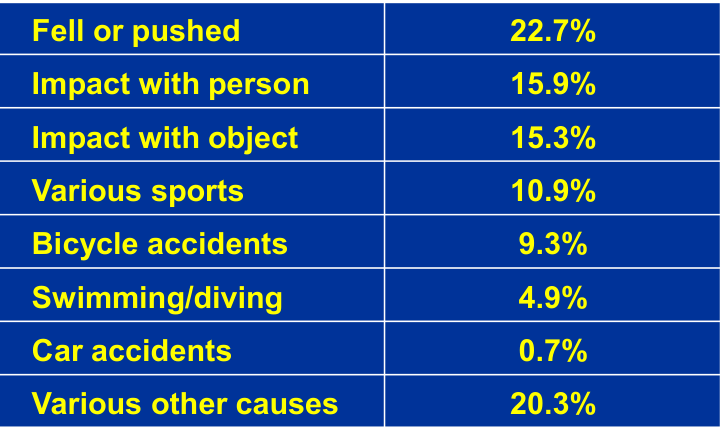
Causes of Trauma
- Fell or pushed — 22.7%
- Impact with person — 15.9%
- Impact with object — 15.3%
- Various sports — 10.9%
- Bicycle accidents — 9.3%
- Swimming/diving — 4.9%
- Car accidents — 0.7%
- Various other causes — 20.3%
Stockwell (1988)
Lecturer — Motor Vehicle Injuries
Very few motor vehicle accidents were recorded, probably because more serious cases were likely to be treated at a children’s hospital or by an after-hours provider.
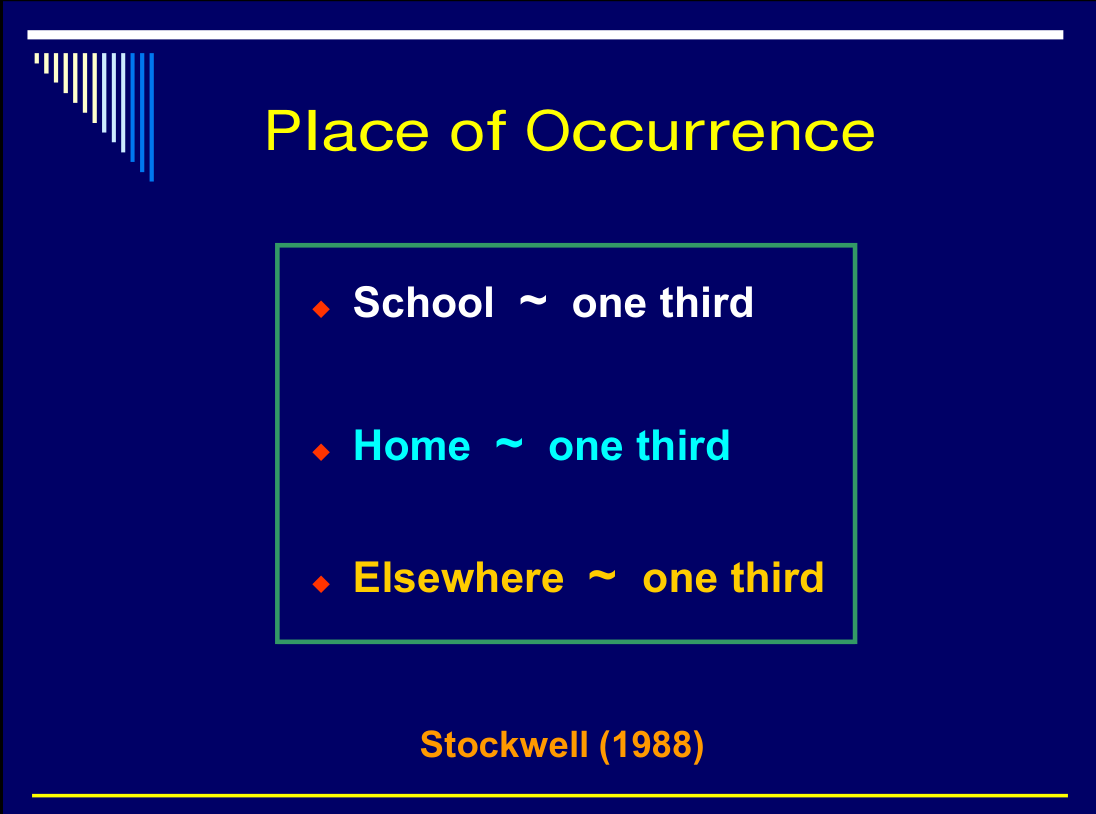
Place of Occurrence3
- School ~ one third
- Home ~ one third
- Elsewhere ~ one third
Stockwell (1988)
Lecturer — Place of Occurrence
The approximately equal distribution across school, home, and elsewhere also reflects the limitations of a school dental service study, because the service was not generally available after hours.
Lecturer — Injury Prognosis
An uncomplicated crown fracture was described as one of the more favourable dental injuries because it is relatively straightforward to manage. Its possible long-term consequences are generally less severe than those associated with lateral luxation, intrusion or avulsion.
L13 cross-reference
Source: L13 - Managing Root Fractures (pre-edit lines 84-96).
Root Fractures4
-
Root Fractures
- Defined as fractures involving dentine, cementum and pulp
-
A relatively uncommon injury
- Andreasen & Andreasen (2007)
- 0.5 – 7.0% of injuries to permanent teeth
- 2.0 – 4.0% of injuries in primary teeth
- Stockwell (1988) – WA School Dental Service
- 0.4% of the injuries (6–12 year old children)
- Lam, Abbott et al (2008) – Bunbury, WA
- 3.0% of the injuries (children and adults)
- Andreasen & Andreasen (2007)
Course objective cross-check
The course learning-objectives note repeats selected Stockwell findings in its L3.5 summary and repeats the 0.4% figure alongside Lam’s 3.0% local figure in its root-fracture summary. These are course summaries of the lecture evidence, not additional study samples.
Footnotes
-
Original PDF page 8: L3 Dento-Alveolar Trauma 2 - Aetiology, Epidemiology and Mechanisms of Injuries to the Teeth, p.8 ↩
-
Original PDF page 9: L3 Dento-Alveolar Trauma 2 - Aetiology, Epidemiology and Mechanisms of Injuries to the Teeth, p.9 ↩
-
Original PDF page 10: L3 Dento-Alveolar Trauma 2 - Aetiology, Epidemiology and Mechanisms of Injuries to the Teeth, p.10 ↩
-
Original PDF page 4: L13 Dento-Alveolar Trauma 6 - Managing Root Fractures, p.4 ↩