Profile Facial Analysis Exercises
About these exercises
Profile (lateral) judgment practice, compiled from the OrthoInstruction module 01 - Facial Form Analysis. For each patient, make your call on the three points below from the profile photo, then expand the Answer to compare. Frontal (full-face) cases are in Frontal Facial Analysis Exercises. The module self-test (covering both frontal and profile) is at the bottom of this note. Underlying theory: Level II Unit B Summary.
For each patient, judge:
- Antero-posterior skeletal jaw relationship — Class I (normal), Class II, or Class III
- Vertical skeletal jaw relationship — normal, long face, or short face
- Tooth support for lip → lip prominence — excessive, normal, or inadequate
How to read the profile
A quick guide to how to make the judgments below. Method follows the DMD3S1 Workbook (primary); norms from Contemporary Orthodontics 6e, Ch.6. Profile analysis has been called “the poor man’s cephalometric analysis” — it identifies underlying skeletal relationships from a photo.
1. Set up — view the patient in natural head position (NHP): seated or standing upright (not reclined), looking at a distant point on the horizon.
2. Antero-posterior jaw relationship — draw two lines:
- Line 1: bridge of the nose → base of the upper lip
- Line 2: base of the upper lip → chin (soft-tissue pogonion)
- A near-straight line = Class I; a convex profile (angle >~10°, upper jaw ahead of the chin) = skeletal Class II; a concave profile (chin ahead of the upper jaw) = skeletal Class III (Fig 6.15). Convexity/concavity confirms a discrepancy exists but not which jaw is at fault.
3. Lip posture & incisor prominence — with the lips relaxed:
- relate the upper lip to a true vertical through soft-tissue point A (concavity at the base of the upper lip) and the lower lip to a true vertical through soft-tissue point B (concavity between lower lip and chin) — a separate reference line for each (Fig 6.18). A lip clearly ahead of its line is prominent; behind it, retrusive.
- cross-check against the E-line (Ricketts’ esthetic line — nasal tip → soft-tissue chin): the lips should sit 2–4 mm behind it (Caucasian norm).1 Lips forward of the E-line → excessive incisor protrusion / lip prominence; lips well behind it → inadequate tooth support / retrusive incisors. A mildly obtuse nasolabial angle is also normal.
- Incisors are excessively protrusive only if BOTH are true: the lips are prominent/everted and separated at rest by >3–4 mm (lip incompetence — the patient strains to seal them). Retracting the teeth then improves lip function and esthetics; if the lips close without strain, tooth position barely affects lip posture.
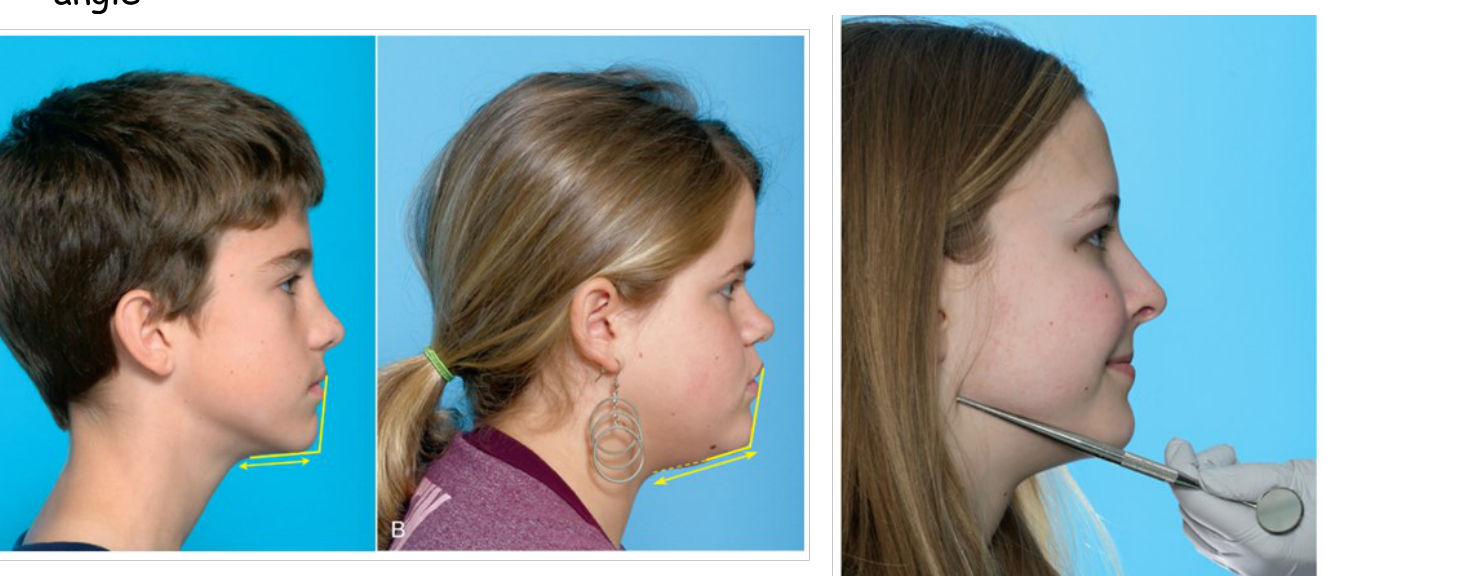
4. Vertical — re-check the facial thirds and note the mandibular-plane angle, estimated by running a finger or mirror handle along the lower border. On a cephalogram this is the Frankfort–mandibular plane angle (FMA) — in a photo you can only estimate low / moderate / steep:1
- Moderate ≈ 25° (normal range ~22–28°) — normal vertical proportions
- Low / hypodivergent (<~20°) — flat mandibular plane → short face tendency, deep bite
- High / hyperdivergent (>~30°) — steep mandibular plane → long face tendency, open bite (downward-backward mandibular rotation)
5. Then make the three judgments (A-P skeletal class, vertical pattern, tooth support for lip) as listed above.
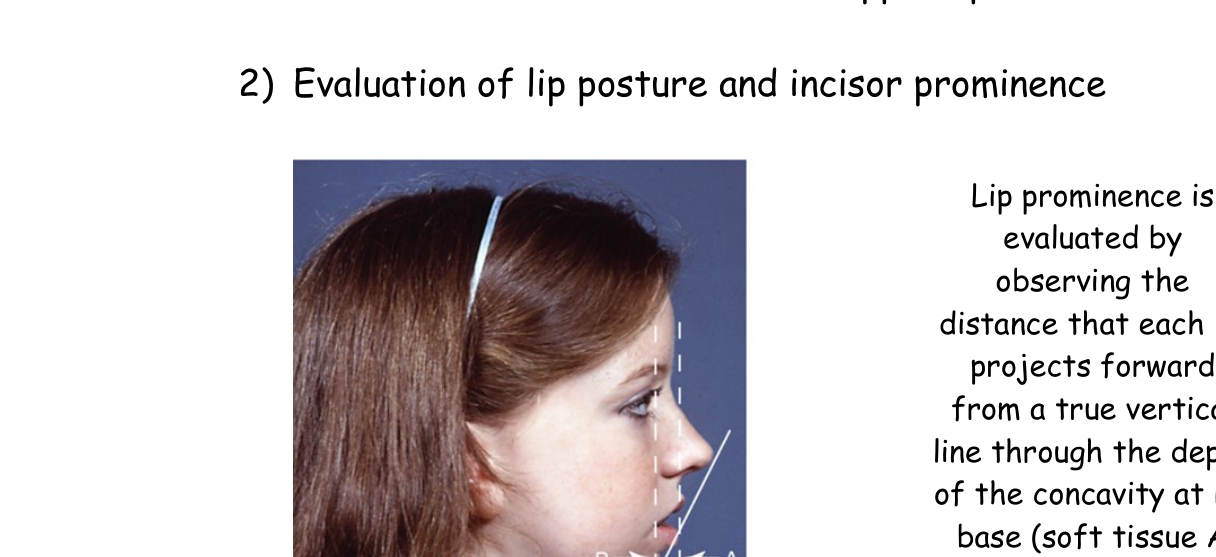 Profile reference lines — A-P jaw relationship. Profile reference lines — A-P jaw relationship. | 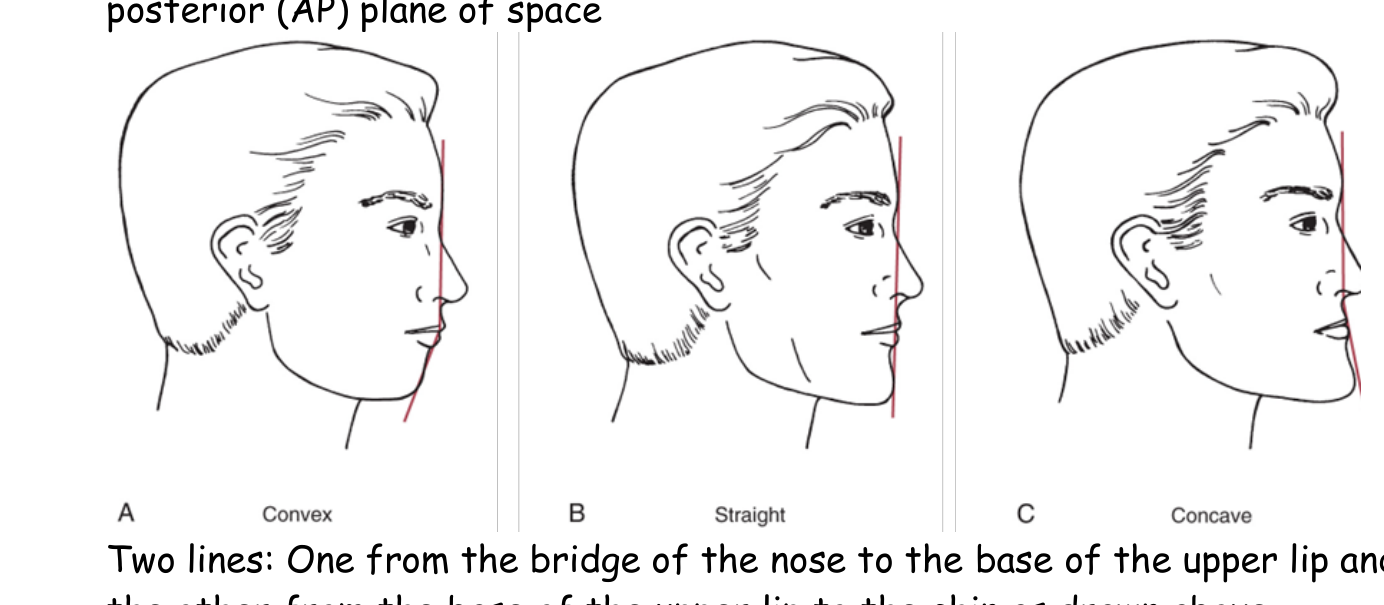 Lip posture relative to the reference lines / E-line. Lip posture relative to the reference lines / E-line. |
Patient 6

Answer
- Skeletal A-P: Class II
- Skeletal vertical: long face
- Lip prominence: OK
- Tooth support for lip: OK (a little deficient for the upper lip, a little excessive for the lower?)
Patient 7

Answer
- Skeletal A-P: Class II
- Skeletal vertical: long face
- Lip prominence: OK upper, excessive lower
- Tooth support for lip: OK upper, excessive lower
Patient 8

Answer
- Skeletal A-P: Class II (despite the prominent chin)
- Skeletal vertical: short face
- Lip prominence: normal
- Tooth support for lip: upper normal; lower inadequate
Patient 9

Answer
- Skeletal A-P: Class III — note some maxillary deficiency, although the large mandible is the major contributor to the skeletal Class III
- Skeletal vertical: normal
- Lip prominence: inadequate upper, OK lower
- Tooth support for lip: inadequate upper, OK lower
Patient 10

Answer
- Skeletal A-P: Class III
- Skeletal vertical: long face
- Lip prominence: inadequate (the upper lip is worse than the lower)
- Tooth support for lip: inadequate
Self-Test
Covers both frontal and profile facial analysis. Attempt each question, then expand the answer. (Reading assignment for this module: Contemporary Orthodontics 5e pp. 158–172 / 4e pp. 176–189.)
Question 1
Which of these are characteristic of skeletal Class II?
- Mandibular retrusion
- Increased overjet
- Long lower face height
- Excessive lip prominence
- Lip incompetence
(Choose: 1 and 2 / 3 and 4 / 1, 2, and 3 / 3, 4, and 5 / all of the above)
Answer
1 and 2 — mandibular retrusion and increased overjet. The other three may or may not be present in a child with a skeletal Class II problem and aren’t characteristic of it.
Question 2
Which of the following are characteristic of skeletal Class III?
- large mandible
- concave profile
- long lower face
- maxillary dental protrusion
(Choose: 1 and 2 / 3 and 4 / 1 and 4 / 1, 2, and 4 / all of the above)
Answer
1 and 2 — large mandible and concave profile. A long lower face and maxillary dental protrusion (dental compensation for the skeletal discrepancy) often are also present, but they aren’t characteristic of the skeletal problem.
Question 3
Which of the following soft tissue findings do not indicate bimaxillary dentoalveolar protrusion?
- lips more prominent than nasal tip
- lips touching at rest but forward from soft tissue points A & B
- lips separated at rest but not forward from soft tissue points A & B
- lips forward from soft tissue points A and B and separated at rest
(Choose: 1 and 2 / 3 and 4 / 1, 2, and 3 / 2, 3, and 4 / none of the above)
Answer
1, 2, and 3 do not indicate excessive incisor protrusion. Protrusion is judged excessive only when the lips are forward from soft tissue points A and B AND separated at rest (statement 4). It would be unusual to have lips more prominent than the nasal tip without dental protrusion, but it could happen with a small nose and large lips.
Question 4
To which of the following facial characteristics does steepness of the occlusal plane relate?
- anterior face height
- mandibular retrusion
- mandibular protrusion
- crowding of incisors
- protrusion of incisors
(Choose: 1 / 1 and 2 / 1, 2, and 3 / 3, 4, and 5 / none of the above)
Answer
1 — anterior face height. It is the only one that correlates well with the mandibular plane angle: a steep angle usually accompanies excessive anterior face height (long face), a flat angle a short face. The angle doesn’t relate systematically to the other characteristics.
Question 5
Which of the following can be judged in a full-face examination of a patient?
- upper face symmetry
- lower face symmetry
- vertical facial proportions
- relative mandibular protrusion
- lip protrusion
(Choose: 1 and 2 / 3 and 4 / 1, 2, and 3 / 3, 4, and 5 / all of the above)
Answer
1, 2, and 3. Upper and lower face symmetry and vertical facial proportions can be evaluated from the full-face (frontal) view, while mandibular protrusion and lip protrusion must be evaluated from the profile view.
Question 6
When the distance between soft tissue points A and B is considered, which of the following are within the limits of Class I, skeletal normal?
- 6 mm
- 4 mm
- 2 mm
- 0 mm
- -2 mm
(Choose: 1 and 2 / 3 and 4 / 2, 3, and 4 / 3, 4, and 5 / all of the above)
Answer
All of the above. The limits of normal extend from +6 to -2 mm. Judged from soft tissue landmarks, skeletal Class II is >6 mm and skeletal Class III is >-2 mm (i.e. more negative than -2 mm).
Question 7
In which of the following orthodontic clinical conditions would the patient’s facial form play a major role in the ultimate treatment plan?
- jaw asymmetry
- crowded lower incisors
- anterior open bite
- spaced and protruding upper incisors
(Choose: 1 and 2 / 3 and 4 / 1, 2, and 3 / all of the above / none of the above)
Answer
All of the above. In all of these conditions the treatment plan depends in large measure on facial form analysis — the plan could differ for identical malocclusions in patients with different facial proportions.
Question 8
Which of the following correctly describe the relationship between facial proportions, esthetics and beauty?
- Faces with more than moderate disproportions are judged unesthetic
- Perfect symmetry is highly associated with beauty
- Proportional faces are judged esthetically acceptable under almost all circumstances
- If the lips are competent, dental protrusion is considered highly unesthetic
(Choose: 1 and 2 / 2 and 3 / 1 and 3 / 2, 3, and 4 / all of the above)
Answer
1 and 3 are correct; 2 and 4 are not. Major facial disproportions are considered unesthetic. Proportional faces are almost always esthetically acceptable (though not necessarily beautiful). Beautiful faces have slight asymmetries — perfectly symmetric faces look unnatural. Dental protrusion is not an esthetic problem until excessive lip separation at rest (lip incompetence) occurs.
Question 9
What is meant by the term “orthodontic triage”? It is a way of sorting patients by (choose the ONE best answer):
- skeletal vs dental problems
- retrusive–normal–protrusive lip positions
- the degree of mandibular protrusion, from Class II–Class I–Class III
- the severity of their problems and their prognosis
Answer
4 — the severity of their problems and their prognosis. Triage (French trier, “to sort”) was first used in medicine to sort battlefield casualties by treatment priority. Here it screens orthodontic patients, separating severe problems needing complex treatment from moderate ones responding to simpler treatment. Facial form analysis is a key procedure in orthodontic triage.
Question 10
Which of the following are more likely to be seen in a patient with a purely dental malocclusion than in a patient with a skeletal discrepancy?
- bimaxillary dentoalveolar protrusion
- excessive lip separation at rest
- anterior deep bite
- dentoalveolar asymmetry
(Choose: 1 only / 1 and 2 / 1 and 3 / 1, 2, and 4 / all of the above)
Answer
1 only — bimaxillary dentoalveolar protrusion (most likely with only dental discrepancies, though occasionally seen in skeletal Class II). The other three can occur without a skeletal discrepancy but are more likely with one: excessive lip separation at rest → long-face patient (mandible rotated down and back); anterior deep bite → short-face patient; dentoalveolar asymmetry → more likely when a jaw discrepancy is also present.
Footnotes
-
E-line distance (2–4 mm behind) and FMA ranges from the profile-analysis workshop notes — Facial Profile Analysis and Facial Profile Analysis Pictures. ↩ ↩2