L18 Case Based Lecture
Dental Trauma Case Questions
Case 1: Radiographic diagnosis of anterior trauma1
Question
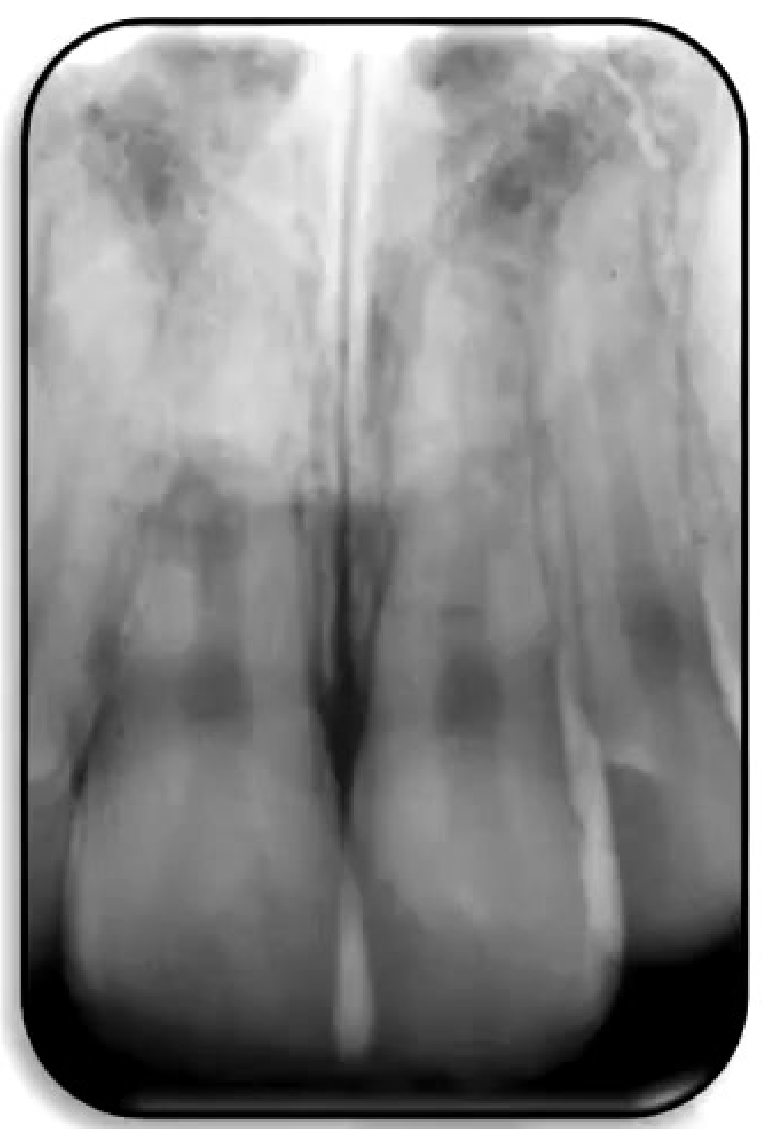
Scenario: A 20-year-old male presents to the clinic three hours after an accident. He has no pain and no clinical signs of soft tissue injury. Teeth 11 and 21 are slightly tender to percussion and slightly mobile.
What’s shown: A periapical radiograph of the anterior maxilla.
Based on the radiographic appearance, what is the most accurate diagnosis?
a) Crown fractures of teeth 11 and 21 with pulp exposure b) Root fracture - mid-third of tooth 11 and root fracture - coronal-third sub-osseous of tooth 21 c) Lateral luxation of teeth 11 and 21 d) Alveolar bone fracture involving the anterior maxilla
Answer
- b) Root fractures: mid-third of tooth 11 and coronal-third sub-osseous of tooth 21.
- Diagnosis is made from the radiographic appearance, which may be hard to see depending on the lighting.
- Lecturer: the scenario may be presented as a series of about five multiple-choice questions.
See - Root-fracture diagnosis
Case 2: Initial emergency management of root fractures2
Question
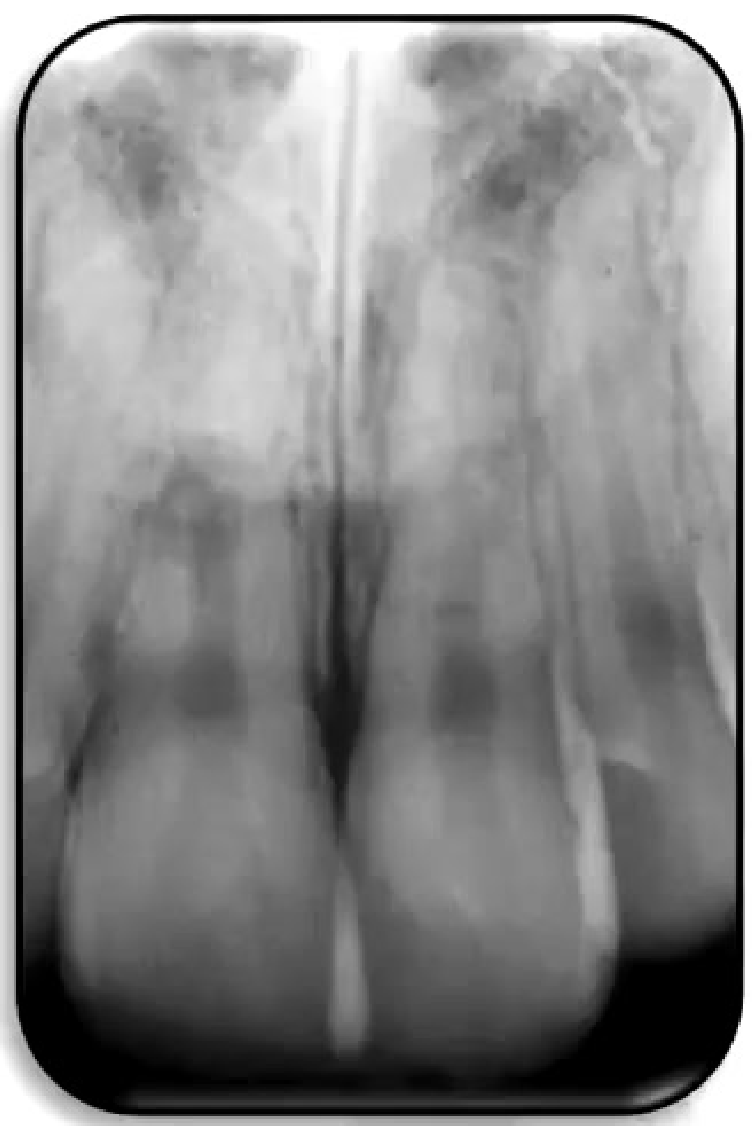
Scenario: Same patient as Case 1 (20-year-old male, three hours after an accident, no pain, 11 and 21 slightly tender to percussion and slightly mobile).
What’s shown: A periapical radiograph of the anterior maxilla.
What is the most appropriate initial emergency management?
a) Extraction of both teeth 11 and 21. b) Initiation of root canal treatment on both teeth. c) Placement of a rigid splint for 3 months and arranging follow-up. d) No treatment is required as the patient is not in pain.
Answer
- c) Placement of a rigid splint for 3 months and arranging follow-up.
- Course teaching: a rigid splint is used only for a bone fracture (6 weeks) or a root fracture (3 months); see L11: Flexible and Rigid Splints.
- Lecturer (transcript): described the splint as flexible; not resolved against the recording.
- Lecturer: treatment questions may be set on a radiographic case or on a clinical scenario without an X-ray.
IADT 2020 guideline
Root fractures: passive, flexible splint for 4 weeks; if the fracture is near the cervical area, splint for up to 4 months.
See - Initial management of root fractures
Case 3: Ideal healing response of root fractures3
Question
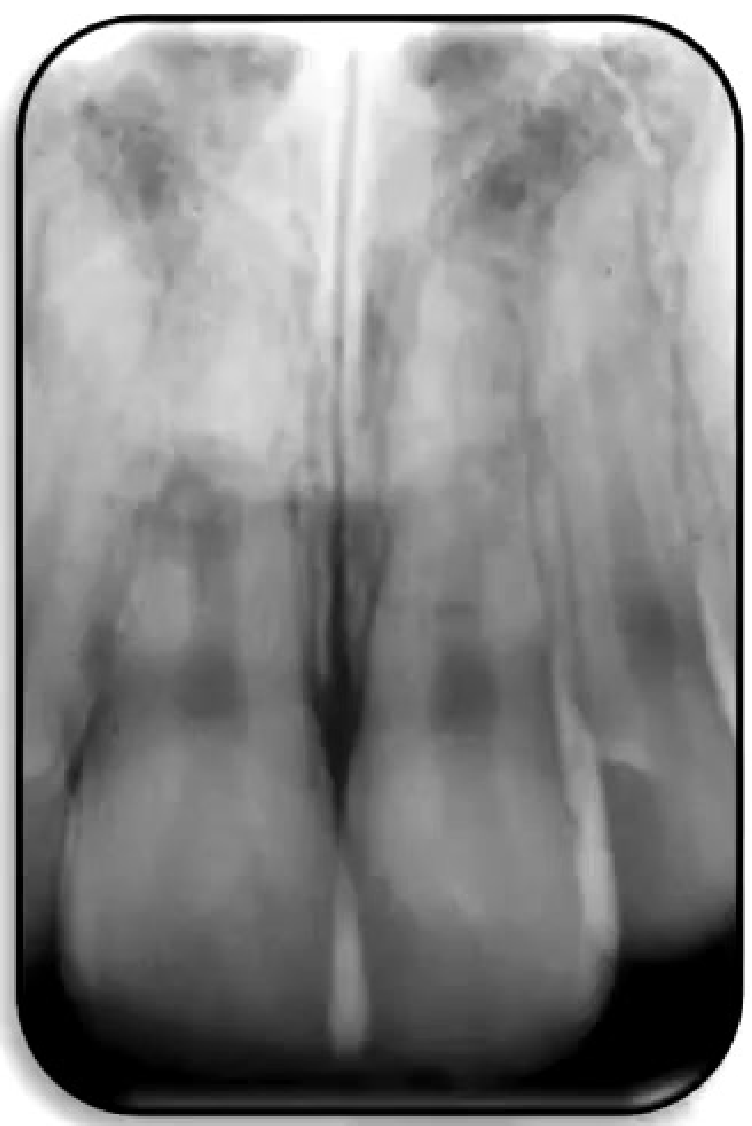
Scenario: Same patient as Case 1.
What’s shown: A periapical radiograph of the anterior maxilla.
What is the most ideal healing response for the injured teeth?
a) Formation of granulation tissue between the fracture fragments. b) Healing with hard tissue (reparative dentine) formed by the pulp. c) Ankylosis of the root to the surrounding bone. d) Development of a periapical abscess.
Answer
- b) Healing with hard tissue (reparative dentine) formed by the pulp.
- Takeaway: for a root fracture with minimal symptoms, splinting for 3 months allows hard tissue healing.
See - Root-fracture healing response
Case 4: Replacement resorption after avulsion4
Question
Scenario: A 14-year-old presents with an avulsed maxillary central incisor that was replanted after being kept dry for 45 minutes. Radiographically the tooth shows external replacement resorption.
What’s shown: A clinical scenario with a radiograph.
Which statement most accurately describes the biological process and the recommended endodontic management?
a) The resorption is driven by an infected root canal system, and immediate root canal treatment with calcium hydroxide is indicated to arrest the process. b) The resorption is a result of damage to the periodontal ligament, and endodontic treatment is not indicated as it will not stop the resorption. However, a corticosteroid-antibiotic paste may be used to inhibit clastic cells. c) The resorption is a transient process that will resolve on its own, and no treatment is required. d) The resorption is caused by excessive occlusal forces, and occlusal adjustment is the primary treatment.
Answer
- b) Resorption results from periodontal ligament (PDL) damage after the 45-minute dry time, not from an infected canal.
- Endodontic treatment is not indicated because it will not stop the resorption; a corticosteroid-antibiotic paste may be used to inhibit clastic cells.
- Manage by review and monitoring over time.
- Takeaway: replacement resorption after prolonged dry time is driven by PDL damage, not infection.
See - Replacement resorption after avulsion
Footnotes
-
Original PDF page 1: L18 Case Based Lecture, p.1 ↩
-
Original PDF page 2: L18 Case Based Lecture, p.2 ↩
-
Original PDF page 3: L18 Case Based Lecture, p.3 ↩
-
Original PDF page 4: L18 Case Based Lecture, p.4 ↩